Avatar

Guest Blog by Pat Chou, TMG Product Manager

Pat ChouSince the introduction of the Cisco’s 40G QSFP BiDi (Quad Small Form-Factor Pluggable Bidirectional module), we’ve seen phenomenal growth and adoption. I guess people do see the benefit.


What’s that? You haven’t heard?

…Ok, let’s say you’re in charge of a data center and your boss reminds you that streaming video and IoT devices are all the rage and if you don’t keep up with bandwidth demand, you’re toast. You have 10G links that use 10G SFP+ SR transceivers at the aggregation layer. You upgrade your switches or linecards to ones that have 40G QSFP ports like the Nexus series switches. Continue reading “Fiber. Great In Your Diet. Costly In Your Data Center.”

Authors

Greg Smith

Sr. Manager, Marketing

Cisco Solutions Marketing

Avatar

You might think we’d cancel the OpenStack Podcast on the rare occasions when both Jeff and I have the flu at the same time. But you’d be wrong. This week, we interviewed EMC Cloud Architect Shamail Tahir (remotely). Or at least we think we did. The transcript of the interview suggests that we were in fact present, but not in the most coherent way.

The good thing is that it didn’t matter. Shamail is a boss when it comes to OpenStack, and he proved that by delivering interesting insights on pretty much every hot topic we could think of, including:

  • What EMC is doing with OpenStack
  • What he and the other participants talked about at the “hidden influencer” meeting in Paris
  • Why you should run certification tests on your OpenStack cloud
  • Why we need an OpenStack roadmap
  • Why the number of OpenStack projects will continue to grow over the next few years
  • What role containerization will play with OpenStack
  • Whether or not DIY OpenStack is a good idea

https://www.youtube.com/watch?v=Xkbaz57ugnI

To see who we’re interviewing next, or to sign-up for the OpenStack Podcast, check out the show schedule! Interested in participating? Tweet us at @nextcast and @nikiacosta.

For a full transcript of the  interview, click read more below.

Continue reading “OpenStack Podcast #17: Shamail Tahir”

Authors

Niki Acosta

OpenStack Evangelist

Avatar

Connecting Dark Assets: An ongoing series on how the Internet of Everything is transforming the ways in which we live, work, play, and learn.

For months now, I’ve been talking about how the Internet of Everything (IoE) “lights up” dark assets—but I never thought I’d be talking about makeup in that context. Of course, my wife would be quick to point out that many people consider makeup a critical asset, so it’s really not that different from other things whose value increases through the networked connection of people, process, data, and things. Here are three examples: Continue reading “In the Beauty Industry, IoE “Lights Up” How People Try On, Wear, and Even Produce Custom Makeup”

Authors

Joseph M. Bradley

Global Vice President

Digital & IoT Advanced Services

Avatar

In an Internet of Everything era, enterprises and public sector organizations have developed an insatiable appetite for data. Data is being gathered from an increasing number of sources, and—from an analytics perspective—the more data your customers have, the better the insights they can gain.

We recognize that analytics represent a truly transformational business opportunity for our partners. It enables enterprises to make dramatic changes in their business processes that will significantly strengthen the competitive edge.  Many strategic analytics deployments will be driven by line of business (LoB) managers representing key roles within enterprise organizations. These are things like manufacturing, product development, sales, operations, marketing, and HR—where an increasing percentage of IT spending is being initiated.

The great news is that Cisco has the ideal, end-to-end infrastructure for big data and analytics deployments, featuring Cisco Unified Computing System (UCS), Application Centric Infrastructure (ACI), and our robust suite of management automation and data virtualization software.

But infrastructure is only part of the equation! Engaging a range of analytics ecosystem partners to help manage data, integrate data, and finally, analyze data will be critical in delivering successful big data and analytics solutions to your customers. Continue reading “On February 12 Partners Learn How Cisco Big Data Analytics Transforms Business”

Authors

Jim McHugh

Vice President, Product and Solutions Marketing

Unified Computing Systems

Avatar

FlexPod had a great 2014 and continues to be a leader in the integrated infrastructure market.  The collaboration and execution between the Cisco and NetApp teams have delivered the following results:

  • Greater than 5,000 customers across 100 countries
  • More than $3B in revenue
  • 80+ validated designs
  • 1100+ Partners

Customer needs continue to change, Cisco and NetApp are addressing those needs by introducing new solutions, technologies, and offerings to accelerate and manage applications in the data center and at the edge. We will also enhance and validate existing solutions with our latest products and technologies. We are excited to be introducing the following new offerings, technologies, and solutions to the FlexPod portfolio:

Offering:
• FlexPod with UCS Mini

Products/Technologies:
• Cisco UCS B200 M4 Servers
• Cisco UCS Manager 2.2
• Cisco UCS Director
• Cisco Nexus 9000
• NetApp Data ONTAP 8.2

Solutions:
FlexPod Data Center with Microsoft SharePoint 2013 and Cisco ACI
FlexPod Datacenter with Microsoft Exchange 2013 and Cisco ACI
FlexPod Data Center with Microsoft Private Cloud 4.0

FlexPod with UCS Mini
An increasing amount of computing is being done outside the data center at the edge. FlexPod with UCS Mini is a simple, easy to manage, and expandable solution that brings the performance and power of Cisco UCS integration in an all-in-one, small footprint optimized for non-datacenter environments, such as remote sites, branch offices, and any location where data is generated and compute resources are  needed. The UCS Management portfolio enables remote operation, automation and policy enforcement across massive multi-site footprints, enabling customers who have invested in FlexPod in their core data centers to leverage that investment at their smaller remote and branch offices.

We are looking forward to an exciting 2015 with FlexPod. These new solutions and technologies will enable FlexPod to meet a wide range of IT needs and run the most business-critical applications whether they are located in the data center or at the edge.  To learn more about our FlexPod portfolio visit our website and to see all our validated designs check out the DesignZone for FlexPod.

Authors

Tim Stack

Product Marketing Manager

Data Center and Compute

Avatar

Adversaries are committed to continually refining or developing new techniques to conceal malicious activity, decrease their reliance on other techniques that may be more detectable, and become increasingly more efficient and effective in their attacks. Below are just three examples—explored in detail in the newly released Cisco 2015 Annual Security Report—of how malicious actors met these goals in 2014. These trends were observed by Cisco Talos Security Intelligence and Research Group throughout last year, and analyzed by the team using a global set of telemetry data:

  • Use of malvertising to help deliver exploit kits more efficiently—Talos noted three exploit kits we observed “in the wild” more than others in 2014: Angler, Goon, and Sweet Orange. More than likely, their popularity is due to their technical sophistication in terms of their ability to evade detection and remain effective. The Sweet Orange kit, for example, is very dynamic. Its components are always changing. Adversaries who use Sweet Orange often rely on malvertising to redirect users (often twice) to websites that host the exploit kit, including legitimate websites.
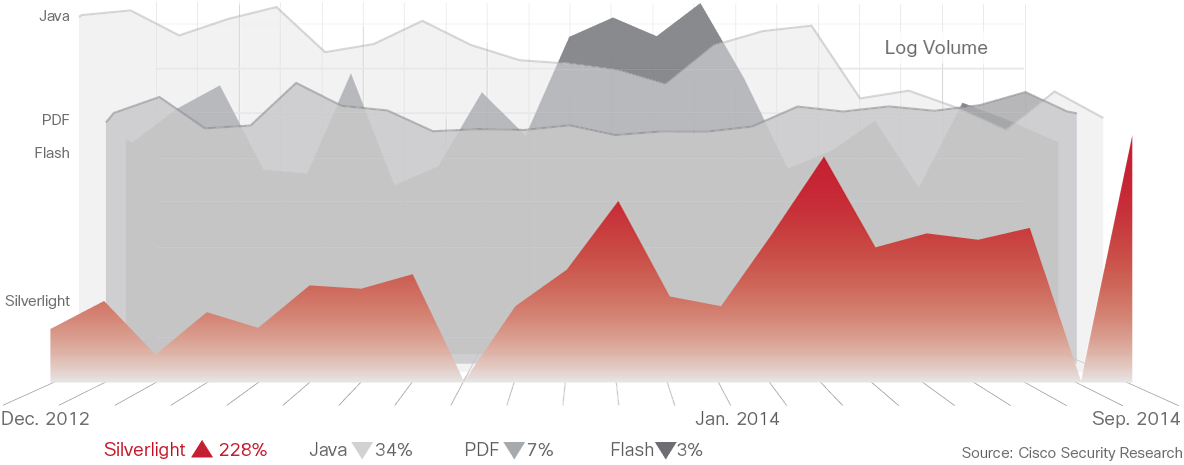
  • Increase in Silverlight exploitation—As we reported in both the Cisco 2014 Midyear Security Report and the Cisco 2015 Annual Security Report, the number of exploit kits able to exploit Microsoft Silverlight is growing. While still very low in number compared to more established vectors like Flash, PDF, and Java, Silverlight attacks are on the rise. This is another example of adversaries exploring new avenues for compromise in order to remain efficient and effective in launching their attacks. The Angler and Goon exploit kits both include Silverlight vulnerabilities. Fiesta is another known exploit kit that delivers malware through Silverlight, which our team reported on last year.

snowshoe

  • The rise of “snowshoe spam”—Phishing remains an essential tool for adversaries to deliver malware and steal users’ credentials. These actors understand that it is more efficient to exploit users at the browser and email level, rather than taking the time and effort to attempt to compromise servers. To ensure their spam campaigns are effective, Talos observed spammers turning to a new tactic last year: snowshoe spam. Unsolicited bulk email is sent using a large number of IP addresses and at a low message volume per IP address; this prevents some spam systems from detecting the spam, helping to ensure it reaches its intended audience. There is also evidence that adversaries are relying on compromised users’ machines as a way to support their snowshoe spam campaigns more efficiently. Snowshoe spam contributed to the overall increase of spam volume by 250 percent in 2014.

These are only a few of the threat intelligence findings presented in the Cisco 2015 Annual Security Report. We encourage you to read the whole report, but also, to stay apprised of security trends throughout the year by following our reports on the Cisco Security blog. Talos is committed to ongoing coverage of security threats and trends. In fact, in the Cisco 2015 Annual Security Report, you’ll find links to several posts that our researchers published throughout 2014, and were used to help shape and inform our threat intelligence coverage in the report.

Authors

Michael Fuhrman

Vice President

Security Services and Cloud Operations

Avatar

If you are involved in designing, supporting or managing a data center, you will undoubtedly rely on technical support services from one or more vendors.  Running your data center, there is always the risk of a hardware failure or being impacted by a software defect.  While relatively rare, hardware does occasionally fail unfortunately.  However you undoubtedly have technical support in place to deal with such problems.  You may have invested in a few extra switches as backup, you may also have failover mechanisms in place.  Almost certainly you will have a support contract in place with your Cisco partner or with Cisco, so you have break/fix expertise on tap for when something goes wrong.   This is critical support for your business, no debate from me.

Engineer Under Stress!

Now, arguably the most important resource you have in your data center is not so much individual switches, routers or servers.  It’s your engineers, those who design and support your data center.  If they have a problem, where and how do they get help?  Who helps them when they are stretched?  When business pressures are telling?  Of course, their colleagues and managers can and will help.  Where, however, can they tap into additional sources of expertise so that they can become even more productive for you?  This is where Cisco Optimization Services come in – including our award-winning Cisco Network Optimization Service (or “NOS” for short), Collaboration Optimization Service, and the one I’m involved with, Cisco Data Center Optimization Services.


Continue reading “Your Design Engineers Need Support and ‘Expertise on Tap’ Too!”

Authors

Stephen Speirs

No Longer at Cisco

Avatar

At Cisco Live Milan, Jim McHugh, Vice President, Cisco UCS and Data Center Solutions Marketing and John Lockyer, Chief Technology Officer at VCE, give an overview of Vblock Systems management featuring VCE Vision and Cisco UCS Director.  Watch the video and learn how managing converged infrastructure holistically can accelerate innovation through automation and orchestration resulting in faster ROI.

Authors

Tim Stack

Product Marketing Manager

Data Center and Compute

Avatar

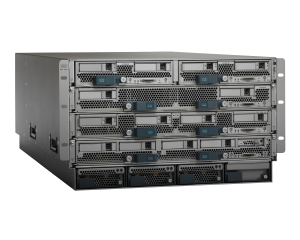
In September 2014, Cisco launched the UCS Mini for what they dubbed “Edge-Scale Computing”. The UCS Mini offering is a stripped down version of the classic UCS system with Fabric Interconnects. To learn about classic UCS, click here.

In this post I will go into some details about the UCS Mini that I’ve learned over the past few months. The information here will assume you have the basic knowledge about what the UCS Mini is and what components are involved. If you need a refresher, I’ve written up a small introduction here.

Let’s dive in.

Fabric Interconnect

The UCS FI 6324 is the same size as the UCS I/O Modules (IOM 2208XP, 2204XP, etc) and fits in the back IOM slot of the UCS Chassis 5108 (version 2).

ucs-fi-6324-breakdown Continue reading “Cisco UCS Mini – a deep dive”

Authors

Martijn Smit

Senior Datacenter Engineer