In September 2014, Cisco launched the UCS Mini for what they dubbed “Edge-Scale Computing”. The UCS Mini offering is a stripped down version of the classic UCS system with Fabric Interconnects. To learn about classic UCS, click here.
In this post I will go into some details about the UCS Mini that I’ve learned over the past few months. The information here will assume you have the basic knowledge about what the UCS Mini is and what components are involved. If you need a refresher, I’ve written up a small introduction here.
Let’s dive in.
Fabric Interconnect
The UCS FI 6324 is the same size as the UCS I/O Modules (IOM 2208XP, 2204XP, etc) and fits in the back IOM slot of the UCS Chassis 5108 (version 2).
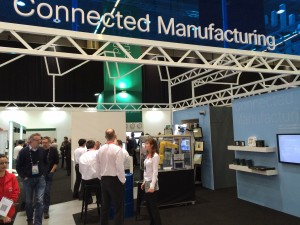
I just got back from a fantastic week at Cisco Live in Milan. We had a packed ‘Cisco Connected Manufacturing’ pavilion at the event, showcasing the latest in demonstrations and industrial solutions for both customers and partners.
The centerpiece of the demos was how manufacturers can leverage technology such as Cisco Connected Factory to address some of the business challenges they are facing including increased competitive pressures and changing global demand. In fact, European manufacturers are turning to technology to give them a clear competitive advantage as they streamline their supply chain and factory operations as well as accelerate their new product introduction cycles. We showcased various components of the Connected Factory, including rapid response and troubleshooting, Profinet integration, IoT Factory in a box and plant network analytics.
We received great feedback and energetic interest from booth visitors. The Manufacturing demos were the highest rated at the show and were recognized multiple times in the various keynotes. I asked my colleague Todd Edmunds, Enterprise Architect, to comment:
“There was a lot of excitement around our working demonstration showing Siemens controls communicating via Profinet – including real-time Cisco IE2000 switch status inside the Siemens programming environment. All across the same network with Rockwell Automation control systems, and anything else Ethernet. Our key message that ‘we can support whatever you need on the network’ really resonated with booth visitors.”
Our various IoT solutions and products can really impact operational efficiencies and help manufacturers achieve significant outcomes such as reduction in unplanned downtime, for example. It was great to see customers understand these benefits and I think that is due to the efforts of the tireless team that brought these demo scenarios to life.
We will be bringing many of these demos and products to the Cisco booth at the upcoming Hannover Messe (April 13 to 17th in Germany). The theme of that show ‘Towards a Fully Networked Industrial Future’ dovetails nicely with our strengths and solutions.
Let me know if you were at CiscoLive Milan and drop me a comment. Thanks for reading!
This year, more than 1.6 million estimated new cancer cases will be diagnosed in America alone. Worldwide, it’s predicted there will be more than 23.6 million new cancer cases diagnosed each year by 2030, if recent trends continue. At Cisco, our global family of more than 74,000 employees feels the heavy impact of cancer as well, whether it means going through cancer treatment, helping an affected loved one or celebrating another day as a survivor.
Cisco is a strong advocate of merging the power of human collaboration and networked connections with an unrelenting passion for using our resources to impact the world around us, especially in modern medicine. From rebuilding healthcare systems devastated by an earthquake to linking rural patients to doctors hundreds of miles away, we’ve been at the forefront of using technology to revolutionize healthcare.
And today, on World Cancer Day, we’re showing that Internet of Everything technology can be an ally in the battle against breast cancer – which strikes one in eight women in the United States.
This past week, I had the opportunity to speak with Dawn Kerwick, Vice-President of Marketing at ePlus. She had some great insight into what ePlus has been doing in the education sector, and I wanted to share that with you as part of the Partner Voices series. Rather than hear me blather on, I’ll just turn it over and let you hear what Dawn had to say, in her own words:
If you talk to any school district today, you’ll hear a common goal. They want to give students the skills they need to thrive in the 21st century. Putting the latest technology into the hands of students and their teachers—and equipping schools with a leading IT infrastructure—are key. Working together, ePlus and Cisco have been doing just that, and earning rave reviews in the process.
ePlus has a long history serving the K-12 and higher education markets. We understand their challenges. We have experience under our belt helping them achieve their technology visions. And we’ve been successful at transforming classrooms into collaborative learning environments—allowing students and teachers to interact without boundaries.
We have a great story to tell, and some pretty neat videos to prove it! Please take a few minutes to check out the videos here, and hear directly from our joint customers about how ePlus helped them leverage Cisco technology to create a first-class learning experience for their students. Continue reading “Partner Voices: Making the Grade”
The growing use of mobility is a new threat vector in the extended network. It’s particularly complex to secure and manage when tablets and smartphones are used for both personal and business needs. The Ponemon 2014 Security Impact of Mobile Device Use by Employees study notes that 66 percent of users download mobile apps without their company’s permission. This downloading behavior increases the attack surface by introducing unapproved or personal mobile applications.
As highlighted in the Cisco Annual Security Report for 2015, mobile applications are a new threat vector that could include malware. The potential for this user-appropriated malware to access corporate resources introduces a lot of new risks that need to be addressed by IT security personnel. At Cisco, we’ve just completed a new integration with Samsung to enable workers to be productive while locking down this expanded attack surface.
#CiscoChampion Radio is a podcast series by Cisco Champions as technologists. Today we’ll be talking with Cisco Distinguished Engineer Joel Obstfeld about VIRL. Our Cisco Champion guest hosts are Brad Haynes and Scott Morris.
Software Defined Networking (SDN) is an exciting evolution in IT. Today, connections throughout a network are made by directly connecting to routers to control them. This is a process that can be time-consuming and prone to error, depending upon the size of the network being managed. Furthermore, the effort involved in making changes across large networks can slow the pace of innovation within an organization.
SDN moves control to the application layer. This provides numerous benefits to IT:
Unified point of automation and management
Consistent deployment of policies throughout the network
Improved operational efficiency
Rapid deployment of new features like security and QoS
Simplified network management overall
Many people think SDN is the future of data center networking. Cloud provider OneNeck, for example, is investing in developing the expertise to lead the market in transitioning its customers to SDN. In their blog, Leading the Market with Software Defined Networking (SDN), OneNeck describes how they are working with Cisco to bring SDN to market.
OneNeck’s SDN lab, for example, is a great example of how our partners add value to Cisco technology. SDN introduces a whole new management framework for networking. By working with real-world SDN applications in their lab, OneNeck is developing the skill sets and expertise required to enables its customers to evolve with confidence.
We need to create more effective mechanisms for attracting and engaging a diverse group of students in technology. In my work as an educator and collaborator with leading companies in a variety of industries, I have noticed a trend: that including women, minorities, and those pursuing non-STEM disciplines in Internet of Things (IoT) technology-related learning is a critical issue that needs to be addressed to yield the greatest benefit from IoT. I am personally very passionate about this topic.
When we launched the University of Wisconsin-Madison, our Internet of Things (IoT) Lab in February 2014, one of our primary objectives was to provide students unique interdisciplinary learning and innovation experiences with IoT technologies. The IoT Lab is not associated with any course – the students who are participating in the IoT Lab are doing so because they are intrigued by and excited about IoT technologies and potential applications. This hub also serves as a campus technology sand-box and innovation community where students from diverse disciplines come together and engage in fun, social, collaborative learning and hands-on experimentation.
The IoT Lab has adopted a novel approach for successfully engaging students. It has fostered participation by dozens of undergraduate and graduate students (a large fraction being women) representing a range of disciplines including not only engineering and computer science, but also other “non-technical” disciplines such as business, human ecology (retailing and consumer sciences), nursing, economics, journalism and mass communications, mathematics, physics, statistics, and philosophy.
NRF 2015 is a wrap. The annual show where anyone who’s anyone in retail goes to learn about the latest ways to grow revenues and improve store operations. Here’s something you may have missed:





 The centerpiece of the demos was how manufacturers can leverage technology such as




 #CiscoChampion Radio is a podcast series by