As with any type of information, the quality of the context improves the quality of the content. That is, the more relevant and accurate the information, the more valuable it becomes.
This truism is highly pertinent to the growing field of location-based services such as those supported by Cisco Connected Mobile Experiences (CMX). The more accurate the location, the more detailed the analytical information or customer-facing content. If we can improve accuracy to get near to the one meter goal, we can greatly improve the quality of that analysis or content. Now the context isn’t which section of a store or area in a hospital, it is exactly where the person is standing at that moment. This increased relevance makes the information more valuable to the venue and its customers, guests, and patients.
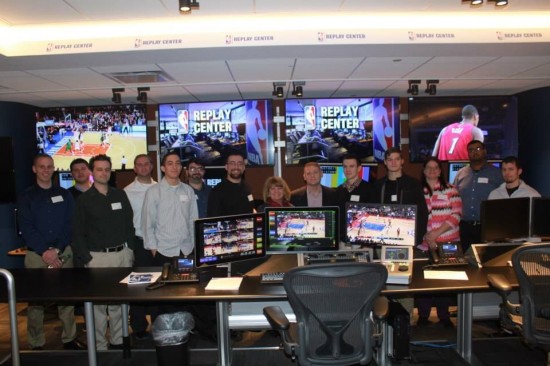
Next week, 30 of the top Cisco Networking Academy students from the New York City Area will work side-by-side with engineers to set up massive networks at this year’s NBA All-Star Game.
As part of a Cisco Networking Academy Dream Team, they’ll have the once-in-a-lifetime opportunity to gain hands-on experience and showcase their technical knowledge in front of potential employers.
Starting this Monday, we’ll follow Deborah Huyler and Andrew Torres, two of the Dream Team students, as they set up wireless access points, provide network troubleshooting, and soak in the sights and sounds of NBA All-Star 2015 throughout the week. They’ll be sharing their stories from Madison Square Garden the Barclays Center, and other event venues through journal entries, photo slideshows, and videos!
The Cisco Networking Academy Dream Team visited the NBA offices earlier this week
When I hear “hybrid” I think about cars. Those gas and electric cars that can switch to whichever power source is needed when it is needed the most or makes the most economical sense. The switch is, or at least should not be noticeable. Having been in a hybrid car I’ve experienced the switchover, the interesting thing is that the car itself does not change. The controls are the same; the car steers and moves that same way it did before. I don’t have to learn anything new or make some changes to the way I drive to continue to use the car.
That’s the way hybrid cloud should be, whether I’m using the private cloud in my enterprise or I’m using IT managed provider clouds. If the workload is completely in the provider cloud, split between the provider cloud and private cloud or completely in the private cloud, it really should make no difference to the workload… or me.
How true are those scenarios though? As soon as part of the workload is in the provider cloud things need to change. Application admins and network admins surely have already been enlisted to figure out how the workload applications can function in the provider cloud and still interact with the private cloud. What services does the workload need? How does workload security work? How does workload routing work? How does the hybrid cloud environment impact the workload? How many different cloud provider APIs will need to be leafed? These are only a few of the considerations there can be many more.
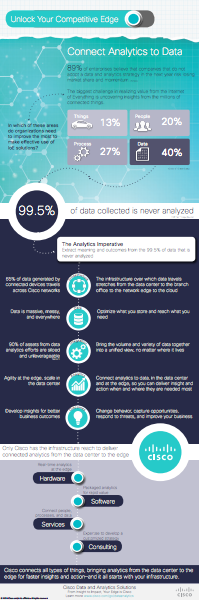
Big data has become big business as businesses mine vast stores of data for insights that can help identify trends, predict behavior, and empower decision makers. And the Internet of Everything (IoE) is creating new analytic use cases and possibilities that were inconceivable just a few years ago.
Cisco’s unique approach to big data and analytics will be on display February 17-20 at Strata+Hadoop World in San Jose, California. This is the easiest way to learn about these solutions directly from Cisco experts and also see how these offerings stack up compared to other vendors.
One-on-One Demonstration and Discussions
Stop by the Cisco booth (#831) to get a first hand look at several key offerings in Cisco’s portfolio including:
Kaon v-Rack® mounted switches, routers, servers, and storage products.
I’ll be there, along with a number of other Cisco subject-matter experts. We would enjoy learning about your challenges and exploring how, with the right hardware, software, consulting, and services, we can help you transform IoE data into actions that create new capabilities, richer experiences and unprecedented economic opportunities.
If you aren’t already registered, take advantage of use code “Cisco20” for a 20% discount on 2 Day and All Access Passes.
Learn about Connected Analytics in the Solution Showcase Theater
Cisco® Connected Analytics for Events, a cloud-based analytic solution that venue operators use to enhance fan experiences, improve advertising and promotion efforts, identify operational and security issues, and provides the foundation for Why Event Analytics Matter on Wednesday, February 18 at 5:35 PM in the Solutions Showcase Theater by Rohit Shrivastava, General Manager of Cisco’s Connected Analytics Business Unit.
Listen to Cisco’s Point of View on Big Data with Analytics in an IOE World
Harness the Power of Big Data with Analytics is the title of Cisco’s keynote session on Thursday, February 19, at 4:50 PM in Room 210 B/F. This presentation addresses the challenge organizations are experiencing due to unprecedented complexity in managing their data, with the rise of Big Data, Cloud and overall hyper connectivity of our world.
Cisco is building solutions to help our customers adopt Big Data solutions, solve business problems using Analytics, and harness the power of an intelligent infrastructure to provide highly differentiated Data and Analytics solutions. In this session, Mike Flannagan, General Manager of Cisco’s Data and Analytics Business Group, will provide an overview of these solutions, help demystify the relationship of Big Data and analytics and bring it to life through customer stories.
The Internet of Things (IoT) was a hot topic at Cisco Live last week in Milan. I got to spend a lot of time with customers, partners, and developers, and came home impressed by the tremendous focus on IoT applications. There is an enormous amount of energy directed at building on the foundation Cisco is creating.
If you weren’t able to join us in Milan, here is my list of the week’s highlights.
We previously committed to providing important updates on our legal action over Arista’s pervasive copying and misappropriation of Cisco intellectual property. Today, an International Trade Commission (ITC) Administrative Law Judge issued an order rejecting Arista’s request to consolidate Cisco’s two ITC complaints.
Arista’s request had itself included an acknowledgement that consolidation could cause a six month delay in the proceedings. We felt this ran counter to the language of the Commission’s own Rule 201.7(a) permitting consolidation “in order to expedite.”
We are pleased that the Administrative Law Judge promptly rejected this request, and with it the argument that Cisco was somehow looking to “game the system.” Our filing of separate complaints was consistent with ITC practices, and focused squarely on delivering a speedy and lowest cost resolution for all involved.
As highlighted in the January 22 update to our blog (Protecting Innovation: International Trade Commission Commences Investigation), Arista’s initial legal arguments had focused on attempting to avoid enforcement of Cisco’s rights by utilizing the “public interest” exemption, an approach the Commission chose not to refer for action. This latest decision is a rejection of Arista’s legal maneuvering to delay the outcome. With the discovery process now underway, we are looking forward to Arista addressing the complaints directly.
We now believe that Arista intends to file a motion seeking a delayed 22 month target date in one of the ITC cases. We hope that in light of today’s ruling, they will reconsider this motion so we can focus on the prompt resolution of the case.
Security is a primary concern for many organizations making the transition to cloud. In the blog, “Taking a Hybrid Cloud Approach to Security”, cloud provider Presidio shares how building a hybrid cloud enables you to maximize security while maximizing flexibility at the same time.
Security in this instance can be thought of in terms of risk. For example, sensitive data and mission-critical applications need a higher level of security than a devops test environment. The challenge for organizations is to accurately assess their risk and align their security strategy with their business objectives. Threats can come from outside – and inside – an organization. The best response to threats goes beyond just the technology underlying your data center and that of your cloud provider.
The truth is, your organization is unique. This means your security strategy is going to be unique as well. The foundation of a solid, comprehensive strategy is, of course, an enterprise-class architecture with end-to-end security. To be complete, however, security policies must be in place which meet the specific security needs of your organization and regulations of your industry.
The architecture must also be supported by procedures that enable the members of your organization to easily comply with these security policies. These procedures must be effective while at the same time not getting in way of the workflows or corporate culture already in place.
Developing – and successfully implementing – such a security strategy can be extremely complex. For organizations new to cloud, especially hybrid clouds, understanding the nuances of comprehensive security may be outside their expertise. This is why an experienced cloud provider is crucial to any secure hybrid cloud deployment. One size does not fit all, nor are all clouds created equal. The right cloud provider can be a powerful partner in maximizing your ability to benefit from a hybrid cloud.
How can you find the right partner? Ask how much they can do for you. Not just what they offer every customer. What can they bring to the table in terms of experience with your industry? Can they help assess your requirements and risks? Do they offer security beyond the commodity-based cloud offerings so common in the market?
A hybrid approach to cloud has much to offer organizations of all sizes. And when deployed with the right partners, you can have confidence in the security of your data and applications.
Learn more about how Hybrid Cloud and Cisco Powered cloud and managed services can transform your business.
Given the tremendous interest in VXLAN with MP-BGP based EVPN Control-Plane (short EVPN) at Cisco Live in Milan, I decided to write a “short” technology brief blog post on this topic.
VXLAN (IETF RFC7348) has been designed to solve specific problems faced with Classical Ethernet for a few decades now. By introducing an abstraction through encapsulation, VXLAN has become the de-facto standard overlay of choice in the industry. Chief among the advantages provided by VXLAN; extension of the todays limited VLAN space and the increase in the scalability provided for Layer-2 Domains.
Extended Namespace – The available VLAN space from the IEEE 802.1Q encapsulation perspective is limited to a 12-bit field, which provides 4096 VLANs or segments. By encapsulating the original Ethernet frame with a VXLAN header, the newly introduced addressing field offers 24-bits, thereby providing a much larger namespace with up to 16 Million Virtual Network Identifiers (VNIs) or segments.
While the VXLAN VNI allows unique identification of a large number of tenant segments which is especially useful in high-scale multi-tenant deployments, the problems and requirements of large Layer-2 Domains are not sufficiently addressed. However, significant improvements in the following areas have been achieved:
No dependency on Spanning-Tree protocol by leveraging Layer-3 routing protocols
Layer-3 routing with Equal Cost Multi-Path (ECMP) allows all available links to be used
Scalability, convergence, and resiliency of a Layer-3 network
Isolation of Broadcast and Failure Domains
IETF RFC7348 – VXLAN: A Framework for Overlaying Virtualized Layer 2 Networks over Layer 3 Networks
Scalable Layer-2 Domains
The abstraction by using a VXLAN-like overlay does not inherently change the Flood & Learn behavior introduced by Ethernet. In typical deployments of VXLAN, BUM (Broadcast, Unicast, Multicast) traffic is forwarded via layer-3 multicast in the underlay that in turn aids in the learning process so that subsequent traffic need not be subjected to this “flood” semantic. A control-plane is required to minimize the flood behavior and proactively distribute End-Host information to participating entities (typically called Virtual Tunnel End Points aka VTEPs) in the same segment – learning.
Control-plane protocols are mostly employed in the layer-3 routing space where predominantly IP prefix information is exchanged. Over the past years, some of the well-known routing protocols have been extended to also learn and exchange Layer-2 MAC addresses. An early technology adoption with MAC addresses in a routing-protocol was Cisco’s OTV (Overlay Transport Virtualization), which employed IS-IS to significantly reduce flooding across Data Center Interconnects (DCI).
Multi-Protocol BGP (MP-BGP) introduced a new Network Layer Reachability Information (NLRI) to carry both, Layer-2 MAC and Layer-3 IP information at the same time. By having the combined set of MAC and IP information available for forwarding decisions, optimized routing and switching within a network becomes feasible and the need for flood to do learning get minimized or even eliminated. This extension that allows BGP to transport Layer-2 MAC and Layer-3 IP information is called EVPN – Ethernet Virtual Private Network.
Integrated Route and Bridge (IRB) – VXLAN-EVPN offers significant advantages in Overlay networking by optimizing forwarding decision within the network based on Layer-2 MAC as well as Layer-3 IP information. The decision on forwarding via routing or switching can be done as close as possible to the End-Host, on any given Leaf/ToR (Top-of-Rack) Switch. The Leaf Switch provides the Distributed Anycast Gateway for routing, which acts completely stateless and does not require the exchange of protocol signalization for election or failover decision. All the reachability information available within the BGP control-plane is sufficient to provide the gateway service. The Distributed Anycast Gateway also provides integrated routing and bridging (IRB) decision at the Leaf Switch, which can be extended across a significant number of nodes. All the Leaf Switches host active default gateways for their respective configured subnets; the well known semantic of First Hop Routing Protocols (FHRP) with active/standby does not apply anymore.
Summary – The advantages provided by a VXLAN-EVPN solution are briefly summarized as follows:
Standards based Overlay (VXLAN) with Standards based Control-Plane (BGP)
Layer-2 MAC and Layer-3 IP information distribution by Control-Plane (BGP)
Forwarding decision based on Control-Plane (minimizes flooding)
Integrated Routing/Bridging (IRB) for Optimized Forwarding in the Overlay
Leverages Layer-3 ECMP – all links forwarding – in the Underlay
Significantly larger Name-Space in the Overlay (16M segments)
Integration of Physical and Virtual Networks with Hybrid Overlays
It facilitates Software-Defined-Networking (SDN)
Simply formulated, VXLAN-EVPN provides a standards-based Overlay that supports Segmentation, Host Mobility, and High Scale.
VXLAN-EVPN is available on Nexus 9300 (NX-OS 7.0) with Nexus 7000/7700 (F3 linecards) to follow in the upcoming major release. Additional Data Center Switching platforms, like the Nexus 5600, will follow shortly after.
A detailed whitepaper on this topic is available on Cisco.com. In addition, VXLAN-EVPN was featured during the following Cisco Live! Sessions.