Punctuation makes a difference, doesn’t it? So does context.
Photo by Takkk, Wikimedia Commons
If you’re a basketball fan with March Madness on your mind, “Drive the lane!” might make you think of something a coach yells to his players. On the other hand, if you’re teaching your teenage son to drive, it means something else entirely. Context matters! (By the way, march madness also refers to the breeding season of the European hare; context is a tricky thing.)
What’s one of the most annoying things about calling a contact center? For me, it’s entering my account number to an interactive voice response (IVR) system and then having a customer service agent ask me to repeat it moments later. In his recent blog, Zack Taylor refers to this as a “Do It Again” moment. Come on, people! We put a man on the moon in 1969 (or not, if you’re a conspiracy buff), but we can’t get an IVR system to send account numbers to agents? Actually we can. But most businesses don’t because it’s been too difficult or costly. We’ll get back to that shortly. Continue reading “Context is Everything in Customer Care”
A Q&A with Cisco President Rob Lloyd and Cloud Senior Vice President Nick Earle
One year ago this week, Cisco announced a plan and a billion dollar investment to build the world’s largest Intercloud – a globally connected network of clouds from Cisco and our partners. As we arrive at the one-year anniversary, I took a few minutes to chat with Cisco President Rob Lloyd and Cloud SVP Nick Earle – two of the ‘architects of the Intercloud’ – about how the idea came about, and what they have learned in the year since the vision was unveiled.
David McCulloch: Can you take us back to early 2014 and remind us why Cisco needed to evolve its cloud strategy?
Rob Lloyd: In late 2013, even as sales of Cisco’s SaaS and cloud enabling technologies continued to rise, we started to see demand for a new cloud model: a hybrid cloud model that took into account our customers’ current IT investments and augmented those with a choice of cloud providers, and access to local and national cloud options to more easily comply with data privacy and industry regulations. We realized that if we could deliver all of that with one holistic hybrid cloud strategy that gave customers a high degree of control over security, policy and application performance, we had a huge opportunity on our hands.
DM: Enter Cisco Intercloud! How did the idea come about?
Rob: A few weeks before Cisco’s annual executive leadership team meeting, Nick Earle, Edzard Overbeek (head of Cisco Services), Jim Sherriff (chief of staff) and I met to brainstorm what it would take to deliver the hybrid cloud strategy our customers wanted. We knew we had some valuable assets already: Cisco Application Centric Infrastructure (ACI) was capable of enabling consistent security and policy across clouds. Intercloud Fabric enabled portability of workloads between clouds. And our Integrated Architecture offers in the Data Center were already market leading. But we realized we could go further still if we fully embraced our extensive global ecosystem of partners. If we could combine Cisco’s strengths together with those of our partners, and move quickly, we knew we could disrupt current cloud models and become the market leader in hybrid cloud solutions.
Have you used a public cloud? The experience as a developer is truly fantastic. Enter your credit card information and go. Need more resources? Click. Tear down a server and start over? Click. Want APIs for granular access to configure and automate every part of your deployments exactly the way you need them? No problem. Built-in integration with the modern tools and platforms you’re using? Of course.
Traditional IT vs Cloud
Compare that to traditional infrastructure where it takes phone calls or tickets, approvals, and many different platforms that typically aren’t integrated just to get access to servers. Automation is difficult or impossible. Moving fast as a developer just isn’t something you can do. You spend your time wrangling the infrastructure instead of building your app.
The public cloud experience for a developer is liberating. It’s easy, fast, and predictable. It helps them deliver on their promises to the business by removing any obstacles to the resources they need.
Smart companies are freeing their development teams from traditional IT models and helping them move fast by taking advantage of cloud.
As consumers, we are constantly bombarded by advertising, especially on the World Wide Web. There is a lot of money to be made either pushing Internet traffic, or displaying ads to consumers. Total annual Internet advertising revenue from 2013 was over US $117bn, and will approach US $200bn by the year 2018. The online advertising industry field is already awash with many players, each clamoring for a piece of the Internet advertising pie. In fact, so many ad impressions are bought and sold daily, that it’s nearly impossible to keep track of who is buying and selling what.
On one side of the online advertising spectrum are publishers. These are domains that receive Internet traffic and make money by displaying advertisements. On the other side of the spectrum we find advertisers who wish to sell products. And in the middle are ad-networks/ad-exchanges: marketplaces where publishers and advertisers can come together to wheel-and-deal on ad impressions. The astonishingly large number of online advertising industry middlemen between buyers and sellers creates terrific opportunities for bad actors to hide. The result is malware delivered through the online advertising ecosystem, A.K.A. “malvertising”.
How “bad guys” view the online ad industry.
How do malicious ads actually make it to end users? In our attempt to answer that question, Talos has uncovered a piece of Internet malvertising infrastructure that is both highly robust, and highly anonymized. It has been an Internet fixture for almost a sesquidecade, with redirection domains operating since early 2001. This infrastructure was designed specifically to focus Internet traffic towards advertising endpoints, unfortunately with little regard paid to legitimacy of the final destination. Continue reading “Threat Spotlight: The Imperiosus Curse –A Tool of the Dark Arts”
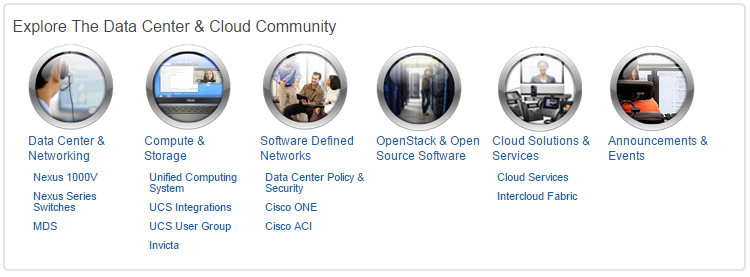
It’s finally here- the new Data Center and Cloud community framework has launched! We created new content spaces for Compute and Storage, Software Defined Networks,Data Center and Networking, and OpenStack and OpenSource Software.
Cisco Data Center and Cloud Community Infrastructure
Last month, more than 100 dynamic women engaged in one of the most inspirational and personal interactive dialogues we’ve seen on what empowers women to “Be Fearless” in the workplace. Led by Women of Impact, Cisco’s inaugural #CiscoChat connected women who shared their thoughts on taking risks and overcoming fear in pursuit of their professional dreams.
As I recapped this inaugural #CiscoChat, I touched on childhood “monsters under the bed” fears giving way to ones that keep women from being brave and bold in the workplace. Even once we learned there were no monsters waiting for us, unconsciously, something – perhaps a movie or teasing from a sibling – rekindled that fear. And the process for conquering it began all over again. So is it difficult to believe that sometimes, nagging fears can creep back into our thoughts and dissuade us from living lives of professional and personal pursuits?
By Bill Gartner, Vice President Cisco’s Optical Systems and Transceivers Group
At Cisco, we pride ourselves on being true business collaborators with our service provider customers.
And we relish any opportunity to work side-by-side with a leading global service provider on a technology program with the potential to advance the entire telecommunications industry.
These opportunities are rare indeed. And today at OFC, the largest global conference and exposition for optical communications and networking professionals, Cisco was fortunate enough to receive such an opportunity.
Verizon announced that it would be working with Cisco and one other supplier to design and build a next-generation 100G metro network in the United States that will deliver improved scalability, functionality and efficiency. To meet Verizon’s mission of offering its customers high-capacity video and wireless solutions, it has decided to modernize its metro optical network. Cisco is honored to be part of this important network transformation.
Using 100G flexible CDC ROADMs and packet aggregation will enable Verizon to advance and scale its network while maintaining existing services and reducing service-activation times as well as network operation and maintenance costs.
“Deploying a new coherent, optimized and highly scalable metro network means Verizon stays ahead of the growth trajectory while providing an even more robust network infrastructure for future demand,” said Lee Hicks, vice president of Verizon network planning. “Cisco met not only our technology requirements but the aggressive timeline to deploy our next-generation 100G-and-above metro network.”
Verizon will test and deploy the Cisco Network Convergence System and the second supplier’s equipment on portions of its 100G metro network this year, with plans to turn up live traffic in 2016. Supplier volumes will be guided by ongoing testing, support and performance.
Verizon and Cisco are long-standing technology and business partners, and we are pleased to play a key role in Verizon’s optical network modernization program.
Cisco has made investments in next-generation optical technologies to help Verizon realize its vision to transform its network architecture to achieve the speed and operational efficiency required to meet the demands of today, while capturing growth opportunities over the next decade.
This new architecture gives Verizon advantages in its metro network including increased capacity, superior latency and improved scalability.
Verizon is a leader in 100G technology having successfully completed several industry firsts, beginning in 2007 with a successful field trial of 100G optical traffic on a live system.
Cisco is very pleased to be working closely with Verizon on its landmark network build-out, and we are committed to making it successful so that Verizon customers will reap its benefits for decades to come!
Well, New Year’s Day is long past. As I continue to plod along with my New Year’s resolutions through this brutally cold winter, I do so with varying degrees of success. I still start my day with an apple-ginger juice and try to eat my veggies. Along the way I bolster my dedication with the incremental successes that a healthy lifestyle delivers. I feel lucky to have my health and I’m trying my best to protect it!
Sometimes, I get bummed when I read the healthcare headlines: There’s a new “super bug”… there is a shortage of doctors… antibiotics are nearing the end stage of their effectiveness…. The headlines can be scary!
But I know that headlines are meant to elicit emotions and capture attention. I recently looked behind the headlines at stories about how companies in the healthcare industry are using Cisco collaboration technology. I came away feeling optimistic. There are some cool things happening!
Technology is making a huge difference in doctor-patient care.
How quickly can your organization stand-up a new application or deploy new services? Most customers tell me, “not fast enough!” I am clearly hearing from them that the new standard expectation across the organization is to receive precise data center resources in “internet time,” easily and definitely on-demand.
But customers are not the only ones affected by these new expectation standards. Application developers also expect to receive the resources they need to support their efforts within one hour — without a lot of process meetings and repetitive, slow paperwork. They want what they want, when they need it, which is always now! Can’t get it now? Out comes the credit card and they go on a shopping spree to outside resources.
Developers don’t worry about security, governance or quality of service. If you are in operations, or you’re a C-level executive, you care. You need to meet compliance guidelines. So how can you get everyone on the same team, working together so the organization can succeed, the old “win-win-win?”
At CiscoLive Milan in January, we introduced the Cisco ONE Enterprise Cloud Suite. Watch this replay of our live broadcast.














 supplier’s equipment on portions of its 100G metro network this year, with plans to turn up live traffic in 2016. Supplier volumes will be guided by ongoing testing, support and performance.