Avatar

Wins, Accomplishments, Fast Action, welcome to the world of Cisco ACI. In this blog, I want to take you closer to the core of ACI excitement. Cisco Insieme Business Unit and Cisco’s premier Partner, World Wide Technology Inc (WWT) have come together in developing an ACI based Business Continuity/Disaster Recovery (BC/DR) solution for the next generation Data Centers. This blog specifically addresses the Disaster Recovery ACI use case implemented in WWT’s Advanced Technology Center (ATC). I will present highlights of how ACI has been implemented at ATC as two fabrics, across two Data Centers with federated controllers implementing an autonomous infrastructure and with replicated tenant configurations that will provide for disaster recovery.

This BC/DR use case couples the storage replication solution by Zert0 on NetApp storage and with a completely integrated and consistent ACI network solution on the primary and secondary sites to enable rapid application bring up on the remote site.  Network and security policies are replicated, compute resources are virtualized and synchronized, and storage is continuously replicated.  This integrated architectural approach addresses one of the major challenges enterprise customers have in deploying BC/DR solutions – aligning the configuration and deployment of network infrastructure in a simple process with the storage and application teams to achieve the Recover Point and Recover Time Objectives.

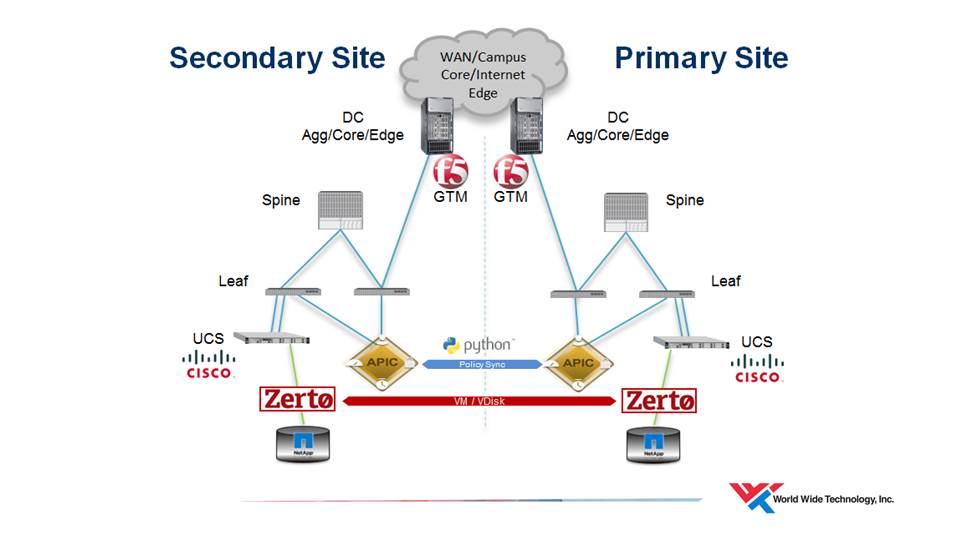
Network architecture: The ACI based network architecture is comprised of two independent fabrics with L3 connectivity between them. Each data center has a unique IP addressing namespace scheme and connects to the WAN. In the operational model per diagram-1, the “East” Data Center is termed primary and the “West” Data Center termed the backup (disaster recovery). Each Application Policy Infrastructure Controller (Cisco APIC) controller cluster is identified as the primary or secondary instance, and changes, additions or deletions to the application tenants, are replicated from the primary to the backup controller. Application tenant configurations are managed through a special Python module developed by WWT that programmatically synchronizes the two fabrics.
BCDR-1

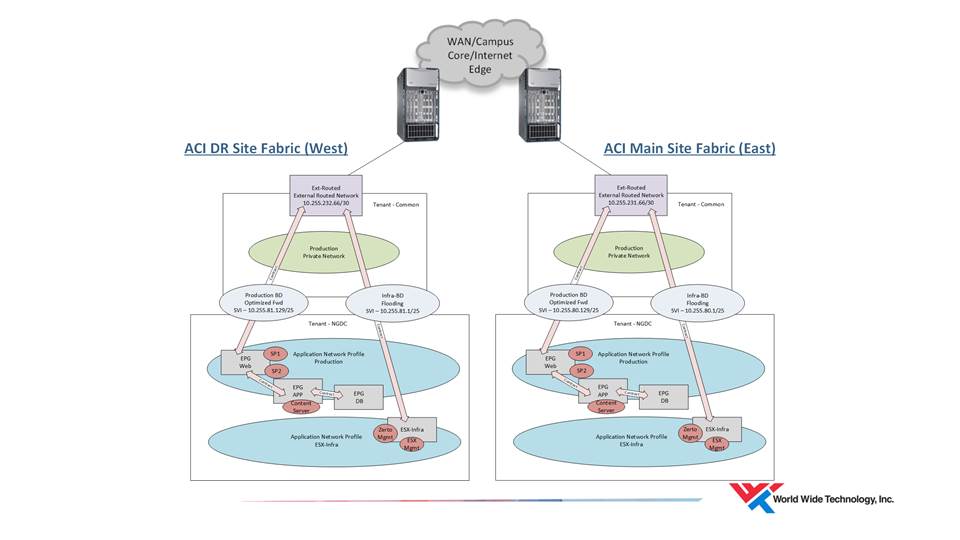
External WAN connectivity for each Data Center is provided through the common tenant in respective ACI fabrics. By using the common tenant for external connectivity, the network and security administrator can assign the appropriate network configuration policy, security contracts and as well as firewall and load balancing services for the fabrics in each data center. The application (DevOps) teams will reference the common configuration and configure application connectivity for intra- and inter-tanant communications through the Application Network profile (ANP). F5 Gobal Traffic Manager (GTM) allows holistic management of multi-data center application delivery via intelligent DNS.
BCDR-2

This ACI based Disaster recovery solution has several other facets like storage replication, orchestration software (developed in-house by WWT) among other solution components. Please watch the YouTube Video for a demo illustration and the whitepaper for design details.

In closing, some key takeaways. Cisco ACI’s innovative architecture enables enterprise apps to treat the Data center as a dynamic, shared resource pool. This pool of resources is managed through a central controller (Cisco APIC) exposing all configuration and management components through a northbound REST API.  WWT exploits this programmatic interface of ACI to develop business continuity/disaster recovery solutions for customers.

Related Links

https://www.youtube.com/watch?v=XnA1P1aYYYc&list=UU-ZgkyIop9MqOL4QF80UU9Q

www.cisco.com/go/aci

www.cisco.com/go/apic

https://www2.wwt.com/sites/default/files/White%20Paper%20-%20ACI%20and%20Disaster%20Recovery%20Solution.pdf

Authors

Ravi Balakrishnan

Senior Product Marketing Manager

Datacenter Solutions

Avatar

Introduction

Nowadays, there are billions of devices connected to the Internet, and this has led to some advances in the Electronics and Telecommunication technology developments in recent years which resulted in various kinds of very powerful devices with communication and networking capabilities that have attracted the industries to adopt this technology into their daily business to increase their efficiency. Other than the industrial sector, there are other sectors like assisted living services, public services, etc., which have a big demand for Information and Communication Technology developments. Therefore, there is the need for a new paradigm in M2M communication which enables “Things” connectivity to the Global Internet Network. This paradigm is known by the term IoT.

IoT is the network of physical objects or “Things” embedded with electronics, SW, Sensors and connectivity to enable it to achieve value and service by exchanging data with the manufacturer, operator and/or other connected devices through advanced communication protocols without human operation. The technology of IoT has been evolved according to the environment based on information communication technology and social infrastructure, and we need to know the technological evolution of IoT in the future. Continue reading “IoT, from Cloud to Fog Computing”

Authors

Maher Abdelshkour

Sr. Network Engineer

Information Security Analyst III

Avatar

Shadow IT isn’t anything new; it is part of human behavior and started with the first mini-computers in family homes. People will always choose the tools that help them do their jobs in the simplest and most efficient way. Unfortunately, when that means using unsanctioned technologies, well intentioned selections can have unintended and potentially dangerous consequences for the company.  These can include: increased security risks, diminished productivity, and increased costs. Additionally, when users select their own cloud services, they inadvertently create silos of information that IT is not unaware of, and potentially create data compliance issues.   By purchasing cloud services on an ad hoc basis, users limit the company’s ability to negotiate volume pricing.

IT leaders and other executives need to make it their responsibility to find out which cloud services are being used, and come to a mutual understanding of which cloud technologies are best for the business. Only through a clear understanding can IT leaders devise cloud strategies that benefit users—and ultimately drive business advancement. At the very least, IT leaders need to become informed brokers. Even better, they may want to establish their own cloud services and merchandize them to reduce costs and better meet user needs.

Continue reading “Bringing clarity to cloud usage: a must-do for shaping more effective IT strategies”

Authors

Jim Grubb

Chief Technology Evangelist

Cisco Customer Experience Center

Avatar

It was only last November that I wrote about our first Cisco Entrepreneurs in Residence (Cisco EIR) cohort in Europe. I knew then we had started something special – an incubation model that allows Cisco to tap into the immense talent of the European startup community and helps address many of the unique challenges entrepreneurs face in the region. Only a few months into our first European season, our startups have gained significant traction inside Cisco – and are demonstrating potential for strategic relationships and differentiation with us.

With this success in mind, I am pleased to announce we are now accepting applications from startups located in Europe, the Middle East, Africa and Russia (EMEAR) to join our second season cohort in the region. We have partnered with Pioneers once again and are looking forward to announcing the winners on stage at the Pioneers Festival in Vienna in May. Find out more and apply here.

Continue reading “Entrepreneurs: Your Invitation to Innovate with Cisco in Europe – Second Season Application Now Open”

Authors

Mala Anand

No Longer with Cisco

Avatar

Privacy and human rights advocates, technology companies, and trade associations have today called on U.S. political leaders to reform the country’s surveillance laws. We add our voice to those calls. These reforms will help show the world that the U.S. Government is ready to lead the dialogue on global standards of conduct, and wants to further build international trust with citizens – a cornerstone for our industry.

We also see a need for governments to agree on transparent standards of conduct. Building a system with appropriate safeguards and limits will serve both national security objectives and the needs of global commerce. In May 2014, Cisco offered a series of recommendations that support customer confidence in the global internet economy, while respecting the role that governments need to play in ensuring the physical safety and the economic security of their citizens. Governments and industry players need to deliver these outcomes for our future. Cisco is ready to play our part and we believe our peers and colleagues in industry and government are as well.

Authors

Mark Chandler

Retired | Executive Vice President

Chief Legal and Compliance Officer

Avatar

Have you ever walked into the office or perhaps an area in your home with your mobile phone and tried to make a call, only to have poor LTE/4G/3G signal strength keep your call from connecting? What did you do? Well if you’re like me, you probably wanted to throw your phone and revert back to the reliable, old land line. What if, instead of relying on the signal strength of your mobile service provider, you were to make voice calls over your home or office Wi-Fi network?

Mobile phone

Mobile network traffic is growing exponentially, and service providers must manage their networks efficiently to meet Continue reading “Increasing Mobile Network Efficiency with Voice over Wi-Fi (VoWi-Fi)”

Authors

Jim O'Leary

Sr. Manager Mobile Solutions Marketing

Avatar

Nearly a year ago, I wrote a blog titled, “Mayday for Insurance and Financial Services,” where I detailed how next-generation customer experience capabilities, such as virtual interactions between business experts and customers, are transforming business processes – such as the “Mayday” button technology offered on Amazon’s Kindle Fire HDX. The purpose of that blog was to explain virtual interaction capabilities and discuss how they are likely to become integrated into the insurance industry in the near future. So what’s changed? Well, I’ve gone from blogging about the changes to come, to speaking at insurance industry conferences about how virtual transactions are now transforming how the industry does business and how Cisco is helping fuel these virtual interactions.

I attended the Property Insurance Report National Conference, and had many great discussions. The focus of the conference was on ways the property insurance world is changing, through consideration of new ideas and the utilization of new tools being built. It’s widely considered that with the arrival of better information and tools, the most sophisticated insurers will be able to separate themselves from those who don’t take these changes as seriously or employ them as skillfully. Features such as online video sales and support are working in the real world for other industries, so how they can be applied to insurance?

At the conference, I gave a keynote presentation titled, “Omni-Channel for Insurance – Virtual Enhanced Distribution & Service Channels”. The presentation specifically focused on how virtual interactions are transforming the insurance industry and improving customer experiences.

https://www.youtube.com/watch?v=icS9vLfv5rQ&list=PLE4063C62F022E881&index=1 Continue reading “Enabling “The Easy” Button for Insurance”

Authors

Rob Cornwell

Practice Advisor - Insurance

Insurance, Americas Business Transformation

Avatar

Cisco_Chat_Mobility_TWITTER

The Internet of Everything (IoE) is driving remarkable change and opportunities across nearly all industries. But few are as visible — and rapid — as the upheavals affecting retail. Today, retailers aren’t just competing with the store across the parking lot. Industry leaders face an expanding universe of mobile and virtual shopping possibilities vying for the attention of their customers.

Recent Cisco retail research shows that mobile commerce grew forty-seven percent in 2014 (Q2), far out-pacing e-commerce (ten percent) and total retail overall (three percent). And it’s not surprising, with nearly every customer using a mobile device of one type or another. Today, eighty percent of shoppers are now classified as “digital.”

Mobile devices — and rapidly evolving customer behaviors — are driving expectations for more fully optimized digital shopping experiences, in store and out. Yet traditional retailers have an exciting opportunity to meet this demand by offering hyper-relevant customer experiences that drive savings, efficiency, and engagement. In merging the best attributes of the physical store with the online experience, brick-and-mortar retailers can drive their own industry disruption. Continue reading “#CiscoChat Explores Mobile Data as the New Currency for Today’s Retailers”

Authors

Avatar

Today, we released the first ever Cisco IOS Software and IOS XE Software Security Advisory Bundled Publication. As a reminder, Cisco discloses IOS vulnerabilities on a predictable schedule (on the fourth Wednesday of March and September each calendar year). In direct response to your feedback, we have also included a Cisco Security Advisory addressing vulnerabilities in Cisco IOS XE Software in this publication. We hope this timeline and additional “bundling” continues to allow your organization to plan and ensure resources are available to analyze, test, and remediate vulnerabilities in your environments.

Today’s edition of the Cisco IOS Software Security Advisory Bundled Publication includes seven advisories that affect the following technologies:
Continue reading “Announcing the First Cisco IOS Software and IOS XE Software Security Advisory Bundled Publication”

Authors

Erin Float

Project Manager

Security Research and Operations Group