Avatar

BOI_2015_finalist1

With Interop less than three weeks away, we are excited to learn that Cisco APIC, the SDN controller for our Application Centric Infrastructure (ACI) fabric, has been selected as Best of Interop 2015 Finalists  in Software Defined Networking (SDN) category. As you may recall, when we announced ACI back in Nov 2013, we mentioned that APIC would be the software controller for the application-centric policy model, and would be available in Q3, CY 2014. In a short span of less than a year, APIC has gained broad industry adoption with more than 300 Customers either deploying or in production already.

Interop Vegas, is a great venue to unveil more aspects of the ACI fabric, the policy model, and key APIC features. If you aren’t going to be in Las Vegas the last week of April, now may be the time to start making plans as we gear up for some exciting ACI news and events, and  hopefully bringing home this Best of Interop award.

But wait, there’s more…

If you are not familiar with ACI or APIC yet, let me take the opportunity to tell you about APIC and why I think it is a finalist for the Best of Interop.

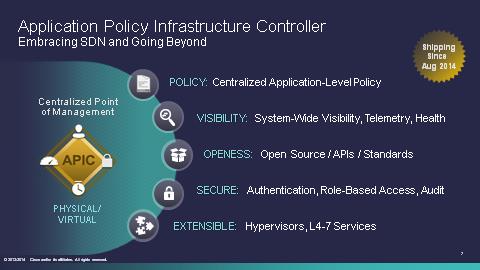
The Cisco APIC is the unified point of automation and management for the ACI fabric and health monitoring. The Cisco APIC is built with open APIs and an open application-centric policy model designed to simplify the provisioning, monitoring, and management of applications across the data center. Cisco’s Application Centric Infrastructure (ACI) is a fabric architecture with centralized automation and policy-driven application profiles designed to make the infrastructure highly responsive to the needs of applications, while significantly simplifying the data center and cloud operational model.

APICGraphic

The Cisco APIC is built on the SDN principles of an extensible/programmable centralized controller, standardized north-bound API’s, a protocol for communicating with and orchestrating data center devices and network nodes, and  features and agents within the network infrastructure to support the controller’s policy model and respond appropriately.

The Cisco APIC uses an application-centric policy model rather than network-centric SDN policies that do not adequately reflect business requirements. Cisco ACI is an open ecosystem of management, services, and security partners that incorporate best-of-breed solutions across physical and virtual infrastructures. Customers have a choice of flexible workflow automation and orchestration solutions on top of APIC and the ACI fabric, including OpenStack, VMware cloud automation solutions, Microsoft System Center, Cisco UCS Director, and more, rather than being locked into a specific automation model.

The APIC software is delivered on turn-key UCS C-Series server appliances, so the user out-of-box experience is simple.

Apparently these stellar traits weren’t lost on the Best of Interop judges as it made it to Finalist status.  We sincerely hope this bad boy brings home the prize too – stay tuned for more excitement to come.

Related Links

www.cisco.com/go/apic

www.cisco.com/go/aci


Authors

Ravi Balakrishnan

Senior Product Marketing Manager

Datacenter Solutions

Avatar

This post was authored by Nick Biasini, Matt Olney, & Craig Williams


Isolate_Image_Export

Introduction

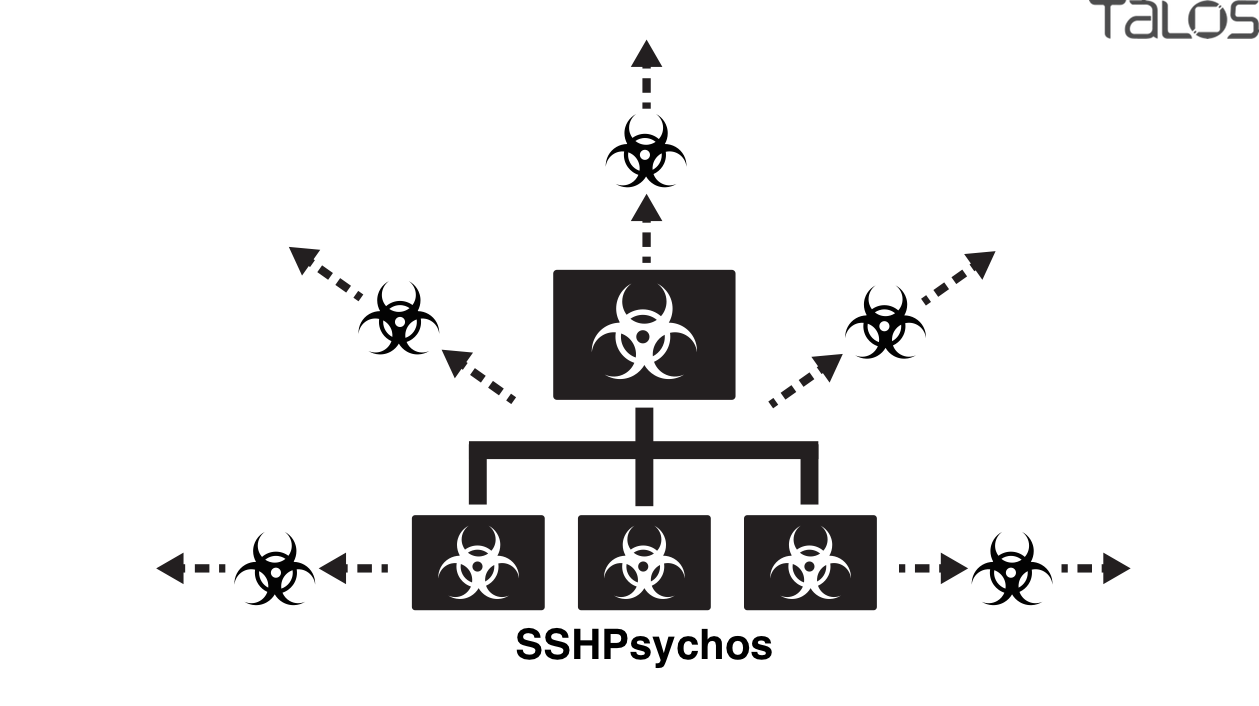
Talos has been monitoring a persistent threat for quite some time, a group we refer to as SSHPsychos or Group 93. This group is well known for creating significant amounts of scanning traffic across the Internet. Although our research efforts help inform and protect Cisco customers globally, sometimes it is our relationships that can multiply this impact. Today Cisco and Level 3 Communications took action to help ensure a significantly larger portion of the Internet is also protected.

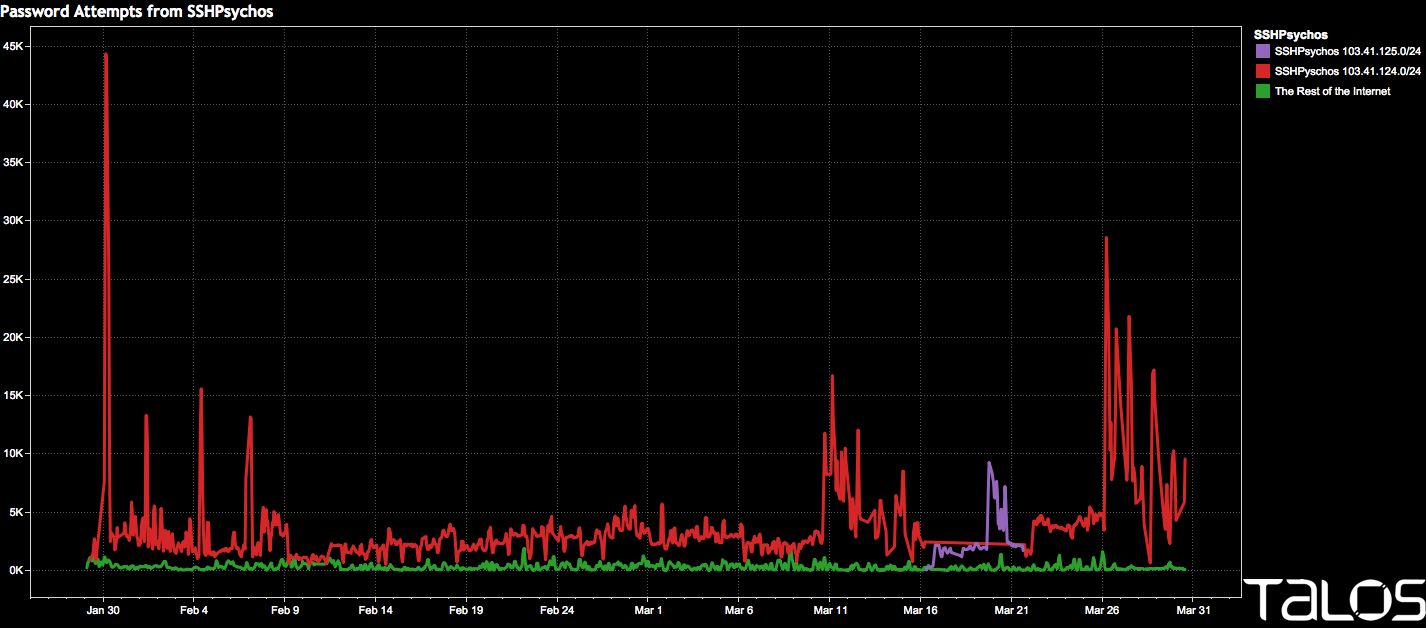
Graphic Showing SSH Psychos SSH Traffic vs Rest of Internet (Green)

Continue reading “Threat Spotlight: SSHPsychos”

Authors

Talos Group

Talos Security Intelligence & Research Group

Avatar

In security, there’s a gap between perception and reality. According to the Cisco 2015 Annual Security Report, 90 percent of companies are confident about their security policies, processes, and procedures – yet 54% have had to manage public scrutiny following a security breach. Not only are there direct costs to a security breach – there are also intangible expenses, including a negative impact to brand reputation, and the erosion of customer trust.

As John Chambers articulated recently at the World Economic Forum in Davos, “There are two types of companies: those who have been hacked, and those who don’t yet know they have been hacked.”  2015 is going to be another year where organizations around the world can expect to be under attack or will discover that they have been infiltrated.

There is a widening gap between resources and needs, as security practitioners lack both funding and manpower to adequately protect assets and infrastructure.  Because of this, CISO’s are increasingly looking to external experts for security guidance.

This is why we are unveiling our Security Incident Response Services.   Our new Incident Response Service is designed to advise organizations on how to reduce time to detection, containment and remediation. Our experts identify the source of infection, where it entered the environment, and what data was compromised. By going to the source – patient zero – and identifying malware movement throughout the environment, organizations can minimize the cost and overall impact of any breach, as well as identify methods to reduce future risk.  The service leverages threat intelligence from the Cisco Talos Security Intelligence and Research Group, Cisco security technologies including AMP Threat Grid and the expertise of the Cisco Security Solutions (CSS) team.  The Incident Response Service supports businesses in two areas:

Cyber Attack Response

Every event is unique and our Security Incident Response methodology provides expedience and allows for flexibility to continuously adjust to the dynamic threat landscape. Whether it’s an insider threat, distributed denial of service, advanced malware at the endpoints or customer data breach, the team guides an organization through identification, isolation and remediation using analysis and data mining, forensic image analysis, infected system dynamic instrumentation, malware reverse engineering and exploit analysis and re‐implementation.

Cyber Security Readiness

As businesses fall victim to increasingly targeted cyber-attacks and data breaches, they need external expertise to assess and promote security best practices as well as to protect corporate data and prepare for the inevitable data breach incident. An important pre-requisite for a successful incident response capability is a strong Incident Response plan, When an incident occurs, everyone knows how to respond, how to escalate, what to do, quickly and effectively. Cisco Incident Response offerings spans infrastructure breach preparedness assessments, security operations readiness assessments, breach communications assessments, and training among other activities.

Our team of experts has been actively working with customers for cyber attack response.  A recent engagement was initiated when a company had identified consumer credit card data exfiltration.  Working hand-in-hand with the customer, federal law enforcement and Cisco Talos, the Incident Response Services team discovered a new malware family targeting point of sale (PoS) systems.  The team identified malware patient zero and its lateral movement mechanism.  This ultimately led to the team’s discovery of a new family of malware, “PoSeidon,” which is detailed in this blog post.  Using best of breed technology, our incident response expertise, and working closely with Talos, the Cisco Incident Response Service team compressed the process of identifying, isolating and remediating for this customer by developing detection and countermeasures.

For more information on Security Incident Response Services team, please see our overview video and our Cisco Security Launch Page.

Authors

JJ Cummings

Managing Principal

Cisco Security Incident Response Team

Avatar

CiscoChampion2015200PX#CiscoChampion Radio is a podcast series by Cisco Champions as technologists. Today we’ll be talking about 802.11ac Wave 2 with Cisco Product Marketing Engineer Mark Denny and Cisco Product Marketing Manager Allen Huotari.

Listen to the Podcast.

Learn about the Cisco Champions Program HERE.
See a list of all #CiscoChampion Radio podcasts HERE.

Cisco SMEs
Mark Denny, Cisco Product Marketing Engineer
Allen Huotari, Cisco Product Marketing Manager

Cisco Champion Guest Hosts
Stewart Goumans, @WirelessStew, Mobility Consultant
Sam Clements, @samuel_clements, Mobility Practice Manager

Moderator
Lauren Friedman (@Lauren)

Highlights
What is 802.11ac Wave 2 and why it is important?
Multi-user MIMO
Wave 2 and backwards compatibility
Troubleshooting Wireless Networks and Wave 2
Infrastructure and Power Requirements with Wave 2
AC toolbox recommendations
Wave 2 and disabling NCS rates

Authors

Rachel Bakker

Social Media Advocacy Manager

Digital and Social

Avatar

This guest blog was authored by Frank Cicalese and contains summarized content from various articles that can be found on Cisco and NetApp’s sites. 

Untitled5Frank Cicalese is a Technical Solutions Architect with Cisco’s Data Center Architecture Team helping customers globally with their Microsoft solutions on Cisco UCS. Frank also worked at Microsoft for over 10 years in several positions that required deep technical knowledge such as Services Consultant, Platform Architect, Database Technology Specialist, Virtualization Technology Specialist and Datacenter Technology Specialist. Frank has in-depth technical knowledge and proficiency with database design, optimization, replication and clustering and has extensive virtualization, identity and access management and application development skills. He is also a writer member of the American Society of Composers, Authors and Publishers with published musical works that have aired on well-known cable and news networks.
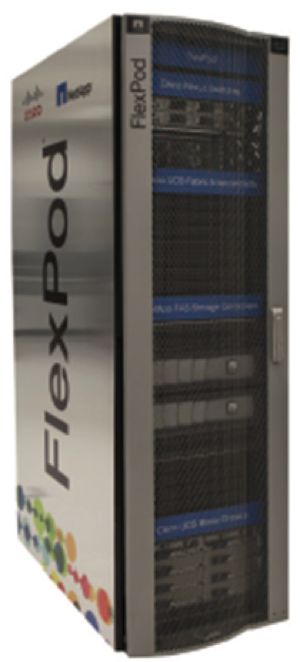



 

FlexPod

Cisco and NetApp have been teaming for several years developing the FlexPod solution portfolio. This portfolio includes architectures that combine NetApp storage systems, Cisco Unified Computing System servers, and Cisco Nexus fabric into an architecture that provides a highly efficient operational model for workload deployments. This architecture is capable of hosting mission critical SQL Server implementations and is capable of providing them with the required throughput and availability for even the most demanding business requirements.

Recently, Cisco and NetApp contracted Scalability Experts to implement a performance and load test that proves my claims in the above paragraph beyond any doubt in my mind.

Scalability Experts, for readers who may not be familiar with them, is a triple Gold Microsoft Partner, and highly awarded consulting company specializing in Data Platforms, Business Intelligence and Infrastructure Solutions. Scalability Experts conducted the performance and load testing over several months using real world workloads. More information on Scalability Experts can be found at http://www.scalabilityexperts.com/

The purpose of this performance and load test was to validate that FlexPod is a premiere platform for the most demanding applications. This performance and load test implements a real world gaming workload on Microsoft SQL Server 2014. Visual Studio 2013 Ultimate Edition was used to generate and run the performance and load tests. For more information about Visual Studio 2013 Ultimate Edition see http://msdn.microsoft.com/en-us/library/dd831853.aspx. More information about Microsoft SQL Server 2014 can be found at http://www.microsoft.com/en-us/server-cloud/products/sql-server/.

Continue reading “FlexPod Datacenter with Microsoft Private Cloud — A Premier Integrated Platform for Mission Critical Microsoft SQL …”

Authors

Renee Yao

No longer at Cisco

Avatar

No one will question that a significant contributor to a company’s long term success is customer loyalty. Loyalty is gained by providing your customers with an experience that make them keep coming back to you for more, and even bringing along others with them – ultimately helping you drive more revenue and profitability.

Technologies like NFV (network functions virtualization) and SDN (software defined networks) make the infrastructure on which services are Continue reading “Customer Centered, Cloud Service Management: Come See it in Action at TM Forum Live in Nice”

Authors

JL Valente

Vice President, Product Management, Enterprise Routing and SD-WAN

Networking Experiences Team

Avatar

Ready to learn about Trove? Oh, sure–you know it’s OpenStack’s database project. But do you really know what it does?

Amrith Kumar is the founder and CEO of Tesora, and on OpenStack Podcast #26, he sat down with us to talk about Trove, Tesora, and the database applications they work with. Specifically, he covered:

  • What Trove does well
  • Who is using it
  • How it interacts with other OpenStack projects
  • Why the hardware matters when it comes to databases
  • What Tesora does
  • How Trove is changing the way data analysts make decisions
  • Why OpenStack is a wonderful teaching tool

To see who we’re interviewing next, or to sign-up for the OpenStack Podcast, check out the show schedule! Interested in participating? Tweet us at @nextcast and @nikiacosta.

https://www.youtube.com/watch?v=ttEcwUVa7Pw

For a full transcript of the  interview, click read more below.

Continue reading “OpenStack Podcast #26: Amrith Kumar”

Authors

Niki Acosta

OpenStack Evangelist

Avatar

I’m looking forward to Collaborate 15 where thousands of attendees travel to Las Vegas to learn, meet and improve their skills and understanding of Oracle databases and applications.   One of the main areas to see improvements in reliability, speed and cost of  Oracle database is the upgrading of server hardware.   Cisco UCS Servers and UCS Integrate Infrastructure offer Oracle customers’  a number of unique upgrade, benefits.  These hardware improvements are here today from Cisco, and its name is UCS. Continue reading “UCS at Collaborate 15: Simplify, Save, Increase Efficiency and Redefine the Word “Hardware””

Authors

Bruno Messina

Product Manager

Unified Computing Systems Data Center

Avatar

Welcome to our latest #SocialRoundup blog series about new social media efforts and best practices. Today, we want to highlight #CiscoChat, our new social media chat program that has been picking up steam recently. The concept was simple: create a standard method for our customers, partners, influencers and employees to engage with Cisco and each other in real time through a single hashtag.

We’ve held three chats to-date, involving hundreds of participants and resulting in nearly 20 million impressions. And we’ve only just begun. Check out highlights from recent #CiscoChat events below.

What Empowers You To Be Fearless?

This #CiscoChat was hosted by the Women of Impact team and joined together Catalina Kowal from Cisco’s Empowered Women’s Network, Cindy Cooley from Cisco’s Men for Inclusion, and Barbara Koch from the Passion Project to discuss how being fearless isn’t really about eliminating fear from our everyday lives completely, but more about finding ways to make our fears not hinder us from being adventurous, from taking risks, from getting up after we fall down, or from being our own advocates. See the full #CiscoChat recap on Storify.

a1 a2 Continue reading “New #SocialRoundup: #CiscoChat Heats Up”

Authors

Autumn Truong

No Longer with Cisco