At this year’s Hannover Messe International (HMI), the world’s largest industrial fair, it was more about how industrial companies are leveraging the Internet of Things (IoT) to evolve Industry 4.0 from theory to practice.
The Internet of Things was everywhere at this show. Almost every vendor on the show floor had an IoT message, in addition there were numerous keynotes and panel discussions centered around IoT. There was a lot of excitement around Industrie 4.0, which facilitates the vision for a smart, digital factory enabled by IoT.
Cisco’s presence at this event was to show how we are taking IoT beyond the theoretical. Cisco partners and customers demonstrated leadership in defining, implementing and showcasing connectivity for the production floor from cloud down through to the sensor. Visitors to the booth this year began to understand and realize that a tested and validated Cisco Connected Factory architecture is the best path to accelerated business value. One engineer from a large automatic company told me, “Ok. Now I get it. Your value is the architecture. You’re taking the complexity out of deploying a stitched together product solution.”
Oliver Tuszik, head of Cisco Germany, reiterates in this video how Cisco is a source for real solutions and practical, proven approaches to IoT including Cisco’s integration with Profinet:
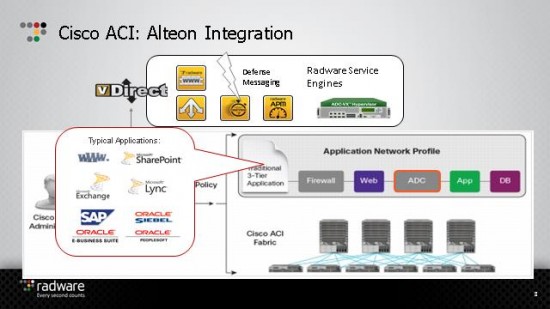
Radware’s Alteon ADC and DefensePro integrated with Cisco ACI fabric enable IT managers drive greater value from their Cisco ACI deployment with automated tenant-based application delivery and security services.
For decades, IT managers were deploying application delivery (L4-7) and security services as point solutions; the network provided the basic connectivity, and each L4-7 had to be configured manually per each application. Virtualizing the compute fabric enabled to automate the configuration stage; however L4-7 and security are still deployed as point solutions – each application infrastructure change still requires intervention in rewiring the physical network, reconfigure network nodes and of course test the application integrity end-to-end and its performance.
Cisco Application Centric Infrastructure (ACI) in the data center introduces a holistic architecture with centralized automation and policy-driven application profiles. ACI delivers automation from the network layer and up to the compute fabric. Radware, by integrating Alteon and DefensePro with Cisco ACI fabric, enable automated tenant-based application delivery and security services.
What is the Radware offering?
Radware offers Best of breed Application Delivery and DoS Protection services. In today’s growing threats to your application service SLA you need a vendor you can rely on to maintain your SLA and eliminate the ‘noisy neighbor’ impact:
Radware Alteon NG application delivery controller (ADC) is a leading load balancer that guarantees application SLA for all Web, cloud and mobile applications.
Radware AMS offers most accurate real-time DoS/DDoS attacks detection and mitigation without blocking legitimate user traffic.
How does it work?
Radware’s developed ‘Device Packages’ for Cisco ACI that enable to insert ADC and DoS Protection services per application and/or per network tenant.
Cisco APIC automates the service insertion process while acting as a central point of policy control.
What’s in it for me?
You can now increase your data center agility without compromising application SLA:
Benefit from deploying Cisco ACI as a dynamic and automated datacenter infrastructure while continuously delivering applications without any adverse application SLA impact.
Applications can move, scale-up or scale-out while retaining the associated L4-7 and security services without any location specific constraints.
Error-free deployment thanks to automated processes running Radware-certified use cases
Use Case Example: Web application service profile
Using Cisco APIC the user can automate the creation and provisioning of a Web application profile. Cisco APIC offers a drag-and-drop UI to easily insert a Firewall, Load Balancer and other L4-L7 network services into a Web application profile. This, in turn, creates a service graph in which a L4-L7 service such as load-balancing, becomes an integral part of the tenant’s web application and can become operational by APIC in minutes.
Together Cisco ACI and Radware can automate the workflow between your application, networking, and security teams and provide a simpler, more efficient, policy driven operational model that will save on OpEx.
Blog Authored by Ron Meyran Radware, Edited and Posted by Cisco
Cisco ITD has been selected as Best of Interop 2015 finalist in the Data Center Category. Finalists were chosen from nine categories including Data Center, Mobility, SDN and Cloud Technologies.
Cisco Intelligent Traffic Director (ITD) is an innovative solution to bridge the performance gap between a multi-terabit switch and gigabit servers and appliances. It is a hardware based multi-terabit layer 4 load-balancing, traffic steering and clustering solution on the Nexus 9K,7K,6K,5K series of switches. Customers do not have to buy any new hardware. It works on all the existing hardware, linecards and supervisors.
Here are some of the quotes from customers, account teams, industry analysts and architects:
“Great milestone Samar Sharma, Mouli Vytla, Rajendra Kumar Thirumurthi and team! We are very grateful for the work you guys did with pioneering and driving this new solution!”
“ITD helped us scale to 1Tbps of cache traffic in single Nexus 7700 ”
“This feature seems almost too good to be true! I am very excited about it.”
“Customers really enjoyed the time and the subject. They said it was the best presentation of the week at Cisco Live”
“Turns out we likely have a far superior solution in ITD that we can bring to the table. One of our web space principles is ‘state is the enemy of scale’ and ITD aligns very well with this mentality without sacrificing too much flexibility or control. It is still early in our conversations but we are confident that ITD will play a strategic role for scaling services”
Click to find out more! You can also visit Cisco Interop Booth at Interop Las Vegas to find out about Cisco ITD Solution!
· The growth trajectory of OpenStack® is similar to that of Linux, and is on track to grow even faster. What started as a sandbox for developers has now become significantly more stable and mainstream.
· Many larger enterprises are now using OpenStack, even in limited deployments, and as the advantages become more apparent, use will increase.
· The code itself has matured dramatically since its introduction five years ago. Updates are now far more likely to be bug fixes and usability improvements rather than major new code releases.
· An impressive number of technology and cloud vendors now offer OpenStack solutions and tools. Almost every major cloud vendor now has a presence in OpenStack. We are nearing critical mass.
2. The OpenStack community is vigilant about protecting flexibility.
· The biggest advantage of an open-source approach is that you can create a much more flexible and vendor-neutral cloud environment. As a result, you can lower your costs, avoid the risks of vendor lock-in, and add new capabilities and approaches much more quickly and easily.
· The cloud is still an incredibly dynamic, rapidly evolving marketplace. New features and approaches are being introduced all the time. If you lock yourself into a single vendor, you’ll be on that vendor’s timeline to bring those new capabilities to your business. Your success may well rest on responding more quickly than your competitors.
3. It can make a big difference in productivity and staffing.
· Using OpenStack on an integrated infrastructure platform, like Cisco UCS® offers significant productivity benefits, because the two architectures work together to eliminate many of the manual tasks involved in building a cloud. OpenStack defines how computing, networking, storage, and other essential cloud elements will interoperate, so your IT engineers are free of repetitive deployment tasks and can focus on more value-added projects.
· If you lock your cloud environment into a single vendor’s approach, you’re limited to staff who specialize in that vendor’s technology—or to long ramp-up times to train existing staff who don’t. But open source technologies are a smart investment and many of today’s developers and engineers are adding open source to their skill set, expanding the number of people qualified to support your OpenStack cloud.
· OpenStack is growing rapidly. Even if you’re not planning to begin implementing an open-source approach right away, it’s critical to start building OpenStack skills in your team now, so you won’t be scrambling to catch up later.
4. Are you avoiding OpenStack because you think using an open-source solution means a long, complex do-it-yourself project? Not necessarily.
· Hardened, enterprise-class OpenStack solutions are now available from open-source leaders like Red Hat®, often as part of pre-integrated, ready-to-deploy solutions developed in partnership with vendors like Cisco. Cisco UCS Integrated Infrastructure for Red Hat OpenStack is a fully documented design guide and bill of materials, designed to accelerate deployment of your OpenStack cloud.
· And for those who prefer to leave operation of OpenStack to the experts, Cisco now provides a fully-managed, on-premises private cloud option, based on technology acquired from Metacloud. Cisco OpenStack Private Cloud® gives you all of the benefits of a public cloud in a private cloud environment, so you can focus on application development.
· The number of tools is growing and responding to the need for support. OpenStack users have made Chef cookbooks and Puppet configuration modules freely available on GitHub. In addition, the latest technologies for putting infrastructure at the service of cloud applications and services are being made available for OpenStack. Vendors now offer software-define networking (SDN) controllers, such as the Cisco Application Policy Infrastructure Controller (APIC), that allow you to perform policy-based management of your OpenStack-based cloud environment.
5. Are you ready for a hybrid cloud world?
· For many businesses, the immediate priority is to create a private cloud environment to deliver IT as a service (ITaaS). But you want to be able to shift workloads to public cloud resources when it makes sense to do so, as well as meet growing demands from lines of business that want to use public cloud services in the enterprise.
· Hybrid cloud is growing in importance as it combines the economic benefits of the public cloud with the control and security of a private cloud. The December 2014 Ubuntu Cloud and Server Survey found that 40% of respondents using OpenStack were planning to implement an OpenStack-based hybrid cloud in the next 12 months. OpenStack is an obvious candidate for hybrid cloud, with the support of an active open source community, as well as major cloud vendors.
OpenStack may have seemed like a curiosity a few years ago. But it’s becoming a big part of the cloud landscape. If you want to capitalize on the benefits of open source cloud environments before your competitors, start paying attention now—or be prepared to play catch-up later.
RSL Care is one of Australia’s largest providers of retirement living, community care and aged care services with more than 28 communities throughout Queensland and New South Wales. This not-for-profit organization offers high quality Homecare, Retirement Living and Residential Aged Care services. In the words of the award-winning CEO of RSL Care: “We are focusing on guiding our customers to make the most out of life through wellbeing and independence”.
We talked to Ian Youngson, the Manager of IS Operations, to understand the wireless deployments at RSL Care. The business outcomes that the wireless deployment enables are support for a voice-over-Wi-Fi for the nurses, the ability to provide guest access to residents and visitors, as well as support for mobile devices carried by the staff and doctors.
Guest blog written by, Julia Slocombe, Vice President of Operations, Western Region at Smart City Networks
Providing dependable wireless communication in the convention industry requires a combination of artful networking design, hardware strength from top-of-the-line equipment, and execution from skilled technicians and administrators. With the partnership of Cisco, the Smart City Networks team has been able to do just that for the more than 35 convention and meeting facilities we service across the country.
Over the past two years, the Santa Clara Convention Center (SCCC) has played host to over one thousand events, with each event seeking seamless connectivity and robust Wi-Fi bandwidth to support a myriad of mobile devices. By relying on the vast industry knowledge of our on-site Smart City Networks leads and the hardware reliability of Cisco, the SCCC can satisfy the WiFi demands of their attendees. Through Smart City’s implementation of a dynamic, scalable wireless network, the SCCC is capable of meeting the needs of all attendees, from 10 to 100,000.
When choosing your path to cloud, it’s important to remember why you are making this transition in the first place. For many companies, the cloud is about increasing agility and optimizing your IT assets to your company’s best advantage. Every company has unique requirements, so every path to cloud is unique as well.
In “Moving to Cloud is a Journey,” Andrew Mametz at Peak 10 describes how colocation can help smooth your transition to cloud. With colocation, you keep ownership of your IT assets. The facilities and personnel required to manage these assets, however, can be maintained by a colocation provider.
Colocation addresses many of the challenges that arise when managing your own data center. By consolidating equipment from multiple companies within a single facility, colocation providers can leverage expertise, capabilities, and volume in ways that are challenging for a single company to achieve. For example, colocation providers can implement multiple layers of security to protect data and applications that can be difficult to achieve in on-premises data centers. Similarly, a colocation facility can maintain a robust power-per-square foot ratio that enables the use of high-density computing solutions for greater operating efficiency.
Colocation providers can also afford to bring on the staff and expertise to maintain 100% network availability, sharing this cost across all of the companies sharing their facility. They can also offer new innovations in technology quickly with low risk to their customers. They are also able to negotiate volume pricing and manage contracts and service level agreements with cloud providers on your behalf.
The cloud brings flexibility to your business. And it brings it in many different ways. You have a great deal of choice with cloud: choice of provider, choice of services, and choice of your path to cloud.
Learn more about how cloud can help you increase your organization’s effectiveness, efficiency, and agility.
Though 2014 has come and gone, one trend that dominated its headlines has unfortunately continued to do the same this year. So, what happens to an organization’s cybersecurity readiness plan when there aren’t enough security professionals to protect the network? What are the tested security strategies that can help organizations prepare, manage, respond to and recover from incidents in a quick and effective manner?
During our next #CiscoChat, we’ll seek to answer these questions and invite you to share your thoughts and solutions with us. #CiscoChat is a program where industry experts answer your questions and participate in an open discussion on a particular topic. Everyone is welcome to join simply by searching the hashtag #CiscoChat on Twitter and including it in your tweets to be seen by others participating. Continue reading “#CiscoChat: Incident Response in a Complex Threat Environment”
If ever there was an industry and a time that epitomize “disruption,” it is the oil and gas industry today. Price declines of more than 50 percent since June 2014 have upended the sector, and dominate the agendas of industry executives. In fact, a new Cisco study identified “energy price volatility” as the external market force causing greatest concern for the industry today. The study, “A New Reality for Oil & Gas: Complex Market Dynamics Create Urgent Need for Digital Transformation,” shows an industry ripe for transformation by the Internet of Everything (IoE).
In the past, oil and gas (O&G) companies have attempted to address oil-price declines by resorting to short-term cost-cutting measures to see them through the slump. But this time is different. For one thing, it does not appear that prices will recover any time soon—if at all. Demand is down, and new production technologies are driving efficiencies that will increase production and keep prices low for the long term. This time, O&G firms will need to do more than cut costs – they’ll need to change their operating models through digital transformation.
For the study, we interviewed oil and gas executives, consultants, and analysts in 14 countries about the industry’s challenges, opportunities, and priorities. These experts identified intelligence from data as the key area needed to improve operational efficiency, and data analytics as the No. 1 driver of faster, better decision-making.
Additionally, the survey named faster problem resolution, better process control, and improved worker safety as the top three business benefits of IoE-powered technologies. The top three IoE-driven operational benefits were improved production efficiency, reduced downtime, and equipment performance optimization.









 Guest blog written by, Julia Slocombe, Vice President of Operations, Western Region at Smart City Networks