We have had a great time meeting with customers and analysts this week at the Policy Control Conference. Kishen Mangat, Cisco’s Senior Director and General Manager of the Policy Business Unit, presented a keynote on Wednesday entitled “The Changing Mobility Business in the Age of Virtualisation.”
During his keynote, he touched on the topic from last week’s blog about how Service Providers are learning to expand their offerings with both additional services to existing subscribers and new ways to create business models and enter new markets. Traditional PCRF and the evolving Policy offerings like Cisco Policy Suite are helping our customers create Continue reading “Embracing MVNOs and Connected Cars with Policy”
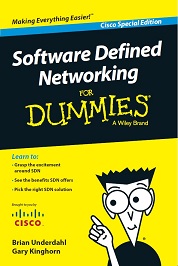
Last week we launched our new book, Software Defined Networking for Dummies, which I wrote the vast majority of and was responsible for producing. And the response to date has been far more enthusiastic than even I anticipated. The feedback from the Cisco field has been great, and there is strong demand for reprints across all regions and localization in a number of languages. [Printed copies can now be ordered from the Cisco Collateral Store at nominal cost here.]
Naturally, we’ve also gotten a number of questions, such as “Does this mean we think SDN is for Dummies?”, “Do we think our customers are Dummies?”, “Why did Cisco decide to leverage the Dummies brand for this topic?”, etc. In order to clear some of this up, the social media team asked me to write a bit of the backstory of the creation of the book, why we decided to do it, and why it’s proving to be such a popular asset.
It all started when I was looking to fill a large gap in Cisco product marketing, particularly around SDN and our Application Centric Infrastructure (ACI). SDN has certainly proven to be a revolutionary break from traditional networking architectures and is really changing the way organizations think about their IT processes and how they design data centers. With all this change, it’s been hard for a lot of people to get their heads around what this new technology trend is really all about. When Cisco introduced ACI as a very sophisticated and comprehensive SDN solution, there’s no doubt it took people a lot of time to understand ACI, how it was similar to SDN, and where it was introducing new innovative concepts. Continue reading “How and Why We Created “Software Defined Networking for Dummies””
It was a wonderful honor to be named to Silicon Valley Business Journal 100 Women of Influence just over a week ago; one that will help greatly with accelerating my initiatives for cloud safety—not just for business, but also for us all.
And for the honor, I owe much thanks to many incredible mentors who have believed in me and for the immense opportunities they have provided me.
This story was originally posted on Cisco Employee Connection, Cisco’s internal employee news site.
We are about to show more than 3,000 girls and young women around the world that they can be the next generation of scientists, mathematicians, engineers and technologists—the dreamers and doers who will invent the future.
In April and May, in more than 80 Cisco offices in more than 50 countries, female students from local schools, Cisco Networking Academy classes, and non-profit organizations will spend a day with us, learning about technology.
It’s all part of this year’s Girls Power Tech event, when we open our doors to girls ages 13 to 18 for a day of site tours, presentations and mentoring. The girls will learn about the Internet of Everything and talk with us about careers in technology. They will imagine themselves in technical jobs—and experience the kind of technology they can help invent.
The activities are in celebration of International Girls in ICT Day, held on April 23. We are a top corporate supporter of this global effort to empower and encourage girls and young women to pursue careers in information and communications (ICT) technology.
Cisco’s recent survey of 7200 banking customers in 12 countries left me with a crystal-clear takeaway: consumers are ready for the Internet of Everything (IoE) — and they want it now.
But to meet that demand, banks need to assess their own capabilities as they begin to light up their own “dark assets” with network connectivity and embark on the journey to IoE readiness.
In our survey, we tested five key IoE-enabled banking concepts related to advice (virtual financial advice, virtual mortgage advice, and automated financial advice) and mobility (branch recognition and mobile payments). These concepts resonated with customers globally: 75 percent of all respondents would move their money to another provider for one or more of the five concepts. And while the interest is significant everywhere, in emerging markets, respondents are twice as likely to move their money. Continue reading “How Banks Can Begin the Journey to IoE Readiness”
Tailored Data Center Integration for SAP HANA enables the use of enterprise storage and networking components that already exist in your data center rather than requiring customers to purchase additional storage and networking to be used only for the SAP HANA environment.
Cisco and its partners deliver a TDI deployment model using a common architectural approach, built on standard building blocks with the Cisco Unified Computing SystemTM (Cisco UCS®) as the base. This approach gives application datacenter managers flexibility of choice in the way that they implement SAP HANA. Cisco supports the SAP HANA TDI deployment with shared storage and shared networking today.
SAP HANA TDI provides the first evolutionary step away from the constraints of a very controlled standalone appliance model toward a model in which application datacenters can be configured using existing SAP certified enterprise storage and enterprise networking. When you use the SAP HANA TDI model, existing network and storage can be used only if sufficient resources are available and if all components used are SAP certified. Here, “sufficient resources” means that sufficient storage capacity and I/O bandwidth are available on both the storage system and the storage network to meet the SAP HANA application needs in your environment.
What does this mean for you? You will gain the following benefits. You can:
Use your existing storage and network investment in people, process, and equipment
Get the best use of your investment in current datacenter switching architecture
Create a more flexible deployment in which server, network, and storage resources can be moved between different SAP HANA and SAP business solutions applications, and even non-SAP applications mitigate risk and optimize operations and resources by using existing data center management processes for SAP HANA implementations
Gain flexibility in hardware vendor selection and SAP HANA configuration
In my role leading the development of Cisco’s IoT Systems and Software, I spend a fair amount of time speaking at industry events and talking with customers and partners. There is a lot of excitement about the Internet of Everything (IoE) – the intelligent connection of people, processes, data and things to the Internet – as it continues to take hold, bringing unprecedented economic opportunities to both the private and public sectors.
To address today’s evolving threat landscape, there’s been a shift from traditional event-driven security to intelligence-led security. Threat intelligence plays an integral role in this shift.
When you hear the term “Threat Intelligence,” it’s easy to have preconceived notions of what it means. Gartner defines threat intelligence as “evidence-based knowledge, including context, mechanisms, indicators, implications and actionable advice, about an existing or emerging menace or hazard to assets that can be used to inform decisions regarding the subject’s response to that menace or hazard.” I like that Gartner’s definition does not include intent. Why? Intent implies that the “menace” is trying to target you, but we know that too often this isn’t the case. Pretty much any piece of malware out there will damage unintended targets. One example is Stuxnet. It targeted Iranian nuclear enrichment facilities. Unfortunately it escaped the purported air-gapped system and has been seen in at least 10 other countries. In more practical terms threat intelligence must be:
In 2013, Roland Holloway learned he was cancer-free. For 9 years, Roland, a Cisco employee, had battled neck cancer, but a surprising recovery inspired him to give back to his community. With the help of Cisco’s Employee Purchase Donation Program (EPDP), Roland is empowering a local nonprofit with new technologies and helping others in need.
Roland, who will celebrate his 20th anniversary at Cisco later this year, is taking advantage of his newfound health to create change in his own neighborhood. “I’ve had a lot of good fortune come my way,” he said. “I enjoy giving back; I can’t change world politics, but I can definitely help my local community.”
After recovering from neck cancer, Roland enjoys spending time with his family and grandchildren
He started by visiting his childhood friend, Johnny Taylor, who founded a veterans’ outreach nonprofit called Promised Land Foundation. Doctors diagnosed Taylor with polio as a child, forcing him to use an electric scooter for transportation and making his goal of serving other veterans difficult. Roland saw his friend struggling, and helped Taylor purchase a wheelchair-accessible van in 2013. “I wanted to help him fulfill his aspirations to help veterans,” Roland said. “I saw him struggling to get around, and he’s using the van to make veterans’ lives easier.”
However, Roland didn’t stop giving back. In 2014, he learned about Cisco’s EPDP through a colleague who had used the program to donate equipment to his daughter’s school. Roland realized that as a Cisco employee, he could purchase equipment at a 75% discount for donation to qualified nonprofits and schools in the United States.