I remember walking through Cisco Live last year in San Francisco and hearing all about ACI and the Cisco DevNet program. To be totally honest, I shrugged it off as just something that was trying to get hyped up and would not have any real impact on what I do.
Well…that has changed over the last year for me. What made it change? I guess a desire to learn and grow. I have also seen how learning to code is becoming very important to any IT position. There is a lot of power in the software layer and learning to harness that power is very important to be able to accomplish our jobs. So, with that in mind I have started to learn Python. Why python? I come from a scripting language background with my years as a Windows admin. I never jumped in with both feet, but I did enough to be dangerous. And learning to write code has always really interested me, I just didn’t have a good reason to do it. Now, with ACI and SDN showing promise and no longer buzz words to me I am going to dive in and learn. Continue reading “Where to learn ACI”
Data Monetization – the art of applying Data to drive business value, sometimes pivots on fairly simple steps with profound consequences. One such step in the world of Digital is when one progresses from mastering the metrics of “How many” visitors to understanding the “Who” are these visitors?
In reality, the notion of “Who” is understood to a very limited degree by Digital property owners, unless the visitor willingly parts way with some of that information. B2B property owners have an even more difficult time giving sufficient reasons for visitors to share that information – unless the visitors are already customers, in which case software download and support become top reasons to part with some limited information to gain access to those forums.
Here is a good discussion on Website Visitor Demographics and its value to Digital Property Owners:
Given the difficulties in getting information about visitors for a B2B business, it is necessary to supplement this knowledge about the digital visitor through myriad techniques. To understand these, it is useful to classify visitors into a few categories:
1. Registered Visitors – the set of visitors who have registered on the site, and typically tend to fall in the Current Customer or Partner category. There may be others including Analysts, Students, Employees and a few more. This is a useful group because while on the one hand we know the most about them, they can also act as a “training” set from which other visitors’ behaviors may be inferred.
2. “Consumed an Offer” Visitor – the cohort that may have registered for a webinar, or downloaded a whitepaper, and in the process, shared something about themselves. The information they shared may be less than the Registered Visitor group, but it is valuable data. A large number of Prospects may fall in this category – making them doubly interesting.
3. “Discovered” Visitor – There are many services available in the business world including from DemandBase, Profound and more who may not be able to tell details about a visitor, but could provide information about the company the visitor belongs to. There are others who can even provide demographic details about visitors. These are significant services as it begins to tell which groups the otherwise anonymous visitors belong to.
4. The still completely Anonymous Visitor – these are those about whom we have no information whatsoever either directly or indirectly.
However, even the completely anonymous visitor is not truly anonymous as they leave their digital fingerprints behind for the data analyst to review, and you could:
Data is not just multiplying at an astounding rate. It is also changing dramatically in nature. Trends like the Internet of Things, Mobility, Cloud, and Big Data Analytics are driving the adoption of different types of storage protocols and architectural requirements as well as increased application workloads in the IT environments.
To help customers design efficient IT operations that can adapt over time to changing business needs, Cisco is announcing new additions and innovations to the Cisco MDS and Nexus Multi-Protocol storage networking portfolio. The latest Cisco innovations include:
We are happy to see that our Partners are also equally excited and looking forward to the arrival of the new Cisco MDS high density Fabric Switch. Cisco’s MDS product line is supported and sold by authorized original storage manufacturers (OSM). Special thanks to all our partners for their support and participation to make the launch successful.
Doug Fierro, Senior Director, Connectrix, EMC Corporation in his blog post ‘ Fibre Channel Customers Get Another 16Gb Boost’ discusses about our customers need for simple, easy to configure, automated FC systems and how Cisco MDS 9396S addresses these requirements. Krister Eriksson, Senior Product Manager, NetApp in his blog ‘Cisco Continues to Focus on its Fibre Channel’, addresses the importance of keeping the Fibre Channel roadmap fresh and invest in new platforms, while Derek Nguyen, Strategic OEM Accounts Manager, Qlogic, in his blog ‘ QLogic FlexSuite Supports Cisco’s Latest MDS 9396S SAN Switch to Meet Growing Demand ‘ analyzes how Cisco is enhancing its market leading MDS portfolio to provide high performance, versatile and affordable solutions for SMBs and Enterprise customers.
New Cisco MDS 9396S Multilayer Fabric Switch: The new versatile and affordable 96 port 16G FC switch delivers industry leading density with enterprise class capabilities and is an extension to the already successful MDS 9148S Fabric Switch.
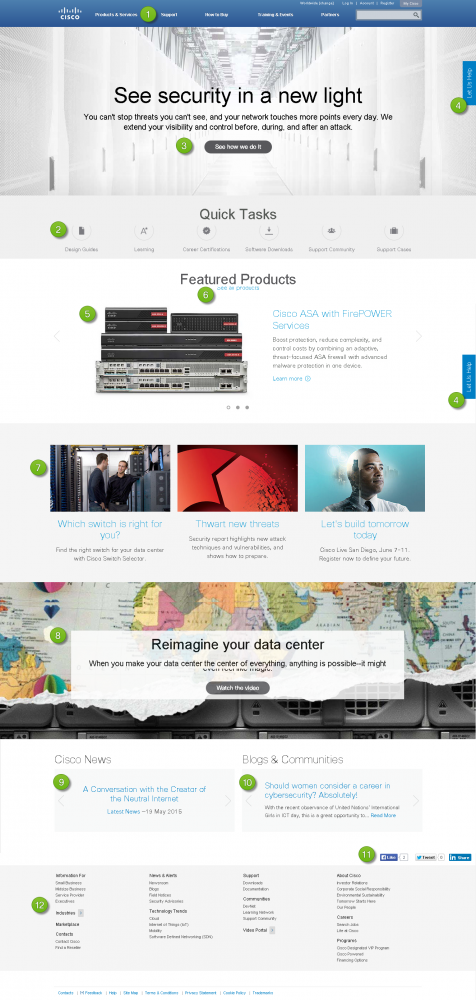
We’ve updated the design of the Cisco.com home page. Not just because we wanted to, but for you. Here’s a point by point overview, starting with the desktop/laptop version:
Same top of page navigation. We’ve keep the same top of page categories, and “mega menu” navigation, as these work very well today. (Yes, we’ll continue to tune these every so often as we have been.)
Quick Tasks. This new element is based on your feedback about your most important regular tasks on journeys on Cisco.com. Since these items are most important to you, we figured we’d put them front and center for easy access. Expect these tasks to evolve over time as we learn more about how people are using them. And, in the future we’ll have different top task lists for Partners, employees and other roles.
The “marquee.” This graphic at the top of the page is a staple of corporate home pages, and we actually toyed with several designs that eliminated it. But in the end, in our testing and reviews, we found that it actually serves a pretty strong purpose to orient visitors and cue them to big announcements or happenings. One innovation: We are personalizing this area, so that over time you may see something different than your neighbor (and more relevant to you).
Let Us Help. We’ve added a linkage to chat online or call so you can get information about our products, services and solutions right from the home page. This follows scrolling down the home page, in a way that we hope is unobtrusive.
Product showcase. Visitors to our site love products, so we’ve opened up a space to showcase featured products. Here, we have used a “carousel” approach because products have enough of a draw to get active engagement (notice that we dropped the carousel we used to have above on the marquee. But here, we think it adds breadth.)
Products link. There’s a prominent link to a newly designed “All Products” page.
“Offers.” Folks in marketing call these “offers” but you can think of them as showcased items that may be of interest specifically to you. We personalize the list based on what you’ve expressed interest in previously.
Watch this space. This is a space for more information that we’ll be experimenting with over time.
News. The new news feed is easier to read, and shows news and announcements from Cisco.
Blogs and Communities. Some of the most interesting information from Cisco is on our blogs, and the content all of you contribute in our communities. This new component gives us a place to showcase these fresh topics right on the home page.
Social sharing. Those social sharing widgets you’ve come to expect on home pages. (This would be a great time to share the new home page if you like it, by the way. 🙂 )
The “fat footer.” We’ve made no changes to the fat footer on the page, which has been very effective and helpful and gets 4-6% of the click-throughs on our pages. One question we had was whether visitors would click through, with the longer page. Based on our early usability testing, the answer seems to be yes, and people seem quite engaged in scrolling when they are drilling down to the information they’re looking for. We’ll be watching the metrics on this area carefully to make sure it’s still “discoverable” and well used.
The Smart Phone View
For the mobile view of the home page, the it’s the same information, but rendered slightly differently:
Same header and menu. We’ve retained the same header and “hamburger menu” as before, as it’s been working well
Let Us Help. The same linkage to chat online or call, but in a more compact form for mobile.
Quick tasks, in a more compact form. Interestingly, this text only version tested very well for phones, but got lost on the page for the desktop view, so we used icons on the desktop and text for phones.
Featured Products, in a more compact, swipable form for mobile devices.
News feed in a compact form.
Blogs & Communities in a more compact form.
Thanks!
Thanks to all of you who participated in the multiple rounds of testing and have also given use feedback in the last many months – if not years – on your needs for Cisco.com.
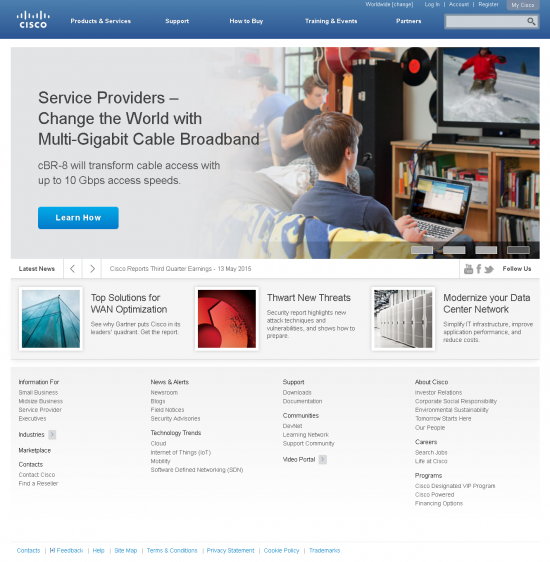
P.S. If the last version of the home page is a distant memory, here’s a picture of it:
You’ve had your “Aha moment.” You get the OpenStack value proposition. You’ve listened to other customers talk about their success with it. You can see the problems it’s going to solve for your organization. You are all in.
But it’s not enough. Just know that. Even if you’re the decider-in-chief, and you can make the call to start an OpenStack initiative at your company tomorrow, you’ve got another, bigger job on your hands, and that’s changing your company culture.
So say the panelists that were speaking at a Cisco-sponsored session yesterday about their experiences with OpenStack. They agreed unanimously that the technology is not the challenge when deploying an OpenStack-based private cloud. It’s changing the company culture. Giving developers more freedom and trusting them to do great things (which a proper cloud will in fact enable them to do), vs. controlling them tightly in a traditional IT environment. It’s embracing the “Fail fast, fail small, fail often,” model that allows for quick learning and innovation.
One panelist said, “The technology is there. It works. It’s easy to use. But changing how people use it is the hard part.” Another pointed out that it’s even harder if you’re in an established (non-startup) company with yearly CapEx cycles and capacity planning. “It’s difficult to get groups to buy in on an OpEx model and move away from their established processes,” he said, with a look that suggested he’s been down that road. A third mentioned “dragging them kicking and screaming” as part of his strategy to get his company there.
Controlling the wireless network can some times feel like trying to stop a river. Employees, customers and vendors have their favored mobile devices and they want to be able to use them for work and play. The momentum for this trend is strong and the promise of productivity high so it’s becoming increasingly difficult to fight this trend. As a result, companies are opening their network to guest traffic.
As you well know, this new openness isn’t without risk. The devices that people bring may not always be productive. And sometimes those devices become rogues that can impact network performance and security.
Let’s be clear that not all rogue devices have evil in mind. In fact, many employees innocently bring their own IP cameras and personal hotspots to “help expand” the capabilities of the network. At a minimum, these rogue devices can cause interference that degrades overall network performance or prohibits critical devices from connecting to the network.
The greater danger is that these rogue devices are the weak link that enables a hacker to breach network security. A hacker can tag onto a tethered personal hot spot for easy entry into the network or can sit outside the venue to gain access.
Whatever the intent of the rogue device, it’s critical that you have a solution that leverages location information to identify and mitigate these rogue devices before they compromise your network.
Talos is always fascinated by the endless creativity of those who send spam. Miscreants who automate sending spam using botnets are of particular interest. Talos has been tracking a spam botnet that over the past several months that has been spamming weight loss products, male erectile dysfunction medication, and dating/casual sex websites. These are all typical products one would expect to be purveyed through spam. What interests us about this spam are some of the ways the spam is constructed to try and evade detection (a.k.a. spam filters).
Beginning in March, Talos noted an absolute explosion in the usage of link shortening services in spam. After looking into the cause we found botnet ‘unknown2250’, as it is called by the Composite Block List (CBL), to be one of the primary parties responsible for this massive increase.
#CiscoChampion Radio is a podcast series by Cisco Champions as technologists. Today we’ll be talking about Cisco Learning Network (CLN) Updates with Cisco Learning Network Community Managers Matt Saunders and Brett Lovins.
Learn about the Cisco Champions Program HERE.
See a list of all #CiscoChampion Radio podcasts HERE. Ask about the next round of Cisco Champions nominations. EMAIL US.
Cisco SME Matt Saunders, @citylifematt, Cisco Learning Network Community Manager
Brett Lovins, @brettlovins, Cisco Learning Network Community Manager
Cisco Champion Guest Hosts Ryan Adzima, @radzima, Infrastructure Engineer, Mobility Architect
Ryan Booth, @that1guy_15, Network Engineer
Transcripts Cisco Champion Radio New design looks cool – https://learningnetwork.cisco.com/welcome MattSaunders https://learningnetwork.cisco.com/community/learning_center/ccie-rs-tech-seminars MattSaunders https://learningnetwork.cisco.com/blogs/unleashing-ccie-rs childebrandt42 I personally have found the site extremely helpful in doing the CCNA-DC @ChrisKnowsIT Any comments\concerns regarding the 3rd party training materials, specifically CBT\videos, done by vendors (ex- INE, CBT Nuggets, etc)? BrettLovins CCIE Lab Builder: https://learningnetworkstore.cisco.com/cisco-ccie-lab-builder BrettLovins https://learningnetworkstore.cisco.com/ccie-routing-and-switching-v5-0 childebrandt42 I have had seen some good videos from CBT and Pluralsight. ntwrk80 Any emphasis on the roads less traveled in terms of learning support for CCDP ARCH, CCNP Wireless, etc in terms of learning tools? BrettLovins CLN Premium info link: https://learningnetwork.cisco.com/community/premium-subscriptions @ChrisKnowsIT Thanks for the insight Ryan that1guy15 NP BrettLovins https://learningnetwork.cisco.com/community/learning_center/ccna_rs_study_sessions_live MattSaunders https://learningnetwork.cisco.com/community/learning_center/it_training_videos cpartsenidis Regarding contributing to the community with content, is any content submitted automatically becomes copyright property of Cisco ? cpartsenidis I had this issue with my website Firewall.cx, which was a bit of a problem 🙂 BrettLovins Acceptable Use Agreement for CLN: https://learningnetwork.cisco.com/docs/DOC-23937 cpartsenidis Thanks Brett. MattSaunders Cisco does not claim any ownership rights in any text, files, images, photos, video, sounds, works of authorship or other materials that Users upload… cpartsenidis Yes, I just read that part Matt – sounds like things have become more flexible MattSaunders 🙂 cpartsenidis Thanks guys for your time and useful information – MattSaunders You’re welcome, thank you! 🙂
Lots of excitement and energy continue to surround NFV (Network Function Virtualization), and it is getting even better. During the charged atmosphere at the inaugural NFV Congress in San Jose, we were delighted by more than just technology posturing, including the availability of SDN (Software Defined Networking)/NFV platforms like Cisco’s Virtual Managed Services Solution that enable Deutsches Telekom’s International CloudVPN, and Telstra’s Symphony initiative for Unified On-Demand services.