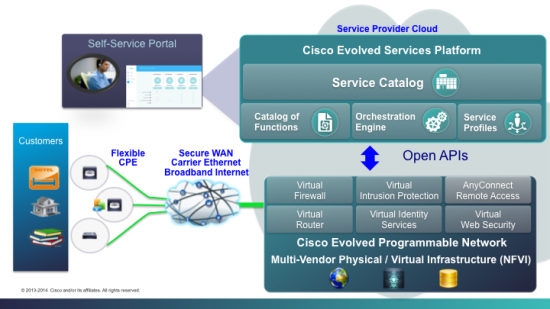
Lots of excitement and energy continue to surround NFV (Network Function Virtualization), and it is getting even better. During the charged atmosphere at the inaugural NFV Congress in San Jose, we were delighted by more than just technology posturing, including the availability of SDN (Software Defined Networking)/NFV platforms like Cisco’s Virtual Managed Services Solution that enable Deutsches Telekom’s International CloudVPN, and Telstra’s Symphony initiative for Unified On-Demand services.
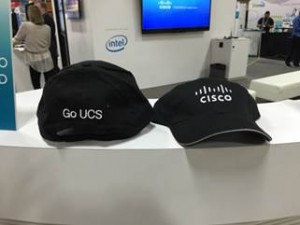
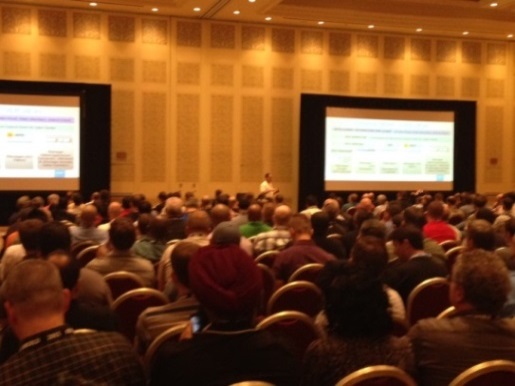
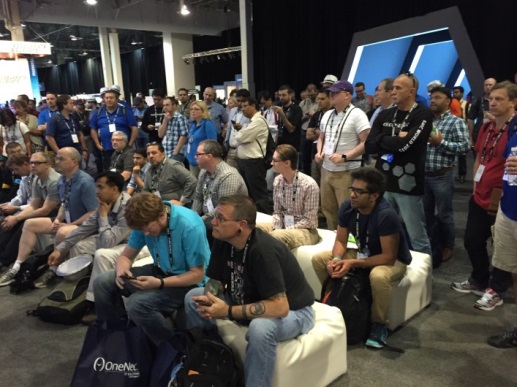
At EMC World 2015, we handed out these “Cisco Go UCS” hats to attendees that stopped by the Cisco booth. I love to hear the stories of customers that are using our Cisco UCS integrated infrastructure based solutions to accelerate deployment of IT infrastructure and implement our latest innovations. This year our presence at EMC World focused on Cisco UCS Integrated Infrastructure, Application Centric Infrastructure, and SAN solutions. We had numerous presentations, demos, and break out session on these areas. We were very excited that our booth, mini-theater and breakout sessions were packed with attendees.
In addition, attendees also experienced our demos and had one-one-one conversations with Cisco experts. The Cisco UCS Manager and UCS Director demos were popular. Many customers were interested in learning more about the infrastructure management and automation capabilities of UCS Director. This management conversation has evolved in the past couple of years from “What is UCS Director” to requests for demos, questions on capabilities, and licensing model. The UCS Director snowball is rolling and the hill is getting steeper. Continue reading “Cisco UCS Integrated Infrastructure at EMC World 2015”
When the “Gigabit City Challenge” was issued in 2013, civic leaders and broadband provider across the country began to rethink how faster broadband speeds could move beyond satisfying consumer demand for streaming and web surfing to fuel economic growth, drive innovative development and develop gigabit communities where innovation labs would drive new business and new industry growth.
In network engineering I have learned that the biggest lie I tell myself is that “I do not need to write this down.” That being said, when you are in the heat of troubleshooting a production issue I really try to design my systems so that I can tell what the heck something does by a label or good name. This does not replace the need for other documentation, but it does help when you are in the heat of troubleshooting a system problem. As I started supporting Unified Communications applications, I discovered there are lots of opportunities to really create a mess when you are configuring things if you do not keep supportability in mind. I want to share with you some tips that I have found helpful in naming objects specifically in Cisco Unified Communications Manager; however, similar concepts can be used for other network components such as Access Control Lists on traditional network equipment too.
When you are starting with a fresh Cisco Unified Communications Manager install, you have a blank slate. This is both good and bad. Good in that you have a lot of flexibility in the system to configure things, but bad because if you don’t put some thought into naming it can get confusing quickly. Spending some time up-front will save you some headaches down the road. Even if you don’t have a fresh Cisco Unified Communications Manager installation, you can start cleaning things up as you provision new services and go back and adapt what is in the other systems when you have time to do so.
Some of the common things you will configure in Cisco Unified Communications Manager will be: Partitions, Calling Search Spaces, Route Groups, Route Lists, Route Patterns, SIP Trunks, Device Pools, etc. First let’s get started with some basic definitions of what some of common objects are. I will also share some examples of how I like to name things to keep them easily sorted so objects of similar function are grouped together in a long list. These are just examples, and your naming convention will have to be something that works for you, your team and your specific environment. Continue reading “Importance of naming standards in Cisco Unified Communications Manager”
Cisco Systems is announcing a new set of features that enhance its HDX (High Density Experience) suite. This blog is the third in a series that explains the new features that comprise the enhancements to HDX.
The first blog in the Enhancing HDX series is here. The second blog in the Enhancing HDX series is here.
What is 802.11v? What is BSS Transition Management? Why are these Important?
In this blog, two different series are intersecting: Enhancing HDX and the series looking at the lesser known but undeservedly underappreciated amendments to 802.11 and the features/benefits they provide.
This blog will briefly explain the basics of 802.11v “Wireless Network Management” and will also explain how 802.11k Neighbor Request/Report and 802.11r “Fast BSS Transition” can provide a “better together” solution with 802.11v. It also explains where it fits in with High Density Experience (HDX).
Wireless Network Management (802.11v)
Wireless network management (WNM) enables devices comprising the WLAN to exchange information with the goal of improving the quality of experience when using the WLAN. Network administrators benefit from using WNM by having additional ability to fine tune the WLAN in order to provide improved reliability of services to their end users and the end users benefit in turn from using a WLAN that has been designed to provide more than mere connectivity.
Client devices and infrastructure may both use WNM to exchange operational information so that both clients and infrastructure have additional awareness of the WLAN conditions. That awareness can help provide a firm foundation for self-correcting events and actions to be implemented. In other words, WNM isn’t about being a “control freak”; it’s about raising the bar in the Wi-Fi ecosystem so as to create better Wi-Fi networks.
But not only does WNM provide information on the state of network conditions, it also provides a means to exchange location information, supports efficient delivery of multicast (group addressed) frames, and enables a power savings mode in which a client can sleep for longer periods of time without receiving frames or being disassociated from the AP.
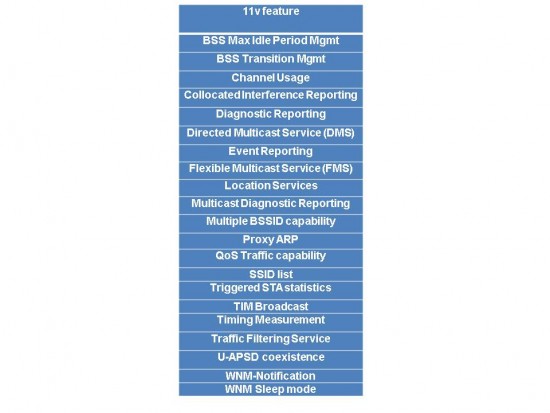
Given this, it can be easily appreciated why WNM has often been described as a “kitchen sink” of features. This blog won’t take the time to go through each and every feature introduced in the 802.11v amendment. But in order to emphasize the potential richness of the feature set, the following is an alphabetized list:
The remainder of this blog is going to focus on BSS Transition Management. Future blogs will cover other aspects of 802.11v.
By 2020, the number of connected devices is expected to grow exponentially to 50 billion. The world of interconnected objects will have it’s data collected, analyzed and used to initiate action, which will provide a wealth of intelligence for planning, management, policy and decision-making.
Defcore is Totally Vanilla and it’s about to get REAL
Defcore is indeed Vanilla OpenStack. That is what panel participants conceded when asked about it in the Defcore session I attended yesterday. They don’t necessarily love the characterization (apparently they’re asked it on a regular basis), but bottom line: that’s what it is. It’s a spec to start out with to build your own implementation of OpenStack. “Add all the great things you want on top of it,” one of the panelists enthused. Another opined, “It’s the spoon that makes sure you can eat your OpenStack ice cream. We are the minimal needed to have a working, interoperable stack.”
Also important to know about Defcore: They’ve spent a lot of time coming to agreement about principles and process, and the next six months will be about beginning to implement those things. Which is to say, “We’re going to have to tell a lot of people ‘No,’” in the words of one of the panelists. “That’s what’s going to start happening.” The panelists reminded audience members that they need their participation to make fair decisions and that this is a community, so it’s time to influence the process if this issue is important to you.
This post was written by Jordi Botifoll, President, Cisco Latin America, and originally published by the World Economic Forum
Latin America faces major challenges in terms of development and competitiveness, but at the same time has a great opportunity to rethink its future and take huge steps forward. The next phase of the Internet, the Internet of Everything (IoE) – a comprehensive ‘nervous system’ of networks that connect people, processes, data and things – offers incommensurate possibilities to transform the region, with important implications for its development, employment and competitiveness.
The Internet of Everything makes networked connections more relevant and valuable than ever before – turning information into actions that create new capabilities, richer experiences, and unprecedented economic opportunity for businesses, individuals, and countries.
Cisco Networking Academy students in Brazil build IT skills and the foundation for a lifelong career. More than 900,000 students have taken Networking Academy courses in 33 Latin American countries since 1997.
We’re accelerating the speed at which we generate, test, and bring ideas to market. New digital work styles with social platforms, mobility, cloud, and video conferencing allow us to move faster.
To stay competitive and agile, companies are knocking down boardroom walls — physically and virtually. They’re turning toward a digital workspace where employees can collaborate across the table or around the globe. No matter the size of your organization, you have many options as you build a digital workplace strategy.
Business Value of a Smart Workspace
Stakes are high both in local and globally competitive markets. To keep pace with demand, you need to meet your performance and production objectives. As you think about budget allocation for real estate, consider workplace transformation as a good place to start. It’s about choosing the right infrastructure and securing your digital space. And mobility is always a key factor.




 In addition, attendees also experienced our demos and had one-one-one conversations with Cisco experts. The








 Jordi Botifoll, President, Cisco Latin America, and originally published by the