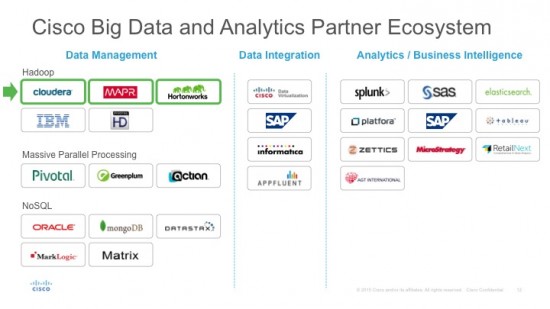
Big data and analytics are not just buzzwords—they have become business imperatives. There are examples in just about every industry and vertical where organizations extracting valuable insight from their data and innovating faster, enhancing customer experiences, and becoming more relevant in the market. Organizations that don’t have a data strategy are starting to fall behind – fast.
To help you develop an impactful big data strategy we are doing a series of 3Big Data Virtual Conferences. These complimentary events give you a chance to get the insider perspective on how to capitalize on the data your organization is already gathering, without even leaving your desk.
The first event, coming up on June 17, focuses on data warehouse optimization. Parts two and three, focused on operational analytics and business analytics respectively, will follow on September 9 and October 7.
Why you should attend
These events will provide you with the opportunity to virtually interact directly with subject matter experts and engage with our big data solution partners by attending their sessions. Each session will feature interactive chats so you can get answers to tough questions, discuss challenges, and gain valuable insights that can help shape your big data strategy.
You’ll get a chance to hang out in the various booths located in the expo hall and download valuable assets to read through at your leisure, as well as join in some fun games.
The first conference in the series – focused on data warehouse optimization – will cover the following topics:
Boosting data warehousing cost-efficiency with Hadoop solutions and virtualization
Effectively managing your infrastructure amongst the constant influx of data
Increasing security through data warehousing best practices
Optimizing your data warehousing to easily create actionable analytics
The best part is that you won’t need to leave your desk, battle traffic and find a parking spot only to realize that you parked 15 minutes away from the venue and there is not a coffee shop in sight for that much needed caffeine boost.
On January 28, 2008, Cisco made headlines with the introduction of the market’s first Fibre Channel over Ethernet (FCoE) Switch, the Nexus 5000. Cisco also reached out to ecosystem partners and demonstrated FCoE capabilities with them at various industry conferences. When we introduced FCoE, we knew that it would revolutionize and transform the LAN/SAN connectivity landscape and lay the foundation for end-to end-convergence in the data center. A unified data center was possible for the first time. Flash forward seven years, and FCoE is now thriving, growing and is supported throughout the data center portfolio.
On May 21st 2015, Cisco introduced 40G FCoE support on Nexus 7000 / Nexus 7700. We continue to innovate and invest in FCoE and Storage Networking in general. Attend this Webinar on June 23rd to learn more.
FCoE Evolution. FCoE roadmap to success
For a while, Nexus 5K was the only platform that could support FCoE, and some of our progressive customers (like Coca Cola Bottling Company), who deployed FCoE with Nexus 5K, in the access layer immediately reaped the benefits of convergence (See below for FCoE customer references). Our customer feedback was that FCoE benefits were extremely tangible, but they wanted even more. Could Cisco extend FCoE beyond access layer? Could Cisco extend it to the core and to the storage array?
In order to support these requirements, in 2010 Cisco introduced new FCoE innovations, including multi-hop FCoE. Multi-hop FCoE enabled customers to deploy end to end FCoE and expand beyond access layer. Customers such as ITOCHU Techno-Solutions Corporation, Boeing Case StudyAdventist Health Systems and others, were able to reap the benefits of multi-hop FCoE (see below for list of FCoE customers)
Cisco continued to innovate on FCoE and currently FCoE is supported across all the Nexus (2K, 5K and 7K), MDS and UCS platforms, with a future roadmap for the Nexus 9K. Fast forward to May 21st 2015, – Cisco announced the support of 40G FCoE across the Nexus 7000 and Nexus 7700 family, along with support for Spine and Leaf architecture. FCoE is growing, is in great demand and we are investing in it to support customer requirements.
The Commonwealth of Massachusetts turned to the Cisco Unified Computing System™ (UCS®), Nexus® Data Center Switches, and innovative technologies such as Fibre Channel over Ethernet (FCoE) to save money on power, cooling, cabling, and network infrastructure.
FCoE is being rapidly adopted in the storage area networking (SAN) category as well.! Proof is in the customer adoption rate, customer case studies and the awards we received(IT Brand Pulse Award ). Cisco is technology agnostic and we keep on investing and innovating in multi-protocol SAN. We believe Fibre Channel will continue to exist, and it is not about FC or FCoE: it is about providing customer choices for their specific infrastructure needs. Strong support of FCoE across all data center platforms is a long term strategy to provide the right solutions to all customers, whether you are a small medium business, large enterprise or cloud provider. Cisco provides all types of customers end to end server and storage connectivity, with a brand you can trust.
As with any type of computing, the quality of the output is directly related to the quality of the input. There are several factors that influence the precision of the location data. Here are several factors in order of importance that influence the quality of location:
AP Density—The number of installed access points in the venue are the biggest contributor to location data quality. It makes sense. More access points means more points of reference, fewer dead spots, and greater capacity to track devices. However, there is a point of diminishing returns after which additional APs are not helpful. If this is the case in your network, you can move these APs into monitor mode.
AP Placement—Closely following AP density, the placement of those access points has a huge impact on location data quality. Placement should start at the perimeter of the space then move inward. Placement should be as non-linear as possible yet avoid dead spots caused by elevator shafts, large open atriums, and wiring closets. During set up, it’s best to define these areas as exclusion zones as one can safely assume that no one will or should be moving through elevator shafts, wiring closets or the second floor of an open, three-story atrium.
It’s also important that access points be placed as close to their mapped location as possible. At a minimum, they should be placed on the correct floor. Ideally, they should be within three feet or less of their actual location and their correct heights and antenna orientation should be recorded in PI
RSSI Signal— The density and placement of the access points should enable the RSSI signal to be stronger than -75dbm by four APs throughout the entire venue.
Chirps and Probes—While the wireless network has the greatest influence on location accuracy, the signal intervals of RF tags and mobile devices also impacts accuracy. For the greatest accuracy, RF ID tags should be set to chirp on all three channels—1, 6, and 11—every 30 seconds.
Multi-floor deployment – In a venue with multiple floors, access points should be aligned along a common vertical axis. Third floor directly above the second floor access point, and so on.
Tracking mobile devices – Locating mobile devices is more challenging. Generally, device manufacturers set probe rates at intervals of 90 seconds or more to save battery life. Reducing the probe rate can profoundly reduce battery life. In addition, many mobile devices randomize their MAC address, making it nearly impossible to get a consistent location fix. The best way to ensure that mobile devices gets good consistent location is to have them associated with the network, sending traffic and utilizing Cisco Fastlocate capabilities of the network.
Zones—You can improve location data accuracy by defining zones within the venue. The general rule of thumb is to define a zone that is twice the size as your desired level of accuracy. Need accuracy to within ten meters? Then make the zone no larger than 20 meters by 20 meters. The zone size should also take into account the average probe rates of your typical clients and their associated user move rate.
Calibration—Location accuracy can be calibrated. While it is a time-consuming process, it can result in the highest degree of accuracy. Essentially, the calibration process involves placing a mobile device in a known location using its probe to validate the location.
I bought a used car this past weekend for my two teenagers to share, for school, work, getting around town, etc. It is a sensible car, four-wheel drive, high safety rating, decent gas mileage, few options and fewer distractions, a big difference from the ’72 TransAm I had as a teenager. Like the car I got for my children the TransAM was 10 years old when I bought it but that’s where the similarities ended.
The ’72 TransAm came in blue with white stripes or white with blue stripes. It was raw power, the new honeycomb grille airflow augmenting the rear facing hood scoop to feed the Rochester Quadrajet 4-bbl carburetor. Every month I scanned my Hot Rod magazine to see if there was some new speed or horsepower tip in one of the columns.
I miss that car; you could do so many things with it. Not only could you service it yourself, there were loads of aftermarket parts and services to take advantage of, I liked that I wasn’t locked into the manufacturer or even have to worry about a specific dealer, it was so easy. And it was my very first hybrid… when I added Nitrous! (I believe that counts as hybrid)
My first car, a 1972 TransAm
Cisco’s Intercloud Fabric (ICF) reminds me of my TransAm (I’m sure you were wondering how I was going to make the transition to Hybrid Cloud). How so? Well ICF is not locked into a specific cloud provider or their virtual machine format. In the enterprise, ICF can run on Hyper-V, KVM + OpenStack and VMware vSphere. The cloud provider can be running VMware, Hyper-V, OpenStack, CloudStack, ICF works with all those cloud management systems. Plus with the current release 2.2.1, ICF packs in a bunch of new capabilities.
There are so many attractions in Orlando that it would take the average traveler 67 full days to experience every one of them?
If you ate breakfast, lunch, and dinner at a different Orlando restaurant every meal, it would take you five years to eat at all 5,300+ of them?
We’ve packed our bags and we’re heading to Orlando next week. It’s not for the attractions or lunch buffets. It is for another exciting year at InfoComm. This year promises to be our best showcase yet and we hope you’ll stop by and visit us.
Our last but not least guest blog on “Why I Love Big Data Partner Series” is up! If you are on your way back home from Cisco Live, this would be a great read for your commute. Rob Rosen from Platfora will take us through how easy it is to uncover previously hidden threats with an integrated big data solution that dynamically analyzes large volumes of disparate security data from Cisco’s security portfolio. If you missed Cisco Live this year, Rob also did a great job summarizing some of the key highlights.
Rob Rosen, Sr. Director Partner Solutions at Platfora, is responsible for developing Big Data solutions within Platfora’s partner community including Cisco, Hadoop distribution providers and Platfora’s growing channel partner team. Rob has worked in leadership capacities with technology leaders in the infrastructure and Big Data space including MapR Technologies, NetApp, Check Point Software and Sun Microsystems.
Highlights from Cisco Live: Top Insights from Platfora
It was a jam-packed week at Cisco Live and I had the opportunity to dive into the latest developments around big data analytics and security. It’s well known that as IT infrastructure has transferred to virtual cloud-based applications and storage, organizations need visibility and security to keep their assets and data safe. I saw a lot of impressive presentations and I was able to share our own technology in partnership with Cisco.
Highlights from this week’s conference:
John Chambers’ keynote:Everyone’s talking about it—and for good reason. As he welcomed the crowd to Cisco Live, Chambers focused on exactly how businesses get disrupted in the digital age. He urged attendees and organizations to not hesitate to scrutinize their IT infrastructure and adopt the new technologies they’d see at the conference.
Collaboration across companies: There was a huge ecosystem of technology companies that partnered with Cisco for a presence at the event. It’s encouraging to see that these tech giants across all industries are collaborating with one another to develop more comprehensive solutions for customers. Cisco’s leading the pack as it models an inclusive approach built on partnerships—which is better for everyone in the long run.
Cisco Intercloud announcement: This is a particularly exciting partnership announcement for Platfora. Cisco’s Intercloud Ecosystem could be described as a hybrid “cloud of clouds.” For anyone looking to pull value from their stored data, manage files or do a huge variety of other vital business tasks, this development is huge.
Last week our featured guest was Carol Barrett, who not only works in data center planning at Intel, but is also a leader in the OpenStack Community. She’s deeply involved in the Product Working Group, the Enterprise Working Group, and the Women of OpenStack, which means she’s got a lot of insider knowledge about what is going on at this moment with OpenStack, and what’s going to be happening down the road. If you missed the live podcast, check out the recording to hear Carol’s thoughts on:
How being a woman is her competitive advantage in the tech world
How the OpenStack Product Working Group is speeding innovation
Who the “hidden influencers” are and why it’s important to get them out into the open
What the Enterprise Working Group is trying to achieve
Why enterprises are so tight-lipped about their use of OpenStack
Why Intel is so involved with OpenStack
https://www.youtube.com/watch?v=hxSTeyyaJDs
Have a show idea? Tweet Jeff and Niki at @openstackpod
See past episodes, subscribe, or view the upcoming schedule on the OSPod website.
To see the full transcript of this interview, click “Read more” below.
The House Judiciary Committee today approved patent reform legislation that helps create a level playing field for those seeking to encourage innovation. This is the second time in two weeks that a key Congressional committee voted in favor of reform. It is a clear demonstration of the bipartisan, bicameral support for reform.
Like any legislation, this bill is not perfect, but it takes a meaningful step toward reform which we support.
The committee approved a strong fee-shifting provision, and beat back efforts to weaken the measure; it includes discovery language that will help stop fishing expeditions; it provides protections against those who would use demand letters to extort cash settlements from small businesses; and it protects small inventors and universities. We’re concerned that the committee weakened the heightened pleading language, and will work to see that it is restored as the bill moves through the legislative process.
Let me thank Chairman Bob Goodlatte, Silicon Valley Congresswoman Zoe Lofgren, and Congressman Darrell Issa, whose efforts on venue reform were of critical importance, and indeed all 24 members of the committee who voted for the bill, for their tremendous leadership in supporting reform.