Avatar

25,000+ IT geeks have left the building – the San Diego Convention Center, specifically – now that Cisco Live U.S. wrapped last Friday. It was a huge success and we have the data to prove it, thanks to Connected Mobile Experiences (CMX). Some interesting and fun stats:

  • You love beer. Happy Hour was, unsurprisingly, very popular, responsible for big spikes in attendance at the World of Solutions (WoS) at the end of each day.
  • You like free swag (…and demos). Attendees, booth staffers aside, spent 2.5 hours on average in the WoS, and 1 hour 16 minutes on average at the Cisco booths in WoS. If you picked up lightsabers at the Cisco Mobility and Enterprise Networks booths, hopefully airport TSA didn’t confiscate them from you!
  • You bid adieu to John Chambers. The crowds came to see his final Cisco Live keynote as our CEO, illustrated by a massive spike with over 5,000 unique devices.
  • You use more than one mobile device. There were 29,000+ unique visitors (devices) at CLUS, not including staffers, and specifically The Hub saw the most action.

jolenewrapup1 update jpeg small

For many more Cisco Live insights by my colleague Evyatar Ram, Product Manager on the CMX team, check out his blog here.

Cisco Mobility wasn’t just gathering analytics in the background at Cisco Live, it was also front and center at the Innovation Talk: Future of the Network. Rob Soderbery, Cisco SVP of Enterprise Products & Solutions, shared how our Mobility solutions create new ways of digitizing business with applications in mind, beyond the wireless network. He showed a live demo of CMX location innovations such as hyperlocation – a Best of Interop Las Vegas and Tokyo winner — and live analytics. In addition, he demonstrated how easy it is for customers to deliver captured portals with pre-set templates that are easy to update and integrate in other data sources such as CRM, powered by Enterprise Mobility Services Platform (EMSP). The talk wrapped with a raffle drawing of two Apple iWatches. Were you one of the lucky winners?

As I left Cisco Live after the show wrapped up, Elvis walked by, sporting a spangly jumpsuit and slinging his guitar. Really, I can’t make this stuff up. I suppose that’s a sparkly reminder that I’ll be seeing him, and you, in Vegas for Cisco Live U.S. next year.

Authors

Jolene Tam

Product Marketing Manager

Security

Avatar

We are now more than one year on from the release of HeartBleed, the first major vulnerability disclosed in widely used third-party code. This is an excellent point in time to look back at what Cisco and our customers have achieved since, including how the Cisco Product Security Incident Response Team (PSIRT) has evolved to meet this new type of threat. It’s also a key time for us to confirm and clarify our commitment to transparency in the vulnerability disclosure process.

Continue reading “Responding to Third Party Vulnerabilities”

Authors

Morgan Stonebraker

Manager, PSIRT Core Team

Cisco Security Research & Operations

Avatar

We recently concluded another successful Cisco Live! event in San Diego which showcased some of the most innovative and exciting technologies in our industry. One of the most exciting solutions present at Cisco Live was in fact running in the background the whole time. CMX Analytics leverages the WLAN network to analyze how people move around the venue, where they spend their time, and when they visited different parts.

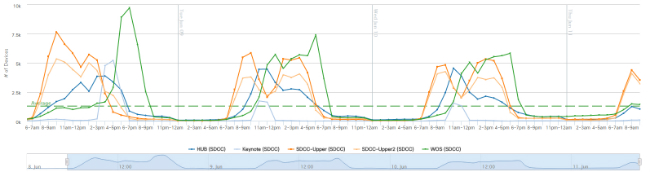
So what can we tell about Cisco Live from looking at CMX Analytics? First of all we can see how people moved around the venue throughout the week. Here we are seeing three days of data showing us where people were throughout the day.

Evyatar1

We can notice several things:

  1. People like happy hour – If you look at the data for WoS (World of Solutions – the green line) we can see that there is a spike in attendance at the end of every day – this corresponds to Happy Hour when visitors could get a beer to cap off a long day at the show. You can clearly see that at the end of the day, most of the visitors congregate in the World of Solutions.
  2. The Hub was a huge success – Within the venue there was a zone called the Hub which was where visitors could meet with Cisco engineers for more casual technical discussions. The Hub is represented by the blue line and what is immediately visible is that people came to the hub after the morning sessions around lunch time. In both the Tuesday data as well as the Wednesday data it’s clear that the Hub traffic peaks at the same time the Upper Floor attendance ebbs.
  3. John Chambers keynote was very popular – the Keynote area (the light blue line) shows a massive spike during the keynote peaking at more than 5000 unique devices

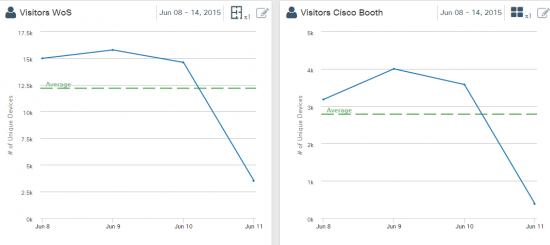
Another interesting question is how many people came to the Cisco booth in the World of Solutions. Looking at the data we can see that on average around 25% of the visitors to the WoS came to the Cisco Booth. Should be noted that to get more accurate data we are filtering out visitors that spent less than 20 minutes in the Cisco Booth (‘walking through’) as well as devices that were seen for more than 4 hours (which we assume are the booth staff).

Evyatar2

Another interesting metric is how long did people spend in the World of Solutions and particularly in the Cisco booth. Looking at the data we can see that on average people spent nearly two and a half hours in the WoS. Continue reading “Cisco Live insights from CMX Analytics”

Authors

Evyatar Ram

Product Manager

Enterprise Networking Group

Avatar

CF imageTShakibManufacturing is entering a new digital era, with more opportunity for mass customization, reduced downtime, and increased innovation. Manufacturers are capturing the value of the Internet of Everything (IoE) by becoming digital. Many are taking their first steps in this transformation by adopting Ethernet to connect plant floor devices to better manage operation and supply chain workflows, improve efficiency, and reduce costs. This digital transformation, however, creates greater exposure to cyberattacks. As a result, mitigating security threats has never been more important. Continue reading “Security as an Enabler in a World of Increased Manufacturing Vulnerability”

Authors

Tony Shakib

No Longer with Cisco

Avatar

The Internet of Everything (IoE) is changing the game for public safety. Through connected smart technologies, public safety agencies can continue to drive the needle forward as they serve their growing populations even as budgets remain constrained. Today’s deputies and officers are accustomed to a mobile world and expect these technologies to be commonplace on the job to improve situational awareness for law enforcement and first responders.

First responders pioneered robust and reliable communications. Police and fire radio systems remain workhorses of the professions. But IoE promises new levels of connectivity for personnel in the field, synthesizing real-time data for swift situational awareness. Through the variety of Cisco collaboration and wireless solutions, public safety agencies can provide first responders with real-time information to improve their situational awareness and on-location effectiveness.

Smart technologies are a force multiplier for public safety agencies and unlock the power of collaboration to improve the safety of communities. Improved practices can knock down barriers in agencies and prevent wasted funds and man-hours. For example, Cisco Connected Justice allows courts, correctional leaders and other key decision makers to perform their duties regardless of location to improve the speed and safety of the courts process. Also, consider the transport of inmates from jails to courtrooms. With every hearing, there is a lengthy and expensive checklist of costs to get the inmate to and from the hearing safely and efficiently. Using on-site TelePresence, courtroom proceedings can be conducted on-site directly with inmates – vastly reducing flight risk and enhancing safety.

Today kicks off a series of blogs that will lead up to this year’s IACP Annual Conference in October where attendees will explore the powerful advantages smart technologies provide law enforcement agencies. Over the next few months, my colleagues and I will share stories about how agencies are improving the safety of communities, saving time, reallocating resources and cutting costs by using Cisco technologies. The next blog will feature the city of McAllen, TX where law enforcement is using Cisco TelePresence in its warrant process to accelerate the investigation process within the department and provide immediate access to judges with video adjudication moving forward.

Last month, I participated in a Public Safety panel to discuss how local government and law enforcement are using Cisco technologies to address the scope of environmental challenges sheriffs face. Explore insights from the panel here. You can also go to our website to learn more about Cisco’s solutions for public safety agencies. To learn more about Connected Justice from the users’ perspective, keep an eye out for Judge Patterson’s upcoming blog series this month that will explore technology in the courtroom. There is a lot happening around public safety and security. I look forward to continuing to share insights and agency success stories as we continue to adopt and evolve with new technologies.

Authors

Bob Stanberry

Senior Law Enforcement Advisor

Avatar

I’ve been thinking lately about how collaboration can work for the IT industry as we strive to address security. Cisco’s supply chain security capability focuses on three key exposures: taint, counterfeit and misuse of intellectual property.

Specifically, I’ve been thinking about how we might detect and mitigate against counterfeit ASICs. I have a hunch that working with the semiconductor industry, we can achieve this goal. Continue reading “Securing the Supply Chain is a Collaborative Effort”

Authors

Edna Conway

Chief Security Officer

Chief Security Officer, Global Value Chain

Avatar

Lately I made the change from deep technical consultant to a more high-level architect like kind of consultant. I now do my work on the turning point between business and technique. One of my first jobs is to make my customer ready for an audit to use the dutch official authentication method, which is called DigID.

There are several requirements, which have to be fulfilled before the customer can make use of the DigID authentication method. One of these requirements is that all the internet facing systems are placed in a DMZ. I tried to explain the importance of a well functioning DMZ. For us as network specialists this fact is obvious, but a lot of people don’t understand the meaning and working of a DMZ. This blog is about the essentials of which a DMZ has to consist.

First we need to understand what we are trying to achieve with a DMZ
• Separation and identification of network areas
• Separation and isolation of internet facing systems
• Separation of routing and security policies

After understanding the achievements, there is another point of interest. Are you gonna build your DMZ with dedicated switches, firewall’s and ESX hosts (physical) or do u use a separate vlan (virtual). There is no clear answer; fact is that bigger organizations build physical DMZ’s more often than smaller ones. Besides the technical aspect, there is off course a financial aspect. Resulting out of the physical/virtual debate comes the debate whether to use two physical firewalls or one physical firewall with several logical interfaces. Equally to the physical/virtual debate there is not just one answer.

For me personally one physical firewall with several logical interfaces with tight configured ACL’s is as good as two physical firewalls. One could dispute this with the argument that if a hacker gains access to one firewall he gains access to the whole network. Personally I don’t think this isn’t a valid argument, because when two physical firewalls are used they are often from the same vendor and use the same firmware with the same bugs and exploits. So if the hacker’s trick works on one firewall, it will often also work on the second one.

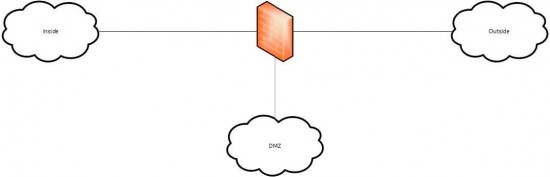
Some images to make the above a little more concrete.

A single firewall DMZ:

DMZ Basics

Continue reading “DMZ Basics”

Authors

Rob Heygele

Consultant

Avatar

The role of the contact center is making a major shift. In the past, the goal of the contact center was to handle customer calls as quickly as possible. Time spent on the phone was time paying for an agent.

Today’s customer calls are being recognized as a powerful opportunity for businesses to turn a negative customer experience into a positive one. In addition, these calls are being used to capture useful information a business can use to improve its operations and bottom line – shifting contact centers from what was viewed as a cost center to a profit center.

To this effect, many organizations are actively investing in developing customer relationships through their call center. The shift is from a customer avoidance strategy to a customer experience strategy.

Connecting with and learning from customers requires more than just a shift in how agents interact with customers. To be able to capture and subsequently utilize information from customers, the underlying supporting technology needs to shift as well.

In “Cameo Global and Cisco Improve the Omni-channel Experience for Customers”, Tim Brannock, VP Marketing from Cameo Global describes how omni-channel cloud services can be used to extend the capabilities and reach of a business to its customers through its contact center. For those who aren’t familiar with the term, omni-channel refers to the integration of different channels – in-store, website, email, social and mobile devices – to create a uniform and consistent user experience across these channels.

According to Cameo, the omni-channel experience can also include a business’ contact center. By providing real-time information to agents, agents can better understand the context of customer questions and provide faster and more accurate resolution. In addition, information can flow from the customer to the business. This enables a business to learn from its customers and improve its operational efficiency and offerings and achieve stronger business results.

The beauty of these solutions is that they can be implemented in an organization’s data center, in the cloud, or in a hybrid implementation that gives businesses the flexibility to seamlessly extend their capacity. The blog also links to an informative case study describing how Talbots, a successful retailer with nearly 500 stores in the US and Canada and a global presence with its online store and catalogs, was able to give outsourcers the same access to customer data available to its internal call center.

Authors

Xander Uyleman

Senior Manager

Global Partner Marketing

Avatar

gartner image 6_15Cisco positioned highest in “ability to execute” among Leaders in the first ever Gartner Magic Quadrant for Unified Communications for Midsize Enterprises, North America.

Many midsize organizations are seriously exploring solutions to replace maxed-out, expensive-to-maintain, and/or end-of-life PBXs. They’re weighing what they may need to support their future communications. This new Magic Quadrant from Gartner, published in May, is the first to look specifically at the unified communications requirements of midsize organizations with between 100 and 999 employees.

Phone System or Full UC&C Suite?

Many midsize organizations talk to us about deploying a new phone system. But most I talk to are balancing a much wider range of evolving challenges.  For example, those may include how to:

  • Empower an increasingly mobile workforce
  • Transform team working
  • Increase employee engagement

It’s important to consider vendors that not only fulfill your initial needs, but enable you to evolve. You need a solution that will scale as you grow and your priorities change. We feel that Cisco Business Edition 6000, which Gartner evaluated, features all the essentials. Continue reading “Gartner Recognizes Cisco as a Leader for UC for Midsize Enterprises”

Authors

Andy Johnston

Solutions Marketing Manager