Cisco positioned highest in “ability to execute” among Leaders in the first ever Gartner Magic Quadrant for Unified Communications for Midsize Enterprises, North America.
Many midsize organizations are seriously exploring solutions to replace maxed-out, expensive-to-maintain, and/or end-of-life PBXs. They’re weighing what they may need to support their future communications. This new Magic Quadrant from Gartner, published in May, is the first to look specifically at the unified communications requirements of midsize organizations with between 100 and 999 employees.
Phone System or Full UC&C Suite?
Many midsize organizations talk to us about deploying a new phone system. But most I talk to are balancing a much wider range of evolving challenges. For example, those may include how to:
This week, Cisco completed the acquisition of, Piston Cloud. Piston Cloud has been a long time member and contributor to OpenStack. I’ve always admired their engineering-savvy approach to OpenStack, the unique and memorable way in which they’ve marketed themselves from a product and culture/brand perspective, and their engineering accomplishments that make it easier to deploy, consume, and scale OpenStack-powered private clouds.
Over the years, my professional relationships with some of the folks there have blossomed into personal relationships, and I’m happy to call many of these folks my friends. For that reason, I’m thrilled that they’ll be joining those of us who came to Cisco via the Metacloud acquisition last year. (Metacloud is now called Cisco OpenStack® Private Cloud.)
I’ve already received a ton of questions about the specifics of the intended acquisition. In short, I’ll quote Cisco Head of Business Development Hilton Romanski to address the most common question, “Is this a talent acquisition or is CloudOS part of the deal?”
Per Hilton, “CloudOS is part of the transaction, but it’s too early to discuss specific plans for how we will utilize the technology in the future.”
It’s no secret that security is top priority for the federal government. It seems like every week we are hearing about a new threat, hack, or breach that has hit an agency. In just the past few weeks, we’ve heard about significant breaches that have resulted in both citizen and federal employee information being compromised.
Obviously, these kinds of attacks are putting agencies on alert. This is especially important as organizations continue to embrace new technologies and polices to improve operations and efficiency. As technology investments bring great new capabilities to government, it’s imperative that IT managers design security in from the very beginning.
I recently discussed this topic in an article published in Federal Times. The article explored how the Internet of Things (IoT) and Internet of Everything (IoE) need cybersecurity protection. In addition to a projected $4.6 trillion in value for global public sector by 2022, the enhanced connectivity offered by IoE technologies also creates an increased need for network security. For example, while BYOD programs are tremendously valuable, these initiatives also create a larger surface area for potential attacks by adding devices to the networks.
With billions of devices expected become connected over the next five years, it’s important that agencies have a plan in place to address their security needs. In general, agencies should focus their efforts on creating a cybersecurity strategy that is visibility-driven, threat-focused and platform-based. As more individuals and devices need network access, having real-time visibility becomes even more critical to gaining insight on surrounding threats and identifying system vulnerabilities. Also, presuming the network has already been breached it can help agencies be more proactive their approach. And lastly, a platform-based approach will provide scalability and flexibility required to address a variety of threats and reduce complexity through centralized management.
The number of ways IoE can make our lives better and our organizations more efficient depends mainly on our ability to think of new ways to use the technology. If we can be confident in the security of IoE, we can be confident developing more applications for it. All organizations should be in a position to ask, “Now that I am confident with my protection, what new things can I develop to save money or time and delight my users?”
Take a look at the Federal Times article for more insights around IoE and cybersecurity, and check out this white paper to learn more about IoE’s impact on public sector.
Each year, Cisco Live is packed with thousands of partners, innovators and progressive thinkers looking beyond today to transform technology tomorrow. For women in the technology industry, Cisco Live 2015 provided us with the opportunity to “ReDEFINE” ourselves, both personally and professionally. CEWN hosted several events during Cisco Live, including riveting keynotes, intuitive panels, “TED talk”-style stories and invaluable executive mentoring sessions with Cisco leaders.
Chances are that your storage area network (SAN) is already feeling the pressure from an avalanche of data. All that data can add real value to your business, but only if you can access it and use it instantly, 24 hours a day, 7 days a week. To make this happen, IT managers need to be able to implement a single storage solution that can scale massively and cost-effectively, without causing performance, reliability, or security issues.
Discover how you can meet these challenges: Attend the Webinar on June 23rd 8:00 PST. REGISTER NOW
To address the high demand for storage in today’s IT environments, driven by proliferation of data from next-gen applications, customers are implementing innovative and affordable solutions to scale their datacenter. In one of India’s largest states (Madhya Pradesh), 6000 government entities across 53 departments need to grow their storage capacity, requiring thousands of network connections ultimately deliver traffic to the ‘Madhya Pradesh data center SAN’. Today, the data center SAN houses 120 TB of storage. Based on projected growth, soon it will need to support 500 TB. The Madhya Pradesh data center SAN is also operationally complex. Read the full case study to learn, What difficulty they faced ?, How did they overcome the challenges ? and What results they achieved?
Business Challenge:
Increase SAN performance
Support QoS and other advanced characteristics across a massive SAN and multiple vendor operating systems
Simplify everything—management, scaling up, and eventual cloud services deployment
“We had expected to use 120 TB of storage capacity in three years and we used it in one year,” Rajesh Banbah, IT Head for Madhya Pradesh “Now with the Cisco MDS, we can evaluate storage needs every six months and scale in baby steps with pay-as-we-grow simplicity.” ( Read full case study here )
Business Results
Obtained full line-rate 16 Gbps performance
Increased redundancy for 24-hour availability
Simplified SAN management through built-in switch intelligence
Do you want to take advantage of Cisco SAN Solutions? Take a guided tour of the innovative new Cisco MDS 9396S high-density fabric switch, which delivers enterprise-class features, pay-as-you-grow scale options, and plug-and-play installation at a remarkably attractive price. Also learn about expanded 16G FICON and open system support on the Cisco MDS 9000 family. Find out how Cisco is extending 40G storage capabilities to the Cisco Nexus 7000 platforms, and see how we have enhanced SAN monitoring.
Today’s manufacturing industry faces an aging industrial machinery infrastructure that presents huge security challenges poised for continued growth in the coming months and years. Increasingly, manufacturers are beginning to view data security as a top barrier to realizing the value of the Internet of Everything (IoE). In fact, the steady growth of the IoE is creating efficiencies and cost savings across the entire value chain, presenting a $3.9 trillion value opportunity for manufacturers. However, this exponential growth of connections and integration between people, processes, data, and things also presents added security risks and threats that are often complex and multifaceted.
Here are a few of the implications and impacts of security breaches for manufacturers:
Theft or Loss of proprietary or confidential information and intellectual property
Downtime in factories and lost productivity – potentially very severe
Violation of regulatory requirements
Loss of public confidence and brand
Economic loss
Impact on national security
According to Symantec, the manufacturing business sector was the most targeted in 2013, accounting for 24% of all targeted attacks. Of those attacks, industrial networks topped the list of systems most vulnerable to cybersecurity issues. Additionally, the number of attacks on industrial supervisory control and data acquisition (SCADA) systems doubled from 2013 to 2014. Unfortunately for manufacturers, 91% of breaches took just hours or less to perpetrate, yet more than 60% of attacks took months – or even years – to detect. This considerable gap gives cyber attackers plenty of opportunities to access a manufacturer’s trade secrets and sensitive production data.
Just before setting off for Cisco Live I heard an economist on the radio talk about the relative performance of leading countries. The key measure was productivity: GDP per worked hour. Certainly historic outcomes are important but they do tend to provide a historic view.
As we accelerate into the digital revolution, I started to think about the best way to measure company performance. Critically, what might indicate future market leadership? Where should a company focus when it comes to communications and collaboration? What is core and what will enable leaders to set themselves apart from competitors?
I decided to spend some time at Cisco Live asking customers for their perspectives. I arrived in San Diego with a long list of potential items. But after John Chambers spoke about market disruption brought about by digitization, I came away with a simple model: The Modular Enterprise.Continue reading “The Modular Enterprise”
Growing up, we all had a favorite teacher. It may have been an impassioned English teacher keen on Shakespeare and Tolkien or perhaps a Science teacher with an over-the-top flair for dramatic experiments. As teachers, they inspired and challenged us. As memories, they continue to travel with us throughout life, still often influencing our behavior. For me that memory is Mr. Meredith, of AP English. His passion for teaching helped shape my own approach as an English teacher years later and continues to live on, transferred to my former students who now teach others.
Beth Carter, of Seneca Ridge Middle School in Loudoun County, Virginia, is that kind of teacher. Diagnosed with breast cancer in the fall of 2014, Beth faced the real fear of infection from others and had to reduce contact with the outside world. But keeping a dedicated teacher from teaching is like keeping the sun out of the sky, an impossible task. Driven by her passion for teaching, and with a little help from Cisco, she soon found a way to keep doing what she does best – empowering others.
Beth’s husband, Gregg, is one of our Systems Engineers at Cisco. He decided to reach out to co-workers for help. Their diagnosis was to provide connectivity to enable Beth to teach her students from the comfort of her home. Cisco gladly provided a TelePresence™EX90 system for use in her house, and a TelePresence SX20 Quick Set (hooked to a Promethean Board) for her classroom. The system streamlines her desktop at home so she can move fluidly from individual work, to video calls, to problem solving over shared documents. This lets Beth talk to her students face-to-face in real-time to solve math problems. Best of all, Beth’s students are learning much more from her than just math. They are learning how to face their challenges head-on. “I am able to teach lessons to my students as if I was actually in the classroom,” she said. “You have no idea how important that is to me as a teacher to know that during my battle with breast cancer I can stay connected to my kids.”
While distance learning technologies excel at bringing us together, they can also have psychological benefits. As Beth’s situation shows, real-time video enabled learning can let homebound students and teachers be a productive part of any class; enjoying social interaction and increasing their sense of belonging to a community. I would have benefited greatly from that as a teenager when homebound, post appendicitis. During that time another teacher, Mr. Ridgely, traveled to visit me. That’s something I’ll never forget. But imagine if I could have joined his class for those two lonely weeks instead, learning from home using TelePresence? I might be a best-selling author today. For those who face long-term illness, video can be the lifeline that keeps them focused and buoys their spirits until they can physically return to school. Students in the classroom can also benefit by developing a greater sense of compassion and understanding for others and the life changing situations they face.
Thanks to Cisco’s TelePresence technologies, Beth is continuing to inspire adults around her while helping build a positive future for the youth of Loudoun County, Virginia. You can listen to Beth’s story in her own words at https://vimeo.com/129800501 and learn more about connectivity at Cisco Connected Learning.
To see how TelePresence can benefit your students and staff, check out:


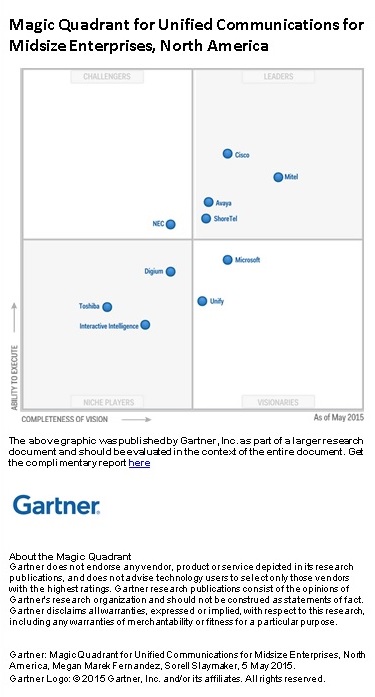 Cisco positioned highest in “ability to execute” among Leaders in the first ever Gartner Magic Quadrant for Unified Communications for Midsize Enterprises, North America.





 As part of the third annual Cisco Empowered Women’s Network (CEWN) Forum at Cisco Live,