Avatar

If you are one of the 330,000 organizations using Citrix XenApp (or if you are considering it) you need to consider Cisco’s UCS M-Series modular servers.

What are M-Series modular servers? M-Series servers are composable infrastructure that disaggregates storage and networking from the CPU/memory complex allowing workloads to be optimally matched to resources. An ideal workload for the M142 compute cartridge is Citrix XenApp. The M142 cartridge has two Intel Xeon E3 servers meaning a single 2RU M4308 chassis has 16 servers!

Cisco recently published a CVD (Cisco Validated Design) for Citrix XenApp 7.6 on M-Series. A CVD is a tested, documented, reference architecture to provide a cookbook for customers. This allows customers faster, reliable, and predictable deployments.

Cisco UCS M-Series with Citrix XenApp 7.6 Physical Server Deployment features the Intel Xeon E3-1275L v3 processors with 32GB per server. Amazingly this modest processor / memory combination supports 60 remote desktop session users or 960 users in 2RU!

Continue reading “UCS M-Series and Citrix XenApp Bare Metal Deployments”

Authors

Bill Shields

Senior Product Manager

UCS Solutions Product Management

Avatar

Any discussion on digital transformation and IoT leads to the fundamental question – “What are the possibilities and impacts in my industry?” The manufacturing industry has been dealing with this question for the last 50 years and in fact, has been an early adopter of technology to enable transformation.   For example,  in the mid-to-late 20th-century, automated inventory control systems (ICS),  material resource planning systems (MRP), and  enterprise resource planning systems (ERP) had a tremendous impact on the foundational operations within manufacturing across the world.  Then in the later part of the 20th-century and the early part of 21st-century transformations within this industry were enabled by the emergence of the PC, explosion of the internet, realization of e-business, availability of IP-based technologies, universal  adoption of RFID and proliferation of wireless components.  All of these innovations marked the first era of digital manufacturing.  This era had a primary focus on using technology to achieve efficiencies, effectiveness and productivity gains particularly within the supply chain, and product lifecycle management functions.

Digital Manufacturing

Today pioneering and prominent manufacturers are looking at the next generation of digital manufacturing which will utilize technology to enable new customer experiences that enhance profitable revenue growth. The German government is credited with calling this next era Industry 4.0. They characterize this era as a time when “people, machines, and industrial processes are intelligently networked.”

Continue reading “The Digital Manufacturing Landscape and the Path Forward.”

Authors

James Jamison

Director, Technical Marketing

Software Platforms Group

Avatar

In all my years as an IT professional, I’ve witnessed a lot of deals and collaborations between companies. But, it wasn’t until I joined Cisco Energy Management that I saw a partnership with a hippo.

Did that get your attention? I hope so.

The truth is Cisco Energy Management did partner with a hippo – Planet Hippo, the first Internet Service Provider (ISP) in the UK to offer cloud Energy Management capabilities to its customer base of small- and mid-sized enterprises.

What I like about the cloud-based model is that it does not require additional hardware or operational costs associated with on-premises software deployments, which removes the financial barriers that many smaller enterprises have to overcome. Today, the Planet Hippo and Cisco Energy Management partnership works together to:

  • Help bring innovation to customers in new markets
  • Work with any ICT device connected to the network, regardless of device type or vendor
  • Cut energy consumption for savings costs of up to 35 percent
  • Deliver a return on investment within a few months
  • Satisfy the Energy Savings Opportunity Scheme (ESOS), a mandatory energy assessment scheme for organizations in the UK

We are excited about our partnership with Planet Hippo and I encourage you to watch the video below to learn more about how this solution is helping businesses thrive.

Authors

Guneet Bedi

Director, Product Management

Asset & Energy Analytics

Avatar

The year 2015 has been a very busy year for Cisco Data center Business Units. We are very pleased to end the year on a high note with the Gartner Data Center Conference at the Venetian, Dec 7-9.  As in previous years, this year’s conference offers attendees a number of exciting sessions and tracks on Data Center Infrastructure and Operations, what’s next in Virtualization, Cloud computing, SDN and other focus areas.

gartner

Continue reading “Want to Empower your Digital Enterprise – Join Cisco at the Gartner Data Center Conference 2015, Vegas”

Authors

Ravi Balakrishnan

Senior Product Marketing Manager

Datacenter Solutions

Avatar

What will Rowan announce at Collaboration Summit? It’s a popular question leading up to Tuesday’s keynote.

If you want to know, then I may be able to share a few things…

The first thing to share is that Cisco Collaboration is hot.  In Cisco’s last quarterly announcement, Collaboration has continued to grow and saw a 17% Y/Y increase. It’s great news for Cisco and great news for the organizations that look to Cisco for the best offerings in collaboration technology.

It’s the tenet of putting forth the “best offering” that, in my opinion, is responsible for our success. And will be responsible for our continued success in collaboration. Rowan has a philosophy of creating products that are delightful to use in all aspects. There is no compromise on quality.

The product designs are simple, clean, and it’s a pleasure to use them. This is evident through the red dot design awards we’ve received. Design is not just how a product looks, but also how it functions. As a frequent user of many Cisco collaboration products, I can tell you the experience is awesome and continues to be more awesome with each iteration.

At the Cisco Collaboration Summit:

  • Will Rowan announce new products?
  • Will Rowan announce new and better experiences?
  • Will Rowan talk about the Apple partnership?

I can only give you a definite maybe on those particular topics. However, you’ll hear announcements of some very cool and exciting things. If you’d like to know what they are, register to watch the live broadcast of the keynote sessions. Don’t miss the opportunity to hear it live and hear it first.

You will hear from:

Register Here
Live Keynote Broadcast
December 8

at 9am Pacific / 12 pm Eastern

Let us know what you think of the news afterward.  There will also be plenty of tweeting going on using the #csummit hashtag.  Watch for it and contribute.  We’d love to hear from you.

Authors

John Gaudin

No Longer with Cisco

Avatar

Today we kick off the third annual Internet of Things World Forum here in Dubai, where more than 2400 attendees from around the globe are getting awakened to the IoT possibilities. We are all on a journey together as we take what was a bold new concept three years ago and transform the way businesses, cities, and countries operate and engage their customers and citizens.

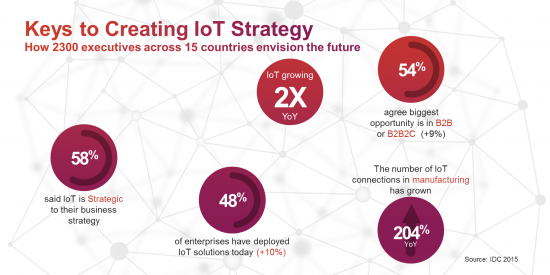
IoT is no longer a buzz word—it’s real.  According to IDC’s Global IoT Decision Maker Survey of more than 2,300 global businesses, 58% said that IoT is strategic to their business strategy and 48% have already deployed an IoT solution today. Clearly, IoT is seen as having real potential to change businesses. And it is impacting all industries.the new key

Continue reading “Celebrating the Internet of Things Journey at IoT World Forum”

Authors

Inbar Lasser-Raab

No Longer with Cisco

Avatar

This week, I’m joining leaders from industry, academia, and government at the Internet of Things World Forum (#IoTWF) in Dubai, and fog computing is a hot topic in many of our discussions. As the Internet of Things (IoT) becomes more pervasive in our homes, cars, city services, and across industries, fog computing will become an essential technology for capturing value in many IoT use cases.

IMG_0028
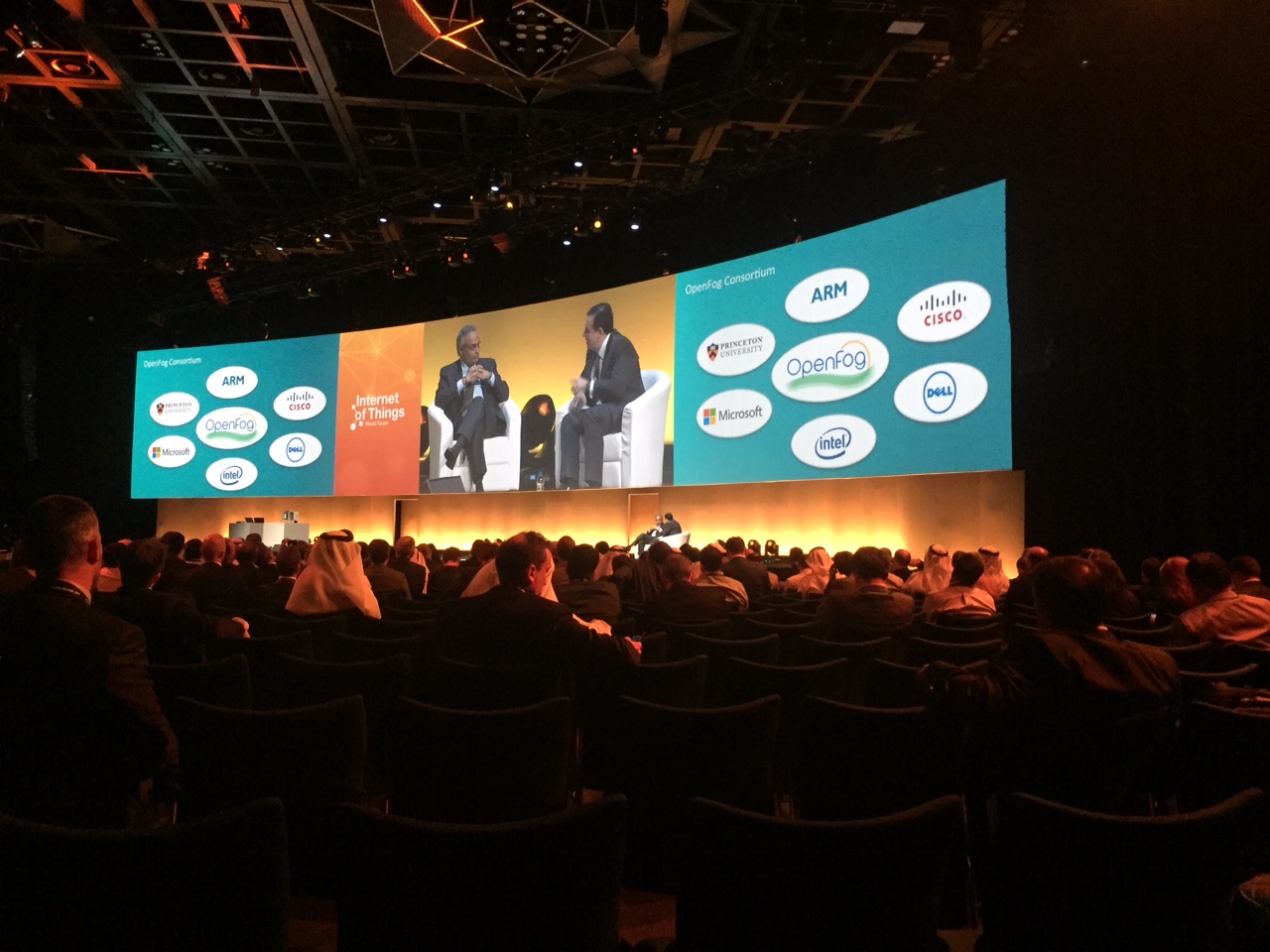
Anil Menon President, Smart + Connected Communities at Cisco and John Defterios, Emerging Market Editor with CNN talk briefly about the newly formed OpenFog Consortium at the IoTWF.

That is why I am particularly happy to be representing the OpenFog Consortium, as well as Cisco, at this global event. The consortium was formed to accelerate the deployment of fog technologies and to provide industry and academic leadership in developing fog computing frameworks and architectures. Cisco has been working for many months with the other founding members—Intel, Microsoft, Dell, ARM, and Princeton University—to form this new industry body. Since our announcement of the OpenFog Consortium on November 19, interest has gained momentum and there is now a healthy pipeline of new members in the process of joining.

Exciting possibilities of a fog approach are coming to life in Barcelona, Spain. Last week, I participated in a live demo of a proof of concept project that brings together a number of disparate smart city services within a single unified architecture, rather than in disconnected, siloed efforts. Barcelona has been working for several years to develop “smart” urban services, including lighting, traffic management, event-based video, and on-demand connectivity. For the most part, however, these services have been developed and deployed independently by different city departments—resulting in a dazzling array of sensors, gateways, repeaters, and other devices positioned on poles, posts, and walls around the city. The proof of concept project consolidates and integrates these separate systems in secure, strategically placed outdoor cabinets, and provides a single-screen view to monitor and manage data, applications, virtual switches and routers, fog nodes, fog services, and the network. This project represents a paradigm shift for smart city services, leveraging both cloud and fog capabilities to integrate a rich set of use cases on a multi-vendor software platform.

Continue reading “OpenFog Consortium Gains Momentum as Fog Picks Up Steam”

Authors

Helder Antunes

Senior Director

Corporate Strategic Innovations Group

Avatar

Yesterday, Cisco announced a new software release for ACI. If you are looking to automate IT, or build out your cloud environment, and want to do so in an open fashion that provides a lot of flexibility – then you’ll probably be interested.

Why? The new ACI release:

  1. Makes managing and securing your cloud environment easier;
  2. Provides openness, expanding customer choice; and
  3. Delivers operational flexibility

https://instagram.com/p/-16eKOtNn1/

OK, so what does this actually mean?

  1. Makes managing and securing your cloud environment easier

Three of the most popular cloud management tools include Microsoft Azure Pack, OpenStack and VMware vRealize. Earlier this year, we announced Windows Azure Pack ACI integration. With this new ACI release, we integrate ACI with OpenStack and vRealize, as well. (More details are here.) So this means that if you need to, say, provision a virtual workload in vCenter, ACI automagically orchestrates things to match computing resources and networking infrastructure.  So, you can enjoy the policy based automation and all the other benefits of ACI regardless of which of these tools you use to manage your cloud environment.

This also means OpenStack users can now create and manage their own virtual networks, extending ACI policy directly into the hypervisor with a hardware-accelerated, fully distributed OpenStack networking solution – the only one available that integrates both physical and virtual environments.

To more easily and completely secure these environments, the new release provides micro-segmentation support for VMware VDS, Microsoft Hyper-V virtual switch, and bare-metal endpoints. Essentially, this means more granular enforcement of security policies.   These can be based on numerous different criteria relevant to attributes associated with the network, e.g. IP address, or the virtual machine, e.g. VM identifier, Name, etc. There are additional capabilities that can, for example, disable communication between devices within a policy group (intra EPG, for those more familiar with ACI) – useful in thwarting lateral expansion of attacks.

  1. Provides openness, expanding customer choice

Piggybacking off some comments above, it’s worth noting that since ACI’s inception, one of its differentiators has been the ability to integrate physical servers as well as virtual machines, and to apply policy consistently across them. Well, now there’s a new kid on the block, as the industry observes an increasingly popular trend to use containers as another way of operating applications.   As part of this announcement, we are extending ACI support to include Docker containers, in addition to VM’s and bare metal servers. This is done by using Project Contiv, which is an open source project that has a Docker network plugin allowing, among other things, automatic configuration of Docker hosts to integrate with ACI. Check out details on this video and/or this white paper. Network Computing commented here, that:

“Given all the hubbub in the industry over Docker, ACI’s new Docker container support is noteworthy.”

Another way this new release is driving openness and providing more choice for customers is around L4-7 services. ACI now supports service insertion and chaining for any service device.  So, customers can leverage their existing model of deploying and operating their L4-L7 device, while automating the network connectivity. This is in addition to, not instead of, the device package model, which provides for more comprehensive ‘soup to nuts’ automation. Speaking of which, as part of this announcement, several new partners also joined the ACI Ecosystem. This video provides some insight into how some of them automate your applications.

  1. Delivers operational flexibility

The new release has a number of tools that create more flexible operating environments. A quick rundown includes the multi-site app, which enables policy-driven automation across multiple datacenters, providing enhanced application mobility and disaster recovery. In short, this means you can run ACI in 2 different data centers, and extend the policy across them. Other tools provide the ability to do configuration rollback, as well as NX-OS Style CLI. This is for the CLI junkie that wants to run the entire ACI fabric as a single switch. There are some other cool nuggets in here as well, like a heat map that provides real-time visibility into system health.

Clayton Weise, Director of Cloud Services at KeyInfo, summed it up best when he said:

“ACI is the direction we’re going to go because it gives us the best flexibility.” (Read the entire Network World story here.)

In summary, this new release adds capabilities that will help you more effectively manage and secure your cloud environment, as well as leverage the benefits of both openness and operational flexibility.


Authors

Craig Huitema

No Longer with Cisco

Avatar

I’m pleased and proud to report that Cisco was named this week as one of the Top 50 Most Innovative Companies by the Boston Consulting Group (BCG). This marks the third year in a row that we’ve been included on this prestigious list alongside other industry innovators like Apple, Google, and Tesla. In all, we’ve been included in nine out of the last ten reports.

I’m even more pleased to see how well our engineering direction aligns with the criteria that BCG highlights as defining the most innovative of all companies. Those criteria are:

1. The Rising Need for Innovation Speed.

The Internet-fueled transformation of industries is happening at incredible speed. From hospitality to health care, TV to telecommunications, our customers are calling upon us to help them out-wit, out-pace, and out-innovate potential disruptors. I’m exhilarated by how our engineers are rising to this challenge.

Take the service provider industry, for example. This is a market that’s under incredible pressure to drive new revenues by rapidly delivering communications and business services securely with greater agility, automation, and simplicity – at a lower cost.

With a project called ‘xSpeed’, Cisco delivered powerful software innovations for cloud networking that precisely met service provider needs in just 13 weeks. The xSpeed team had autonomy to execute and they delivered first demos within three weeks. xSpeed is one of our internal startups, called Alpha’s, combining the speed and agility profile of a startup with the resources and scale of Cisco.

2. Strong Innovators are Lean Innovators.

BCG calls out the power of small teams. I couldn’t agree more! The culture I have been driving within engineering is to have my engineers “Think Big, Act Small” while we provide the autonomy to execute. Another great example of our success here is the rapid rise of Cisco Spark, our team collaboration application that is transforming the way teams stay connected. That team has experimented, taken risks, dared to break glass – and customers are loving the outcomes! On that note, watch out for more exciting Spark news at our Collaboration Summit next week!

3. Enabling Technology-Enabled Innovation.

We have encouraged our customers to embrace digital, connected business processes. We’ve also led the world for three decades in connecting our own business processes, from the way we close our books to the way we empower our sellers. How we innovate has become technology-enabled too. Today we’re creating end-to-end engineering workflow automation and enabled continuous integration for our agile development efforts. The result is that we’re moving faster than ever. We have reduced technology build time by 50 to 60% in many cases. And we’ve created iterative processes to enable us to review internal demos every two weeks. How’s that for technology-enabled innovation!

4. The Prerequisites of Profitable Adjacent Growth.

Pursuing market adjacencies has always been a Cisco strength. Today, more than 40% of our product revenues are generated by businesses outside of switching and routing. And we’re aggressively pursuing more areas of innovation, including Edge Computing, data analytics at the edge, and the Internet of Things.

Cisco engineering is maniacally focused on creating innovation that matters to our customers. And I’m proud to see our efforts recognized in this report. It’s a great accolade to the 22,000+ engineers who are powering Cisco’s Innovation Engine every day!

Authors

Pankaj Patel

Executive Vice President and Chief Development Officer