


Sustainability 101 is a blog series that you can turn to for information about different environmental terms that may come up at work, during discussions with friends, and even at your family gatherings.
Energy efficiency is sometimes confused with energy conservation, but they are two different concepts. Energy conservation is focused on using less power, like turning off lights when they aren’t being used. Energy efficiency, meanwhile, focuses on reducing waste. So, if a device like a light is needed, how we can make sure the least amount of energy is wasted. They are similar and related, yet distinctly different. Both can help reduce utility bills and environmental impact, but here we’ll focus on energy efficiency.
There are ample opportunities to make businesses more energy efficient. One example includes smart building practices, such as installing sensors that learn occupant behaviors and ambient preferences to automatically adjust heating, cooling, and lighting as needed. For Cisco, our equipment is often an “always on” device, so we focus on making products use energy as wisely as possible to help support customers and partners as they are on their own journey to decrease energy waste.
Energy efficiency, a key focus for Cisco product design
Cisco prioritizes energy efficiency as a core part of our Circular Design Principles. We don’t just build products; we integrate energy efficiency into our design requirements. Our strategy includes choosing highly efficient power supply units (PSUs), using a consistent method to measure the energy use of our products and building in features that help our devices save energy based on how much work they are doing.
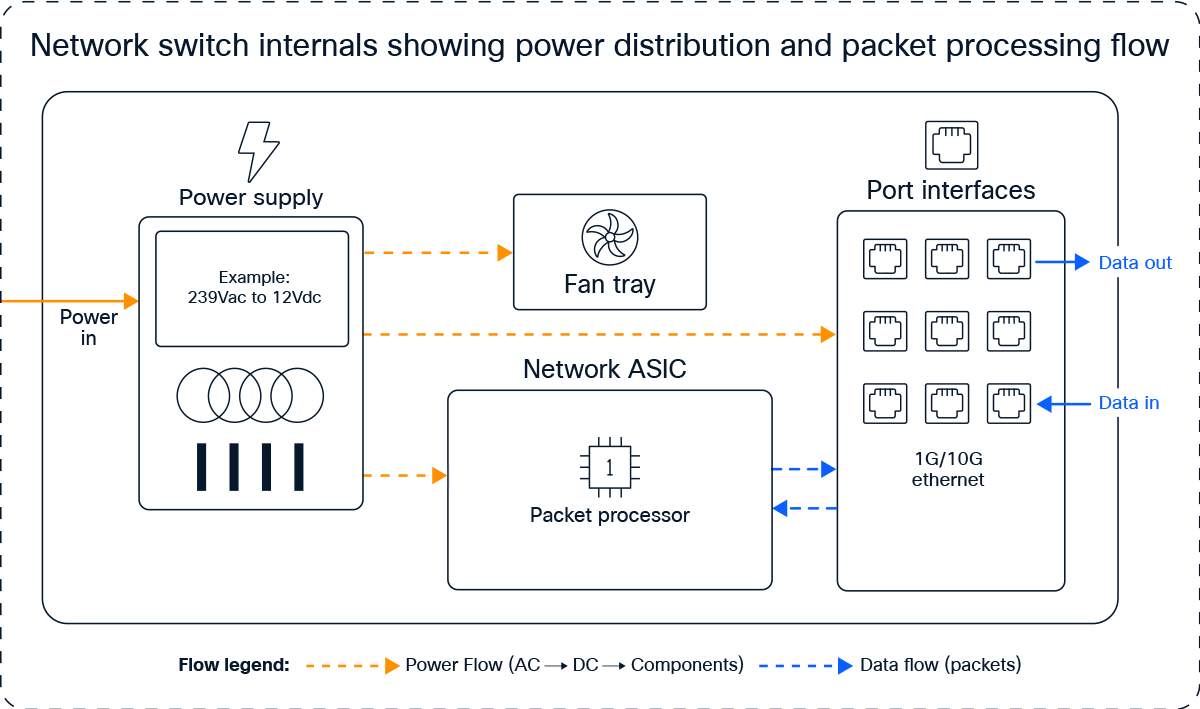
To understand how we do this, it helps to look at where a networking device uses energy. All power needed by the system goes through the Power Supply Unit (PSU) and then get distributed throughout the system. The three largest power draws in the system are often ASICs, Optics, and Cooling. ASICs (or application specific Integrated Circuit) are the heart of data processing and traffic management, moving our customers’ data from its source towards its destination. Pluggable optics, or copper ports, are where customers plug in cables to connect one system to the next in the data path, and our products use power to help send/receive this data onto the cable. These components and others get hot when energy is being used, so we need fans (or other thermal solutions) to maintain a safe temperature. So, although the power used to cool the components isn’t being used for moving data (the ultimate goal), it is a necessary component in the system. By looking at exactly how each of these parts uses energy, our engineers can find ways to make our products run more efficiently, which can help our customers save money and reduce their environmental impact.
Energy efficiency inside of a product is making sure as much of the power as possible is being used for necessary functions. Inefficiencies are inevitable: such as power wasted from moving energy around or circuitry that has to operate over a wide range but can only be in optimal operation for half of the range. Cisco’s engineers must balance energy efficiency, along with cost and time to market, at every stage of product development.
Energy efficiency in Cisco’s operations
We also incorporate efficiency into our direct operations. Through Cisco’s global EnergyOps program, we implement energy efficiency and renewable energy projects in our owned and leased facilities. In our fiscal year 2025, we invested US$15.4 million to fund 78 energy efficiency projects, which enabled us to avoid approximately 11.4 gigawatt-hours (GWh) of energy consumption. Our real estate organization also works to maximize efficiency in our operations by:
- Installing LED lights to increase lighting efficiency
- Balancing airflow and improving hot and cold aisle containment within our labs
- Retrofitting and optimizing major mechanical equipment and control systems to improve energy efficiency
- Electrifying our buildings, moving from natural gas systems to heat-recovery chillers and electric systems
- Installing meters as well as using artificial intelligence and advanced analytics to better monitor and optimize energy usage in our buildings
- Engaging employees to promote, educate, and incentivize them to conserve energy
At Cisco, we’re proud of our work and progress in advancing energy efficiency, aware that our efforts contribute to Cisco’s purpose. Through our products, solutions, and operations, we drive energy efficiency and resilience — helping advance sustainability for Cisco, our customers, and communities around the world.
Check out how Cisco’s Circular Transformation strategy governs how we incorporate energy efficiency and other Circular Design Principles into our products.
About Corporate Social Responsibility
We empower social change agents with technology and expertise. Our goal: Accelerate global problem solving to benefit people, society, and the planet.
Learn about Cisco CSR X/Twitter
 Facebook
 LinkedIn
 E-mail