Network demands are surging as businesses adopt AI across more applications, branches, and cloud environments. At the same time, networking and security teams are under growing pressure to protect distributed users, devices, applications, and data—without adding more operational complexity.
In today’s distributed, cloud-first environments, legacy overlay security can’t protect high-bandwidth AI workloads, remote users, hybrid branches, and dynamic data flows.
To safely scale AI initiatives while protecting corporate data and preventing data leakage—and without overwhelming already-stretched IT teams—growing businesses need embedded network security, infusing protection into the network itself.
The AI double-edged sword: How is AI changing network security?
AI and agentic workloads demand massive bandwidth and create complex, unpredictable traffic patterns. Data now flows dynamically across hybrid environments, remote branches, cloud applications, and multicloud infrastructures. In fact, a single agentic task generates 450% more traffic than a human doing equivalent work. Securing that movement requires a more agile, intelligent network.
At the same time, attackers are using AI to increase the volume, speed, and sophistication of cyberattacks. Phishing campaigns are now hyper-personalized, malware is adapting to evade detection, and automated bots are probing networks for weaknesses at an unprecedented scale.
AI-era threats require AI-assisted network and security operations. By integrating AI directly into network devices and leveraging AI-enabled SecOps tools, networking and security teams can move from reactive firefighting to faster detection, prioritization, troubleshooting, and response. This can help growing businesses adopt AI with more operational confidence, while helping lean teams reduce manual investigation and contain risk faster.
Overlay vs. embedded network security: What’s the difference?
Traditional overlay security adds appliances and software to existing infrastructure. This often creates more operational complexity: fragmented visibility, disjointed consoles, inconsistent policy enforcement, and bottlenecks that can slow performance.
Some businesses may look into upgrading a firewall appliance or investing in new routers, but with this add-on approach, traffic may need to be routed out of its way to a security checkpoint and back again. That added latency and complexity can be especially challenging for AI workloads, distributed users, and cloud-first environments.
Embedded network security changes the model. Instead of treating security as a separate layer, protection is integrated across the network fabric itself, including routing, switching, wireless access, cloud access, and identity-aware controls. The network becomes a point of visibility, intelligence, and enforcement.
In this model, every node becomes both a sensor and an enforcer, and every connection becomes a point of visibility and control.
The five core pillars of secure networking
Moving away from fragmented point solutions and adopting a secure networking model can help reduce operational complexity, improve resilience, and give lean IT teams more consistent control across distributed environments.
The Cisco approach to secure networking is a model that can support business continuity, modernization, and scale without a linear increase in tools or manual work.
1. Embedded security across the entire network.
Secure networking starts by embedding protection into the infrastructure, not bolting it on piecemeal. Cisco 8000 Series Routers with built-in Cisco firewall provide protection at the WAN edge, helping organizations secure distributed environments and support cloud-managed security. Cisco Wi-Fi 7 and Cisco Smart Switches extend embedded security directly into campus and branch infrastructure, where users, devices, and applications connect.
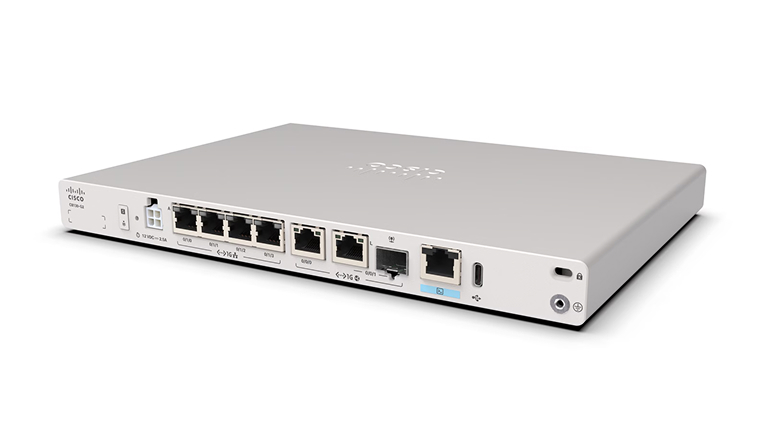
Cisco Multicloud Fabric (announced at Cisco Live 2026) helps IT connect sites directly to clouds and cloud-to-cloud with built-in security, end-to-end visibility, and a fabric that scales with AI workloads.
These solutions help IT teams gain visibility and enforce policy closer to where activity begins, whether supporting remote employees, securing branch connectivity, or protecting regulated environments where consistent access control and uptime are critical.
2. Advanced solutions built for the demands of AI.
The agentic AI era requires a network that can support true innovation while defending against rapidly evolving threats. At Cisco Live 2026, the secure harness for agentic AI was announced: Cisco Cloud Control.
Cisco Cloud Control is an AI-native management solution for orchestrating and securing enterprise IT infrastructure. Cisco Cloud Control gives humans and agents a unified operations platform that brings every Cisco domain and third-party tool into one environment—one login, one view, one operating model.
Cisco also delivers AI tools to enhance security operations. Cisco AI Assistant and AI Canvas make ops more actionable by helping teams detect threats faster, simplify management, and respond more effectively. These capabilities can reduce the burden on lean IT teams by making complex network and security tasks easier to understand and act on.
With intelligence built into the operating model, teams can move from manual investigation and reactive troubleshooting to more proactive, AI-assisted operations.
3. Protection beyond the traditional firewall.
Firewalls remain essential, but modern security can no longer rely on firewall-centric thinking alone. Users, devices, applications, and data now operate across branch locations, cloud services, software-as-a-service (SaaS) platforms, remote environments, and hybrid infrastructures.
Cisco’s approach to secure networking goes beyond the firewall by integrating protection across routing, access, and cloud environments. Secure routers and firewalls help protect traffic moving between sites, clouds, and users while SASE extends identity-aware protection to cloud applications and remote users.
This equips IT teams with consistent control across WAN edge, campus, branch, cloud, and remote access environments.
4. Unified access control.
In distributed environments, trust cannot be assumed based on location. A user in the office, a remote employee, a branch device, and a cloud application all need consistent, identity-aware access control.
Cisco Access Manager enables unified access control across users, devices, and applications. It helps organizations verify who and what is connecting, apply appropriate policy, and reduce the risk of unauthorized access.
Together with Cisco SASE for Meraki, organizations can extend secure, identity-aware access to remote users and cloud applications without multiplying management tools.
5. Simplified operations through a unified platform.
For many growing businesses, the biggest security challenge isn’t just the number of threats. It’s the number of tools required to manage them.
Cisco helps simplify operations through a unified platform that brings networking and security together across routers, firewalls, wireless, switches, access control, SASE, and AI-powered operations. This integrated approach helps lean IT teams maintain high performance and strong security while reducing complexity.
Policies can be applied more consistently. Visibility improves across users, devices, branches, and clouds. AI-assisted capabilities help teams investigate, troubleshoot, and respond faster. The result? Integrated security and network performance that lean teams can manage more consistently across distributed environments.
For teams building a business case, the Cisco secure networking model can also support tool consolidation and operational efficiency discussions.
Secure networking on a global scale: Silverstream Technologies
As a maritime technology company helping the shipping industry improve vessel efficiency and reduce emissions, Silverstream Technologies depends on digital collaboration and dependable access across a growing global business.
For a company focused on serving customers across a complex maritime ecosystem, the network is more than infrastructure. With the Cisco Meraki dashboard and Cisco Secure Client, Silverstream strengthened the technology foundation needed to support its operations, connect teams, and scale securely.
The company now enforces consistent policies, encryption, and monitoring across all facilities and remote connections—including a London HQ with more than 1600 detectable wireless networks.
Silverstream’s secure, cloud-managed Cisco network also helps it achieve ISO 27001 certification by adhering to the rigorous data protection standards demanded by the world’s leading shipbuilders.
Secure networking for nonprofit organizations: YMCA of Niagara
YMCA of Niagara is a mission-driven organization with a goal to deliver better digital experiences across distributed locations. Supporting multiple facilities, programs, staff, members, and guests requires reliable connectivity and simplified IT operations.
With Cisco Meraki switches and SD-WAN appliances, YMCA of Niagara transformed their network foundation to better support secure access and consistent connectivity across community environments. Thanks to the Cisco Premier Breach Protection Suite, YMCA of Niagara deploys threat detection and response across network, cloud, endpoint, and email, with integrated tools like XDR Premier and Cisco Secure Email Threat Defense combined with 24/7 managed services.
By moving to the centralized Cisco Meraki dashboard, their IT team is now spending less time managing complexity and more time supporting the services and experiences people rely on. They have achieved an 80%+ decrease in mean time to resolution (MTTR) and 70% reduction in support incidents with Cisco.
Taking control of network security in the AI era
The AI era has rewritten the rules of enterprise technology. To keep pace with business demands while defending against automated, intelligent threats, organizations can no longer rely on fragmented, bolt-on security tools.
The future belongs to those who build security from the ground up. By unifying networking and security into a single embedded architecture, IT teams can simplify daily operations, reduce complexity, and build more consistent availability, policy control, and operational resilience.
It’s time for your network to do more than connect your business. With Cisco, your network actively defends itself—everywhere—so you can scale assuredly as you grow.
Experience Cisco secure networking
for yourself with an in-depth demo today.