This blog has been updated on 2 September 2025 to reflect regulatory developments in the European Union with the Omnibus I regulatory simplification package which amends the Corporate Sustainability Reporting Directive (CSRD) and the Corporate Sustainability Due Diligence Directive (CSDDD), as well as the recently published Joint Statement on Transatlantic Trade and Investment.
The Omnibus I aims to streamline and reduce compliance burden on companies and the “Stop-the-Clock” Directive gives companies more time to implement CSRD and CSDDD. Together with the EU Commission, the Parliament and Council will start negotiations on the final text of the Omnibus I as part of the trilogue process this Fall. Furthermore, the Joint Statement on Transatlantic Trade and Investment mentions that the EU and U.S. have agreed that the EU CSDDD will not result in an unnecessary administrative burden.
Cisco supports a streamlined, effective, and practical legal framework for human rights and environmental due diligence and reporting. Therefore, we suggest several key changes to the Commission’s proposed version of the Omnibus I, reflecting Cisco’s emphasis on pragmatic solutions based on our experience with complex value chains:
- Maximizing CSDDD harmonization to prevent divergence across Europe, including maintaining a homogeneous EU civil liability regime under CSDDD to ensure legal certainty;
- Refining new definitions in the Omnibus I proposal (e.g. “plausible information”, “relevant stakeholders”);
- Establishing an “information cap” for data requests across all company sizes under both CSRD and CSDDD;
- Ensuring that CSDDD business relationship suspension is an optional, temporary measure.
Cisco’s long-standing commitment to corporate responsibility
Cisco has a longstanding commitment to upholding human rights by conducting due diligence in our supply chains and internal operations in alignment with the United Nations Guiding Principles on Business and Human Rights and the Organisation for Economic Co-operation and Development Due Diligence Guidance for Responsible Business Conduct.
In recognition of our commitment and actions, Cisco was listed 3rd out of 60 ICT companies on Know the Chain’s benchmark, which assesses companies’ ability to manage human rights risks in their supply chain. Furthermore, in October 2023, Cisco was honored as a leader in the Global Child Forum’s annual benchmark report, acknowledging our concrete actions to embed children’s rights into our company practice.
Embedding Corporate Due Diligence Into our Business Operations
As we strive to securely connect and protect people and businesses from cyber threats, and support workers in our supply chain, we take a mindful and systematic approach. We design and build solutions with security, privacy, sustainability and human rights in mind. This approach empowers our partners, customers, and their users to leverage the potential of connected technologies to improve their lives and fulfill their business objectives.
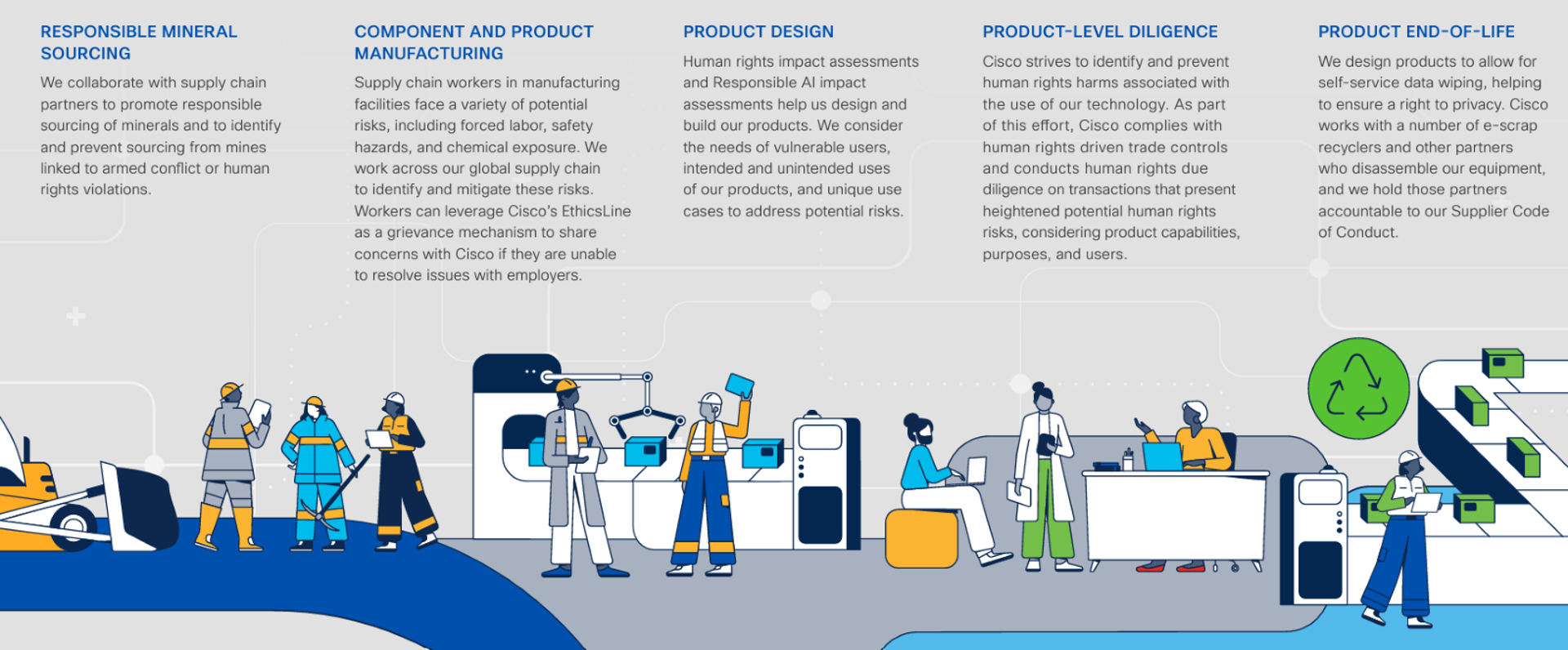
Our diligence extends throughout our products’ lifecycle, from mineral sourcing to product design, manufacturing, reuse, and end-of-life.
We engage in the prevention and remediation of adverse human rights impacts in our supply chain. We assess potential impacts on stakeholders, including vulnerable workers in our supply chain and end users of our products and solutions.
Aligning global corporate standards and public policy
The CSDDD sharpens corporate attention to human rights and environmental due diligence within their internal operations and supply chains. If done right, this due diligence framework will help companies to identify, prevent, mitigate and address potential adverse impacts of their operations. Cisco supports the objective of the CSDDD to provide a consistent regulatory framework for this responsibility and to create a level playing field across the EU’s 27 markets.
Businesses have an important role to play, alongside civil society and governments, in addressing risks in supply chains, responding to new challenges, and navigating a shifting geopolitical landscape. For most businesses, corporate responsibility has evolved from a peripheral concern to a core consideration. If the EU Parliament, Council and Commission adopt the Omnibus I following their negotiations, this will bring more clarity and legal certainty to businesses and a harmonized approach across the EU. A pragmatic CSDDD would be a significant milestone in our journey towards a more responsible corporate world, while also supporting operational efficiency in executing that due diligence.