


The Fundamental Shift: From Tools to Intelligence
For too long, the delivery of services has been fragmented, with Support and Professional Services using different tools optimized for specific functions or lifecycle stages. This has led to a fragmented experience where customers, partners, and Cisco teams spend more time on data collection and tool maintenance than on high-value analysis. Cisco IQ represents a shift from this tool-centric model to an intelligence-centric one. It is a multi-persona system, serving customers, partners, and our own services teams through an API-first architecture. Our objective is to turn decades of institutional knowledge into a living, adaptive system that makes your infrastructure smarter, more resilient, and more secure.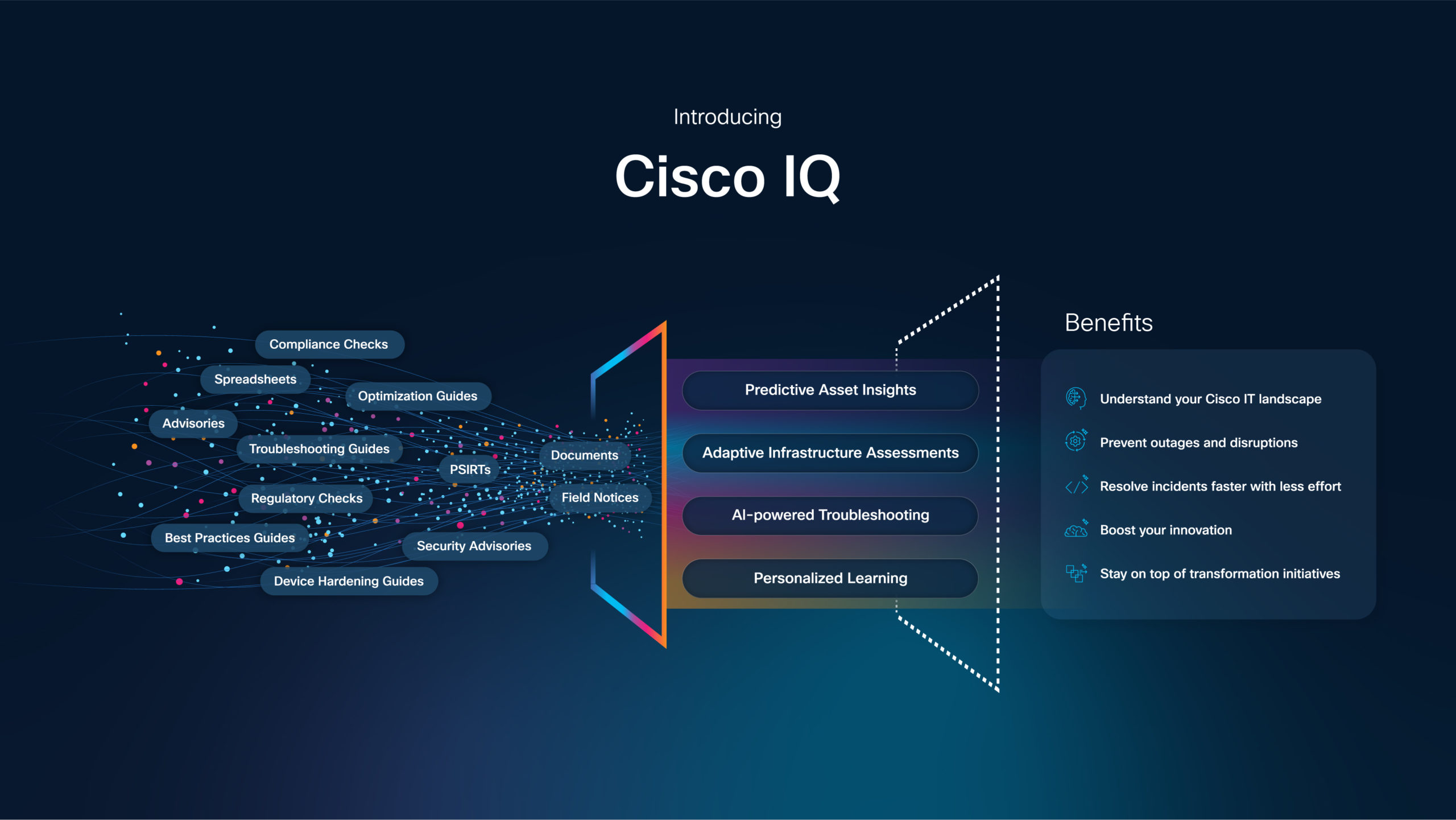
The Core Architectural Pillars
To deliver on this vision, we engineered Cisco IQ around four foundational pillars. 1.Data Fabric: A Digital Model of the Lifecycle. The foundation of any intelligent system is its data and context. Data Fabric creates a comprehensive digital model of the infrastructure lifecycle, connecting data from planning through operations. It is designed to handle the full spectrum of data—structured, unstructured, static, dynamic, batch, streaming, and MELT (Metrics, Events, Logs, Traces). This is the bedrock that provides easy, standardized access to all necessary context. 2.Document Intelligence and Knowledge Management. Cisco’s greatest asset is our decades of accumulated knowledge. Cisco IQ is designed to unlock it. We use a sophisticated combination of document intelligence, knowledge graphs, and LLM-based reasoning to convert our vast library of unstructured content—product documentation, design guides, and security policies—into structured, retrievable knowledge. By using retrieval-augmented generation (RAG), we ensure that when the system provides an answer, it is accurate, explainable, and grounded in verified Cisco data. 3.Generative AI and Principled Automation. Enterprise operations demand determinism. You expect the same input to produce the same result, every time. However, the LLMs that enable so much innovation are probabilistic by nature. Reconciling this is a core engineering challenge. We have built a system of guardrails—from RAG to schema enforcement and Human-in-the-Loop (HIL) validation—to deliver deterministic outcomes from these probabilistic models. This discipline ensures that our AI-generated automation is reliable and trustworthy, and it is a practical application of our Responsible AI principles. 4.API-First Design with Modern, Evolving Interfaces Cisco IQ is engineered to be API-first. We believe that programmatic access is fundamental to modern IT operations. All capabilities are exposed through well-designed APIs that adhere to Cisco’s API design principles, enabling deep integration into your existing toolchains and workflows. While APIs provide the foundation, human interaction requires a flexible and intuitive experience. Built on top of these APIs is our Multi-Modal UI. Different tasks require different views, so we provide three integrated interfaces:- Dashboards: For monitoring known metrics and KPIs. This is the reliable bedrock of operations.
- Conversational AI: For open-ended, natural language questions. This is the discovery tool for investigating issues.
- Generative UI: For complex analysis where the system creates the best visualization—a chart, map, or timeline—to explain the data. This is the insight engine.
From Architecture to Application: Concrete Services in Cisco IQ
These architectural pillars enable a suite of powerful, integrated applications, tailored for both Support and Professional Services engagements.Capabilities for Cisco Support
Predictive Asset Insights: Solves the persistent challenge of asset management by reconciling data from purchase contracts, device telemetry, and support cases into a single, unified inventory. It tracks lifecycle milestones and delivers relevant Field Notices and Security Advisories, enabling proactive infrastructure management. Adaptive Infrastructure Assessments: Provides a standardized assessment framework across multiple domains, from operational health to security hardening. It uses AI to interpret best-practice guides, generates tailored assessment plans, analyzes your configurations, produces structured findings, and provides prioritized recommendations.
 AI-Powered Troubleshooting: Redefines the support experience. It includes a modern case management interface with an AI assistant for more efficient interaction. Behind the scenes, our agentic AI drives the troubleshooting process, employing both hypothesis-driven and evidence-driven methods—just like an expert engineer—to systematically narrow down root causes for faster case resolution. The agentic AI system also leverages digitized internal knowledge (from our best humans) as well as the entirety of past issues and solutions (via anonymized Root Cause Analysis notes) to inform the AI as it troubleshoots.
Capabilities for Cisco Professional Services
For Professional Services, the challenge has always been scaling our deep technical expertise consistently across every engagement. To solve this, we are introducing automated, data-driven workflows to complement our human-led delivery. Cisco IQ provides the tooling to achieve high quality, personalized engagements at scale. Digitized Delivery Framework: This is a suite of capabilities designed to automate the end-to-end Plan, Design, Implement, Operate and Optimize processes. It transforms traditional workflows into fully automated, AI-ready processes for execution. Key components include:- Digital Requirements Gathering: Instead of static documents, this provides a centralized system to capture and integrate customer solution requirements. This ensures requirements are traceable, consistent, and reusable across the entire delivery
- Documentation Sharing: A secure, centralized space for sharing project documents, designs, and plans, ensuring all stakeholders are working from the same context with clear version control and approval
- Documentation Automation: Empowers our engineers to create professional, customer-ready deliverables by combining standardized data models, reusable templates, and AI-assisted content generation. This enables faster, consistent, and compliant documentation.
- It can optionally integrate with customer CI/CD tools, and it leverages AI to accelerate test environment design, test case creation, and results analysis.
- Most importantly, the framework is intelligence-driven, utilizing the Data Fabric to share context from other lifecycle stages. This enables the creation of customizable tests that are tailored to your specific business needs and operational reality.
Enterprise-Grade by Design
We understand that for any of this to be useful, it must meet the stringent security and operational requirements of your business. Deployment Flexibility: Meeting Your Operational Reality Cisco IQ is designed to meet you where you are. We offer three distinct deployment options:- SaaS: For teams prioritizing ease of use and rapid deployment, our cloud-hosted offering is optimal. A “Cloud-Assist” component on-premises acts as a secure bridge between your systems and our cloud environment.
- On-Prem Tethered: For organizations with strict data residency requirements, this option combines the security of on-premises data storage with the convenience of receiving automated updates and new features from the cloud.
- On-Prem Air-Gapped: For organizations with the most stringent compliance and data sovereignty mandates, such as those in highly regulated sectors. This deployment has no external connectivity, and all updates are applied manually.
The Journey Ahead
Cisco IQ is currently in Early Field Trials with a select group of customers. Over the next six months, we will expand these trials, using direct feedback from real-world use cases to guide our development. As we move toward general availability, planned for Q2 of 2026, Cisco IQ will become a foundational element of Cisco Support, setting a new bar for the value and capabilities customers can expect from our premium tiers. We are also committed to empowering our partners by providing flexible access through the graphical user interface, upcoming APIs, and resell opportunities via Cisco Partner Support. This is being created with your real-world challenges in mind. To learn more about our roadmap or express interest in future trials, reach out to your Cisco account team. Learn more:[1] Source: Business analyst Paul Kedrosky: https://paulkedrosky.com/honey-ai-capex-ate-the-economy/


Insightful blog Bhaskar!
The statement “to deliver deterministic outcomes from these probabilistic models” made the penny drop for me.
Cisco leads in the AI era,excited to witness all the innovations.