



Today at Cisco Live, we are announcing Agent Builder in Cisco Cloud Control Studio, a new way to customize and extend Cisco Cloud Control with AI agents. Agent Builder is a key capability for making agents work the way teams operate.
What is Agent Builder?
Agent Builder is where teams bring their tools, knowledge, and operational expertise into Cisco Cloud Control. It brings together three of the most important parts of building agentic operations: connecting third-party products, building AI agents, and creating reusable agent skills. Builders describe what an agent should do in natural language, connect the tools and knowledge it needs, test it in a sandbox, and publish it through a versioned lifecycle.
Agent Builder is one of the capabilities being announced inside Cisco Cloud Control Studio, the new part of Cisco Cloud Control built for customizing and extending the platform with custom agents.
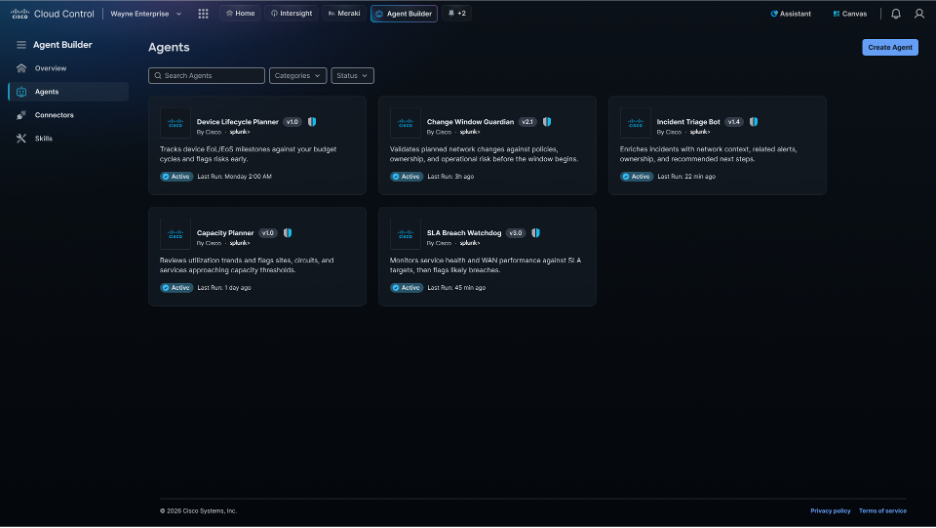 A single view of every agent built or deployed in Agent Builder.
Connect your tools
Most IT organizations run a mix of Cisco and third-party tools. Tickets live in ServiceNow. DNS, DHCP and IPAM live in Infoblox or BlueCat. Incident management runs through PagerDuty. Documentation is spread across Confluence and other wikis. Each system holds part of the operational picture—and none of them hold all of it.
That’s why we unveiled Agent Builder, with more than 50 ecosystem integrations planned, so you can connect those systems directly to your agents. Native integrations are pre-built, validated, and configured through a guided flow. No custom code required. For systems without a native integration, Agent Builder supports Model Context Protocol (MCP), an open standard that lets AI agents securely access tools, data, and enterprise systems beyond Cisco. In the future, customers and partners will be able to build their own MCP connectors for any tool with an API.
Once connected, a tool’s data and actions are available to every authorized agent. Agents can pull context, correlate signals, and propose remediation, all from inside one investigation.
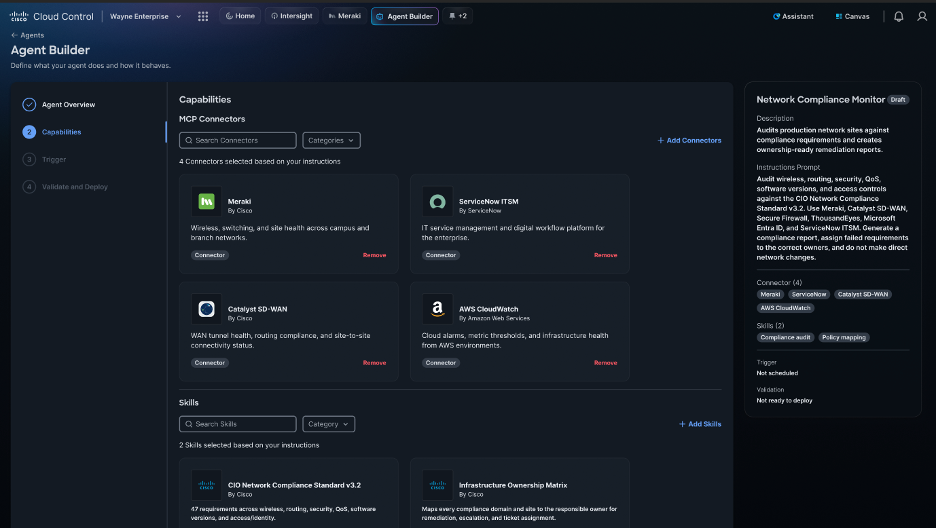 Extending AI agents to third-party tools through Model Context Protocol in Agent Builder.
Build agents tailored to how you operate
Build AI agents that fit the work your teams do every day, including agents for compliance audits, morning health checks, incident triage, configuration drift monitoring, and more.
Customers also choose how each agent runs.
Ambient agents operate continuously in Cisco Cloud Control. They monitor data, watch conditions, and act or alert when something happens. An ambient compliance agent, for example, checks device configurations against company policy on a daily schedule and generates a report. Operators do not need to be in a session. The agent works in the background and notifies the team when it completes or needs approval.
Live agents are invoked during sessions in Cisco AI Canvas. They join active investigations alongside operators in real time, pulling context, correlating data, and proposing next steps as the work unfolds.
The two modes work together: ambient agents keep the environment monitored, and live agents step in when complex work needs extra reasoning. Together, they let teams use AI in the way that fits the work, whether that is monitoring quietly in the background or thinking alongside operators during a live investigation.
Encode operational knowledge as skills
Agent Builder turns runbooks, SOPs, and procedures into reusable skills that agents can call when relevant. A skill might be a DNS troubleshooting procedure, a firewall validation step, or a compliance review checklist.
Because skills are reusable, any authorized agent can call them, turning institutional knowledge into something that the platform actively uses, not something buried in documents. Ovder time, your team’s standards shape how AI agents operate.
Governed, observed, and evaluated
Building an agent is the easy part. Trusting one in production takes governance, observability, evaluation, and a clean lifecycle. Cloud Control Studio delivers all four.
- Governance. Every agent runs under policy enforcement through Cisco AI Defense. Customers define what each agent can do, when it can act, and what actions require human approval. Agents propose. Humans approve before anything changes in production.
- Observability. Splunk AI Agent Monitoring captures every agent’s execution, including outcome, duration, trigger, and a full trace of every LLM call, tool invocation, and skill execution. Operators can drill into exactly what happened and why.
- Evaluation. Splunk AI Agent Monitoring, powered by Galileo, scores agent outputs for accuracy, relevance, and correctness. It flags hallucinations and detects drift when agent quality degrades over time.
- Lifecycle. Agents go through a draft, sandbox, and publish lifecycle. Builders verify behavior against real data before agents touch production. Version control tracks every change, with full rollback support.
The result is an agent platform that is auditable, traceable, and trusted in production.
Get started
Agent Builder in Cisco Cloud Control Studio is being announced at Cisco Live. If you are at the conference, come see it at the booth or in sessions throughout the week.
If you are not attending, visit Cisco Cloud Control webpage to stay up to date on the latest product innovations and partner integrations.
Thank you to: Airtable, Aisera, AWS, Anomali, AppOmni, Arctic Wolf, Atlassian, Automation Anywhere, Auvik, BigID, BlueCat, Coralogix, Corelight, Cycode, Cyware, Datadog, Elotl, Endace, Forward Networks, Gluware, Google Cloud including Wiz, Harmonic Security, InfluxData, Infoblox, IP Fabric, Jamf, Komodor, Kong, Linear, Microsoft, NetBox Labs, NetBrain, NinjaOne, Okta, Oligo, Opal Security, Ordr, PagerDuty, Ping Identity, Port, PowerDMARC, Qualys, RunReveal, Slack from Salesforce, Semgrep, ServiceNow, Snowflake, SpecterOps, Tenable, Token Security, Torq, Upwind, Workato
Some products or features described may be in various stages of development and offered on a when-and-if available basis.


