



A year ago, at Cisco Live, we previewed Cisco AI Canvas, an agentic workspace where IT teams and AI agents investigate and resolve issues across every domain. It was built for teams that need to move from alert to evidence, from evidence to decision, and from decision to resolution faster.
During beta testing, AI Canvas was available in Meraki and Splunk. Today, Cisco AI Canvas is moving into Controlled Availability as an integrated part of Cisco Cloud Control rather than in the individual products themselves. This release reflects months of beta feedback from operators, architects, and IT leaders across industries who have used AI Canvas in real environments.
What AI Canvas was built to solve
Cisco has spent four decades building category-defining products across networking, security, compute, observability, and collaboration. Each product is powerful on its own. The next opportunity is what becomes possible when they work together as one operational platform.
A single operational question often spans many domains. Why is an application slow? Why is call quality poor? Did a recent firewall change affect user experience? Operators often become the integration layer, moving across tools and assembling the incident story by hand. The signal is usually there. The challenge is correlation, not data, which is why mean-time-to-resolution (MTTR) gets stretched to hours and sometimes days.
Cisco Cloud Control provides the foundation that brings Cisco products into one operational environment, giving teams a shared way to view their environment, get correlated alerts across products, and take action with AI assistance. AI Canvas is built on that foundation, as a workspace where the shared context becomes agentic action.
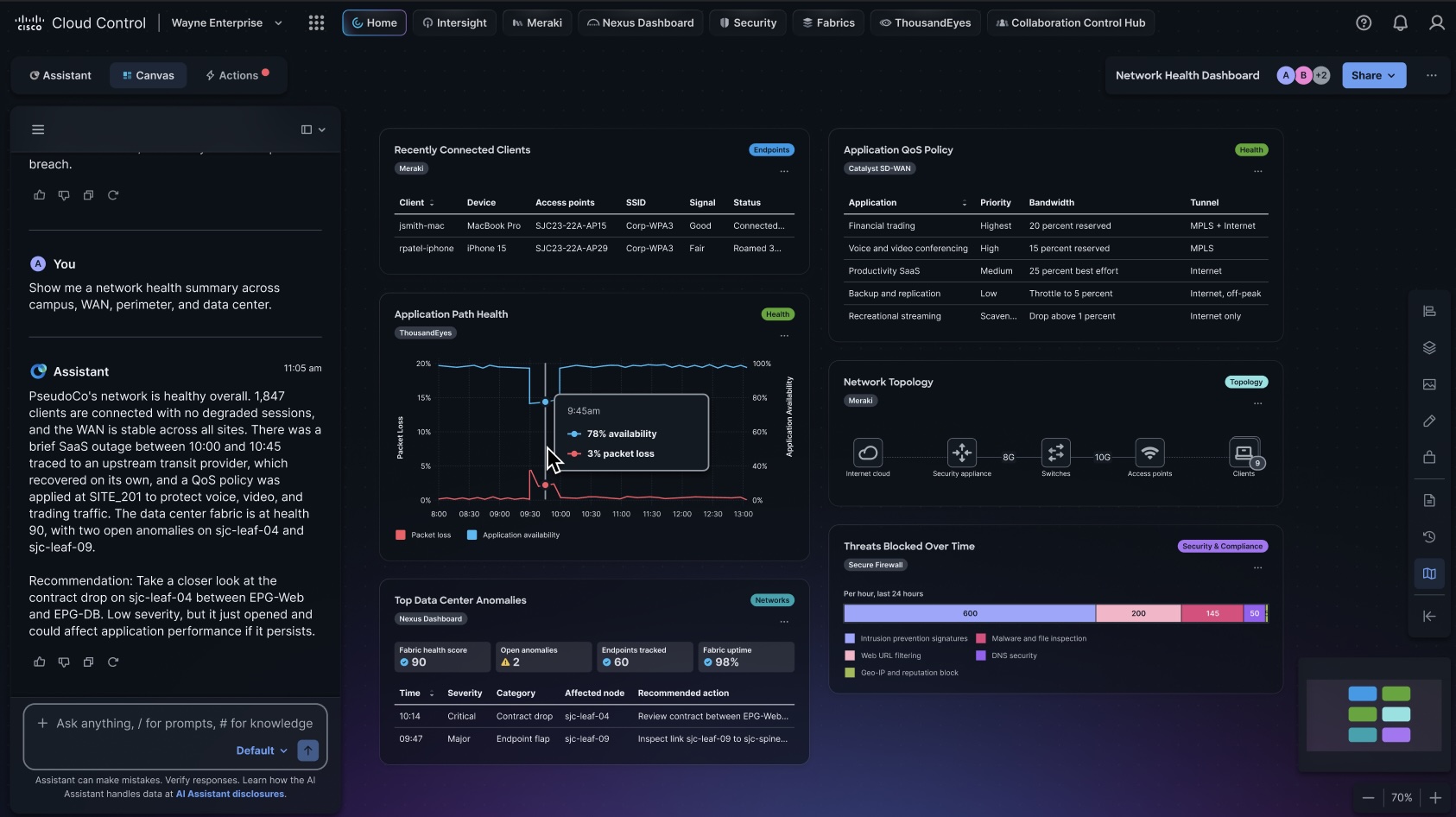
Inside an AI Canvas investigation
AI Canvas changes the operating model from manual investigation to agent-led investigation, with the operator in control.
Operators ask questions in natural language. From a single prompt, AI Canvas runs a structured multi-agent investigation. It reads the question, identifies the domains involved, builds a plan, and dispatches specialized agents to gather evidence in parallel. AI Canvas synthesizes the findings into one sourced answer, with the reasoning trail visible so operators can defend the conclusion or hand it off cleanly.
Default Mode powers the day-to-day experience. When operators need to check the health of a site, look at recent activity, or pull a quick view of an asset, Default Mode returns answers quickly with the relevant context. Most operational questions live here.
For more complex incidents, this Controlled Availability release brings something new.
What is new in Controlled Availability
This release introduces capabilities that make AI Canvas more useful for daily operations and more trusted for complex investigations.
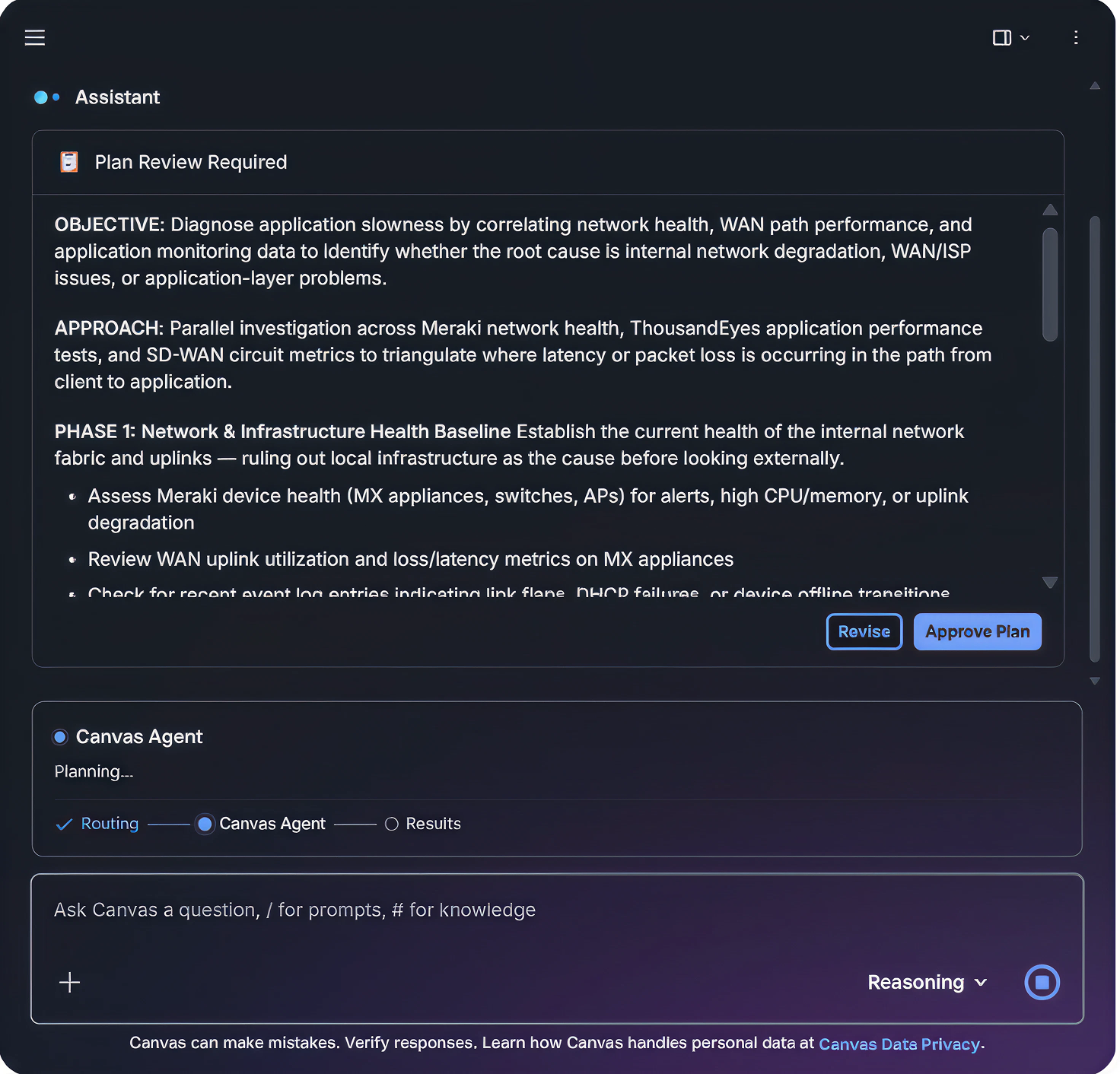
1. Deep Reasoning Mode is built for harder, multi-domain problems where teams need a clear, defensible answer. AI Canvas creates a full troubleshooting plan up front, grounded in best practice. The operator reviews, revises, or approves the plan before any agent runs. As the investigation proceeds, every step, finding, and conclusion is sourced and supported by evidence. Operators end up with an investigation that is easy to follow, easy to defend, and easy to hand off, especially when getting the answer right matters most.
Default Mode keeps everyday operations moving. Deep Reasoning Mode steps in when issues require deeper analysis.
2. Interactive generated widgets give operators the exact view they need for the question they asked, including topology maps, performance charts, summaries, and reports drawn from live data. Operators can click in, drill down, export, or push a widget into the next step of the investigation.
3. Multimodal context lets operators bring in the visual evidence they already rely on. Screenshots, dashboards, RF heatmaps, topology diagrams, and error images can become part of the investigation alongside live telemetry. The result is more complete investigations because AI Canvas reasons over the same evidence the operator is looking at.
4. Knowledge base built in lets teams bring runbooks, SOPs, and policies directly into AI Canvas. AI Canvas starts with Cisco best practice and becomes more specific to each customer’s environment as approved knowledge is added. The result is AI that follows the team’s standards, with investigations aligned to how the organization actually operates.
5. Board Library gives operators Cisco-curated starting boards for common scenarios, including security posture reviews, wireless troubleshooting, compliance checks, and application performance investigations. Each board is structured so teams can run a meaningful investigation immediately rather than start from a blank page.
Each of these capabilities exists because operators told us what an agentic workspace really needed.
Shaped by operators across industries
This release has been shaped by alpha and beta customers across industries – financial services, healthcare, retail, manufacturing, technology and more. Their teams ran AI Canvas against real environments, real incidents, and real operational patterns. They helped us refine what operators need from an agentic workspace: clear plans, sourced findings, useful visualizations, persistent context, faster investigation, and human control.
That feedback is visible throughout this release. We are grateful to every customer and operator who helped shape this milestone.
Designed for how teams work
AI Canvas is designed for how operators actually work. It is where humans and AI agents come together in one shared workspace, working from the same evidence, the same context, and the same proposed actions. Multiple teammates can join the same investigation in real time, while AI agents handle the heavy lifting of gathering context, correlating signals, and proposing next steps across domains.
Findings, decisions, uploaded files, and approved actions stay with the investigation across handoffs, shift changes, and escalations, so the next operator picks up where the last one left off rather than starting cold.
That continuity is what helps reduce MTTR. Instead of repeating work or rebuilding context, teams keep the work moving across people, shifts, and the AI agents working alongside them.
Customize & extend with Cloud Control Studio
Agent Builder in Cisco Cloud Control Studio was also announced at this year’s Cisco Live. It is a new part of Cisco Cloud Control, designed for customers and partners who want to extend the platform with their own tools, agents, and operational knowledge.
In Agent Builder, customers can do three things:
- Connect third-party tools. Through native integrations or open Model Context Protocol connectivity, tools beyond Cisco can become part of how AI Canvas reasons across the environment.
- Build custom agents. Customers can build agents tailored to their own operational needs, such as configuration drift monitoring, compliance checks, escalation workflows, or recurring incident investigations. Agents join investigations live inside AI Canvas.
- Turn knowledge into reusable skills. Runbooks, SOPs, and procedures become reusable agent skills that any authorized agent can call during an investigation.
Teams can also discover, share, and adopt agents and integrations through the Cloud Control Marketplace, the third-party ecosystem inside Cloud Control. Marketplace gives teams a curated way to extend the platform with capabilities built by Cisco and partners.
Anything connected, built, or adopted through Cloud Control Studio and the Marketplace is usable in AI Canvas. The more tools, agents, and skills added, the more capable the workspace becomes for the customer’s specific environment.
Come see it at Cisco Live
Cisco AI Canvas, alongside Cisco Cloud Control, is entering Controlled Availability for United States commercial customers. If you are at Cisco Live, come see Cisco Cloud Control with AI Canvas at the booth for a live demo, or in sessions throughout the conference. Session catalog for AI Canvas here.
If you are not attending, visit the Cisco AI Canvas webpage to stay up to date on the latest product innovations.
Some products or features described may be in various stages of development and offered on a when-and-if available basis.


