So how many of you go on a business trip to another country only to find upon your return the shock of a lifetime, your phone bill? I know that I have and instead of the promises of lower prices from the big operators, you get hit with roaming surcharges and the like? C’mon you know that you have.
We found a fast-moving company named MTX Connect based in Luxembourg has solved the travelers’ problem. Delivering flat rate data services on true roaming multi-network that ensures seamless coverage and service globally. MTX Connect targets corporate and enterprise B2B services, business travelers, and workgroups needing customized usage profiles and 100% control of charges along with the flexibility of having connectivity whenever or where ever they need it. Unlike many of the large existing operators that focus on many internal key performance indicators (KPI), MTX Connect has a customer comes first mentality.
Servicing customers across Europe, North America and Asia and provides coverage at a global level in specific countries through Asia, Australia, and Africa. With offices in Moscow, Tallinn, Kiev, Limassol and Hong Kong.
To expand to other countries MTX Connect leverages a great partner program. Offering all their partners exclusive use of their highly intuitive SIM management platform, including real-time data diagnostics and automatic billing at the rates you set. Enabling them to speed up administrative and billing processes, concentrating on other aspects of business.
MTX Connect fully understands the challenges of mobile Internet solutions, the complexities of their customers’ businesses and the need for a reliable, secure and cost effective solution. Their customer support team is formed of highly experienced members of our management team, so they will always be able to answer any queries.
MTX Connect created a virtual, cloud based architecture to service their customers. With many CCIEs employed, they chose the Cisco Ultra Packet Core to service their large global customer base. MTX Connect was established in 2012 and is licensed by Luxembourg Institute of Regulation (ILR), and maintains GSM Associate membership since 2013.
It’s been just over two months since Cisco unveiled our vision for the new era of networking, The Network. Intuitive. The response has been amazing. Employees, partners, customers, and influencers are all excited about what happens when a network constantly, learns, adapts and protects.
And the more people learn what Cisco’s intent-based network can do, the more excited they get.
Which is why we asked Peter Dinklage to tell the next part of the story in a video launched today (one below). This next chapter is about helping businesses understand just how game-changing the new network is – and that Cisco is the only company capable of building that network.
https://www.youtube.com/watch?v=CNXNWsfNlgU
To help businesses understand what Cisco’s network makes possible, they need to hear about these innovations in a simple and relatable way. We worked with Ogilvy, our new agency, to develop the idea for the video. The team did a fabulous job making something that is both surprising and bold – just like the new network.
Peter Dinklage is the perfect messenger because of his global fame and ability to speak in a bold, intelligent, and captivating way. As he wanders through the streets of London, you hang on to each of his words as he describes just how simple – and monumental – the new network is.
This video provides the air cover our sales teams and partners need by creating buzz and excitement in the marketplace. It becomes a reason to connect to discuss how Cisco can help businesses meet their goals using the new network. It also brings a strong sense of pride for our brand to our employees, partners, and loyal customers.
I’m so excited to have Peter on board. And so proud to share this video with the world.
Help us amplify the next part of the network story by sharing the video on your social channels using #networkintuitive.
As many of you may have read on Monday in Tom Edsall’s blog post, Cisco announced our intent to put Cisco ACI into the public cloud – AWS, Microsoft Azure, and Google. This allows our customers to place policy anywhere. And now, with ACI Virtual Edge (AVE), we will continue to fulfill our ‘ACI Anywhere’ promise.
As outlined in my blog post in May, we at Cisco are committed to innovation, choice, and openness for customers in the wake of VMware’s decision to cease support for the third party virtual switch APIs in vSphere 6.5U2 and beyond.
I’m excited to announce that we are following through on our commitment. We will soon begin Early Field Trials (EFT) of the ACI Virtual Edge (AVE), our next generation of the Application Virtual Switch (AVS) for ACI environments. We are on schedule to ship by the end of this year. The ACI Virtual Edge is hypervisor independent, offering consistent policy control across multiple hypervisors, with our initial version targeted for VMware ESXi.
Cisco understands the burden of operational change. We have designed the ACI Virtual Edge for an easy transition with minimal operational disruption. Current customers can continue to use the AVS and move to the AVE at their convenience. We will continue support for the AVS to alleviate customer concern. With this solution, customers can maintain their existing policies and operational procedures.
Stay tuned as we will continue to reveal more in the coming weeks. If you are attending VMworld, please seek out the Cisco team or prearrange a meeting through your account team. We’ll be happy to reveal more and show you a live demo.
The in-booth theater will also feature the solutions above in addition to the solutions offered by many of our eco-system partners, CommVault, DellEMC, IBM, Intel, NetApp, Nvidia, Pure, Veeam, and VMWare.
On Tuesday August 29 from 2:30-3:00, Cisco will be speaking in a breakout session titled “What’s new with Cisco HyperConverged Infrastructure”
Cisco will also be co-hosting a VIP reception on Sunday evening with CommVault and Pure. Meet us at the TAO in the Venetian on August 27, from 8-10pm.
We invite you to come by Booth 614 and see why Cisco Does Compute!
Guilty pleasures. We all have them. While my list is long, binge watching home renovation shows is definitely at the top. I just love the idea of a crew coming into my house and completely transforming it from the ground up, based on my vision. My vision includes a house with an open floor plan, an all-white kitchen with the latest appliances, and a digital infrastructure so I can enjoy smart lighting, thermostats, and other capabilities managed with an app. Relying on a professional team’s expertise and getting to enjoy my dream house without experiencing remodel havoc… I’m in!
Renovating a house isn’t that different from renovating a network. Maybe a certain floor-plan worked great for you 5 years ago, but now with a growing family your needs have evolved. The network you had five years ago most likely isn’t meeting your needs today either. New innovations, evolving security threats and increased traffic are requiring you to upgrade. For both your house and network the foundation is key. Your house needs a reliable and stable foundation because we all know you don’t want to deal with leaks and plumbing issues down the line. Similarly, your network foundation is not the place to cut corners. The benefits of best in class products and solutions are endless—continuously learning, adapting, and automating, even after they’ve been installed.
You get it. Hiring the right “builder” to help you renovate your house is critical to the process and success. Hiring the right “builder” to manage your network migration is equally important and critical to the success of your business. Don’t worry, we won’t leave you in the dark to figure it out on your own. We can bring your vision of a secure, automated, faster network to life.
Cisco Services is basically the dream home renovation team of IT. Our experts live and breathe digitization. We’ll work side by side with you to design and deploy your ideal network and to bring your vision of a secure, automated, faster network to life.
We can help you move to a network foundation that integrates the technologies your business demands, but where do you begin? Our DNA Advisory Service is the first step. This Cisco Service helps you create a strategic plan to achieve your business objectives through technology while maintaining a stable, secure network during your transition. Our experts work with you to understand where you want to take your business. Then we build a roadmap with predictive steps to take you there. Want to know more? See how manageable your “fixer upper” network project can be with these 4 steps.
Click here to indulge yourself in the four steps to the new network.
Smarter Node Selection for Low Latency Mobile Services
Written by Humberto La Roche, Bob Smith, and Tim Stammers
One particular aspect of mobile network evolution that deserves attention is the idea of reducing round-trip time (RTT) between consumers of a service and the service source itself. So much so that in 5G, this concept has acquired its own unique 3GPP term: URLLC which is an acronym for Ultra-Reliable Low Latency Communications. Cisco envisions, as does AT&T among other leading carriers (see [1, 2]) that low latency communications will enable a new class of network services characterized by tight control loops involving Augmented Reality (AR), Virtual reality (VR) and even haptic communications triggered by the immediate network response to a touch event. Cisco is excited about these possibilities and is pursuing an aggressive mobile network evolution strategy designed to deliver an end-to-end system architecture enabling low latency capabilities. But amidst all of this, it is probably worth unpacking the basics so that we can develop an understanding of what is truly needed and how we can help carriers realize the end-game.
Perhaps the most relevant control loop today is the one that keeps the venerable TCP protocol operating well in networks. The TCP congestion control algorithm brilliantly introduced by Van Jacobson and others [3] defines a method whereby a channel can signal performance to a sender, in real time, to adjust its streaming rate to the end-to-end congestion state. It is understood empirically that in most regimes and most TCP versions, the TCP throughput performance is inversely proportional to RTT or some power of RTT between 1 and 2 [4] . And why is this important? Well, notwithstanding the introduction of QUIC [5], this observation is very important because most traffic delivered, over 90% by volume, is carried by TCP protocol! And this includes consumer video whether managed by the operator or streamed by an over-the-top content publisher. And the network can help reduce RTT latency by allowing for content servers in the form of content delivery network (CDN) caches to be deployed close to the consumer of the TCP traffic. Reducing the latency to enhance performance is hugely important for video traffic which today is primarily delivered over TCP. And even QUIC itself uses TCP-style congestion control to rate limit itself and so the dependency on RTT is still present as a consequence.
But most mobile core networks are not designed to assign a geographically appropriate IP address, one based on the location of the user, to the mobile device. In fact, the conventional wisdom up until now has been that an operator would not ever want to do that! Why? Well, the reason is very basic: mobile networks are designed with the principle of IP address continuity in mind: a mobile device preserves its IP address no matter where located in the mobile network. In a nationwide network, a user can in principle travel thousands of miles, adding significant transport latency, and still use an IP address that has no relationship at all to the location. And this, up until now, has been considered a good thing.
But something changed along the way. Mobile application designers started to build resiliency to underlying IP address changes into their apps. For example, a video streaming app might play from a buffer while it silently restores TCP connectivity to the server when an underlying IP address change occurs.
Or, a mobile application designed might build an app using a protocol stack designed from the outset to not care about underlying IP address changes. The aforementioned QUIC protocol from Google has this feature and new protocols in the ICN/NDN family [6] also do. Network-hosted mobility is becoming less important!
Putting it all together, a priority for mobile network architects should be to figure out precisely how to do a geography-based selection of anchor points so that low latency services can be maintained despite user mobility. This is a traffic management function which Cisco has achieved in a manner entirely compatible with existing mobile device features and with emerging 3GPP R14 and 5G architectural principles. The key concept is the disaggregation of the mobile core called “Control and User Plane Separation”, or CUPS in 3GPP specifications [7-10]. In CUPS, the mobile core is decomposed into a centralized control plane supporting session management, policy and charging, as well as regulatory features and User (or bearer) Plane entities that can literally be deployed anywhere the IP network allows. In Cisco’s micro-services-based Cloud Native Mobile Core solution, the core also includes an intelligent EPC node selection function that allows for the dynamic selection and re-selection of these User Plane entities so that they are geographically appropriate at any point in time and for a specified subscriber and specified Access Point Name (APN). In this way, the IMS APN or any other APN which is required to be always anchored and for which RTT is a lesser consideration, can remain so but any other selected APN such as a video APN, a specialized low latency APN, or even an Internet APN, can be locally anchored with geographic specificity to the location of a user, and based on the Subscriber’s profile.
Such intelligent and dynamic node selection is but one of the many capabilities of Cisco’s Node Selection and Load Balancing (NSLB) product which was unveiled at MWC 2017. Cisco’s NSLB is a leading Cloud Native virtualized software application in the overall Cisco Mobility packet core portfolio. In both 4G and 5G cores, Cisco’s NSLB enables Node and Slice selection, Node/Slice load balancing, and bearer traffic steering at high scale, in a more dynamic, flexible and cost-effective manner than classic DNS techniques can enable.
Through its dynamic analysis of session signaling, and select real-time network interactions, Cisco’s NSLB product enables carriers to implement a truly Cloud Native DevOps service and network operations model over NFV-based EPC and 5G core architectures, by enabling the activation and deactivation of specific core nodes and slices linked to new services, new capabilities, and / or new core capacity. In support of such DevOps operations, NSLB also enables the carrier to dynamically add/remove candidate EPC node types, and slices as a basis for performing subscriber impacting maintenance activities or changes – again without the need to manipulate or distribute new DNS zone files and without the need for MME or DNS system feature upgrades.
Cisco’s NSLB is a pre-5G version of the 3GPP/5G-defined NRF and NSSF elements [10] that works in the LTE networks deployed today. While Node and Slice selection is an embedded defined function in 3GPP’s 5G architecture, today’s leading carriers aren’t waiting for 5G to reap the operational benefits of intelligent node selection, and are working today with Cisco on innovative use cases such as the mobile low latency services described above.
Low-latency mobile session processing, in conjunction with dynamic geographically-based core node selection is a powerful feature combination. It enables consistent delivery of low latency services in the presence of mobility, and allows for a highly scalable mobile network supporting video traffic delivered over TCP (or other protocols for which RTT is a consideration). Dynamic management of proximity on a per-APN and per-subscriber basis might actually be the elusive standards-based feature that delivers the promise of edge computing!
If you have a question or would like more information please email: mobilecloud@cisco.com
V. Jacobson and M. J. Karels, “Congestion Avoidance and Control,” in SIGCOMM ’88, Stanford, CA, 1988: ACM, 1988.
T. V. Lakshman and U. Madhow, “The performance of TCP/IP for networks with high bandwidth-delay products and random loss,” IEEE/ACM Transactions on Networking, vol. 5, no. 3, pp. 336-350, 1997.
As adoption of the Internet of Things (IoT) makes the world more “connected,” drones or UAVs (Unmanned Aerial Vehicles) are no exception. We are seeing an increasing number of cloud-connected drones deployed for commercial applications. But what happens when there is an absence of continuous connectivity?
Fortunately, fog computing can step in where wireless or LTE connectivity might fail.
Fog-enabled drones create endless possibilities for commercial use. My colleague Chuck Byers offers a great example in his recent drone delivery use case blog for Open Fog Consortium. But the commercial use of drones plus fog computing doesn’t stop when pizza and beer arrive at your home on a Friday night. Drones are key to many even more disruptive services. Some of Chuck’s examples include:
Enterprise IT and networking services such as extending your Wi-Fi range, delivering extra computing power, or providing short-term storage exactly where needed
4G and 5G cell network restoration
Video surveillance of large areas (for example, campuses, military bases, ports, refineries, power plants, and railroads)
“Always-on station” for electronic news gathering
Health services that deliver emergency equipment, such as defibrillators or epi-pens
Even advertising (imagine flying billboards)
One thing all of these have in common is their need for cooperation between sophisticated computational resources on the drone, and even more sophisticated hierarchies of fog-based support intelligence on the ground.
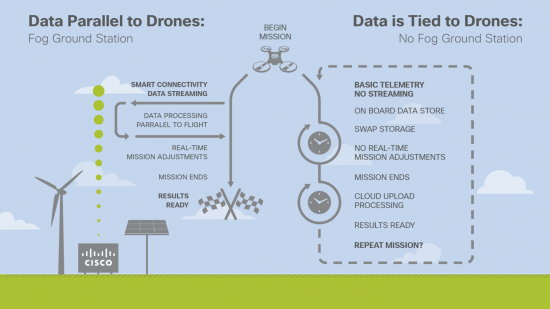
Consider the precision agriculture use case depicted in the following diagram. Many farm fields in rural areas lack backhaul Internet connectivity or the bandwidth to perform full-on cloud operations. In the absence of a fog computing ground station architecture (shown on the right), it might take 48 to 72 hours to get initial feedback on the quality of the data captured from a data-gathering mission. If there is a need to repeat the mission based on data issues, it’s a whole new endeavor and it might be too late. With solar or wind powered intelligent fog ground stations in place, the same mission could be executed quite efficiently, on time and with the highest level of data quality.
I’m not suggesting that fog computing should replace cloud-powered IoT and Internet-connected drones. Rather, there is a great opportunity for them all to work hand-in-hand. Fog computing plays a critical role in many use cases where business impact could be lost in the absence of low-latency, cost-effective and reliable cloud connectivity. Highly scalable and robust architectures need to support and leverage both of these scenarios. And that’s the beauty of fog computing.
In my keynote address at InterDrone conference on September 6 in Las Vegas, I’ll be outlining some interesting opportunities combining these disruptive technologies – drones and fog.
What are some other business-critical fog computing use cases you can think of?
IoT promises to boost corporate profits worldwide by 21 percent by 2022, according to Cisco analysts. That’s because IoT can help businesses lower costs by realizing new efficiencies and drive new revenues by enabling new business models. Digital transformation in general, and IoT in particular, can help organizations become more productive and more responsive to their customers. It also can enable businesses to expand their operational models from one-time product sales to models that generate recurring revenue.
As organizations embark on this transformation journey, however, they are encountering challenges with IoT implementation. These include figuring out how to secure connected devices, networks and the data they handle, as well as how to find the talent who will design, implement and maintain security protocols.
The rapid and wide-scale adoption of connected sensors and IoT devices in manufacturing, finance, telco and utility settings means that the global economy’s critical infrastructure is increasingly vulnerable to cyber attacks. October 2016’s Mirai botnet attack, for instance, used tens of millions of unsecured connected devices to deploy a denial-of-service (DoS) attack on an internet infrastructure company.
The result? Many high-profile online services and websites were taken offline. It is estimated that $110 million in potential revenue was lost due to the attack. And the company attacked lost more than a quarter of its customers.
To compound the IoT security challenge, a significant and growing skills gap exists. The shortfall of cybersecurity experts is expected to reach 1.5 million globally by 2019. There are just 500,000 developers worldwide working on IoT. So, there is and will be a need for many more developers as connected devices and applications proliferate in the years ahead. Some estimate the demand for IoT professionals will reach 4.5 million within five years.
Seasoned IT and OT professionals acquiring new skillsets relevant to address IoT will fill the majority of these roles. This means there is a tremendous need for training and certification. Many organizations are struggling to understand what skills are and will be required to allow for successful IoT implementations. The good news is that Cisco offers a reference framework for these skillsets, and the training and certification programs to arm individuals and existing team members with the tools they need to address digital transformation and IoT implementations.
To help organizations and individuals take advantage of all that IoT has to offer while keeping devices, networks and data safe, Cisco has just released a white paper, How to Succeed Through Securing the Internet of Things.
This white paper helps organizations prepare for IoT initiatives by:
explaining what’s prompting the expansion of IoT,
providing an overview of the resulting risk landscape,
offering best practices on how to protect your organization from such risks, and
sharing how Cisco security training and certifications can help optimize your IoT security posture.
Charles Schulz once said, “Happiness is a warm puppy.” And Mr. Schulz should know, after all, as he created the Peanuts comic strip and much beloved beagle, Snoopy! Far and wide, if you ask Cisconians who some of their best friends are in life — many will respond with a four legged fur ball that sleeps quietly at their feet while they work.
They’re the faces that become familiar to us on WebEx calls, sometimes get to visit our offices, and whose adventures always seem plentiful. They keep us smiling, help lower stress levels, listen to us as we bounce ideas off them throughout the day, and keep us active — because who doesn’t love a good walk around the block?!
To honor #NationalDogDay this year, we decided it was time to introduce you to some of our favorite #DogsOfCisco on Instagram!
Hippo’s Cisconian: Drew McInnis, TS Business Analyst – GES
What Made You Want to Start an Instagram for your Dog?: Originally I wanted to have a place to post her pictures without annoying my friends from my personal Instagram. Now I’m just having fun trying to see how far I can grow her page!
What’s been the best thing about having your dog on Instagram?: Being able to interact with people around the world who just love dogs! It hasn’t really occurred to me before how universal a dogs smile is or how you can easily communicate across languages by using emojis.
What’s the best thing about being a part of the #DogsOfCisco on Instagram / Why do you #LoveWhereYouWork?: I love Cisco because there is such a focus on work/life balance. I mean how many companies take into consideration their employee’s pets and implement Bring Your Dog to Work day and even have blog posts about the #DogsOfCisco?!
Do you have a great Cisco memory or story with your pup? At one of my off-sites my team made me bring Hippo to dinner so she could meet everyone in person! They all follow her on Instagram and always ask to see her on WebEx. She’s absolutely a member of our team.
What’s a fun fact about your pup?: She snores so loud it has woken me up before!
Follow Tango on Instagram:@ilovetotango(He also shares with his sister, Slate)
Tango’s Cisconian: Nenuca Syquia, HR Consultant
What Made You Want to Start an Instagram for your Dog?: Tango is so quirky, and the world deserves to see that cuteness, especially on a hard day. He is also a testament to what a loving home can do; he came to us from a shelter in Mexico, already sweet but so thin and nervous. He has come a long way from that little street dog! Slate makes cameos on his IG only because she is adorably lazy (so much so that we call her “Slazy” and Tango is called ‘Crazy’!)
What’s the best thing about being a part of the #DogsOfCisco on Instagram / Why do you #LoveWhereYouWork?: Seeing other happy dogs with their very happy owners (and office-mates).
Do you have a great Cisco memory or story with your pup? Tango came to one of our training sessions on design thinking, and he became our mascot for the two days. Slate came to the second version of the workshop, months later. So, they are both trained in design thinking and how HR is using it to change the game for our leaders and employees! They’re both true Cisconians at heart!
What’s a fun fact about your pup?: Even though Tango could run a marathon a day, and Slate would sleep 24 hours a day if she could, these two are best of buddies! They often sleep together, and when they don’t, they greet each other with kisses in the ear – no fail.
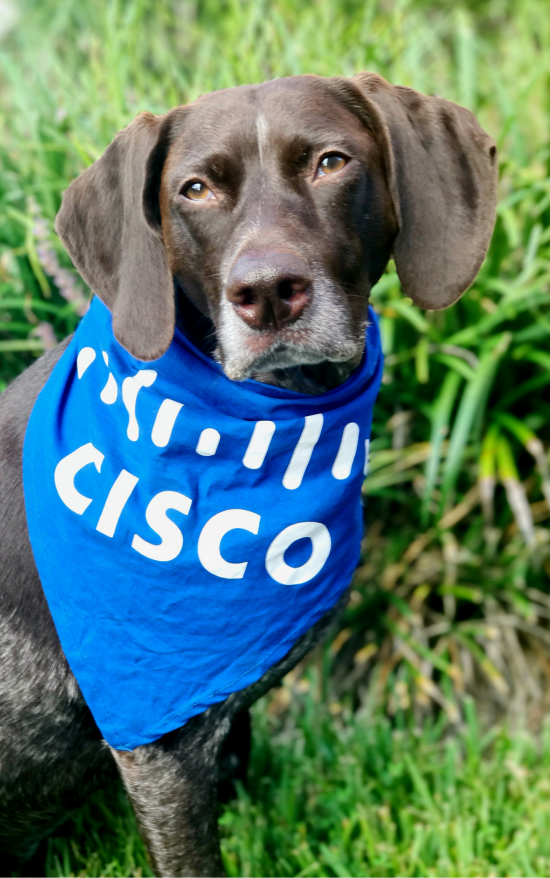
Kimbee’s Cisconian: Casie Shimansky, Social Media Manager, Talent Brand
What Made You Want to Start an Instagram for your Dog?: Being a photographer and longtime Instagram Lover — I knew I was about to inundate IG with photos of Kimbee’s face the second we got her. It only seemed right to give her a space all her own for our adventures which include Saturday Agility classes and “Pupcations” we take every year with her.
What’s been the best thing about having your dog on Instagram?: I love how people respond to her and how happy she makes others. We’ve been told quite a bit that people will seek her posts out when they need a smile or just to see what she’s been up to.
What’s the best thing about being a part of the #DogsOfCisco on Instagram / Why do you #LoveWhereYouWork?: I love that Cisco recognizes that, for many of us, our lives include furry counterparts. On a day she wasn’t feeling well, my manager even moved a 1:1 that we had scheduled so I could run her up to the vet in the only time they had available for us. It’s a pretty awesome thing to be working for a company that understands Kimbee is more than just a dog to us, she’s our family.
Do you have a great Cisco memory or story with your pup? I was on a WebEx call for Girls Power Tech just after we got Kimbee with a group in Boston. Back then…any time I spoke, Kimbee thought it was absolutely necessary to chime in too. Once that happened, I had to explain to the girls what was going on in the background and that I was throwing raspberries over to Kimbee to keep her quiet. At the end of the presentation, one of the questions from the girls was, “Can we see Kimbee?” She was instantly the most popular part of the presentation. I really am just this pup’s sidekick.
What’s a fun fact about your pup?: We found Kimbee thanks to the power of social media! We struggled to find German Shorthaired Pointers in our area through rescues — so, I reached out to a friend who I had been following on IG for years that had rescued GSPs before. She pointed out that many folks try to rehome their GSPs through GSP Facebook Groups — and a few weeks later, Kimbee’s face popped up.
Lumi and Bowsers’s Cisconian: Ray Leung, Talent Brand Manager
What Made You Want to Start and Instagram for your Dog?: Because everybody loves dogs! My girlfriend and I created their Instagram accounts with the goal of documenting their livelihood by sharing their experiences and candid moments for people to see. I’ve only recently become a dog owner but I’ve come to learn that they each have their own unique characteristics and personality traits and it’s fun to humanize that in a way and share that with the world.
What’s been the best thing about having your dog on Instagram?: I love capturing photos of my dogs in adorable, funny, or even awkward position.
What’s the best thing about being a part of the #DogsOfCisco on Instagram / Why do you #LoveWhereYouWork? It’s great that my dogs are also part of the#WeAreCisco family. When meeting new people or just casual conversation around the office, I find that a majority of people either have some interest or just absolutely love dogs. Dog owners all have a connection of sorts with one another, and non-dog owners still love to part of the conversation and ask tons of questions. It’s always a great #lovewhereyouwork moment when you’re able to share the joys in your personal life with the people you interact and work with on a daily basis.
What’s a fun fact about your pups?
Bowser = Bit territorial and cranky to other dogs that he doesn’t know. But very friendly to those in his inner circle. Lots bark, but no bite (he’ll bark til you walk a little closer and then he’ll cower away).
Lumi – Means snow in Finish. Which perfectly describes her white look. Another fun fact, we brought her to corgi con when she was a pup and convinced every other corgi owner (and probably Lumi as well) that she was an albino corgi. She’s even mastered the sploot. When we take her to the dog park, she almost always gravitates to other corgis to play.
Emery’s Cisconian: Richie Chea, Business Systems Analyst
What Made You Want to Start an Instagram for your Dog?: My girlfriend and I wanted to create a photo album of our dog so we could see him grow up. Somehow, he got really popular and it turned into a way for us to share Emery with the world.
What’s been the best thing about having your dog on Instagram?: The ability to share his photos and mischief with the world. I was amazed the number of positive comments and messages we received about how Emery cheered and brightened up people’s days.
What’s the best thing about being a part of the #DogsOfCisco on Instagram / Why do you #LoveWhereYouWork? It is cool how we can show the work-life balance and how you can still have a dog while having a busy work life. It is crazy how much Emery cheers me up and I am excited to share that with not only Cisco, but the world.
Do you have a great Cisco memory or story with your pup? I brought Emery in to Cisco when he was about two months old and everyone went crazy. The best memory of that day was when I let him out of his crate and he wasn’t shy but wild. He ran to everyone and wouldn’t stop shaking his little stump tail.
What’s a fun fact about your pup? Emery’s currently on a strict diet and exercise due to his recent weight gain.
Is your dog living the Cisco Life too? Be sure to share a photo on social and tag #WeAreCisco #DogsOfCisco so we can keep that cute puppy fix going all year long. We hope your pups get lots of treats and belly scratches this National Dog Day! 🐶
Think working at Cisco sounds “pawfect”? Apply here ➡ We’re hiring!
















 Follow Kimbee on Instagram: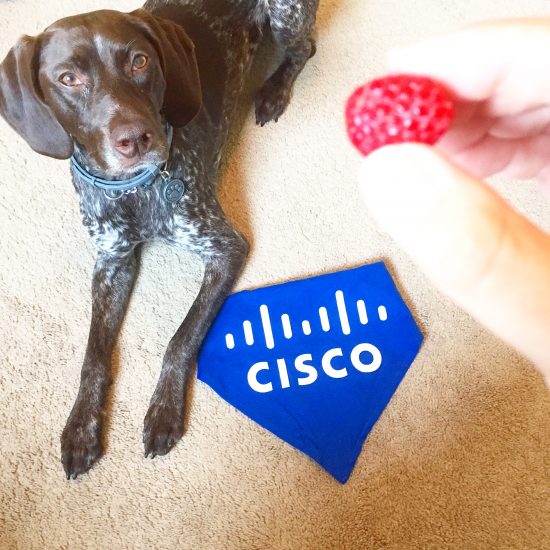
 Follow Lumi and Bowser on Instagram:
  When meeting new people or just casual conversation around the office, I find that a majority of people either have some interest or just absolutely love dogs. Dog owners all have a connection of sorts with one another, and non-dog owners still love to part of the conversation and ask tons of questions. It’s always a great #lovewhereyouwork moment when you’re able to share the joys in your personal life with the people you interact and work with on a daily basis.
 Follow Emery on Instagram: