Avatar

Join Cisco and Citrix on November 2 for an SDx Central moderated webinar to learn how trusted innovators, Citrix NetScaler and Cisco ACI joined to meet the rapidly changing needs of users and new applications using software-defined networking to modernize data centers. Discover how you can achieve business agility by building a secure, policy-driven architecture that offers deployment flexibility and the ability to choose the strategy that works best for your organization now and in the future.
This upcoming webinar follows earlier Cisco-Citrix presentations featuring joint solutions between Cisco ACI, Cisco Tetration and Citrix NetScaler. In May 2017, ACI-NetScaler joint solution won Best of Citrix Synergy, in the Storage and Networking infrastructure category. The Citrix – Cisco alliance has expanded to encompass Citrix NetScaler – Cisco Tetration and Citrix NetScaler – Cisco CloudCenter to create a broad range of data center solutions.

The November 2 webinar is open to all Cisco and Citrix customers and partners and will cover the gamut of business drivers: data center customer needs, key aspects of the Cisco-Citrix joint solution architecture, flexible deployment options, value proposition, and case studies from actual deployment of this solution. Don’t miss this unique opportunity to learn about how Cisco and Citrix can reduce the complexity of your data center and improve your business agility. Register today!.

Webinar Key Takeaways:

  • The challenge: Digital transformation will continue to disrupt traditional operations and systems.
  • The solution: Modernizing data centers with software defined networking.
  • Customer success story: Tiger Resort Okada Manila, the largest integrated resort in the Philippines achieved business agility through data center automation with Citrix NetScaler and Cisco ACI. View this customer testimonial from Mark Aquino, Sr. Mgr. Network Technology of Tiger Resort – Okada Manila, and hear how the largest integrated resort in the Philippines provides an extraordinary experience for their customers, while achieving business agility.  Watch now (2:25)

Related Links:

www.cisco.com/go/dcecosystem

www.citrix.com

https://blogs.cisco.com/datacenter/cisco-aci-ecosystem-brings-digital-innovation-to-dutch-healthcare


https://blogs.cisco.com/datacenter/cisco-aci-and-citrix-netscaler-win-best-of-citrix-synergy-2017-award

https://blogs.cisco.com/datacenter/double-the-excitement-with-a-disney-experience-at-citrix-synergy-2017


Authors

Ravi Balakrishnan

Senior Product Marketing Manager

Datacenter Solutions

Avatar

Artificial Intelligence.  Blockchains. Biometric identification.  Regulation.  Intuitive design.  Inclusion.  Globalization.  Future banks without a balance sheet.

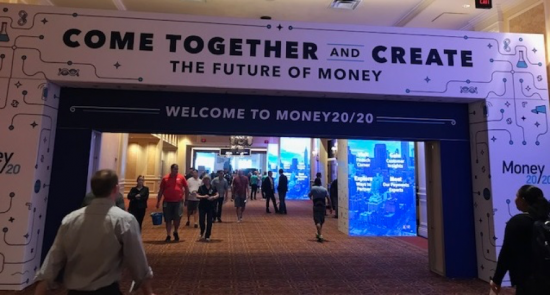
These were all the big topics discussed this week at Money20/20 in Las Vegas and innovation was everywhere, but what was very apparent was that the innovation is occurring at a faster and faster pace.

AI in financial services is rapidly being used for personal finance, risk management, research, forecasting, algorithmic trading and fraud detection.  AI involves complex techniques such as machine learning, neural networks and deep learning with both structured and unstructured data to build statistical inferences.  Research from Roubini ThoughtLab predicts Financial Services providers plan to double their use of AI, from 17% today to 36% by 2022.  At Money20/20, it seemed like everyone was already using AI and speakers were even saying that we need to consider a hippocratic oath for future data scientists given where this technology is headed.

Steve Wozniak from Apple put it into context though, in his Empowerment of Humans in Tech discussion.  He said that AI is simulated intelligence today and we’re still a ways from The Singularity.  He made the crowd laugh by saying artificial intelligence would be intelligent if you hire the AI, fire the CEO and the company makes more money.  Across the many discussions on AI, the take-a-way for financial services companies was that you have to think about rooting deep learning across the entirety of your enterprise.  By building centralized teams with AI expertise and sharing capabilities while fostering a culture of innovation you can begin to harness the potential of this technology at scale across a business.

Many FinTechs were showcasing the promises of blockchains and leading the way for traditional financial services to look at this technology.

Several of the discussions on regulation centered around cryptocurrencies and the need for private and public sector institutions to work together to find practical solutions that could harmonize interests.  With bitcoin hovering above $5K this was obviously very interesting conversation. In driving awareness and direction toward consensus, regulators talked about the Global Blockchain Council and the Blockchain Alliance as two groups that were endeavoring to bring parties together around this burgeoning technology.

Blockchains were also discussed during the sessions on Inclusion where speakers talked about how this technology was helping women gain much-needed access to financial resources in developing countries.  Also, from a regulatory standpoint, the Financial Conduct Authority in the UK discussed their sandbox for FinTech saying that it was working to speed innovations to market and that it was also good for regulators – helping them to better understand what innovative firms are trying to accomplish.


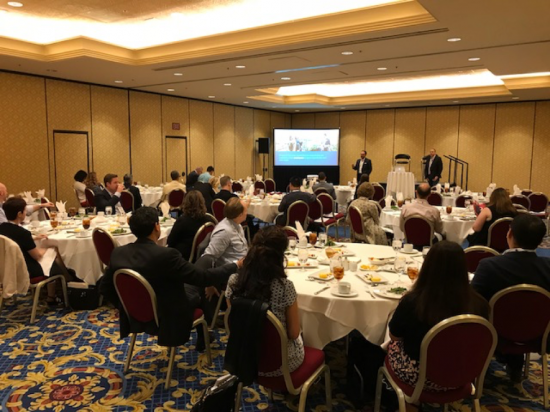
Apple had the closing keynote on Day 1 and they announced payments through iMessage.  As they typically do, Apple amazed the crowd with their easy to use demo of payments through simple mobile texting.  On Day 2 of the conference, we held a luncheon with Apple to discuss the co-engineering innovations being delivered to market through the Apple & Cisco partnership.  We covered network fast lanes, security and collaboration solutions that are delivering innovation today straight out of the box.  Learn more about the Cisco & Apple partnership here.

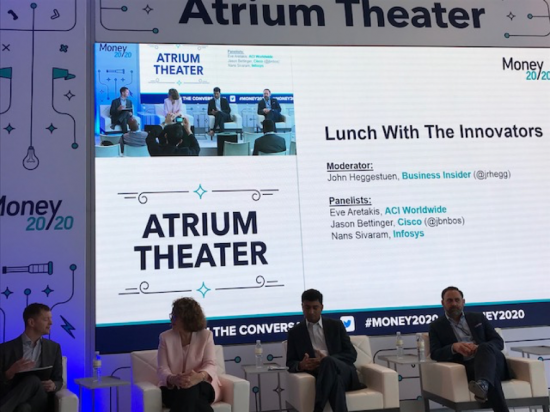
The other narrative apparent across the conference was that the internet was being used for virtually every financial services transaction today, which makes the network more important today than ever before.  Intuitive design and contextual commerce are important in developing next-generation financial services applications, but your network core must also be intent based.  A network that can make faster decisions, mitigate security threats and manage the unprecedented scale of data and devices to deliver a differentiated experience for your financial services platform.  Jason Bettinger, Cisco Global Director of Consumer Industries, made the case for The Network. Intuitive. during the Lunch with Innovators session on Day 3 of the conference.  So, if you’re building the Bank of the Future or the next FinTech disruption, you need a network that is built for innovation.


Learn more about The Network. Intuitive.


Authors

Joe Zakir

Market Manager, Enterprise & Global Financial Services

Americas Marketing & Communications

Avatar

Due to the high-profile data breaches, cybersecurity has become a household word. Think back to just one month ago, when the data breach at Equifax exposed the personal information for 145.5 million consumers – almost half of all Americans.

At Cisco, we know our customers and other business leaders are increasingly aware of this important issue and are taking steps to make their organizations more secure, but there are a lot of obstacles on the road to being prepared. One of the biggest is finding trained and certified security personnel.

Simply put, there are not enough qualified applicants to keep pace with the need. In 2017, there are 1 million unfilled cybersecurity positions, and if we keep on this trend, this number is expected to grow to 3.5 million by 2021.

The good news is that there is a way to fill the gap.  From community colleges to top-rated universities, higher education institutions are racing to include cybersecurity training programs in their curriculum. Cisco is making its contribution to filling the gap through the Networking Academy, recently adding a Cyber Operations Track to our regular Cisco Certified Network Associate Routing & Switching (CCNA) to train new security operations center analysts in universities, colleges, high schools and vocational schools. We have also invested $10 million in scholarships for this training.

But it’s not enough to offer the training.  We need to make it attractive to everyone – including the younger generations of students, millennials and the neo-digital natives of Generation Z. But the largest untapped potential is from the 50% of the population: women.

Women’s representation in the cybersecurity workforce has remained at 11 percent since 2013, despite the growing shortage of cybersecurity workers worldwide, according to a recent (ISC) survey. We need to make tech jobs attractive to women and girls.

Organizations need to prioritize attracting, retaining, developing and celebrating women to take advantage of this untapped pool of potential security professionals. Events like International Girls in ICT Day aim to introduce girls and young women to careers in technology. At Cisco, our Connected Women organization has a global reach with more than 6,800 members across 42 countries. Our recent Women of Impact conference had 9,000+ employees, customers, and partners who came together as a global community to learn and be inspired by the theme. These types of events are driving forces to promote gender diversity, but there is much more work that needs to be done before we will see the percentage significantly increase.

I urge all of you to take an active role in encouraging women to pursue careers in technology and especially in cybersecurity. Join mentoring circles and executive shadow programs. Reach out to middle and high schools to guest speak at their events. Use your passion for technology to drive programs and initiatives that will lead the change.

As the first White House female CIO, Theresa Payton, said recently in an interview, “I believe the best cybersecurity professionals are insatiable learners and highly skilled problem solvers who think about the user while never underestimating the adversary.” These are the qualities organizations should be seeking across all candidates, but first we need to encourage more women to pursue this work to ensure a pipeline of qualified security personnel. It’s going to take a cultural shift, and it needs to start now.

October is Cyber Security Awareness Month, and Cisco is a Champion Sponsor of this annual campaign to help people recognize the importance of cybersecurity. For the latest resources and events, visit cisco.com/go/cybersecuritymonth.

Authors

Alison Gleeson

Senior Vice President, Americas

Worldwide Sales

Avatar

The complexity of network management often produces unintended conflicts. The network manager knows how the network should perform, but somewhere between design and implementation, coding errors happen, wired and wireless networks conflict, security gaps are overlooked, and performance is compromised. Ultimately, the network manager’s requirements aren’t met.

What if the network was so advanced it could automatically implement the network manager’s intent—consistently—across the entire enterprise?

Now it can.

In June, Cisco introduced a new kind of network, built from the ground up for the demands of the digital era. We announced the culmination of years of research and development: an intent-based network that constantly learns, adapts and evolves. But that announcement represented more than groundbreaking technology. It was also about the transformation of how we deliver networking innovation to our customers.

Along with our intent-based networking technology, we announced that our new generation of switches – the Catalyst 9000 series – would be the first Cisco hardware product sold with a software subscription. With today’s introduction, we’re building on our commitment to eventually offer all of our software by subscription by adding it to our wireless portfolio.

Ongoing access to innovation

Why is this so important?  Historically Cisco has monetized our software innovation via a hardware model. Many people are surprised to discover that the vast majority of our engineering team are software engineers. But when we sold our products, customers purchased the hardware with a perpetual software license. Now, the industry is shifting towards a software-centric consumption model.

In a software-centric model, customers purchase a software subscription for a set term—typically three, five or seven years—which gives them ongoing access to innovation from the vendor. Software licenses are portable and because licenses are not tied to the hardware, customers can renew and scale as their business requires. And for customers seeking a more predictable budget spend, shifting from CapEX toward an increasingly OpEx model, Cisco’s software subscriptions offer provides increased financial predictability.

With the pace of change in the wireless industry – and with the velocity of innovation Cisco is driving into our intent-based networking portfolio – that’s a huge advantage for our customers. Our new wireless subscriptions provide access to the latest features, ranging from policy-based automation and network segmentation (SD Access) and application prioritization for iOS devices  to network-as-a-sensor capabilities (Identity Services Engine) and location-based analytics (CMX).

New suite of wireless subscriptions

Customers may choose from three new subscription offers for Cisco DNA Access Wireless.

  • DNA Essentials delivers basic security, automation and monitoring capabilities in addition to access point license, network management and Cisco Software Support.
  • DNA Advantage promotes innovation and simplifies operations with policy-based automation. Capabilities customers can implement include policy based automation and analytics, proactive health monitoring and flexible network segmentation and security.
  • Cisco ONE Advantage is the optimal choice for making the full transition to intent-based networking. This suite includes advanced security, automation and analytics capabilities, including network-as-a-sensor and location-based analytics, along with Cisco Software Support.

Network innovation has always been at the center of what we do. And today, we’re leading a generational change to intent-based networking that will revolutionize how networks are built and managed. We’re excited to introduce software subscription with our wireless portfolio. It’s an ideal way for customers to consume Cisco innovation while ensuring their wireless networks keep up with their rapidly changing business.

https://www.youtube.com/watch?v=sOZ4g1Yzz30&feature=youtu.be

To learn more, visit:


Authors

Sachin Gupta

Senior Vice President, Product Management

Cisco Intent-Based Networking Group

Avatar

To truly be transformative, the Internet of Things (IoT), needs to be able to handle massive amounts of data in near-real time for advanced use cases such as drones, self-driving vehicles, and embedded artificial intelligence (AI) applications. It also needs to be completely interoperable—from end-user devices and sensors all the way to the cloud.

That’s why, when we formed the OpenFog Consortium nearly two years ago, one of our top priorities was to develop a reference architecture that could serve as the foundation for fog computing and networking standards. We delivered that architecture last February. This week, I’m pleased to say, the Institute of Electrical and Electronics Engineers Standards Association (IEEE-SA) announced it will use the OpenFog Reference Architecture as the basis for its work on fog standards. The IEEE Standard Working Group on Fog Computing and Networking Architecture Framework expects to complete the adoption of the first version of the OpenFog Reference Architecture by April 2018.

This is a huge milestone for fog—and for IoT. Traditional architectures can’t deliver on the operational challenges for today’s advanced digital applications. The OpenFog Reference Architecture took the first step by providing a universal technical framework for distributing computing, storage, control, and networking functions closer to the users along a cloud-to-thing continuum. It encompasses various approaches to disperse information technology (IT), communication technology (CT) and operational technology (OT) services through information messaging infrastructure as well as legacy and emerging multi-access networking technologies.

Now the IEEE-SA working group will complete the job by providing clear specifications for vendors to use in developing Fog-based hardware, software, and services. The group will begin meeting in November under the leadership of John K. Zao (Taiwan Chiao-Tung University) as the chair, and Tao Zhang (Cisco) and Jingyi Zhou (ZTE) as vice-chairs.



vice-chairs.

This joint effort will deliver fog-specific architectures that will accelerate the adoption of transformative IoT applications. The initiative helps to solidify the OpenFog Consortium as a unifying force to ensure interoperability of IoT systems, from “things” at the edge of the network, all the way to the cloud. You can hear more details next week at the Fog World Congress, October 30 – November 1, in Santa Clara, where IEEE and the OpenFog Consortium are jointly running the first multi-day conference on fog computing.  I will be presenting about this vision and this work together with Robert Fish of IEEE Communication Society in the Tuesday keynote The working group will also be presenting in a breakout session.

As chair of the OpenFog Consortium, I am extremely proud of the work we have done to accelerate the development and adoption of Fog frameworks, architectures, and now, standards. And I’m proud of the leadership role Cisco continues to take in advancing fog as a catalyst for digital transformation.

Authors

Helder Antunes

Senior Director

Corporate Strategic Innovations Group

Avatar

There have been a number of articles written on data center outages and their business costs of lost productivity, infrastructure damage, loss of brand reputation and goodwill in the marketplace, and litigation costs.  Data center outages can occur from a number of factors such as such as component quality issues, power supply disturbances, or human error. Even turning systems off for routine maintenance could lead to a potentially costly incident to the business.  However a multiyear Ponemon study, “Cost of Data Center Outages” found that the fastest growing cause of data center outages was cybercrime.

The negative impact from cybercrime is not only the data theft, regulatory fines, or litigation costs but also the downtime of critical systems. Businesses rely on their data center availability to drive employee productivity, engage with their customers, and generate revenue. The Cisco 2017 Security Capabilities Benchmark Study found that outages due to security breaches often have a lasting impact. According to the benchmark study, 45 percent of the outages lasted from 1 to 8 hours; 15 percent lasted 9 to 16 hours, and 11 percent lasted 17 to 24 hours. Forty-one percent of these outages affected between 11 percent and 30 percent of systems.

Attackers can leverage a number of techniques to attack the data center; from sophisticated malware to a rise in DDoS (distributed denial of service) attacks targeting the application layer. In those application layer DDoS attacks, web servers, application servers, or online services are targeted and flooded with just enough traffic to knock them offline. They target applications in a way that they appear to be actual requests from users. Since they can be smaller than traditional volumetric DDoS attacks they may go unnoticed by security solutions until it is too late.

To protect against application-layer DDoS attacks, Cisco integrated comprehensive, behavioral DDoS mitigation from Radware into its Firepower 4100 Series and 9300 next generation firewall (NGFW) appliances.  Radware’s Virtual DefensePro capabilities add application layer DDoS protection to Firepower’s tightly integrated, multi-layered threat protection including application firewalling, next generation intrusion prevention (NGIPS), and advanced malware protection (AMP).  Context and intelligence is shared among security functions to accelerate threat detection and response and maximize your security investment.

Integrating Radware DDoS to Firepower NGFW protects data center resources to better function in a DDoS attack and prevent sensitive information from being compromised. Firepower NGFW resiliency is improved in a DDoS attack, allowing it to better distinguish between legitimate and illegitimate traffic. Firewalls by design track stateful connections and may become easily overwhelmed by DDoS attack traffic.  Many attackers target the firewall directly in DDoS attacks, trying to cripple it to leave the network unprotected so this layer of resiliency can be important.

For more information on Cisco Firepower NGFW’s, please visit:  https://www.cisco.com/go/ngfw

For an overview of Cisco Firepower NGFW with Radware Defense Pro, watch this video:

Authors

Christina Hausman

Product Marketing Manager

Security

Avatar

Joel Parks, Alicia Davis, and Nick Wallace were all involved in putting together DevOpsDays Nashville this year—which makes them interesting to us right out of the gate—but they’re also the kind of people you just really enjoy sitting down and chatting with if you work in the tech industry.

DevOpsDays just happened last week, (October 17-18), so of course in this episode, they give a rundown of how it went, what kind of content the speakers covered, what kind of companies sponsored it, and what they see for the future. But that’s just the beginning. In this roundtable-style chat, these three industry veterans talk about all kinds of things that are going on in Nashville specifically and in the IT world in general, including:

  • Why the tech industry is thriving in Nashville
  • What kind of Kubernetes deployments they’re seeing and what the business drivers are behind those deployments
  • How to keep up with the rapid rate of change in tech today
  • Which companies are doing the right things to keep people happy

See the video podcast on our YouTube page, or listen to the audio version on iTunes. And if you like what you hear, we invite you to subscribe to our channel so you don’t miss any of the other exciting podcasts we have scheduled over the next several months.

Authors

Ali Amagasu

Marketing Communications Manager

Avatar

When I was eight, my family upgraded from a small, run-down, red Geo Metro to a brand new, sparkling gold Honda Odyssey. I remember my excitement about the automatic doors. And the fact that I would no longer have to climb through the passenger front seat to get to the back of the car. However, as newness often does, my enchantment with the Honda soon wore off. Within the first year, our beloved car was given the nickname: the “loser cruiser,” and the rest is history…

When I think back to this car though, despite its subpar looks, it holds a special place. Our family had it until it died at 250,000 miles.

This car, it grew up with me and my sister. It took us from elementary school into our high school years. It witnessed friendships being formed and secrets being told. It drove us to countless soccer and volleyball practices and tournaments. It taught us the frustrations of traffic jams and the importance of stopping for gas before the gas light comes on. It detoured to many Wendy’s drive-thrus for those delicious $1 chocolate Frosties.

This car created traditions—driving my family 32 hours to and from Iowa every December and July. When I think back to our Honda, I remember fights with my sister about who would get to choose the first movie on road trips (with the television strapped in between the arm rests of the front seat). I remember me laughing hysterically to my sister’s sarcastic one-liners about people in other cars. Or my dad chuckling while my mom and I tried to make up lyrics to a song. It reminds me of family and time well spent.

Phil Abram, Executive Director for Connectivity and Infotainment at GM said it best:

“The American relationship with our car is so deep, so abiding. People name their cars; they don’t name their dishwasher.”

GM recognizes this emotional connection that people have to their cars, and because of this recognition, they aim to extend this relationship even further. With the connected vehicle.

Hear Frank’s story about his first car and how his GM car experience has evolved since 1959, with the use of Cisco technology.


Do you have any special memories with your first car or a GM car? Feel free to share below!


To learn more about IoT and connectivity, visit the Internet of Things site: Here

To see more customer stories, visit our hub page: Here 


Authors

Jillian Zimmerman

Marketer

Customer Stories @ Cisco

Avatar

The vintage look may be back in style when it comes to fashion and décor, but not when it comes to the new digital era. Dreamland, a vintage theme park at Margate, wanted to maintain their history, while embracing the digital era to connect with customers on a new level.

Our partner Local Measure stepped in to help.


This beloved theme park in the U.K. needed to reinvent itself. As part of a £25 million renovation, they wanted to bring their 150-year-old theme park into the digital age. They wanted to engage with visitors on the spot. Connect with customers beyond the park. And keep them coming back for more.

Local Measure says…

Local Measure was glad to help bring their dreams to life. Its solution lets Dreamland see real-time updates from visitors, from anywhere in the park. When visitors arrive, they can log in with a social account to get free Wi-Fi powered by Cisco Meraki. Then they show up on Local Measure. That’s when the magic starts.

Local Measure picks up the feedback visitors post on social media, from kudos to complaints. It sends the feedback to park staff through Cisco Spark. If visitors celebrate a birthday or comment on a ride, staff hear about it on the spot. So they can do something about it, like reach out on social media. Or even in person, if need be.

Now, Dreamland gets a wealth of data about who their customers are and what they like to do best at the park. They can also interact with visitors in a personal way. And they have a detailed list of guests they can invite back.

That’s a digital dream come true.

Find out more about how Local Measure helps businesses with their leading customer intelligence platform.

The story doesn’t end there. Read more stories on what our customers and partners are doing all over the world.

To see more about this Local Measure story:

Authors

Gioia Ferretti

Partner Stories and Communications

Global Partner Marketing