Avatar

Digital innovation is setting the course for long-term economic growth in the Middle East. While the region’s digital economy has historically lagged behind the rest of the world, it’s quickly catching up. With an estimated 160 million potential users by 2025, McKinsey estimates that the Middle East’s digital economy could contribute up to 3.8 percent annually in GDP – amounting to approximately $95 billion.

This week I was in Dubai, United Arab Emirates, arguably one of the most technologically advanced cities in the world to attend the World Government Summit. In just a few decades, the city has reinvented itself from a quiet fishing port to a global investment hub and leading travel destination, now renowned for its record-setting skyline, driverless metro and man-made islands.

Thanks to comprehensive government investments in digital innovation with the aim of advancing key social, economic, governance and environmental indicators, this incredible transformation is expected to pick up pace in the coming years. Cisco estimates that Dubai’s digitization initiatives could generate a potential AED 17.9 billion (USD 4.87 billion) in value by 2019. By combining the vision of its leadership with a unified strategy, the Emirate has placed itself firmly at the forefront of smart cities worldwide, while also emerging as the top destination for startup growth in the Middle East and North Africa region.

What’s happening in Dubai is a testament to a larger push by the United Arab Emirates to position the country as a leading global digital player. The UAE’s Vision 2021 plan for diversifying the economy and creating a prosperous and sustainable economic future is commendable, and I believe that technology will be the key to making this vision a reality.

Smart Government, Smart Future

Recently named the second most tech-savvy government in the world by the World Economic Forum’s Network Readiness Index, the UAE has emerged as a global standard-bearer for e-government in recent years.

According to UAE Vice President, Prime Minister and Ruler of Dubai His Highness Sheikh Mohammed bin Rashid Al Maktoum, “A successful government reaches out to the citizens rather than waits for them to come in.” To this end, most government services in the UAE are now accessible via mobile devices, and the UAE has set a target by 2018 for 80 percent of government services to be accessed by mobile devices.

This transition to more flexible government interactions has translated into remarkable success in citizen participation and technology adoption. The implementation of e-voting has helped increased voting eligibility from 6,000 people in 2006 to 224,000 people in 2015. And the e-dirham prepaid card, which allows citizens to pay fees to any government entity, has already generated more than 80 million total transactions. These advancements in innovation and technology deliver greater ‘happiness’ and ease of use for all its citizens, support the UAE’s Vision 2021 and illustrate the government’s commitment to embrace the digital era and to use digitization to drive positive change.

Creating an Innovation-Enabling Environment

Global competitiveness demands a constant flow of new ideas. The UAE’s National Innovation Strategy, announced in 2014, will help the country realize its ambition of becoming one of the most innovative nations in the world. Most notably, the initiative requires all government entities to reduce spending by one percent and to dedicate the savings to research and innovation projects.

Mapping back to UAE Vision 2021, the National Innovation Strategy identifies digital technology as one of the top seven primary national sectors. Just last year, the UAE announced plans to develop and exploit 3-D printing, with the potential to revolutionize the construction industry. Meanwhile, the government’s autonomous transportation strategy aims to make a quarter of all trips driverless in Dubai by 2030.

By making digitization a national priority, the UAE has created an ecosystem of innovation that fosters cutting edge ideas and cultivates a culture of forward-thinking. Through a solid framework focused on advancing innovation and creating government infrastructures, the United Arab Emirates and other countries in the region can pull ahead, expand their economies, increase high-quality jobs and secure a better quality of life for their citizens in the Digital Era.

Authors

John Chambers

No Longer with Cisco

Avatar

5G needs to be architected to thrive in an environment where an increasingly higher percentage of overall mobile data is being consumed from indoor environments, and where the businesses that are responsible for those indoor environments are increasingly requiring wireless service be offered to all users, irrespective of their carrier affiliation. Consequently, lowering the barriers to indoor adoption is going to mean tackling the thorny issue of multi-operator, shared 5G networks.

With almost 10 years of small cell experience, Cisco has experienced first-hand many of the barriers that currently exist to indoor deployments. Many of which have led to the Small Cell Forum and 5G Americas to describe Wi-Fi as the default small cell technology for multi-operator support.

If multi-operator, indoor shared networks are going to be essential for 5G’s success, Cisco thought it time to review the adoption of such capabilities in today’s 4G market. What are the key takeaways from those learnings and what does the industry need to do to ensure 5G will be able to thrive indoors? These are some of the subjects covered in a new whitepaper from Cisco, entitled “5G – Thriving Indoors”.

5G’s New Radio is going to define new split options between a Centralized Unit, most likely realized as a Virtual Network Function, and a Distributed Unit, realized as a conventional Physical Network Function. One approach being championed by the small cell ecosystem is to define a multi-vendor split to enable a common DU/PNF to be shared between multiple operators who are then responsible for their own respective CU/VNFs. Looking to leverage the experience of other wireless ecosystems that use a combination of published specifications, open source libraries and code to execute interoperability testing, Cisco is pleased to announce the establishment of the “open-nFAPI” open source project, a set of libraries, simulators and associated Wireshark dissectors that is aimed at accelerating adoption of the Small Cell Forum’s multi-vendor nFAPI split architecture.

Distributed under version 2 of the Apache Software License, the code in the open-nFAPI project is conducive to integration by the widest range of industry stakeholders, from other alternative open source ecosystems interested in RAN virtualization, e.g., the Telecom Infrastructure Project (TIP), the Central Office Re-architected as a Data Center (CORD) initiative and the Open Air Interface (OAI) project, through to integration into closed-source proprietary RAN products.

We think that the small cell industry has a great opportunity to drive the definition of multi-operator LTE and 5G systems using an open source approach. The establishment of the open-nFAPI open source project is the first step on this path, and Cisco welcomes other Small Cell Forum members, 3rd party developers, other open source ecosystems and researchers to contribute to the project.

Read our White Paper here.

For additional Cisco 5G content, visit our page here.

Authors

Mark Grayson

Cisco Fellow

Cisco’s Emerging Technologies & Innovation Group

Avatar

‘Magic Hound’ is the code name used to reference a seemingly limited series of malware distribution campaigns that were observed targeting organizations in Saudi Arabia as well as organizations with business interests in Saudi Arabia. Similar to other malware distribution campaigns that Talos has observed and documented, this series of campaigns made use of phishing emails containing links to malicious Word documents hosted on attacker controlled servers. When opened, the malicious documents display a message instructing the user to enable macros in an attempt to entice recipients to execute the attacker’s scripts and download additional malware, thus infecting their systems. Unlike some of the more sophisticated campaigns seen in the wild, in the case of ‘Magic Hound’ the attackers made use of commodity malware and tools. This included tools such as IRC bots and Metasploit Meterpreter payloads as well as an open source Remote Administration Tool (RAT).

Talos is aware of this targeted campaign and we have responded to ensure that customers remain protected from ‘Magic Hound’ as well as other similar campaigns as they are identified and change over time.
Read more »

Authors

Talos Group

Talos Security Intelligence & Research Group

Avatar

For any workload, SAP included, most of us would agree selecting the right tool depends on the task you’re performing.     Knowing which tool, or how much capacity or resource to apply is usually defined by your objective.


 

Great motivators understand this.  Humans become bored if tasks are too easy, but demotivated if tasks are impossible.  But something that is “just right” results in optimal performance – we commonly call this “rising to the occasion.”   As much as I hate to admit it, overcoming a 25-point deficit in the third quarter is a good example.


Sociologists label this The Goldilocks Rule.


The Goldilocks Rule postulates that humans achieve peak performance when working right up to the edge of their capacity and ability.  As Goldilocks discovered, not too hard, not too soft, just right.


Can we apply this concept to converged infrastructure?  Does the right tool matter in your SAP data center?  Should you standardize on an architecture designed to support a steady stream of real-time transactional data, or something better suited to crunching out critical analytics.  Should you look to grow out or grow up?


The answer is absolutely, unequivocally, maybe.


Nobody wants to be caught with less capacity than they need (disastrous), and nobody wants to spend for capacity they cannot use (wasteful).  Instead of the Goldilocks Rule, data center professionals refer to “just right” as “Scalability.”


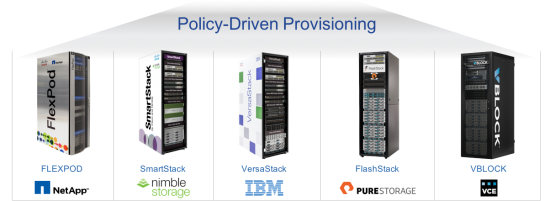
Modern data centers support a dizzying array of transactional and analytical workloads, and one size does not fit all.  That’s why Cisco developed the industry’s broadest family of scalable converged infrastructure solutions optimized for a variety of workloads.


However, for one of our SAP customers, a large North American retailer, even this was not enough.  Our customer was looking for one vendor who could provide “extreme scalability,” including a large single-node solution for SAP ECC (ERP Central Component), that could ultimately increase to over 20TB of memory as their business needs grow!  In this case, they require a very large scale-up solution.


For vertical NUMA-type workloads such as this, Cisco and Bull are pleased to announce the bullion S16 will join our already robust portfolio of SAP solutions.   Cisco now offers one of the largest capacity scale-up platforms currently certified by SAP.


“I’m very excited about our new partnership with Cisco for the Bull bullion S16 enterprise servers.  The addition of the bullion S16 high-end server to Cisco’s portfolio will create new opportunities to jointly address very demanding infrastructure solutions which require exceptional scalability and in-memory features.
Arnaud Bertrand, Group SVP, Head of Big Data, Atos.


“Cisco and Bull have a long relationship working together to meet customers’ data center needs.  Reselling the bullion S16 for large memory database applications expands our partnership and compliments the scalability of our Converged Infrastructure and highly flexible and secure network solutions.  Our goal is to provide the industry’s best application-aware programmable infrastructure.”
Satinder Sethi, VP, Engineering, Cisco Computing Systems Group


The Bull bullion S16 joins the Cisco SAP solution family:

  • Integrated Cisco Support – Cisco “one-call-for-all” resolution
  • Extends Cisco’s tradition of x86 performance leadership.
  • Cisco’s portfolio scales to match all workloads, from 2 CPUs up to 16 CPUs & 24TB of memory
  • Cisco offers both compute & network performance leadership, including the only 40GB fast fabric certified for SAP HANA
  • Over 500 deployed customers, including Siemens, one of the largest SAP HANA environments in the world
  • Common Cisco Management framework (coming)


If you’re planning to modernize your SAP data center with scale-out solutions that provide the flexibility necessary to protect your investment, or you need the maximum scale-up capability of our new bullion S16 platform, click on these links, or go to our web site for additional information.


And please visit us at SAP Sapphire in Orlando, May 16-18.  We’ll help you architect the “just right” solution for your SAP data center.


Tools Photo by Lachlan Donald from Melbourne, Australia – “Sharpest tool in the shed”

Authors

Brian Ferrar

Enterprise Marketing Manager

UCS & Data Center

Avatar

There are obviously many, many challenges involved in building a next-generation network, but in terms of geography, not too many operators face the challenges Cable & Wireless Communications face.

As one of the largest providers in the Caribbean and Latin America region, C&W serves over six million subscribers and thousands of business customers spread across thousands of square miles and multiple countries.

Despite these challenges, Cable & Wireless enjoys an unmatched reputation for reliability and performance among carriers in the region.

So naturally we were honored when Cable & Wireless selected Cisco and Ericsson to help upgrade its IP/MPLS network in the Bahamas, Jamaica and Barbados. This new network will not only help Cable & Wireless manage its rapid traffic growth while improving overall performance, but will serve as the backbone for new IPTV, fixed and business-to-business services.

Through the next-generation strategic partnership, Cisco provided the routers and switches, while Ericsson supplied and installed the network management system and provided overall project management and customer support.

Similar to the other 100+ customers we’ve worked with in the past year, the Cable & Wireless network upgrade would not have been possible without the benefits of the partnership. As C&W CTO Carlo Alloni says in the video below, “It’s like having two super competent, top-notch, technology leadership companies coming together and really complementing each other in what they do best.”

https://www.youtube.com/watch?v=q-p2zIkLseU

And the partnership continues to grow. In the past few months both Vodafone Hutchinson Australia and Telefonica Guatemala chose the Cisco-Ericsson partnership to help upgrade their networks.

Just last month at CES, we introduced the Evolved Wi-Fi Networks (EWN) solution, which brings together Ericsson’s mobile technologies and applications with Cisco’s Wi-Fi portfolio to provide reliable Wi-Fi with the highest performance.

As we approach Cisco Live Berlin, and Mobile World Congress, we look forward to meeting with customers to discuss these solutions, as well as our plans for the networks of tomorrow.

If you’re going to Barcelona, please stop by the Cisco and Ericsson booths to see what new solutions we’ll be developing and offering together in the months ahead.

Authors

Doug Webster

Vice President

Avatar

I had the misfortune recently to have a car accident.  Airbags deployed, two cars written off, scary stuff.  Thankfully, both the other driver and I both walked away, very much shaken, but unhurt.  And thankfully the crash happened at not too high a speed which contributed to what I will call our ‘good fortune’ in being able to walk away.  Within a minute or two of the accident (and I was just out of the car by this time), a voice came from inside the (empty!) car: “Mr Speirs, is that you, are you OK, can you hear me?” Spooky or what!

My car has – sorry had – early generation “Connected Car” features, including “Emergency Call”.  And this was a trained call centre  operator checking that I was OK, letting me know that they had connected the emergency services.  “We’ve told the police that your airbag has deployed and also the precise location of your accident” I was informed.  Impressive!  And a real example of Internet of Things (IoT) technology in action.

What then is “Emergency Call”?  If an accident sets off the airbags or seat-belt tensioners, the Emergency Call to a central call centre is activated automatically. This ensures, in the event of an accident, that

  • The driver receives swift, targeted assistance in emergency situations from trained staff;
  • The driver benefits from immediate and automated transmission of data relevant to the rescue operation (site of accident, risk of injury), and hence optimum medical care for those involved in the accident
  • And even better – no mobile phone is necessary – emergency call is made via the car’s integrated SIM card.

Except.  Yes there is an exception.  Except when there is no mobile signal.

Some city dwellers may find this strange, but venture out of built-up areas in the UK and other countries and the mobile coverage  can be patchy.  Recently an official investigation found, rather bluntly, that “the [mobile] coverage on the UK’s trains and motorways was ‘frankly appalling'”.

This presents challenges to the car industry, the consumer, the politicians and regulators, as well as the mobile service providers. First a word on the Mobile Network Operators (MNOs): my intent here is not to criticise, rather I’m highlighting the opportunity for the proactive mobile operator.  Which of them will win the autonomous car race?

Mobile Coverage on Major Transport Routes: The Ofcom App

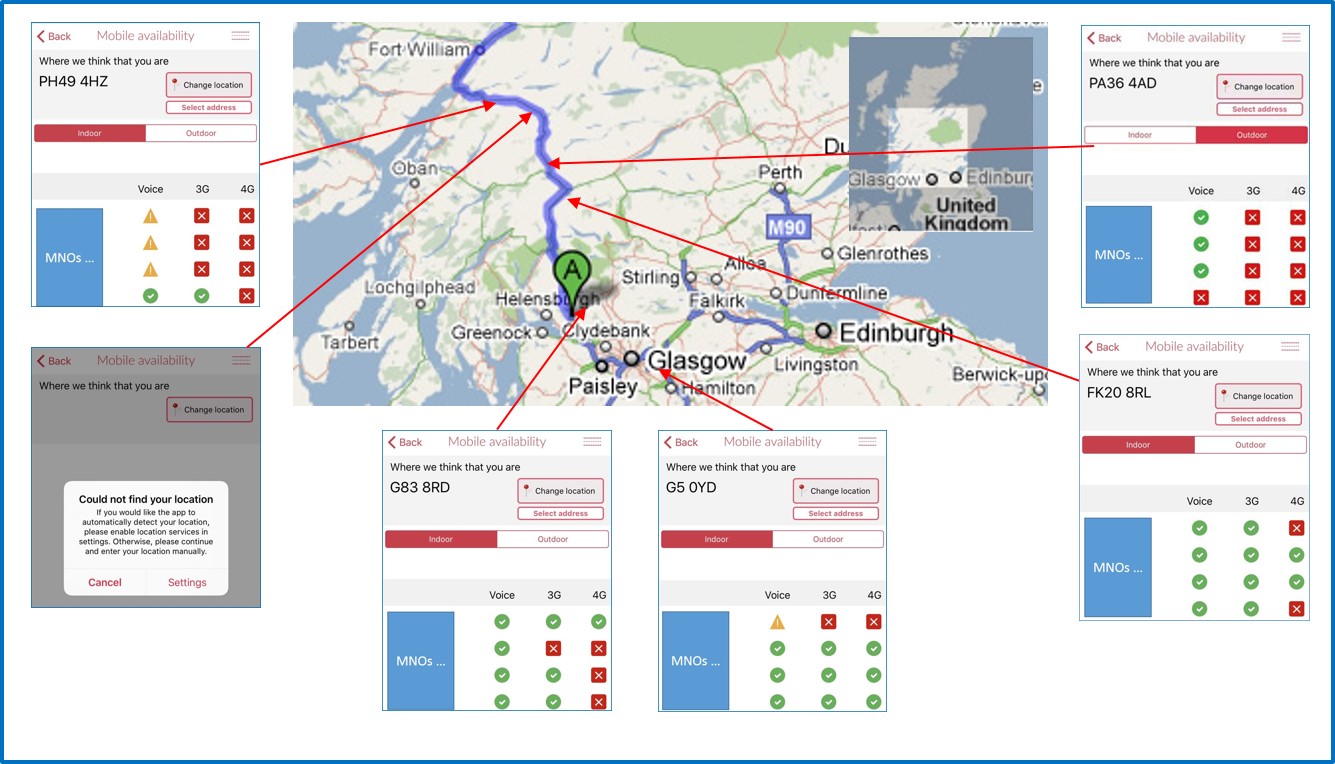
Before I discuss these challenges, let me report on a small mobile coverage experiment I undertook recently while researching this blog. I regularly drive the major west coast road, the 167 mile A82, from Glasgow to Glencoe and beyond to Inverness, and I asked my son Callum (he would say “told” 🙂 … and I did say I’d name-check him!) to test out the mobile signal coverage  along this route using a nice little coverage app from UK telecommunications regulator Ofcom.  I’ve put together the map below showing a selection of coverage examples along the route.  My map certainly “hints” at places your Connected Car features including Emergency Call are unlikely to function as hoped- for example I’ve shown examples where we could’t get any mobile signal at all to use the app!

Figure: Scotland’s West Coast Route: A82 Mobile Coverage Examples (Date 14 January 2017)

Caveats!

Please note the blue rectangles in the Ofcom app screenshots.  I’ve placed these here intentionally to cover the names of the various MNOs offering service in these areas – each line of green “tick” and red “cross” represents good and no coverage respectively from each MNO.  Also note that we weren’t able to use the app en-route in all places, specifically those without 3G or 4G – so a few of the above screen shots I took at the comfort of my desk simply by entering post codes (aka ZIP codes) into the app.  However this didn’t help in areas that don’t have identifiable post codes – as shown, the app “could not find” my location when en-route.  Finally, please note that this was the state of play on 14th January 2017.  Mobile coverage is expanding and I hope to be able to report on major improvements in the very near future! (you heard it here first :-))

“But Nobody Lives There”!

Mobile Coverage at the Glencoe Visitor Centre

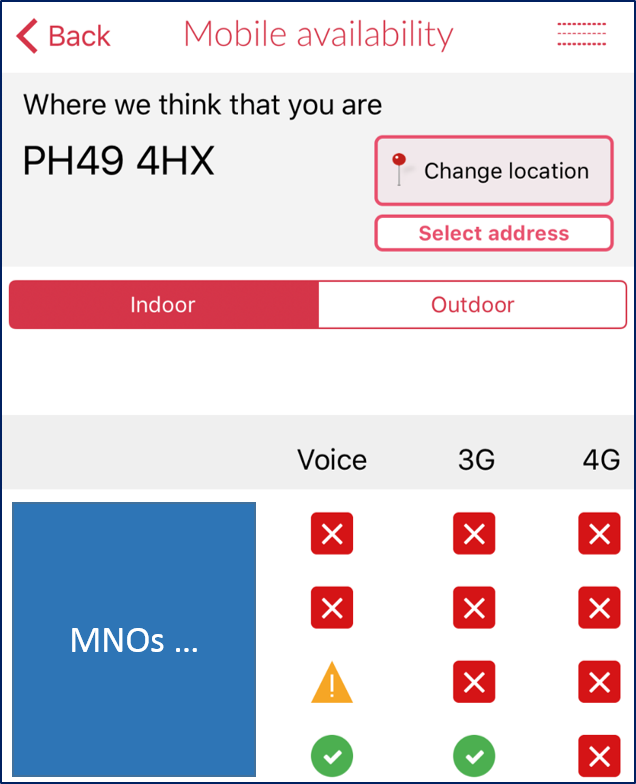
Yes this is what I hear from the cynics and city-dwellers.  Let’s look at some of the facts.  Glencoe Village is tiny.  It only has around 250 residents.  But the Glencoe Visitor Center (postcode PH49 4HX) receives over 130,000 visitors per year. Glencoe Mountain (PH49 4HZ) receives around 150,000 visitors per year. Tyndrum (FK20 8RZ) is a tiny village but is a hugely busy stop-off point for people on long journeys. Scenic Loch Lomond (G83 8RD) receives well in excess of 1 million visitors per year. Next to nobody lives in any of these locations.  Yet lots and lots of people visit these places, and over 1 million vehicles pass by each of these ever year.  What do they have in common?  They are location on the major A82 trunk road.  And all have major mobile phone coverage gaps, as the Ofcom app demonstrates.

The opportunity is there for the proactive service provider with a smart marketing campaign: first to market with 4G in these areas, for example, could capture not only the local population but a good portion of the visitors, never mind the connected car opportunity.

Implications for the IoT and the Connected Car

Politicians need to be aware of mobile coverage limitations when planning connected car initiatives and regulations.  For example, while the EU’s “eCall” regulation from 2018 is well-intentioned, it assumes pervasive mobile connectivity.

For the car manufacturer, it’s clear that at some point, they will wake up to the challenges I’m outlining here and start placing their “Emergency Call” and upcoming Autonomous Car business with the MNOs who can prove the best geographical network coverage.  This will be more important as the autonomous car approaches reality in the next 10-15 years, since 5G coverage is recognised as “mandatory” by the likes of BMW.  Clearly, this will need to be pervasive geographical coverage – at least along our roads: Who would want an autonomous car that could only drive to the city limits?!

In my opinion, the need for pervasive (100%) geographical mobile coverage has not been, to date, broadly acknowledged nor prioritised in the UK. The prevailing metric has been a focus on population coverage, which reflects on where people live rather than where they go to or travel through.  UK MNO EE, for example, called out their competitors’ commitment to such goals in their CEO’s open letter to their competitor CEOs.   Telecoms.com – facetiously I have to say – questioned the need for 100% geographical coverage: “the remaining geographical coverage holes mainly concern people desperate to put their photos of the Scottish Highlands of Facebook without delay”.  And the lack of broadband provision for businesses in rural areas – a subject I blogged on last year regarding my local ski centre ticket office queues – reflects this lack of problem recognition and prioritisation.

The Mobile Network Operator Opportunity

As I mentioned above, my intent here is not to criticise or blame: priority calls have to be made.  Rather my intent is to highlight the need and the opportunity.   With my car crash, the real benefit of – and need for – IoT-like “Emergency Call” became crystal clear to me.  As did the mobile coverage reality: I’m “fortunate” that my car accident happened in an area of good mobile coverage.  Mobile services can indeed be the platform to potentially save lives by enabling rapid emergency services response.

In terms of raw numbers, KPMG’s 2015 report on the economic benefit to the UK from autonomous cars claims $50Bn+ opportunity by 2030. They cite that the “Telecommunications industry will benefit from dramatically increasing data traffic”, with “forecast growth of approximately 12% annually to 2030”.

The network, then, has and will become ever more central to the driving experience.  MNOs investing in pervasive road, rail and geographical coverage stand to win in the connected transport and autonomous car race.

In the meantime, just be careful where you have your car accidents!


Authors

Stephen Speirs

No Longer at Cisco

Avatar

As promised in my last blog post, here are some solutions to tackle the 7 fatal flaws of innovation. (Inspired by the book Winning the Brain Game: Fixing the 7 Flaws of Thinking.)

We cannot solve our problems with the same thinking we used when we created them.

– Albert Einstein

Solution 1: ‘Framestorming’ (for Leaping)

We’re quite familiar with the word brainstorming, where we try to generate as many ideas as quickly as possible without judgment. “Framestorming” adds a “frame” element to the brainstorming activity and is intended to address the flaw of leaping.

The concept behind framestorming is not to find answers right away, but to ask right questions and discover more about the real underlying challenges in any innovation activity. Generate as many questions as you can by asking a series of “why,” “what if,” and “how” questions. Then you take the top two or three questions from that list and focus on getting more meaningful answers. This is better process for kick starting and sustaining an innovative venture.

Solution 2: Inversion (for Fixation)

Inversion is the cure for fixation flaw. It involves flipping our thinking and assuming opposite of what is out there. This “outside in” or “from the other side” approach helps us overcome many preconceived notions and situational constraints.

Innovation is a journey full of navigating around obstacles. Creative thought processes that include probing questions like “what if X happens” or “what if Y didn’t happen” could open many doors otherwise assumed closed forever. A proven example of inversion is the genesis of Cirque du Soleil shows from traditional circus.

 Solution 3: Prototesting (for Overthinking)

Many times, instead of lengthy thought exercises, it’s better to let experimental data provide the guidance for what to do next. In the startup world, Lean Startup methodology promotes hypothesis testing and validating. Most of the companies supporting internal and external innovation have this under control. Validating your innovation thought process from real or potential customers and building what they really need (and willing to pay for) is an unbeatable endorsement for any experiment.

Solution 4: Synthesis (for ‘Satisficing’)

 While searching for an optimal solution, sometimes we arrive at an odd juncture where we’re forced to choose one path. Synthesis helps alleviate the impact of the flaw of satisficing by encouraging a “both-and” thinking instead of “either-or” thinking.

There are two ways we can leverage synthesis technique in innovation:

  1. Double Down

Blackjack players often use a strategy of double down to increase their chances of higher returns, at higher risk levels. The same method can be used by companies facing threats of irrelevance, or stagnation, and are under pressure to deliver quick results.

  1. Decomposition

Decomposition, as the name suggests, refers to breaking down a segment to make it easier to choose multiple options as part of “both-and” philosophy. Retailer Target successfully adopted this strategy, while competing with discount retailers like Walmart on one end and high-end brands like Macy’s on the other.

If you think you can or can’t, you’re right.

– Henry Ford

Solution 5: Jumpstarting (for Downgrading)

Sometimes our innovation efforts go deep into a death spiral, because of the belief that a “fresh start” is required to bring an idea to life again. Focusing on optimistic “can-if” statements instead of pessimistic “can’t-because” constructs might be one way to address the flaw of downgrading. A famous anecdote explains this transformation very well: “We can’t use traditional ball point pen in space because of lack of gravity” to “we can have a writing tool in space if we use a pencil, may be.”

Other useful techniques include Why-How Laddering and Temporal Windows. Our brains think in terms of process-driven “how” questions while our hearts think in terms of purpose-driven “why” questions. Balancing and leveraging the two complimentary thought processes can do wonders for any stalled innovation project.

Temporal windows are self-evident when many of us make New Year’s resolutions. Human minds occasionally need a fresh start of some kind and new year, new quarter, new leadership, new funding, new organizational structure, new charter, and many such “new” entities could provide that much needed fresh start.

 Solution 6: Proudly Found Elsewhere (for Not Invented Here)

Although breeding a culture of Proudly Found Elsewhere (PFE) in place of Not Invented Here (NIH) takes lot of time and energy, it’s essential for concepts of co-creation, co-innovation, and co-economy to thrive. As I had described in my previous post about the Open Source Software movement, there’s an increasing level of awareness about not reinventing the wheel in the computer software industry. However, incremental innovation improvements (i3) need to spread homogeneously throughout other industries to create a movement around innovation.

Solution 7: Self-Distancing (for Self-Censoring)

Many times, we make bad decisions in the heat of the moment and seek guidance from a trusted counselor. Self-distancing can help us all become that trusted observer. The concept of “The Impartial Spectator” was mentioned by Scottish philosopher Adam Smith in his 1759 book The Theory of Modern Sentiments. In Eastern philosophies, the notion of Sakshi or Witness is at least a few millennia old. The essence of this solution is to emotionally detach yourself from the heat of the situation and have an objective, fact-based look at it as an outsider. As a foundational element of mindfulness philosophy, self-distancing can eliminate troubles associated with self-censoring and many other flaws of innovation.

What are some of the techniques you implement to overcome these deadly flaws of innovation?

Authors

Biren Gandhi

Head of Drone Business & Distinguished Strategist

Corporate Strategy Office

Avatar

It seems our customers all want the same thing: help addressing their business needs based on the capabilities they’re trying to solve for, help staying ahead of competition, and guidance on the “how” of implementing against their Digital Journey.

This might sound like a tall order, but that’s exactly where Cisco and our powerful partner ecosystem thrive!

Virtually every customer today is seeking to address business imperatives linked to one of following four digital capabilities:

  • Personalize Customer Experiences
  • Enable Workforce Innovation
  • Optimize Business Operations
  • Manage Risk

For example, within the consumer industry, many retailers are looking to enhance the customer experience by doing such things as engaging customers in store dynamically and predicting and personalizing their engagement.  In manufacturing, some customers want to optimize business operations through increased asset utilization and implement secure remote management services.

In healthcare, other customers may want to enable workforce innovation and patient satisfaction by implementing solutions that will enable greater collaboration among physician and specialists and offering the option for remote patient consultations.  Within Cisco’s Digital Transformation Group, we are mapping specific technologies to all of these capabilities – and many, many more! We’re in the process of finalizing full capabilities frameworks and robust industry Points of View and we will be sharing them with the Partner ecosystem soon.

When Denny Trevett and I presented a session at Partner Summit in San Francisco about the “why” and “how” of digital transformation, we shared examples of customer-in win stories, how to engage with ecosystem partners, and rolled out a detailed guide to drive digitization with ecosystem partners. You can view session video here.

Digital transformation is creating unprecedented opportunity for our customers and partners. This all leads to a new way that we need to engage and sell. In Denny’s newest blog, he shares the concept of starting with a customer’s business challenges and the desired goals in mind, instead of leading with technology and solutions first.

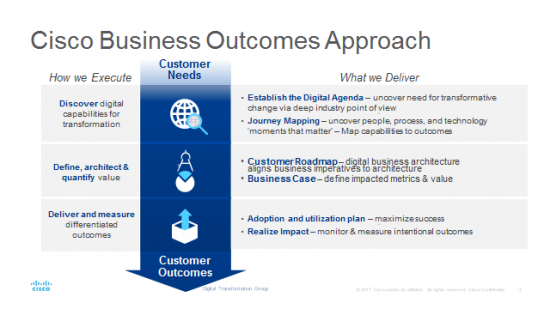
We all know that we can’t sell the way we used to. We need to sell in a way that focuses on customer needs first and sets a digital agenda that leads to impactful outcomes that transform. We’ve seen a lot of success with our Business Outcomes Approach (BOA); a holistic journey that helps us differentiate and win in the marketplace. It helps us identify, prioritize, and execute the pieces, all through a customer lens.

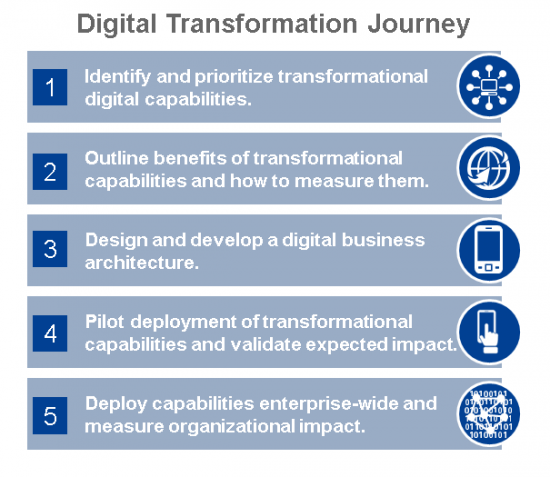
Each customer’s digital journey is going to be different. So, as their trusted advisors, we must define, design, and quantify value to deliver and measure differentiated outcomes. By doing this, we will realize true transformation and establish or strengthen customer trust and relationships, which leads to more opportunities.

The key differentiator for Cisco and our partners is how we bring this together for customers; and the great news is that this best positions us to own the digital conversation. By connecting Line of Business and IT, along with our robust ecosystem portfolio of partners, as well as continually mapping new technologies to business capabilities, we better enable our customers’ digital journeys.

Plan for Success: We encourage you to talk to your Cisco Partner Account Manager to explore how you can differentiate and have the best chance for success with Digital Transformation.

Plus, explore the new Partner Guide to Driving Digital Transformation. Find more information on the Customer-in approach including examples showing real-life win stories, workshops, account analysis tools, info on how to find and connect with ecosystem partners, drive multi-partner deals with Cisco ACES, Marketing ENGAGE and much more.

Authors

Sandy Hogan

Global Vice President

Digital Transformation Group

Avatar

Manufacturing to IT: “You just don’t understand the reality of the factory floor.”

IT to Manufacturing: “Your legacy systems expose us to security and hackers.”

Greater than 99% of the companies I visit waste time, budget, and emotional cycles battling between the information technology (IT) and the manufacturing organizations. While we are familiar with the term IT, Operations Technology (OT) describes the factory organization and systems running the shop floor and connecting equipment. OT tends to drive most internet of things (IoT) projects.

Source: http://www.sensationalquotes.com/Dating.html

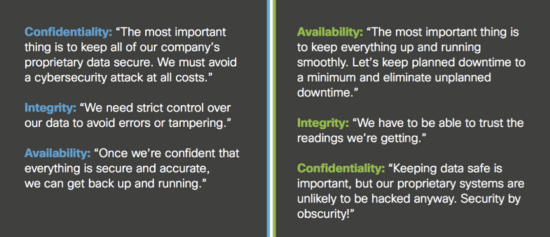
IT and OT use many of the same terms; however, they do not speak the same language. Our research shows not only do IT and OT not speak the same language, each organization prioritizes the same terms in the opposite order of each other:

                                                 IT                                                               OT

The result: lack of alignment, trust, and confidence. Ultimately, the IT and OT groups work against each other rather than collaboratively.

Historically, IT projects supporting operations spend months (sometimes years) gathering requirements, planning, and then implementing a solution. By the time the solution gets deployed the business objectives have evolved to the point where the solution no longer addresses the need. IT has struggled to gain sufficient access, time, and mindshare from their operational counterparts to be effective.

However, Operations must co-own the historical misalignment for a project’s challenge to be successfully deployed.

Gartner Research’s Britain Steenstrup appropriately summarized the anticipated future state between IT and OT in this research:

“As more companies work toward IT/OT alignment, the CIO and the IT organization will be at the forefront of fostering relationships and changing the culture of the organization. This will require a hybrid of traditional IT and OT skills and development of new intellectual property, while experience external to the company will be tapped into to assist with cross-topic education.”

At Cisco, we have evolved our manufacturing (OT) execution model with our IT deployment model. Our approach is simple. We converged our IT and OT teams, not only virtually, but also physically in the same office space. We developed a Services Management Operating System (SMOS) led by operations services, not technology services. In addition to these tactical steps, the most significant step we took shifted our deployment approach.

Source: https://www.pinterest.com/pin/500040364848314587/

We now focus our efforts guided by “North Stars” to achieve our strategic objectives. We shifted away from long requirements gathering phases to short/rapid cycles of learning projects (30-60-90 days). The goal of these rapid cycles of learning is to advance toward the objectives. Advancing toward the objective means we’ve learned something and then applied the learnings towards achieving the North Star. In fact, we have achieved our most significant cycles of learning by “failing fast” during the 30-60-90 day cycles.

Over the next few weeks, we will be releasing our white paper, video, and infographic providing examples on how to converge your IT and OT approach. We’ve included a number of customer success stories including:

  • Fanuc: Zero Downtime for Big Data Maintenance Analytics
  • Daimler Trucks North America: Combined factory and corporate network for manufacturing operations

We also describe required business capabilities like:

  • Enabling real-time decision making through fog computing
  • Eliminating unplanned downtime through predictive maintenance
  • Deploying wireless technology on the factory floor
  • Ensuring cybersecurity for a new world of connected machines

Please take a few moments to read these insightful and actionable materials, then contact me or your Cisco representative so we can help get you started.

More IT/OT materials are available here:

Authors

Neil Heller

Manufacturing Industry Solutions

Manufacturing