Avatar

I am a wife, sister, daughter, aunt & Cisco employee. I’m also a full-time working new mom.

My son just had his 1st birthday in October. Working a full-time job on top of being a new Mom as a woman in technology can sometimes be hard. But thanks to the supportive culture at Cisco, this is a whole lot easier. They didn’t write a handbook or anything, but Cisco is great about giving employees work and life balance. Here are top pieces of advice to full-time working new Moms at Cisco:

  1. Find your balance: Being a new mother, you are pulled in a lot of directions all day every day. Whether it is taking a 15 minute break to go for a walk, or going to a work out class after work, find a small chunk in your day to have “you” time. Giving yourself time to recharge your batteries makes you a better mama and better Cisco employee.
  1. Have open communications with your manager: You may have had a tough night because your teething infant kept you up until 3am (I had many nights like these), or it’s your first Mothers day and you want to take a personal day to celebrate the momentous first time occasion. Keep your manager in the loop of these things & he or she will support you.
  1. Don’t hold back on traveling: I got the opportunity to attend Cisco’s annual Global Sales Conference. However, I was worried, because I was still breastfeeding. This was going to be a big juggling effort. Once I figured out the details of care for my son at home, my next thing to figure out was how I was I going to make breastfeeding work on the road. I had to take several breaks throughout the conference to tend to breastfeeding matters, and also needed a service to ship my breastmilk home to my son. Cisco was fully on board and went above and beyond in supporting me, a full time nursing mother.
  1. Find a support system at Cisco: There are tons of full-time working mothers at Cisco. Becoming a new mom is a whirlwind. Find a few other folks you can talk to from time to time, who can relate to what you are going through. Parents face very similar challenges & Cisco has an army of working mothers and fathers who can offer guidance and advice.

Alexis' new baby

Because of Cisco I wake up everyday excited to go to work. I am able to work full time with super talented individuals and am also able to focus on my newborn son, due to the supportive culture of working parents here at Cisco. Thank you Cisco for making it a whole lot easier to be a Mom and be a power woman in technology!


Want to join the Cisco team? See open opportunities here.

Authors

Alexis Doherty

Marketing Manager, Global Sales Enablement

Financial Services Industry

Avatar

Cisco Live EMEA, the industry’s premier education and training event for IT, networking, and communications professionals, is just days away and we’re ready to showcase our innovative healthcare solutions during the event.

If you’ll be attending Cisco Live, there are a few ways to engage with the healthcare team on site.

Visit us in the Digital Healthcare space in hall 3.2 of the World of Solutions from Tuesday the 21st to Thursday 23rd to see our healthcare demos in action.

In the healthcare space, we’ll be showcasing the Medical Data Exchange Solution, which allows for the easy access and sharing of patient records. This demo includes patient onboarding, patient data retrieval, video consultation, and how to input vital parameters and view live and historically inserted data.

We’ll also share how you can protect medical devices and patient data from network threats using intelligent device detection and network segmentation with Cisco Medical NAC.

Also in the space, we’ll be demonstrating how to make healthcare available to anyone, anytime, and anywhere focusing on helping vulnerable populations live happily and independently for as long as possible with our partner Focuscura.

On Tuesday, February 21st, be sure to stop by the MediBus, which is a mobile care facility that improves access to health services for refugees and close the vaccine gap. The bus, which partners with Charité – Universitätsmedizin Berlin, the State Office on Refugee Matters, Deutsche Bahn, and SAVD Videodolmetschen, is Germany’s first vaccine vehicle.

If you’re unable to see the bus in person on Tuesday, check out a smaller model of the vehicle in the Smart Cities lounge.

On Thursday, February 23rd at 2:30, attend the customer innovation session featuring the Francis Crick Institute.

As one of the world’s leading biomedical research institutes, the Francis Crick Institute requires a collaborative and innovative environment for its 1,200 researchers to tackle some of the most challenging scientific topics. In building its new facility in London, the Francis Crick Institute turned to Block Solutions and Cisco to enable next-generation digital capabilities with high-performance, intelligent infrastructure.

In this session, attendees will interact with IT and business leaders from the Francis Crick Institute and Block Solutions to better understand design considerations, key business outcomes, and plans for future innovation with Cisco’s Workforce Experience solutions.

Have additional questions about the healthcare demonstrations or activities at Cisco Live EMEA? Leave them in the comments below.

We look forward to connecting with you next week in Berlin!

Authors

Jason Mortensen

Global Healthcare Solutions Portfolio Manager

Digital Transformation Group

Avatar

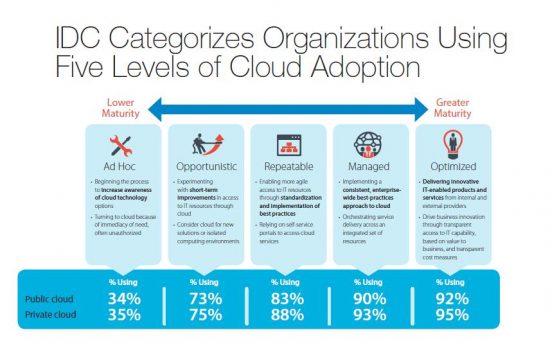
Cloud is a top investment area for digital transformation but why is it that only 3% of enterprises have an optimized cloud strategy? In a recent InfoBrief sponsored by Cisco, IDC categorizes the maturity spectrum of cloud adopting organizations from ad-hoc (beginning awareness and immediacy to adopt) to optimized (mature and delivering IT-enabled products and services).

Source: IDC InfoBrief, sponsored by Cisco, Cloud Going Mainstream. All Are Trying, Some Are Benefiting; Few Are Maximizing Value. September 2016.

Those organizations with an optimized cloud strategy are the ones getting the most out of cloud – transforming business, expanding into new markets, and responding to changing customer requirements with agility. But how do you get from ad-hoc to optimized? Everyone’s journey is different, but I’d like to share a few imperative “must haves” to factor into a complete cloud strategy. This is by no means exhaustive, but can be used to sanity check your own journey to an optimized cloud strategy.

Focus on Business Outcomes. Most cloud customers I talk to see cloud as an important part of their digital transformation, and they know adoption can drive significant business value. The greater the level of cloud maturity, the better the level of business outcomes including improved revenue growth, more strategic allocation of budgets, lower costs, reduced time to provision services, and increased ability to meet SLAs.

Build on a Solid Foundation. When moving to the cloud, one thing that is often overlooked is the underlying infrastructure that connects users to cloud-based applications. A solid network is foundational to connect everything – no matter the location, device, or cloud. And a cloud-ready network is key to delivering high availability, security, mobility, and a great user experience.

Make it Hybrid. We are finding that hybrid cloud is the new normal in this multicloud world. We know that 73% of organizations are pursuing a hybrid cloud strategy, which includes subscribing to multiple external cloud providers and running workloads using a mix of public/private cloud and dedicated (on-premises) IT capabilities. Organizations with a mature cloud strategy expect to be able to choose from multiple cloud providers based on location, policies, and governance needs. They are also more likely to practice DevOps, use microservices architectures and containers (e.g., Docker) in their cloud architecture, and deploy cloud-based Internet of Things (IoT) applications. Hybrid is resonating with customers as they balance the benefits of private and public cloud services to meet their unique business requirements.

Make it Secure. New highly-distributed infrastructures and connections are creating more security threats and vulnerabilities. Customers we talk to demand consistent, integrated security across their multicloud environments as a basic requirement. Holistic security that spans from the data center, cloud, and to the edge is important to securely adopting cloud.

Make it Flexible. As I said in the beginning, every journey is different. Many Cisco customers are embracing cloud at different rates and have different needs when it comes to adoption, deployment, growth, and maintenance. Some will want to outsource all their needs, while others may have the technology, budgets, and in-house resources to run their entire cloud infrastructure. Exploring different consumption models gives customers the flexibility to support their short and long-term objectives.

Dialing in the right combination of technology, resources, and solutions to reach an optimized cloud state must start with a complete cloud strategy. Businesses that don’t have one, may find themselves haphazardly trying to keep up with rapidly evolving requirements of the multicloud world.

For those of you joining us at Cisco Live Berlin (February 20-24), be sure to join us at the World of Solutions where we’ll be showcasing the latest Cisco Cloud innovations.

When it comes to cloud, what are your top imperative “must haves “and why? Please share them here.

For more information:

Authors

Kip Compton

No longer with Cisco

Avatar

The next OpenStack Summit is just three months away now, and as is their custom, the organizers have once again invited you–the OpenStack Community–to vote on which presentations will and will not be featured at the event.

Don’t roll your eyes. Voting for the talks is a legitimate and worthwhile exercise.

How worthwhile and how legitimate?

Well, I’ve wondered that myself from time to time, so I recently cornered track chair Gary Kevorkian and asked him a few questions about what really goes down during this whole speaker selection process. Here’s what he said:

Me: Do the track chairs really pay attention to the voting?
Gary: To provide context, the track chairs work before and after community voting. Before voting, we spend a few days to ensure all the talks are in the proper tracks. After voting, each track chair first creates a list of the talks in their track they like and then works with their fellow track chairs to merge all the individual lists into one…and that becomes the final list that is submitted to the Foundation.

To answer the question, I think each track chair uses the voting results differently. Personally, I try not to look at the voting results until after I take a first pass at my list of recommended talks. Then, the results can either become a point of validation or make me go back and re-read an abstract to make sure I’m really understanding the talk. You also have to be mindful of the variety of talks within your track.

Me: How much influence does it have on the final choices? As a percentage. 50? 75? 90?
Gary: Again, it’s going to vary from person to person. For me personally, I’d say 50%.

Me: Can you tell when companies are engaging in ballot box stuffing?
Gary: Sometimes. But I think track chairs have become wise to the practice. Our goal is to make sure talks are selected based on a combination of their value to the audience as well as how the community responds to the talks in the voting.

Me: Have you ever rejected a talk that had a ton of votes?
Gary: Not yet. Once you get past the ballot box stuffing issue, the OpenStack community is really sharp in terms of recognizing great content. But as Jack Palance said in City Slickers, “day ain’t over.”

Me: Conversely, have you ever chosen a talk that very few people voted for?
Gary: I wouldn’t say “very few.” There was a talk at the Austin Summit (this is my 3rd time as a track chair) that didn’t do well in the voting but we all agreed that it was a valuable talk. It turned out to be very popular.

Me: Are you stone-cold sober when you vote, a little sober, or are there several cocktails before you all get down to business?
Gary: I’ve already had a few Moscow Mules just answering these questions.

Me: How long does it take?
Gary: The first phase, before voting, takes 3-4 hours. The second phase, after voting, is a bit more grueling. It can take up to 8-10 hours. The real challenge for me is making the hard decisions about talks that are “on the bubble” and may or may not make the final list.

Me: Are there fights?
Gary: Let’s just call them “heated discussions.”

Me: Is there crying?
Gary: Damn…who’s cutting onions?

Me: Do you enjoy selecting the talks?
Gary: Absolutely. I won’t lie…there’s a fair amount of effort that goes into the process. But seeing the final list of talks for our track being published as part of the final Summit schedule is a great feeling. I really enjoy giving back to the community that has given me so much.

So there you have it! Your votes may not be the sole factor in choosing Summit talks, but they are important. They have the power to draw attention to a great talk that may otherwise have been overlooked, they confirm community interest in talks that were already appealing to the track chairs, and they probably help sort out some of those “heated discussions” Gary alluded to earlier.

Ready to vote? Here’s the link to get you started: https://www.openstack.org/summit/boston-2017/vote-for-speakers. If there’s a specific talk you’d like to vote for (like any of the submissions from my Cisco colleagues, listed below), use the Search field in the upper left-hand side. Otherwise, I recommend starting with the red “All Categories” button right beneath that, and choosing the one that appeals to you before you start reading abstracts.

Good luck! Hope to see you at the Summit!

Architectural Decisions

Cisco UCS + Red Hat OSP (UCSO) – A Tale from the Trenches, Miguel Barajas

Designing Cloud Native Apps – Deep Dive, CB Anantha Padmanabhan, Meenakshi Sundaram Lakshmanan, Rahul Upadhye

Architecture and Operations – Networking

Cloud Use Case: Why Use a Hardware-Based Forwarding Plane?, Leon Zachery, Sridar Kandaswamy, Thomas Bachman, Martin Klein (SAP)

Everything You Need to Know About OpenStack Networking (But Were Afraid to Ask), Niki Acosta, Dan Hersey

Fast Data and Packet Processing: Virtual, But For Reals, Anne McCormick

Getting Started with OpenDaylight, Charles Eckel

Getting Started with OpenStack, Charles Eckel

Integrated Network Policies Across Containers, VMs, and Bare Metal Infrastructures, Sanjeev Rampal, Minashu Raj

Neutron and Quantum Theory: How to Write Code That Runs in Spite of Uncertainty, Ian Wells, Naveen Joy, Jerome Tollet

OpenStack with OpenDaylight Power Networking, Charles Eckel, Vikram Hosakote

Securing OpenStack Networking, Naveen Joy

Ubiquitous Network Connectivity VMs, Bare-Metal, and Containers with Neutron and Contiv, Rohit Agarwalla, John Joyce

Architecture and Operations – Ops Tools

Kolla-Kubernetes: Day 2 Operations Enable Sleep Optimization, Pete Birley (independent), Serguei Bezverkhi, Steve Wilkerson (AT&T)

Business and Strategy

Panel from the Trenches: Will Containers Save Us?, Christopher MacGown, Forrest Carpenter, Jonathan LaCour (DreamHost), Ben Cherian (InkTank Storage), Jesse Proudman (IBM Blue Box)

CIO Cloud Strategy

OpenStack’s Digital Transformation Opportunity, Niki Acosta (moderator), Kip Compton, Tim Yeaton (Red Hat), Al Sadowski (451 Research)

Community Building – Business and Strategy

Finding the Balance between Open Source and Proprietary Work, Dave McCowan, Douglas Mendizábal (Rackspace), Christopher Solis (IBM), Fernando Diaz

The Evolution of the User Group: Facilitating OpenStack Adoption, Gary Kevorkian, Lisa-Marie Namphy (OpenStack Bay Area Meetup), Beth Cohen (Verizon), John Studarus (OpenStack San Diego Meetup)

Community Building – Developers

Next Generation OpenStack Developers: Collaboration Review, Leon Zachery, Dipa Thakkar

OpenStack Mentoring: The Ninja Becomes the Sensei, Emily Hugenbruch (IBM), Anne McCormick, Amrith Kumar (Tesora), Trevor McCasland (AT&T), Chirag Shahani (Nuage Networks)

Tales from the Trenches: How We Screwed Up OpenStack, But Containers Will Save Us All, Christopher MacGown

Containers

Running Conatinerized Applications on OpenStack with Rancher, Jason Grimm

Developers – Big Data

Using OpenStack Orchestration for Big Data Workloads, Hart Hoover

Evaluating OpenStack

Enterprise Cloud Offering Models and Service Strategies, Robert Douglas, Istvan Blasko

Hands-on Workshop

Barbican Workshop – Securing the Cloud, Dave McCowan, Douglas Mendizábal (Rackspace), Ade Lee (Red Hat), Kaitlin Far (JH-APL), Fernando Diaz

How-to and Best Practices

Enabling Cloud Applications and Traditional Workloads on an OpenStack Cloud, Jeff Hemric, Chris Taylor, Robert Douglas

Enterprise Grade OpenStack Clouds: Been There, Done that!, Jeff Hemric, Chris Taylor, Desh Shukla

OpenStack Cloud Enterprise Essentials: Security, Monitoring, and Metrics, Jeff Hemric, Chris Taylor

Networking

Demystifying the Neutron ML2 Plugin for Cisco UCS Manager, Sandhya Dasu

FWaaS v2 – A New Beginning, Sridar Kandaswamy, Yushiro Furukawa (Fujitsu Ltd.), Chandan Dutta Chowdhury (Juniper Networks)

Integrating Network Devices Into Your DevOps Workflow, Jason Grimm, Steven Carter (Red Hat)

Security

Comparing the Barbican and Vault Security Models, Dave McCowan, Douglas Mendizábal (Rackspace)

Securing Your OpenStack Private Cloud – Overview, Best Practices, and Recommendations, Jason Grimm, Chris Riviere, Steven Carter (Red Hat)

The Ins and Outs of Pen Testing OpenStack Clouds, Sebastian Jeuk, Deepika Gupta

Telecom and NFV Operations

Turbocharging VNF Performance with Vector Packet Processing, Kevin Bringard, Dan Hersey

Telecom and NFV Strategy

Cloud Native NFV Networking, Ian Wells, Bin Hu, (AT&T), Bryan Sullivan

Upstream Development

Real-Time Resource Forwarding with Searchlight and Zaqar, Calvin Rutley, Laurent Baeriswyl, Lei Zhanf (Intel), Fei Long Wang (Zaqar PTL)

Authors

Ali Amagasu

Marketing Communications Manager

Avatar

It’s time for Cisco Live! Europe. Next week and for the second year in a row we will host the event in Berlin, Germany. If you are not familiar with Cisco Live, you can watch a brief video with some of the highlights from last year.

Cisco Live is about you. This is your time to learn, network, share insights and acquire hands on experience with our solutions in the DevNet Zone. Cisco Live features distinct programs enabling you to build a personalized agenda mapped to your individual interests. And .. as you would expect, one of the many technology tracks we feature is about Cloud.

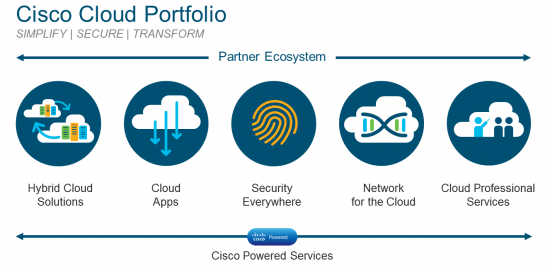
As Kip Compton articulated in one of his most recent blogs ‘we are continually innovating and expanding our cloud offerings to meet demands and provide the freedom to choose the best environments and consumption models for our customers.’ And in fact, we have an ever growing cloud portfolio, which includes cloud security, hybrid cloud solutions (cloud infrastructure, cloud management and orchestration software), cloud applications, cloud professional services and a vast partner ecosystem.

Cisco Metacloud™, CloudCenter™ and Prime Service Catalog

What I am particularly excited about is the opportunity to share with you what the integration of multiple solutions can do for your business. For example, in the World of Solutions – specifically in the Data Center and Cloud area – you will be able to witness how Cisco Metacloud and CloudCenter can work together and how they can interact with Prime Service Catalog to offer end-to-end provisioning and deployment of cloud services across various cloud environments. Let’s briefly review the individual solutions first:

  • Cisco Metacloud™ is our Private Cloud as a Service offering powered by OpenStack – delivered in a data center of your choice – and inclusive of hardware, software and expertise. Compared to IT built and managed OpenStack-based solutions, Cisco Metacloud offers lower risks, single point of accountability, guaranteed SLAs and faster time to value. And you do not need to know much about OpenStack to deploy Metacloud in your environment. As a side note, Metacloud can be a formidable platform for Big Data. We can demonstrate how a user can leverage an OpenStack orchestration (Heat) template to deploy Hadoop on Cisco Metacloud. The provisioning of the required infrastructure (network, storage and compute) for Hadoop is seamless. Stop by at our Metacloud booth to learn more.
  • Cisco CloudCenter™ is an application-centric hybrid cloud management platform that securely provisions infrastructure resources and deploys applications to data center, private cloud, and public cloud environments. If you want to learn more about CloudCenter my previous blog will provide you with a brief overview or (even better) you can see it in action at the event.
  • If you are using automation to deliver data center and application services, Cisco Prime Service Catalog is your essential user interface. Cisco Prime Service Catalog delivers the ultimate customer user interface for the self-service model. It replaces multiple manual ordering methods with a simple tool that streamlines order and lifecycle management.


A Powerful Combination

Now let’s bring these solutions together … what can you do with this powerful combination?

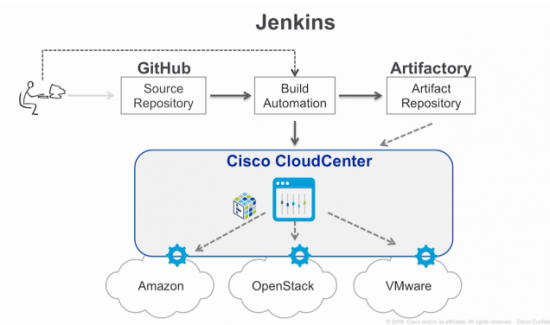
You can see DevOps in action: If you are a developer who has put together a Dockerized application, sooner or later you will want to test it or deploy it in a production environment. And you can deploy the application via CloudCenter on Cisco Metacloud and test any changes in production …. basically without leaving your integrated development environment. For example, after you check the code into GitHub, a Jenkins build process can be triggered. The build process invokes the application profile deployment and injects the latest successful build artifact in CloudCenter. Subsequently, the code is deployed to the test environment, which in this case resides on Metacloud. The developer will then be notified that the new code has been deployed.

You can then determine the best cloud fit for your application: Ok the code is finally ready .. and with CloudCenter you can optimize the placement of the application depending on your criteria. You can profile your application using price and/or performance metrics across a large number of supported cloud environments (e.g., Microsoft Azure, AWS, Metacloud etc..) By running a benchmark you can select the target cloud deployment platform that best meets your needs. For example, should you decide to retain your data and applications on premises Cisco Metacloud would represent an ideal target.

And finally, if you are just a user you simply want to gain access to an application ….. and fast! This is the way IT as a Service is supposed to work. You can easily provision an enterprise application via a self-service portal using Prime Service Catalog. The user simply selects their desired application from a menu of business services. This sets the automated delivery processes in motion. The application gets transparently deployed on Cisco Metacloud or whichever cloud deployment model was chosen by the IT administrator. And if the developer tweaks the code, it will happen in the background without you (the user) being aware of it.

In summary, Cisco Prime Service Catalog + Cisco CloudCenter + Cisco Metacloud provide a comprehensive and a powerful combination to support the entire lifecycle of your cloud applications. You can talk to our experts at the Metacloud and CloudCenter booths about each of these solutions and their combined value proposition. Additionally, Jeremy Oakey, will host a session on Thursday Feb 23rd at 11:30 AM that you do not want to miss: Multicloud and Application Centric Modeling, Deployment and Management with Cisco CloudCenter’ – BRKCLD-2008.

Cisco Business Cloud Advisor

Last but not least, we have an array of Cloud Professional Services to help you continuously improve your Hybrid IT environments. Expertise is a major barrier for organizations to be able to optimize their multicloud strategies. Our Cloud Professional Services team can help. Stop by first at the Cisco Business Cloud Advisor (BCA) booth to receive a personalized summary regarding your cloud environment and enter to win daily prizes! The Cisco BCA Adoption Report – developed in conjunction with IDC – is available in a number of European languages: German, French, Italian, and Spanish in addition to English. Fill-in the survey, see where you are compared to your peers.

Ask about our BCA Workshops or simply attend my session (‘Multicloud Strategies for Greater Business Impact’ on Thursday Feb 23rd 1:15 pm – PSOCLD-2900) to learn more. We will review the latest cloud trends and discuss how you can begin closing ‘the cloud gap’ by leveraging some of the IDC research findings and industry best practices.

See you in Berlin …. and in the meantime …. please refer to the resources listed below if you would like to learn more …

Auf Wiedersehen.

Reference Materials


Authors

Enrico Fuiano

Senior Solutions Marketing Manager

Cisco Cloud Marketing Team

Avatar

It’s more than just connecting school buses. It’s connecting a community. 

A medical clinic in Tibet. A school district in Texas. A financial services company in South Africa. A convenience store in Canada. What do they have in common? They’re all going digital with solutions sold through Cisco partners. We thought you’d like to know more about the amazing things our partners are doing. In our new series, Cue Partner, you’ll hear from our partners and how they’re helping customers around the world. 

First up, Presidio says…

The Huntsville Texas School District has over 633 square miles of bus routes, but only 6300 students. Kids who live at the district outskirts can ride the bus for up to three hours a day. So, they asked us to provide Wi-Fi on buses so kids could do their homework. In the process, we realized that by connecting their other technologies, we could provide much more functionality. 

So, we built our first Connected Bus architecture on a Cisco network. This includes an app for parents to see when their kids check on and off the bus. GPS tracking reduces wait times for students, and we can analyze that data to choose better bus routes. Students with long commutes can use Wi-Fi, with access to approved sites, to get homework done. And we added services that keep tabs on driver and vehicle performance, so we know if a driver is going too fast or if the bus needs work. 

We’re using similar technology on all buses, at bus stops, in school facilities, and throughout the community, and integrating it with emergency response, community organizations, and citizen experience services. So, if something does go wrong, we can get the right help there fast. It’s more than just connecting school buses. It’s connecting a community.

Thanks, Presidio! 

The story doesn’t stop there. 


Authors

Julie Colwell

Marketing Manager

Global Partner Marketing

Avatar

For the past few months, I’ve been using the teams feature of Cisco Spark to manage the projects that my team – the Chief Technology Office in the Cisco Collaboration Technology Group (CTG) – is undertaking. This experiment has been a smashing success and I wanted to share the interesting way in which I’ve been using Cisco Spark.

In case you are not familiar, Cisco Spark is a tool that provides messaging, meeting, and calling in a seamless experience. One of its features is called teams. A team is a collection of users working on a shared goal. Each team has spaces (formerly known as rooms) where users can chat, share files, and have meetings. Any team member can join or leave any space in the team at any time. (Read more about teams.)

The CTO organization is a really interesting one: We’re 25 engineers across 9 time zones. Most of us are senior and heavily engaged in projects across CTG. In fact, the CTO organization supports around 20 distinct projects. I needed a lightweight way to keep tabs on the progress of each initiative and to have a continuous dialog on how we’re doing against goals.

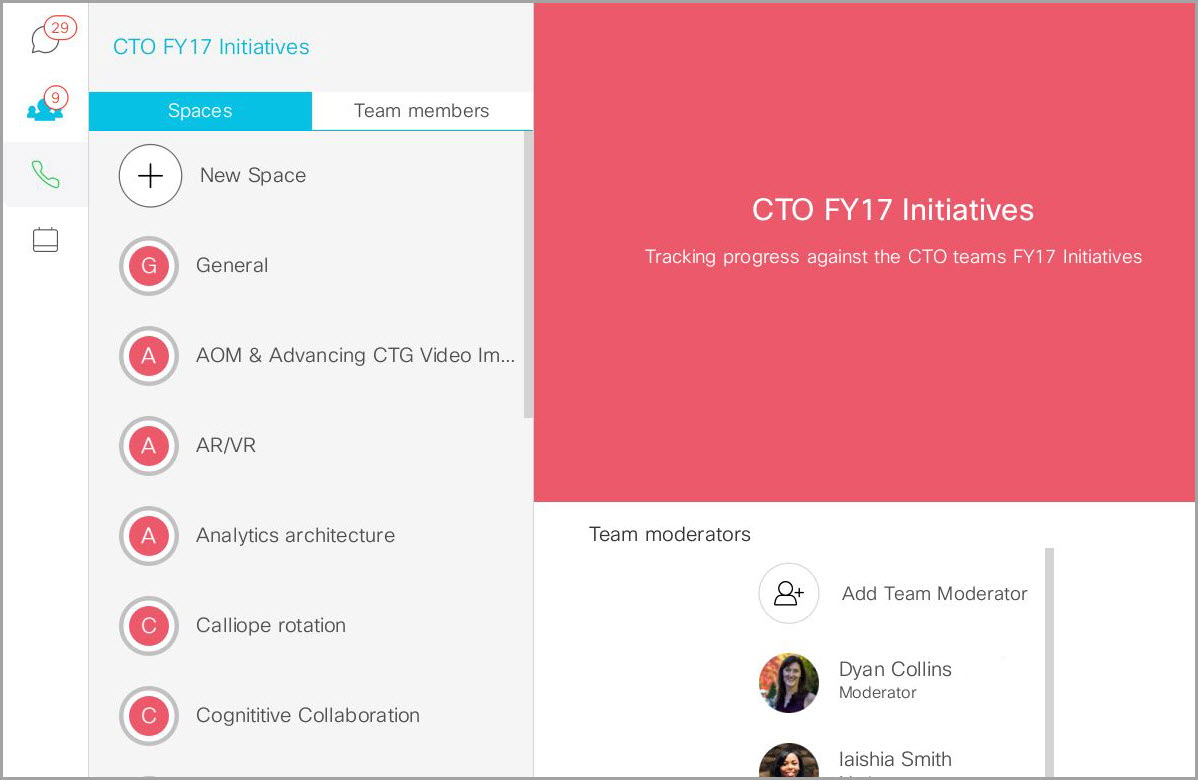
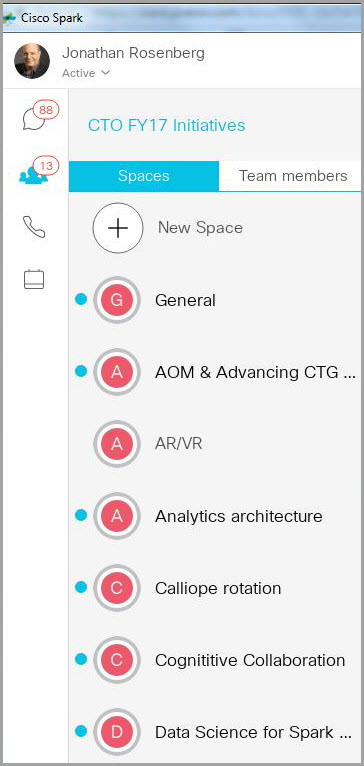
To facilitate that, we created a new Cisco Spark team called “CTO FY17 Initiatives.” Into this team went all the members of my organization. We then created a space within that team for each initiative. The first screenshot, taken from my actual Cisco Spark application, shows our first few initiatives.

For example, one of our initiatives is working in the Alliance for Open Media (AOM) on a next-gen codec. So, there is a space called “AOM” in the “CTO FY17 Initiatives” team. I have 20 initiatives, and thus 20 spaces within the team. The owners of each initiative joined the space for the initiative they own. In the beginning of each quarter, the initiative owners create a single slide summarizing their goals for the quarter and post that slide into their respective space. Each Friday, they post a weekly update into the initiative space. I review the update, post questions, and we have a dialog in the space about how the work is going.

This has worked really, really well. First, it provides me a single place I can go to see all of my team’s initiatives in a single list. In the past, that list would be in a spreadsheet or a PowerPoint slide somewhere on my desktop, and I’d have to hunt for it. Now, with Cisco Spark it’s easy to find.

The real benefit is that everything is together. In the past, my PowerPoint Initiative list was disconnected with the quarterly goals (usually on a different slide), which was even more disconnected with the discussions around each initiative, which were spread across calls, emails, and Cisco Spark chats.

By using Cisco Spark teams, it is now all in one place. The team list shows me all the initiatives. With one click, I can go into each initiative, and click on the files activity to see the quarterly goals. The messages in the space show me the weekly updates and conversations I’ve had around them.

Because spaces are persistent, I have an easy way to go back and look at the agreed upon goals, review the progress and discussions each week, and easily understand the current situation and history. This is literally a dream come true for project management. 

Another benefit of having all of the initiatives in a single team, in one place, is that I can easily run through the list and visually confirm that I received updates on each. As you can see in the screenshot to the left, by simply looking at the team list every Friday I can quickly see which initiatives are missing a weekly update.  The blue dot indicates there is a new message–in this case, a new update.

This allows me to really be on top of everything. If I haven’t seen an update as expected, I can post a message asking for status. In the past, this would have been really, really hard to do: I’d have to pull up my initiative list in PowerPoint, do multiple searches in email against the owner name and/or topics to find emails with updates, and then if I didn’t see something, I’d have to create a new email asking for updates. That’s the kind of tedious project management that no one likes to do. By using Cisco Spark in this way, those days are gone. In just a few minutes I can see the latest update in every initiative and poke when there wasn’t one.

My team also likes using Spark teams because they feel that I have better visibility into what they’re working on each week. In the past, we’ve relied on larger infrequent updates or weekly one-on-one meetings. Now that we’re using Spark Teams, we can use our scheduled one-on-one meetings to focus on other topics and discussions because we’re already current on the initiatives. Furthermore, it is easy to bring other members of my team into any one of the initiatives spaces should I need them to join the discussion. With all the past messages and documents already in the space, they’re up to speed in no time.

The open nature of the team means everyone in my organization has full visibility into progress and can drop in and out of each of the initiative space to chime in as they see fit. This makes everyone feel included.

I’ve used many tools over my career to manage programs for a small team. Cisco Spark is by far the best. Its persistence, its integration of messaging and content, and its teams feature have made it the best tool I’ve ever used for staying engaged with my team on their individual initiatives and keeping track of progress against goals.

Got a small team you want to manage? Give this a try and let me know how it works for you.


Start by visiting the Cisco Spark site and downloading the app.

Authors

Jonathan Rosenberg

Cisco Fellow and Vice President

CTO for Cisco's Collaboration Business

Avatar

Digitization is opening up new business opportunities for Service Providers. 5G is enabing mobile operators to evolve their core and IP networks to deploy new revenue generating services and more impactful experiences bringing greater business agility, reduced cost, and complexity.

5G Network Evolution Brings New Risks

As Mobile Operators transition their mobile networks to 5G, they are increasingly vulnerable to targeted cyber-attacks across a growing attack surface. Recent advancements like the all-IP evolved packet core have opened mobile networks, devices, and customers to a host of sophisticated threats. Technologies such as Small cells, virtual, and cloud technologies combined with the business imperative to deliver services rapidly, necessitate securing their network boundaries and critical “network edge” interfaces.

Hackers are sophisticated, financially motivated and are launching new attacks that are increasingly hard to see and stop across mobile networks. Mobile Service Providers lack visibility across their network and are unable to identify and stop threats before they disrupt and negatively impact their networks and customers.

A new approach to security is required to protect against IP-based threats, one that helps protect data flows and workloads across physical and virtualized mobile infrastructures. Security has become a requirement for Mobile Operators as they transform to 5G, making it necessary to deploy security across multiple places across the mobile network.

New Security Announcements to Drive 5G at Mobile World Congress 2017

Cisco will announce new security solutions for Mobile Operators in coming weeks. With Cisco, you will soon be able to transform your mobile networks towards 5G and confidently move toward profitable business outcomes by leveraging security as a key business enabler.

Stay tuned for more Security updates from Cisco coming soon at Mobile World Congress 2017!

For the full report, download the White Paper on LightReading, Evolving the Mobile Security Architecture Toward 5G

For more information on Cisco SP Security, visit Service Provider Security Solutions

Authors

Sam Rastogi

Senior Product & Solutions Marketing Manager

Avatar

On February 8th, the OpenFog Consortium released the OpenFog Reference Architecture (RA).  This 162 page document represents more than a year’s work from our global membership of 55 organizations.

The OpenFog RA is a mid-level guidepost document, full of invaluable architecture recommendations for anyone wishing to implement fog components, fog nodes, entire fog networks, or fog-based applications.  It describes in detail several illustrative fog use cases in transportation, smart cities, and visual security. The RA also discusses eight core fog capabilities that we call the Pillars of OpenFog, including Security, Scalability, Openness, Autonomy, Manageability, Agility, Hierarchical organization and Programmability. A detailed architecture stack shows the interrelationships between various hardware, software infrastructure, and application software layers, as well as various cross-cutting concerns—such as security, performance, manageability, analytics and control—that impact the function of all layers.  The document describes the OpenFog RA from several viewpoints (component level, node level, system level, etc.), so readers can select the perspective closest to their interests.  Finally, as security is one of the most complex and critical aspects of IoT systems, a special appendix dives deeply into OpenFog security guidelines.

The OpenFog Reference Architecture describes each element of this architectural framework.

The OpenFog RA is the first of a suite of documents planned for publication by the OpenFog Consortium.  Future versions of the RA will include more details on several architectural aspects, and additional use cases.  Other documents will describe how fog works in specific applications or vertical markets, and will provide much more information about the interfaces between RA functions.  While the OpenFog RA is not a standards document, we intend to work with standards development organization partners to develop rigorous, enumerated standards covering many aspects of the OpenFog architecture.

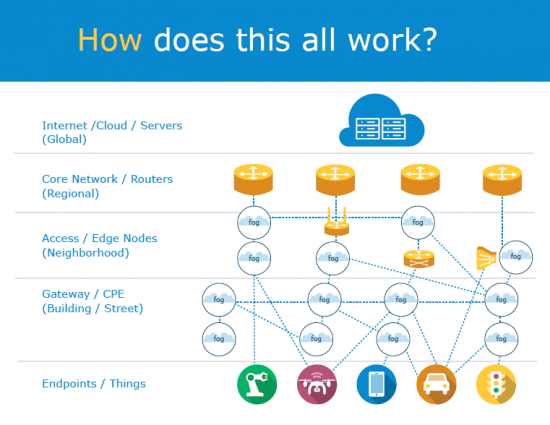
Fog enables services to be distributed closer to things, and anywhere along the continuum between cloud and things.
Fog enables services to be distributed closer to things, and anywhere along the continuum between cloud and things. 

The OpenFog RA provides a key framework for the implementation of fog networks, offering guidelines valuable to key stakeholder groups:

  • For business decision makers—key attributes and economic justifications for fog
  • For technologists—architectural and implementation details
  • For researchers—illustrations of fog-related technical challenges

The OpenFog Reference Architecture is available for free download to anyone who performs a simple registration at the OpenFog web site: https://www.openfogconsortium.org/ra/

If you are interested in participating in shaping the future of fog computing, consider becoming a member of the OpenFog Consortium. And mark your calendar to attend the first Fog World Congress, October 30-November 1 in Santa Clara, California.

Authors

Helder Antunes

Senior Director

Corporate Strategic Innovations Group