Tech Field Day covers a wide variety of events such as Mobility Field Day, Storage Field Day, Data Field Day, and now Cloud Field Day. Cisco presented at #CFD1 to a panel of 14 influencers and to a larger audience via live stream on September 14.
For those of you who haven’t seen or heard of Tech Field Day, here is the breakdown: the top influencers (bloggers, podcasters, speakers, and freelance writers) come to Cisco to listen to a few experts talk about exciting topics in a presentation and discussion format. The influencers may ask questions throughout the presentation which makes the sessions more interesting and interactive.
Manufacturing customers are already gaining insight from IoT data by securely connecting machines and sensors. One example of this is the Israel-based manufacturer Lordan.
Lordan is a manufacturer of thermal-engineering heating and cooling systems and has a global reputation for delivering high-quality custom made designs.
Their Challenge
Lordan needed a manufacturing automation system that could identify bottlenecks, reduce downtime and waste, and improve overall equipment effectiveness (OEE). Requirements included the ability to view overall throughput and track mission-critical manufacturing information in real time directly from the production floor, rather than relying on periodical assessments.
What they wanted was a window into production that would enable them to improve inefficiencies within the plant – a system allowing end to end visibility.
The results were immediate.
In addition, they were able to:
Save more than 600 labour hours a month with workforce optimization
Identify material-flow bottlenecks immediately and fix issues with mid-shift change management
Receive direct cost savings within weeks of the system’s deployment
Amir Aloni, CEO of Leadermes.com, explained why security was top of mind:
“Security issues regarding data connectivity to the cloud have been of the utmost concern to our customers in traditional manufacturing industries. This challenge prevented many manufacturers from moving to a digital factory and optimizing production efficiency. Our partnership with Cisco helped us create a unique industrial data connectivity tool, eliminating the security risks involved in cloud-based data transfer and is enabling us to provide a smart, scalable, plug and play solution with very fast deployment and reduced installation costs.”
Lordan installed the following solution:
Cisco converged industrial infrastructure creating a highly reliable intelligent and secure fixed/mobile connectivity solution within the plant
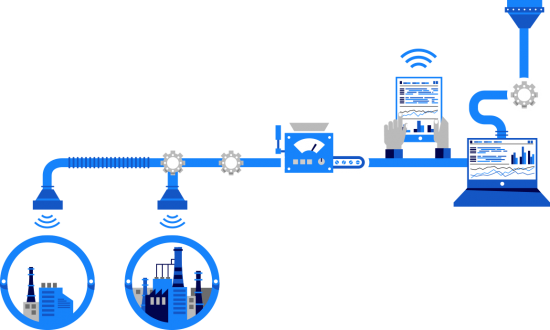
Wi-Fi connected, non-disruptive PLCs and sensors on each machine collecting basic yet essential production data
Cisco FOG computing networking nodes enabling the LeaderMES application running on it to collate and analyze specific data and securely transmit to the LeaderMES cloud service. Fog enabled localised computing and analytics at the asset
This service enables a manufacturing operations management platform, online data analysis, live visibility and alarms & alerts
The Cisco AS Solution Validation team (SVS) approached the development of this use case with three major building blocks:
R&D addressing the current customer needs while reducing manufacturing floor OPEX and increasing productivity
Cisco Product pull through by utilizing the Cisco IOT product line
A dedicated day 2 support package via Advance Services
Submitted by Kelsey Kusterer Ziser, the Editor of Upskill U at Light Reading
While the number of gigabit broadband deployments are rapidly increasing, service providers continue to face growing challenges in identifying the right architectures to support advanced networks, how to migrate from legacy equipment and how to successfully strategize for future upgrades and deployments. Despite persistent challenges, high-speed, low latency networks set the stage for vast economic and infrastructure benefits, and are fundamental to the growth and expansion of smart cities.
Gigabit broadband-enabling technologies are at once complex, varied and geographically dependent –like next-generation passive optical networking (NG-PON) to fiber-to-the-home (FTTH) to DOCSIS 3.1 to G.fast. In order to deliver the benefits of gigabit services to data-hungry consumers and municipalities, operators need clear roadmaps for future technology development, and must identify new best practices to deploy network operations efficiently and cost effectively.
Starting September 28, Light Reading, in association with Cisco, covers the cultural and technological impetus behind increasing gigabit broadband deployments, the growth behind smart cities, and gigabit-enabling technologies like DOCSIS 3.1 in a four-course series at Upskill U. During this free, online series, lecturers from Orange, Comcast and US Ignite will address the drivers behind gigabit broadband services, future expectations for deployments and the technological and economic impact of gigabit broadband networks.
Tune in to Upskill U for these exciting lectures in the Gigabit series:
Gigabit 101 (Wednesday, Sept. 28, 1:00 p.m. ET): Will Barkis, Senior Technology Analyst, Orange, delivers a high-level overview of the gigabit technology landscape, and the challenges and the benefits of each technology.
Gigabit & the Great Migration (Friday, Sept. 30, 1:00 p.m. ET): Robert Howald, Vice President, Network Architecture, Comcast, and co-presenter Alan Breznick, Cable/Video Practice Leader, Light Reading, examine gigabit broadband deployments, roadmaps for future technology development and the best ways to manage ongoing network operations efficiently and cost effectively.
Gigabit & Smart Cities (Wednesday, Oct. 5, 1:00 p.m. ET): Joe Kochan, COO & Co-Founder, US Ignite, covers smart city transformations underway today, what that transformation looks like from the network side and what the future holds as technology continues to evolve.
Gigabit & DOCSIS 3.1 (Friday, Oct. 7, 1:00 p.m. ET): Ty Pearman, Director, Access Architecture, Comcast, with co-presenters Saifur Rahman, Engineer, Comcast and Alan Breznick, Cable/Video Practice Leader, Light Reading, delve into DOCSIS 3.1 and where cable is headed with SDN/NFV, software-based networking and other new technologies.
Each 45-minute live session at Upskill U includes a Q&A with expert speakers, and all courses are archived so listeners can revisit content any time. Keep ahead of the learning curve and register today for Upskill U’s Gigabit series at http://www.lightreading.com/upskillu. I’ll see you on the chat boards!
According to Pew Research, one-in-seven Americans are television “cord cutters”, Millennials’ (18 – 34 year olds) are leading the way in bypassing traditional TV viewing with video streaming services, leading to a generation of cord cutters and cord nevers. According to new research from The Diffusion Group, a majority of Millennial Cord-Nevers – young adult broadband users that have never signed up for a pay-tv service — believe that subscription streaming services like Netflix and Hulu adequately satisfy their video needs. Consequently, they feel little need for a traditional cable, satellite, or telco-TV service.
A parallel scenario to this is a cutover from traditional phones services to cellular plans. About 45 percent of U.S. households use only cellphones. Even among households with wired phone service, according to a government study in 2015, about half of them have already foregone landlines for an Internet-based phone service sold by phone and cable companies along with other bundled TV services.
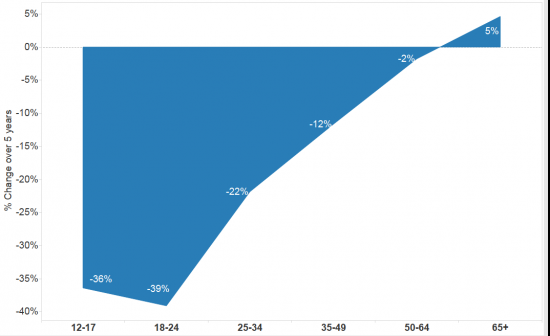
Viewers (of all ages) have been watching less traditional TV over the past few years, resulting in a drop in the number of minutes viewed. According to Nielsen’s Total Audience report, Teens (12-17), younger Millennials (18-24) and older Millennials (25-34) have reduced traditional TV viewing over the past five years.
Figure 1: Traditional TV viewing by age group
Source: Nielsen Q12016
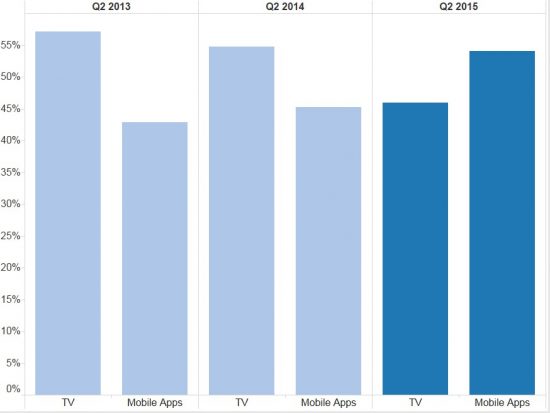
So, where is that time formerly reserved for TV viewing being spent? On another screen — with mobile apps! Apps now reign supreme as the top media channel in the United States, even without the help of a mobile browser. For the first time ever in 2015, time spent inside mobile applications by the average US consumer has exceeded that of TV, according to Flurry Analytics.
Figure 2: Percentage time spent on TV and Mobile Apps (US Daily Average in Minutes)
This growth of Internet video is also reflected in the Cisco Visual Networking Index (VNI) study. Globally, Internet video (including fixed and mobile) traffic will grow 4-fold from 2015 to 2020, a compound annual growth rate of 31% where Internet video traffic will reach 127.8 Exabytes per month in 2020, up from 33.7 Exabytes per month in 2015.
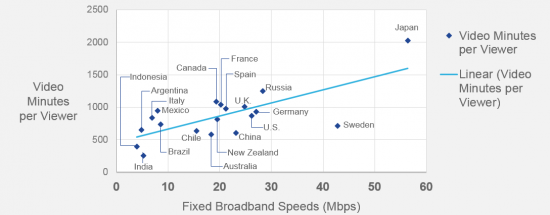
Deployment of higher speed broadband is key to this trend. There is a strong correlation between average broadband speeds and number of video minutes viewed per viewer, according to the Cisco VNI study (Figure 3). As average speeds increase in each country, the number of video minutes that each viewer is able to consume also increases.
Figure 3. Increase in Average Speeds (Mbps) Increases Internet Video Viewership (Minutes)—2016
Cable operators have a lot to gain from bringing streaming apps onto their platforms (capitalizing on this shift in video consumption). While the set top box continues to have a prominent role in the American home, service providers and cable operators are well aware of the need to address the preferences of the next generation of consumers that consume their video content on a plethora of devices at any place and at any time. Comcast for example will soon let its customers bypass the cable box and get Xfinity service directly on their television sets or streaming media gadgets. The new Comcast app will transform Samsung smart TVs and Roku devices into quasi cable boxes (read more about Comcast’s streaming app strategy). Media outlets such as ESPN are also making their content accessible on computers, smartphones, tablets and streaming devices to fans who receive their video subscription from an affiliated provider. ESPN also plans to launch a digital streaming service online (read more about ESPN’s transformation and challenges). Millennials are clearly reshaping the video landscape. For cable operators and their content/media partners, now is the time to find the right blend of traditional TV programming and mobile app experiences to meet the demands of a new generation that prefers not to be tied to a cable or even a living room couch.
One year ago, I became the new leader for Cisco’s Corporate Development team, leading Cisco’s acquisitions and investment strategy. The corporate development team was already firing on all cylinders, and this last year proved just how impactful we could be. The past 12 months became one of the most active years in Cisco’s history, with 11 acquisitions and over 40 investments.
The single biggest measure of our team’s success is our ability to help Cisco identify market disruptions and capture opportunities that were not possible through other avenues. With investments and M&A, we hold some of the most powerful tools for innovation, but we must continue to transform ourselves, creating new ways of having impact that Cisco will be able to leverage in the years to come.
With this in mind, I set three primary mandates for this team 12 months ago:
Accelerate impact through M&A,
Expand the Cisco Investments platform, and
Attract the best talent to help us continue to be innovative
Accelerate impact through M&A
Acquisitions have always played a significant role in driving Cisco innovation. This year was one of the most acquisitive years in Cisco’s history. We completed 11 acquisitions in the past 12 months, including three acquisitions in three days in October 2015. Some highlights include:
CloudLock extended our leadership position in cloud security, building on past acquisitions such as OpenDNS
Acano accelerated the interoperability and scalability of our collaboration infrastructure across cloud and hybrid environments
Jasper, our most transformational acquisition this past year, catapulted Cisco into a market and thought leadership position in IoT.
Looking ahead, M&A will continue to play a transformational role in accelerating Cisco’s position in our key priority areas.
Expand the Cisco Investments platform
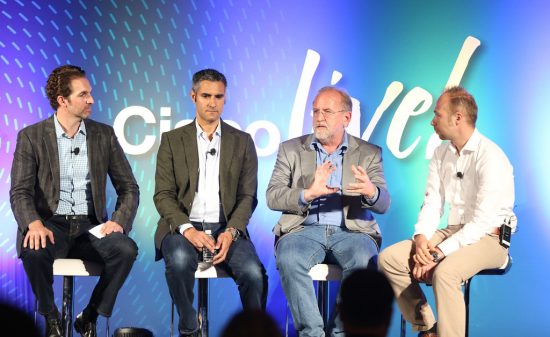
Rob Salvagno hosting a panel on Cisco Investments at Cisco Live.
Cisco Investments, Cisco’s corporate venture capital arm, has been funding startups for over two decades, but often is overshadowed by the headlines and impact of our M&A activity. However, it is Cisco Investments that has gone through the most significant transformation recently. We have significantly expanded our investment strategy, we are more agile and entrepreneur focused, we are building out a unique value proposition built around Cisco’s go to market and IT organization, and we are doing all of this on a worldwide basis with exciting opportunities in Europe, Israel, China, India and the rest of Asia Pacific.
This year we chose over 25 portfolio companies to be featured in the Cisco Investments Pavilion at Cisco Live, Cisco’s annual event for over 25,000 of our customers and partners. We also enabled our entrepreneurs to tap into Cisco’s larger start-up ecosystem and venture community relationships, hosting over a dozen engagements and events with entrepreneurs, Cisco IT, Cisco executives including our Chairman, and VC partners.
Over the past 12 months:
We invested in more than 40 opportunities, including 10 LP positions in funds
Over 40% of our investments were outside the US
We’ve grown our theme-based investments; now, approximately 50% of the investments we make are theme-based, focused on next horizon opportunities and future market disruptions, and driven by the corporate development team instead of a Cisco business unit. The remaining 50% of our investments continue to be sponsored by Cisco businesses.
Attract the best talent
This year I added several key senior positions, including a senior leader from our sales organization to build out the development platform for our portfolio companies, a new leader for Asia Pacific with financial expertise from Cisco Capital, and a new leader for IoT, Collab and Apps and Enterprise Networking who was most recently at Comcast Ventures.
Even with all these milestones across M&A, Cisco Investments and talent, we must continue to find new ways to have impact. This year saw a number of new efforts launched including Cisco’s first joint venture in China with our partner Inspur, the public launch of our first wave of Alpha startups including Tetration Analytics and Cloud Defense Orchestrator, and our first EIR cohort in Europe. In addition, we completed our second major divestiture with the sale of our connected devices business to Technicolor. I will be dedicating a future blog to some of these activities.
It is an exciting time at Cisco, with many opportunities in front of us. I don’t believe there is a team in the market that can match our capabilities – the number of deals, the diversity of deals, the complexity of deals – across investments, M&A, joint ventures and divestitures in a strategic advisory + execution role, on a worldwide basis, for over 20 years. Corporate Development and Cisco Investments continues to help chart what this path forward will look like. My team and I are ready for the journey.
As founding members of the Cloud Native Container Foundation and Open Container Initiative. We believe cloud Foundry is a key element in cloud native platform strategy. We are also committed to contributions in the open source Cloud Foundry community.
Many readers will be familiar with Cisco’s partnership with Pivotal; providing a fully assured, high performance, Pivotal Cloud Foundry environment, leveraging Cisco Metapod.
However, you may be less aware of Cisco’s commitment to the wider Cloud Foundry ecosystem and open source efforts.
As we look at the modern application landscape, there are multiple challenges facing our customers:
Firstly, migration to an all-microservices infrastructure is a serious undertaking for most enterprises. Potentially a multi-year, complex strategy; With uptime of legacy and in-transition applications being critical to the businesses, operational effectiveness and customer SLA’s.
This is to say, for companies moving towards cloud-native, greenfield is a luxury most do not have. While we believe this transition will occur, successful migration requires a phased approach, with newer services, applications and components sitting alongside and often interoperating with older components.
Secondly, the rapidly evolving ecosystems around DevOps enablement, microservices architecture, and container technologies add their own complexities, especially when considering the number of options available and the associated pros and cons around each. This complexity is then compounded by competing marketing messages and hype.
We see these issues echoed in our customer interactions, observing a mixture of technologies such as Cloud Foundry, side by side with containerization/orchestration strategies, and the companies’ legacy infrastructure in a siloed fashion.
While this evolution is a known pattern, it cycles through the enterprise every 5-7 years as new technologies emerge. The current shift is causing additional complexity primarily due to the organizational dependencies, breaking down siloes in order to allow cloud adoption, and DevOPS methodologies to succeed, enabling infrastructure convergence, and a reduction in complexity.
Distilling the reasoning for the mixed environments we observe produces common themes and a snapshot of the current landscape, covered below:
1. There isn’t a magic bullet.
While Cloud Foundry provides an excellent way of running cloud native and now dockerized HTTP(S) applications, it is too inflexible when it comes to some workloads; especially those in the earlier phases of migration from legacy infrastructure, where packaging and easy deployment and distribution are the intended goals at this phase (rather than *true* microservices.)
Equally, the container movement provides much more flexibility for packaging and orchestrating a range of application types, however this route creates the complexity of choosing, managing and assuring your own container stack and related infrastructure. Additionally, container layer re-use often allows software developers to take shortcuts and unknowingly accept risk when composing their applications leveraging a set of services or container images.
2. Competing Ecosystems have differing focus areas.
Due to the container ecosystem’s momentum around Docker, a huge array of community and vendor-backed services are becoming rapidly consumable, especially in the area of data persistence.
The Mesos project’s primary goal is to allow self-managing service frameworks and it is clear to see why the container ecosystem would bring benefits to developers looking to rapidly test, consume or evaluate data services. Adding to this, Kubernetes brings an opinionated orchestration tool that comes with service discovery and replication baked-in.
3. Infrastructure Automation and Deployment Effort.
True production automation is an often oversimplified or ignored concern when considering technology stacks for an application or shared pool of resource.
What works well in small clusters may not scale well. Technologies that do scale may not cope well with multi-datacenter or multi-AZ topologies. Even if the stack components scale perfectly, the automation code and glue to reliably deploy and manage these components is often lacking far behind the capabilities of the tools themselves; leading to an investment in tooling which must be considered when considering a platform.
In this area, we see a large number of roadblocks in the consumption of cross-ecosystem efforts, with each ecosystem and sub-project usually mandating it’s own automation choices. This makes unification quite hard…
Consider for example running a data service cluster alongside the regular day to day management of your cloudfoundry cluster;
Your primary ecosystem would suggest investing in time to produce a BOSH release to ‘productionize’ the service, where as a production ready mesos framework may already exist.
Equally, a developer with a kubernetes infrastructure, knowing Pivotal Cloud Foundry operations manager has a certified production-ready RabbitMQ service would be expected by their ecosystem to re-automate or re-package that service into their environment, rather than having to learn and deploy BOSH and it’s dependencies for just one data service.
In this way, the automation pinned to each ecosystem or project, increases the barrier to entry for leveraging cross-ecosystem benefits.
The above issues cause barriers that prevent companies, even those with microservices and modern infrastructures, from fully unlocking the speed and Agilities associated with the ‘DevOps’ mindset, especially where legacy or brownfield environments exist.
If we do not leverage the best from both the PaaS and Container ecosystem, developers will continue needing to trade off one ecosystem for potential early access to innovations in another. Alternatively, be stuck managing two, mainly-siloed infrastructures.
This picture is worse in larger companies which are trying to support their teams with a development platform: In this case, choosing a company-wide platform with one ecosystem will prevent access to capabilities could drive some teams away from adoption and into another round of Shadow IT.
As part of our cloud native open source efforts, we wanted to solve this problem of DevOps team choice vs siloed infrastructures internally;
Cloud Foundry simplicity and developer UX for developers who wished to consume it.
Container Orchestration (Kubernetes/Marathon) for developers with their own container build pipelines.
Container ecosystem dataservices and support for non-microservices transitional applications.
No operational cost of two infrastructure stacks, reducing the cost of automation, resource, tooling, and infrastructure.
Introducing Container Cloud Foundry
We have taken the open source Cloud Foundry components, including DEA and Diego and packaged them to run simply and efficiently on modern container orchestrators, such as Mesos/Marathon or Kubernetes. The deployment has also been coupled with service discovery to allow the components to converge without needing deployment/start ordering and allows items to re-converge or move compute nodes due to failures or scheduled maintenance.
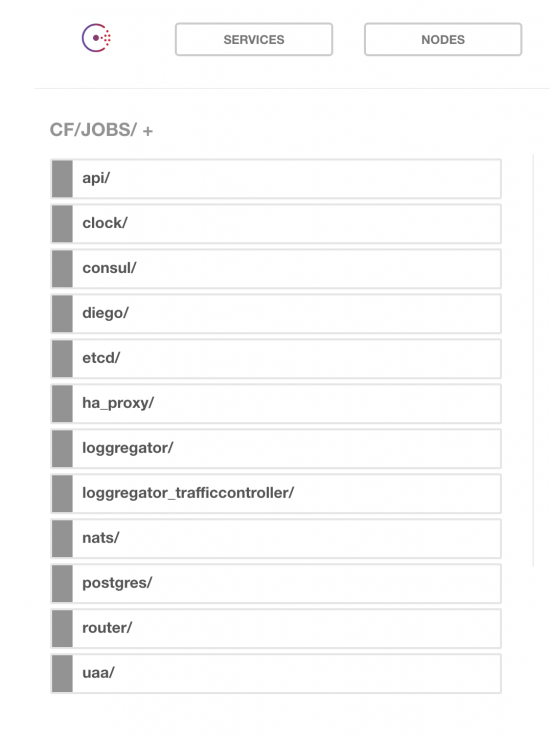
Consul becomes our BOSH in this case, providing information on the state, reachability and location of each component.
We realized Containerizing the Cloud Foundry application components would make them more consumable to the wider container communities than trying to move the container ecosystem to BOSH releases. In this way, we can augment container stacks deployments such as Mesos or Kubernetes, allowing a subset of teams to leverage Cloud Foundry.
Whats more, we now have the flexibility in a single stack to leverage Mesos Framework and Containerized dataservices, reduce the need for two siloed stacks and bring the two ecosystems closer together.
Consider the potential benefits below:
Reduction of deployment complexity for open source Cloud Foundry.
Simple, rapid bare metal deployments of Cloud Foundry.
Cloud Foundry scale-out or upgrade operations that take seconds.
Service brokers taking advantage of immediately available containerized services.
Enterprises able to offer what developers choice from a single stack.
Support for Cloud Foundry in a huge number of non-IaaS environments (without hacking BOSH CPI’s).
Developers able to evaluate new data services without needing operational blessing.
Easier customization of Cloud Foundry components by users.
New community members can leverage Cloud Foundry from their existing container stack without dedicating VM’s.
Containerized Cloud Foundry Tech Preview
We did not want this to be a one off technical preview. Therefore we produced a build pipeline that will take an existing cloudfoundry BOSH release, and produce the relevant containers for a deployment, tagged with that cloudfoundry version; ready to be consumed from a docker hub style repository.
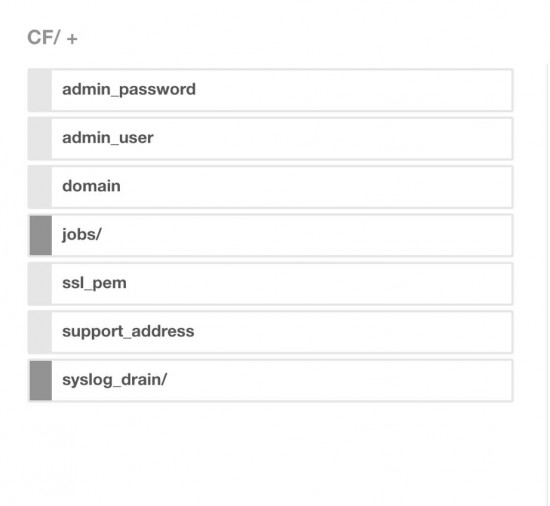
We have also limited the complexity of configuration, by picking a subset of Cloud Foundry configuration parameters (such as admin username/password, system domain name etc) and configuring those dynamically, using our Consul service discovery cluster as a bootstrap K/V store for the information.
Therefore the generated docker images are generic and consumable for all deployments:
In this way, you won’t need to use the pipeline to produce your own ContainerCF as we don’t bake in per-deployment items like passwords or domains; just consume the same public images for a given Containerized Cloud Foundry release.
See it in action!
Here’s a little demo video of the deployment and consumption of CloudFoundry via the cf cli.
Sounds good? What next..
We are excited to see what the community can achieve with Containerized Cloud Foundry. To that end, we’ll be OpenSourcing not only the generated Containerized Cloud Foundry docker images into a public docker hub, but also the build pipeline to allow community members to add their own innovations.
Over the coming days, we’ll be building out documentation at http://container.cf, firstly on consumption of the existing images and then on the pipeline itself.
If your interested in learning more or contributing, follow our efforts @ContainerCF or join the #containerCF cloudfoundry slack channel.
Matt Johnson (@MattdashJ) and his team contributed this innovation and drafted the content for this blog post.
Thanks Matt!
By Daniel Etman, Director of Product Management, Cable Access Business, Cisco
We go into this year’s SCTE/ISBE Cable-Tec Expo with considerable momentum in the industrial transition to CCAP (or, the Converged Cable Access Platform) — and as trials and deployments get underway, we continue to build-in the features our customers tell us they want.
Chief among them this year is a way to add MPEG video monitoring and SDN configuration capabilities to the cBR-8 — our #Gigababy, as we affectionately call it, and flagship CCAP platform. With 100+ customers deploying cBR-8, across four continents, the industrial desire for gear capable of delivering multi-Gigabit speeds to consumers and businesses couldn’t be clearer.
New for the cBR-8 at this week’s Expo is an MPEG video monitoring and SDN configuration application, already doing well in tests with several customers in multiple countries. It was designed to enable cBR-8 customers to holistically configure and monitor video on a per-session basis — even if the constituent gear (i.e. CMTS vs. DNCS) remains separate.
The monitoring portion can show performance statistics, on a per-session or per-channel basis, in terms of quality, packets-per-second, packet loss, and pretty much everything you need to properly analyze how well a particular session is doing. Here’s a short list of other requested-and-delivered features:
The Video SDN app can monitor and configure video sessions on converged platforms
Moving this functionality “outside of the box” yields better overall performance (on-board can result in a lower priority for resources)
No more need to visit each and every chassis! Relevant information is collected and aggregated from multiple chassis, into a single view
We purposefully separated the monitor and config functions, to give broader control over who can configure video sessions
It’s a beautiful path to virtualization, because it works seamlessly across virtual and physical edge QAMs.
Plus, it’s based on the OpenDaylight SDN controller, YANG models, and REST-ful APIs — staples of the open source landscape.
It’s much easier to show you the new video monitoring and SDN config app in person, than to describe it in words. Stop by our booth #648 at to see it in action!
Mexico is rapidly becoming one of Latin America’s economic success stories. With a thriving manufacturing hub and a fast-growing IT industry, Mexico is clearly a significant economy in Latin America and an economic lighthouse for the region.
At Cisco, we’re proud to play a role in helping drive Mexico’s continued economic transformation. We started operations in Mexico in 1993, and employ more than 1,000 employees throughout the country. We also have a long history of developing Mexico’s growing pool of skilled IT workers through Cisco Networking Academies. The Networking Academy program in Mexico is one of our largest worldwide, with more than 50,000 students enrolled in 300 academies around the country. Building off of our ongoing investment in the country’s IT talent, we announced a new Global Service Center in Mexico City last year, our fifth in the world.
Today I met with President Enrique Peña Nieto to reaffirm Cisco’s long-term commitment to Mexico, a strategic center of country digitization and innovation. Our commitment is two-fold, supplementing our existing IT manufacturing footprint, and initiating a new partnership with the government to accelerate its digital economy.
Establishing an IT Manufacturing Powerhouse
Mexico is in the midst of a manufacturing boom. The country leads manufacturing growth in Latin America and continues to gain momentum in a wide range of industries, including electronics, consumer goods and automobiles. This has helped bolster Mexico’s rising middle class, which now represents about 40 percent of Mexico’s total population, or some 44 million people.
Cisco is working with Mexico to propel this trend by strengthening its global leadership position in advanced technology manufacturing. We plan to increase our existing production at manufacturing facilities in the country, developed through our contract manufacturers. These facilities are expected to supply products to more than 110 countries, and directly complement our manufacturing efforts in the U.S. and around the world.
Wakening Latin America’s Silicon Valley
Mexico has poured more than $1 billion in investments last year and more than 500,000 IT professionals nationwide into Mexico’s tech industry, which is quickly rising to global prominence. The Financial Times even recently referred to Guadalajara as the “Latin Silicon Valley.”
The investments we are building upon today are designed to help the Mexican government accelerate digitization while boosting its economic trajectory, with investment in areas such as education, healthcare, security, infrastructure and the Internet of Things. We’ve already seen the profound economic, social and political benefits of Cisco’s similar partnerships with France, the United Kingdom, Italy, Germany, India, and Israel. Likewise in Mexico, we expect the partnership to increase GDP, create new jobs, and increase innovation. Technology has the capability to fundamentally enable access to better, more high-quality employment opportunities and services, and we believe that our investments are poised to help improve quality of life for citizens in Mexico, as well.
I am excited about our ongoing partnership with Mexico as secure digital technology continues to create new opportunities for business and for its citizens. I believe that at Cisco, we are at our best when we combine our business strength with our ability to do great things around the world. With our focus on innovation and IT education in Mexico, Cisco continues to deliver on that promise. We are honored to work with the people of Mexico to accelerate their digital economy, and help further their economic and societal success.
In honor of David Letterman… we hope we did him proud:
10 – Come Fly the Friendly Skies of Cisco. Hey, we are raffling off a drone end of day on Wednesday and Thursday. These are not just any old white box drones. These are custom Cisco branded drones. It’s a super limited edition, too. Like there are two in the whole world. Come on by the booth and register. Winner need not be present.
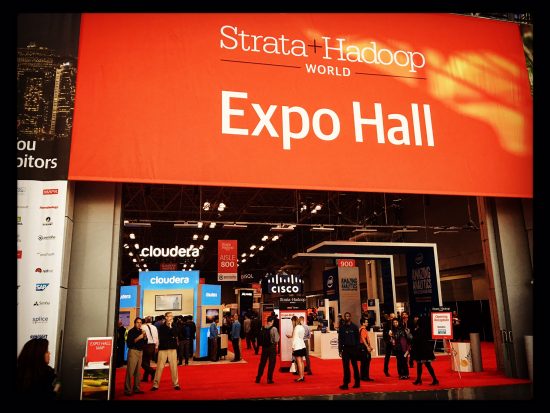
9 – Have a drink on us (Wednesday night). Once again Cisco is one of the Strata+Hadoop Data After Dark sponsors. This is the social event of the show. This year it is being held on the USS Interpid. Stop by. Mingle. Drink. Mingle some more.
8 – Our SWAG is better than your SWAG.
I know this is a relative claim. All the booths in the Expo Hall have some sort of SWAG. Cisco’s though is pretty good I think… shoot on by the booth get registered and get a cool hat. Sit in on and hear our SMEs (aka Subject Matter Experts) wax on about cool stuff and get a free book. Then yes, there is the drone give away.