On August 22, 2016 Chris Dedicoat, Cisco’s Executive Vice-President of Worldwide Sales, took to the main stage at #CiscoGSX in Las Vegas and told the entire Cisco Sales force to “demo with dCloud!”. What happened next? I can tell you exactly what happened next, because I had duty at the dCloud booth. A lot of people who had never used dCloud stopped by to ask us how they could get started with dCloud.cisco.com
Even more satisfying than the sudden interest from hundreds of new users (sparked by the invitation from the boss to use our services) was getting to celebrate the successes of sales leaders who were already winning with dCloud – smart, hard-working people like Scott Hanson, Jeremy Bresley and Brian Narcum, who already knew about Cisco’s best kept secret.
Hi there! It’s been exciting times since we launched, as customers have been showing exceptional love towards HyperFlex, amassing more than 600 customers, thousand of nodes and many petabytes of hyperconverged storage around the globe. While some of you may have been busy following the U.S. Presidential Elections, the HyperFlex team has been working on all fronts to bring you the 1.8 release – although, yes, we did take a quick break to watch the debate.
In this post we’re going to cover the 5 things you must know about our latest product release:
Intelligent End-to-End Automation with Network Integrated Hyperconvergence
The Cisco HyperFlex Installer provides the most comprehensive End-to-End automation across compute, storage AND networking. Using a simple and intuitive wizard, the entire process takes minutes to complete and uses UCS Manager service profile templates that are optimized for hyperconverged environments, in order to ensure rapid deployment and expansion. So many configurations and validations including server firmware, QoS policies and VLANs definitions that have been traditionally manual and error-prone are now conveniently automated. Check out this video to see what happens behind the scenes during cluster deployment or expansion:
Simplified Operations – Hyperconverged and Converged Infrastructure Working Together
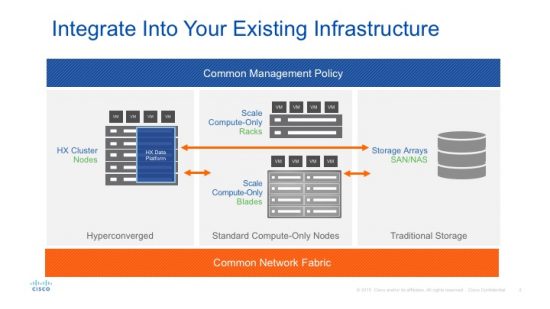
Hyperconverged solutions set to improve daily operations by eliminating the silos between servers and storage. But how do these clusters fit within the datacenter? Some competitors create a new silo by introducing a cluster that doesn’t play well with the rest of your environment. With HyperFlex, unified management across hyperconverged and existing SAN environments simplifies operations and provides better flexibility. For example, usage of the same compute-only nodes can be shifted between HCI and CI clusters based on your changing application needs, providing true cloud experience for your infrastructure.
Independent Scaling of nodes, compute or capacity with UCS Racks and Blades
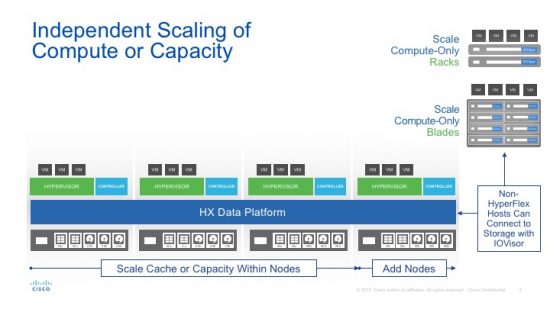
As you grow your HyperFlex environment, you have the flexibility to scale based on your specific needs. You can add additional nodes, but you can also choose to independently scale capacity or compute. In this release, in addition to the option to add Cisco B200s compute-only nodes, you can now add UCS C-Series Rack servers as compute-only nodes. HyperFlex now supports adding up to 8 compute-only nodes to 8 hyperconverged nodes and manage up to 8 clusters in a vCenter instance – so effectively up to 128 nodes in total. And if you decide to add graphics intensive VDI instances – you can add GPUs to those nodes. This flexibility enables much finer scaling granularity that dramatically optimizes your Total Cost of Ownership (TCO).
Private and Hybrid Cloud Automation with UCS Director and CloudCenter
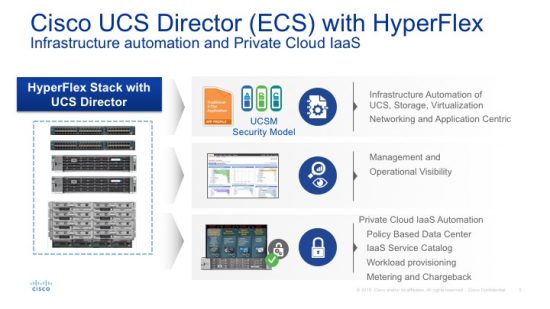
Yes – we are already releasing new integration capabilities with prominent Cisco Data Center portfolio products. UCS Director now provides Infrastructure-as-a-Service Automation – from cataloging through provisioning to metering and chargeback – for all workloads across both HyperFlex and traditional clusters, allowing you to truly achieve policy driven datacenter. In addition, Cloud Center (formerly CliQr) can already integrate with HyperFlex to facilitate Hybrid Cloud mobility across clouds, further increasing your infrastructure agility.
Tech Preview of our new HyperFlex Monitoring and Management Dashboard
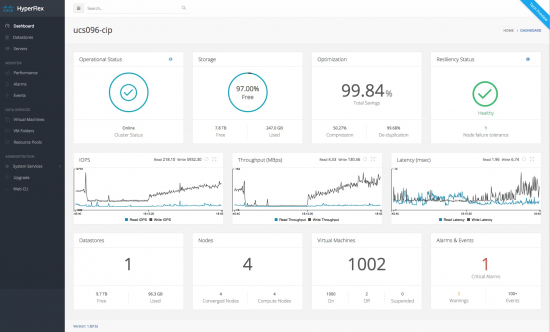
We have more new stuff! Daily operations with HyperFlex can be performed from within the native management tools you use every day. But on top of that we’re introducing an HTML5 dashboard that provides sleek, snappy and comprehensive view of the HyperFlex environment with advanced monitoring and management capabilities. Want to see more than the screenshot below? Ask your account team and they’ll be happy to share more information.
As you can see, Cisco HyperFlex is quite unique, delivering truly Adaptive Infrastructure for your datacenter. This solution is designed to truly adapt to the needs of your environment, providing automated and tailored deployment process along with granular scaling of resources. HyperFlex seamlessly integrates with and adapts to the changes in your environment using a single management foundation for all hyperconverged and converged workloads in the datacenter.
Want to learn more?
Contact your Cisco rep for an overview and demo of HyperFlex
Time flies when you’re having fun and building great products! Those who have been following CloudCenter (formerly CliQr) know that it’s been about 6 months since we were acquired by Cisco. During that time, we’ve have been extremely busy. Not only was there a lot of normal day to day activities needed to integrate into Cisco’s processes and systems, but the team was also working to crank out another great feature-filled release. I happen to be especially proud of this release since I was it’s my first release in the product manager role for CloudCenter.
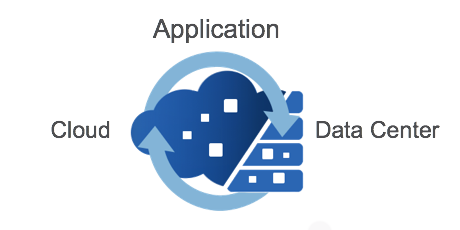
Image: CloudCenter combining both cloud and datacenter in one platform
With my new role comes some great perks like getting to play with the engineering builds right when a new feature is completed. I’m proud to report that not only is CloudCenter 4.6 now generally available, but it’s a great, big, first release under the Cisco banner. This release delivers an even deeper integration with Cisco ACI, a more simplified networking model across clouds, and an easier deployment experience.
Deeper ACI integration
CloudCenter first introduced Cisco ACI integration about a year and a half ago—right before CiscoLive 2015 in San Diego. Naturally, after the acquisition in April, one of the first things we set out to do was to deepen that ACI integration and provide more value to our customers. The 4.6 release’s vision centered around generally increasing networking flexibility. But also giving users the option to use either existing Cisco ACI objects (endpoint groups, bridge domains, and virtual machine managers) or dynamically create new ones.
The net/net of these new and enhanced ACI features is that CloudCenter with Cisco ACI blows away any other solution to give a seamless experience, no matter if you’re using vSphere, OpenStack, Azure Pack, or any other on premise IaaS cloud API. Network administrators gain flexibility in configuration, automation during deployment, and control of what end users are able to do via self-service on demand offerings —all without ANY coding to the ACI API. On the flip side, end users get a more consistent and expedited deployment of their application profile from an easy to use, self-service experience.
Simplified Networking
Since the acquisition, people keep asking us, “are you going to stay cloud-agnostic?” Fortunately, the answer is “Yes” and there is no plan of that changing. We continue to refine the list of clouds, versions, and regions we support out of the box. And we continue to add enhancements that support a multi-cloud world.. The new “Simplified Networking” configuration works by letting an administrator abstract cloud networks and assign a label based on the network’s technical features.
As an end user, all you have to do is provide your business requirement for the application you’re deploying. CloudCenter then maps all the technical stuff behind the scenes. Need a “Secure” network in Metapod? CloudCenter will map the application in the background to “Network X”. Instead, if the application is landing on AWS, Azure, vCenter, or any of the other clouds we support, the equivalent of the “Secure” network might be “Network Y”.
By abstracting each cloud’s networks into a business-requirement defined label, it makes end users’ life SO MUCH EASIER. Gone are the days when they have to know about the underlying cloud’s network capabilities. At the same time, administrators get more control and guarantee that applications are being deployed appropriately though policy.
Deployment Experience
For those old school CliQr users and admins, you’ll notice some slick new user interfaces in this release. Sticking with our mantra of “make life easy for users and admins”, we added the ability for admins to pre-set and hide certain fields from users on the deployment form, let application tiers be deployed across availability zones within a cloud region, and streamlined the deployment screen flow.
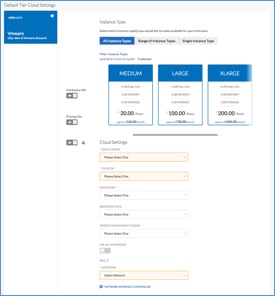
Image: New deployment environment configuration screen
Above you can see the new deployment environment configuration screen. Note the visible and non-visible settings for each field. If I’m an admin, I love this feature because it means I can lock down and hide fields that my users don’t need to worry about. Less room for error, less questions from users, and more smooth sailing!
There’s a ton more that made it into the CloudCenter 4.6 release and you can find it all in the release notes. In the next 6 months, you can be sure to expect more announcements of our progress, both in feature releases and as we make waves as a new product within Cisco!
Cybozu, a Japanese-based information system service company, wanted an open workspace where their 300 plus employees would stay connected. The company wanted a network where workers had a place to share ideas with one another while also offering the flexibility to work from satellite offices or from their homes.
Cybozu embarked on an office renovation that encompassed President Yoshihisa Aono’s vision of trying to create a better balance work and personal life. The company renovated their entire office and created open spaces without walls and cubes. They also began allowing workers the opportunity to work from home or open smaller, satellite offices in their hometowns. In order to make sure that their employees were connected, Cybozu interviewed dozens of companies to update their wireless network, but found that Cisco was the right choice for them.
“Cisco’s solution provides excellence in interconnectivity,” said Hirotaka Yamamoto, Executive Office Management Manager at Cybozu.
Using a variety of network products such as the Cisco Aironet 2700 Access Points, Cisco Catalyst 3850 and 2960-X Series Switches, Cisco was able to create a wireless infrastructure that met Cybozu’s requirements. This infrastructure connected the entire system onto one network. The network included the telephone, videoconference and contact center – all of which were managed in the cloud.
With the new netowork employees’ lives are a bit more in balance as they can work from home if they want or come into the office. While in the office, no longer are workers stuck at their desk for eight hours a day; business can be conducted anywhere they choose. Some employees congregate in the kitchen/juice bar while others work in conference and seminar rooms.
This interconnectivity has allowed the Japanese company to open smaller satellite offices in the hometowns of their employees.
“My return to my hometown led to the establishment of the Osaka office,” said Uki Okada, Global Development Division Osaka Development Department Manager. “Deployment of Cisco [products] made it easy to connect.”
For more information on this case study, please click here.
This is the second part of a 2 part blog series and you can find the first part here.
After presenting at Smart Industry 2016, I continue to examine how design thinking can drive IoT success.
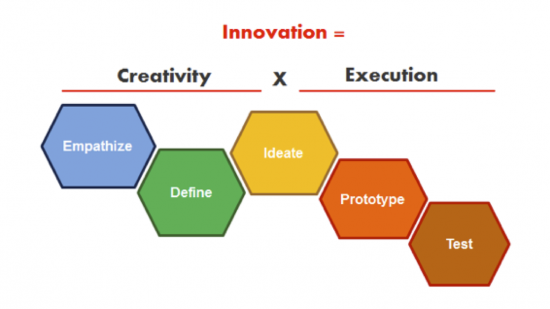
Applying internet technologies to the world of things offers an ocean of possibilities, but the path to a tangible ROI can be elusive. I’ve noticed that companies who have been successful at it have applied many of the principles of design thinking.
Success in Execution Comes at a Price
The ability to successfully execute on their business case is what separates successful companies from startups. Developing the solution, positioning it with customers, and profitably delivering on its value proposition becomes embedded into the DNA of most companies as they grow their revenues and business.
In order to maximize productivity and profitability, internal processes are solidified and jobs become defined by the tasks and responsibilities. Digitization changes the rules of the game. Now the processes and silos that have helped the business grow stand in the way of continued success.
Driving Creativity through Empathy
Companies that have successfully implemented large-scale IoT platforms addressed the Creativity side of the equation and focused teams on spending more time empathizing with their peers to redefine requirements.
Let’s consider the case of a large North American Utility that defined the business case for its Smart Meter platform. They had the foresight to create an entirely new organization made up of IT architects, power distribution operations experts, and consultants. The team spent their first year breaking down silos that separated IT from OT so they could fully understand the business drivers and translate these into solution requirements.
In addition to the initial drivers of reducing power theft and revenue leakage, the team identified additional power load management benefits and identified ways to resell capacity to local municipalities and telecom operators. This substantially increased the ROI of the $1B platform while reducing the impact on rate payers. The project also defined the industry-leading Automated Metering Infrastructure (AMI) technology which was the first large-scale deployment of a two-way communications platform.
The emphasis on creativity is the main value of design thinking and is critical for IoT success. Other successful IoT implementations have all required similar shifts in organizational culture, across the manufacturing, retail, and financial services industries. By combining IT & OT teams into a single IoT organization and focusing on processes that built trust and collaboration, these companies have been able to drive a greater level of understanding of the real problem and a workable solution.
Have you seen design thinking lead to IoT success? Comment below to keep the conversation going.
This post was written by Cisco Intern, Mark Henderson, who interned for us over the summer in Toronto, Canada. He’s back at school now, but his post inspired us. Have a great year Mark!
***
“If you’re not nervous, you’re not growing.” This quote is one that I have held as a personal mantra, I remember hearing it from my mom when I was growing up before every minor league hockey game and before every big presentation in school. And she was right. When I look back on the moments where I truly learned valuable lessons, they were when I overcame a personal fear like giving a public speech or putting my heart into playing hockey. Unfortunately, it’s also pretty easy to avoid these nervous situations, follow a comfy routine, and ultimately stagnate any potential for growth.
Pursuing this idea of never getting comfortable, you can imagine my excitement when I landed a Sales Development Internship at Cisco Canada. The 12-week position provided me with so many opportunities to develop neglected, lacking skills of mine. Every single day I worked at Cisco, I was exposed to work that made me nervous for all the right reasons and thus instilled valuable skills in myself through learning from the experiences.
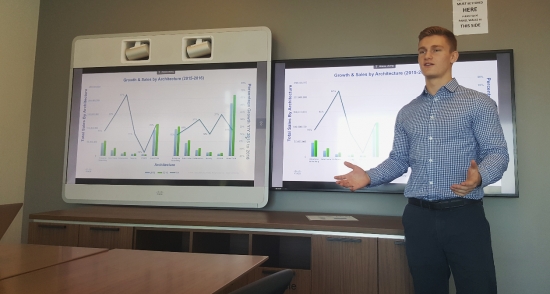
For example, like many of us, I was a poor public speaker growing up and would always get sweaty palms, a racing heart, and a shaky voice before appearing in front of an audience. In my first month at Cisco, I was tasked with giving three big presentations to different groups: an account team, the Canada Partner Organization, and Cisco executives when we visited the San Jose office. These definitely worked up my nerves, but every subsequent presentation I was slightly less nervous than the last. After about eight presentations, I miraculously found that I no longer got nervous speaking in front of others, and I actually enjoyed the conversations I had with my audience! Cisco gave me the opportunity to overcome my fear of public speaking by challenging me throughout multiple opportunities to speak in front of others.
However, public speaking was just one factor that threw me outside of my comfort zone, so here are a few more situations where I felt nervous and how that helped me better myself at Cisco:
Executive Exposure: The first time I spoke to a Vice President at the Cisco Toronto office I was tremendously nervous and probably blanked out on some of things I wanted to say. But, because I was offered this exposure multiple times over the course of the internship, I found myself perfectly comfortable speaking with leaders towards the end. So much so that I even decided to offer feedback on social branding to the Director of Brand Strategy and Content because I developed the confidence to bring my ideas to the table.
Calling Partners and Clients: Along with executive exposure, I was offered opportunities to speak with partners and clients about new, innovative solutions. This taught me how to keep composed when in any situation and really research my information before meeting a potential buyer or re-seller. This meant that I was able to prepare myself for the multiple paths for our conversation might take.
Thinking Outside of the Box: Lastly, one of the biggest things Cisco helped me with in my personal career is fostering the ability to think outside of the box and provide creative solutions to big problems. The internship revolved around account research where there were clear issues at Cisco-related organizations with very vague solutions. Our jobs as interns were to provide ideas on how to solve these problems, regardless of how outside of the box or crazy our solutions were, those concepts were always taken into consideration. This was a really powerful lesson for me to see that even during an internship, my thoughts were still sought after and valued.
In conclusion, Cisco offered me an incredible opportunity to grow. Yes, there were times every day where I felt the butterflies in my stomach or my heart would begin to race. Instead of avoiding this fear, however, I embraced it because I knew that it was the key to my personal development and growth as a professional. Thank you Cisco, not for making me nervous…but for making me better.
Quantum computers could break commonly used public key algorithms, which would affect cryptography used today. For that reason, there has been great attention on quantum safe crypto recently. We have blogged about it in numerous occasions [1], [2] , [3]. In that context, last week the 4th ETSI/IQC on Quantum-Safe Cryptography in Toronto, Canada brought together diverse players in the quantum-safe cybersecurity community to facilitate the knowledge exchange and collaboration required to transition to a quantum secure era.
Cisco was among the participants of the workshop with two presentations. Scott Fluhrer presented a method for adding quantum resistance in the IKEv2 key establishment by using postquantum-secure preshared keys, and proposed a scheme for adding quantum resistance in the TLS key exchange without introducing changes to the TLS handshake. The former has been submitted to IETF in order to add quantum resistance to the IKEv2 key establishment. The TLS proposal aimed to provide a minimally-disruptive solution, without significant extensions to the protocol, by hiding a new algorithm behind the abstraction barrier of DHE. In both cases, the result is a key establishment that is postquantum secure as long as at least one of its two algorithms is secure.
David McGrew later focused on hash-based signatures (HBS) in the workshop. He summarized the most prevalent hash-based signature schemes proposed in the literature and standards bodies today. He presented the practical challenges and tradeoffs between these schemes and describe some considerations of signatures being used in certain environments. David then tried to address some of the state management challenges of stateful HBS schemes. Part of our HBS vision has been shared in our recent blog.
We also had the chance to attend interesting presentations in the CxO sessions, ISARA’s PQ browser demo, Andreas Husling’s PQCrypto presentation, NIST’s standardization effort session, quantum-safe IoT by Phillips, LWE by Jintai Ding and more.
We further had more discussions with industry peers, academics and standards representatives from ISARA, Microsoft, Intel, Entrust, NIST, CESG, ETSI and CRYPTO4A. We must say that all discussions were very interesting and converged towards the need for a strong foundation on which we build an agile framework where used algorithms can be transparently updated in a post-quantum world as necessary. Cisco will continue to influence and collaborate with various players towards this strategy.
We would like to thank ETSI and IQC for organizing a very interesting workshop.
Cisco has always been incredibly enthusiastic about the role of the partner and there is no disputing the unbelievable success we’ve had together. As a matter of fact, today over 85% of the business we do in the marketplace is done through our partner ecosystem. There’s no other company in the industry like that.
Visit SuccessHub to learn more about driving value realization and accelerating growth in the digital economy.
We are on a shared journey, and the digital shift and transition to a subscription-based and as-a-service business model is one that we’re going to be driving together. Still, from time to time I hear concerns that partners will no longer have a role in the digital economy. In my opinion, nothing could be further from the truth. Yes, the past decade has ushered in entirely new ways of doing business, and our industry has been reshaped and reinvented in almost every respect. But now more than ever, change has created new complexities and uncertainties for customers. That, in turn, has led to a larger and more critical role for partners.
From public, private and hybrid cloud to managed services and more, IT environments are more complicated than ever. At the same time digitization has made technology buyers more educated and empowered than ever. A new breed of technology buyer has emerged, leading to the need for new approaches to the purchasing process.
Today’s buyers want to pay as they go and try things out – before they commit. They have higher expectations for their technology investments, and they want ROI and outcomes. In addition, line-of-business leaders are now playing a much more active role in the decisions about the tools they’re using, and about how they bring those tools into their respective organizations.
These are monumental changes, and they require a monumental shift in strategy – one that is focused on the customer journey and on driving loyalty after the initial point of sale. To succeed as this shift unfolds, partners are being asked to make sense of today’s complex IT mash-up for their customers. They’re being asked to become service integration and product adoption experts. And they’re feeling the pressure to continuously deliver value and empower their customers to hit their outcomes and improve their brands in the marketplace.
https://youtu.be/hTE3KbttINk
Getting it right and making it all come together is no easy task. It requires time spent listening to the customer, understanding their preferred outcomes and matching those outcomes to the right solutions. Ultimately, it means ensuring that customers are effectively adopting and using their technology solutions to the fullest potential. The reward for partners? As outcomes are met, trust will be built and new opportunities will unfold, almost effortlessly.
The Partner Transformation Journey
With value realization and adoption representing the future of IT, it’s critical that we evolve our businesses to align with the massive transformation that is taking hold. At Cisco, we’re evolving and innovating across our entire organization, and because partners are so central to our business, we want to share what we’ve learned about the changing IT landscape with you. That’s why we created our SuccessHub resource center, which offers innovative partner-focused content, playbooks and processes built around adoption, value exchange and customer success. We’ve also been holding adoption and lifecycle management workshops to help partners exceed customer expectations for the Cisco technology investments they’ve made.
Last but not least, our data-driven platforms, programs and tools, such as Cisco Impact, Lifecycle Advantage and AutoQuote, are designed to nurture adoption and customer success every step of the way throughout the customer journey. With these offerings, the ultimate goal is to enable customers to achieve their stated business outcomes—whether it’s to improve customer service, make supply teams more efficient or something entirely unique to their company.
A Digital Wake-Up Call
While change can create uncertainty and even chaos, the truth is that the digital economy has served as a wake-up call for all of us. Gone are the days when the customer relationship ended when a product was shipped out the door. In fact, today, that’s when the customer journey begins. And it’s where partners can really begin to show their value, too.
There’s no question that as our industry continues to evolve, the importance of the partner will increase exponentially. All of us at Cisco stand ready to support you and work with you in partnership as the transformation unfolds.