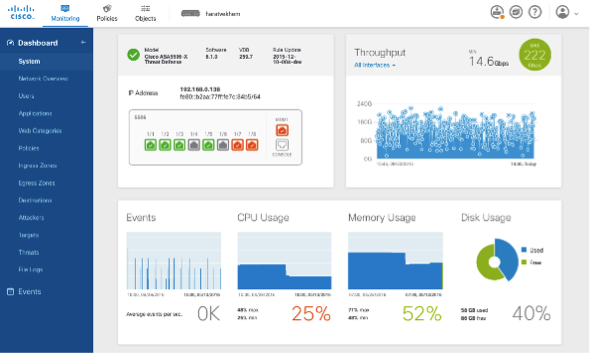
The Team is excited to present a new SNA video. SNA is a free network level monitoring and management tool for our line of Cisco Switches. A fluid interface is accessible via browser on any 550X, 350X, and 350 Series Switches.
SNA will manage the new generation of 550X, 350X, 350 and 250 Series, as well as discover past generation 500, 300, and 200 Series Switches.
Organizations must take advantage of the digital economy in order to succeed and grow.
But to do this, and do it securely, we can’t be compromised by complexity.
Our IT landscapes are often systems cobbled together over the years. We may have servers from 15 years ago and cloud apps from 15 minutes ago. We face a constantly evolving threat landscape of sophisticated attacks and attackers. And we often confront security problems with a patchwork of point products that don’t fit or work together.
To defend against advanced attacks and thrive in today’s digital world, we need more effective security. Security that is simple, open, and automated.
In the next few weeks we’ll look at each of these aspects of security effectiveness and discuss how Cisco is delivering products and services that are simple, open, and automated. In this post I’ll start with how we are creating simpler security experiences for customers – be it simple to deploy, manage, or scale.
Making Life Easier and Security More Effective
Leonard da Vinci said, “Simplicity is the ultimate sophistication.” I couldn’t agree more. The most effective solutions use innovation and technical know-how to take what’s complex and make it simple. We see this play out every day. From smartphones, to online shopping, to smart houses – we’ve come a long way in using technology to simplify life. Yet for some reason, when it comes to security, life isn’t so easy.
Most organizations use as many as 60 different point products to attempt to secure their network, endpoint, and cloud environments, yet we read every day about successful, damaging attacks. Would you bring 60 products to solve any other IT problem?
Deploying, managing, and scaling security tools that don’t work together easily (or at all) is time-consuming at best and often, it’s a seemingly impossible task. Too often the latest tool becomes expensive shelfware.
You can’t throw more people at the problem either – there aren’t enough. And even if there were, it’s cost-prohibitive. The scale function required to keep pace with the ever-evolving attacks and a dynamic business landscape requires consistent hiring of elite quality talent – which is very hard to consistently fund for most organizations even when supplemented or enhanced with services. To be effective, security needs to be simple.
Now you might be thinking, “Time out, the words simple and Cisco haven’t always gone together.” What’s more, “simple” probably doesn’t come to mind when you think about security. But Cisco is set on changing this. We are tackling complexity and offering simpler yet exceedingly effective security experiences to our customers. Here are just a few examples.
Cisco is creating more effective, simpler security experiences for customers.
Simple to Deploy
Need a way to combat ransomware or malvertising attacks? We can’t wait months to deploy a solution when attacks are happening now. We need to enable effective security for thousands of users in minutes, not months.
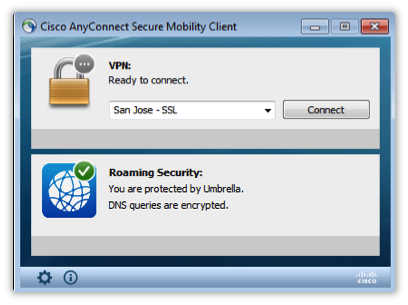
Cisco Umbrella and Cisco Advanced Malware Protection (AMP) help protect against these attacks fast. Umbrella protects employees both on and off the corporate network from making connections to bad IP addresses, URLs, and domains. It can be deployed in under an hour, and doesn’t require an agent. AMP continuously monitors network and file activity across your infrastructure. If a malicious file is seen anywhere in the world, AMP blocks it everywhere. Turning on AMP is as simple as activating a software license on many of your existing Cisco security solutions.
Simple to Manage
In my last post I talked about the new Firepower Device Manager which makes it easier than ever for network admins to run their NGFW. Workflows walk you through choosing constraints and policies from a single access control screen. Firewall, AVC, URL filtering, IPS, and AMP – done. Visualizations let you see policies and traffic so you always know exactly what is going on.
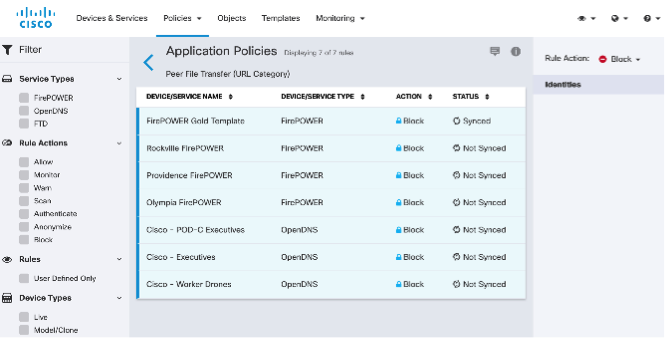
Cisco Defense Orchestrator is another example. Network operations staff can easily manage thousands of security devices (Cisco ASA, Cisco NGFW, Cisco Umbrella, and more) from a simple cloud-based portal. Without being a security expert, you can optimize, configure, and manage policies across your entire network, whether you have dozens or thousands of locations. And when you see a misconfiguration or inconsistency you can change a policy quickly. Cisco Defense Orchestrator simplifies policy management while making security policy stronger.
Simple to Scale
Security has to extend when and where you need it. To protect branch offices, you can activate a Stealthwatch Learning Networks license on an existing Integrated Service Router (ISR) to identify malicious traffic on the local network – where there is often little security deployed.
Adding Umbrella Branch to your ISR adds protection at the DNS-layer – the simplest way to prevent users from connecting to websites that host malware.
While security will always face complex challenges, you can see there’s a lot Cisco is doing to make security simple to deploy, manage, and scale. And in many instances we’re also helping you to get more from your existing security and network investments. We’re continuing to innovate across our portfolio of solutions with the aim of making security more effective and your life easier.
In my next blog I’ll talk about how our commitment to building products with openness in mind is helping us reach this objective. In the meantime, I encourage you to explore our security solutions and see how we’re making effective security simpler for our customers.
Running an efficient, secure data center today is a bit like running an obstacle course in the dark. Except, on this course, someone keeps moving the obstacles and adding more track.
In any given moment, we really can’t know for sure what’s going on in the data center. SDN, virtualization, containers and cloud services—while awesome—aren’t making things any clearer. Which is ironic, since better visibility into our applications, their traffic flows, and dependencies is exactly what we need to successfully migrate to these technologies in the first place.
Without real visibility, how can we feel confident in our ability to make any changes, let alone wholesale migrations, without slamming face-first into a wall?
The answer appears to be Cisco Tetration Analytics. And it’s the subject of our – drum roll, please – 200th episode of TechWiseTV.
https://youtu.be/a5FddThT6vc
Let’s Talk Tetration
In this episode, I’m joined by Tetration Analytics product manager, Jyothi Prakash, and Benny Van De Voorde, a data center architect in Cisco IT, who shares his hands-on experience with Cisco’s new analytics platform.
What does it take to be an agile digital service provider in today’s competitive marketplace? For Level 3, it’s all about speed, simplicity, and flexibility.
Claudio Scola (pictured left), Level 3’s director of global product marketing, spoke with Cisco about how the company is using orchestration and software-defined networking (SDN) to deliver customized service offerings and stand out from the crowd.
Transforming the Customer Experience
For Level 3, success begins and ends with the customer. It sounds simple, but it can be a tricky transition for communication service providers (CSPs). After all, for many years, customers viewed network services as plumbing. So, many CSPs competed largely on price—and found their businesses getting commoditized.
“If you give everyone the same baseline, it’s going to be ok for some but also poor for some other people,” says Scola. “The old style of making a million widgets that all look the same because you’ve got economies of scale created an outdated user experience, and it isn’t working anymore.”
Level 3 is taking a different approach by starting with a simple premise: No two businesses are the same, so their network solutions shouldn’t be either. The company built a foundation to deliver customized network services on demand. Today, customers can select the specific combination of features and services for their needs. They can choose packages that flex capacity up and down based on network performance triggers or scheduled workloads, and pay only for the resources they use. And they can design and order their own tailored network solutions through a self-service portal.
Automated, Adaptive Service Delivery
That kind of tailored service delivery sounds great, but there’s a reason most service providers have used a one-size-fits-all approach: Delivering custom services on demand is hard. A large operator can have tens of thousands of heterogeneous networking devices from multiple vendors, as well as different management and operational processes in different markets. You can use scripts to automate some of that. But if you have to spell out every single step in provisioning every service, those scripts get very complex. And with a large network that changes all the time, managing scripts and keeping them up to date becomes a monumental effort.
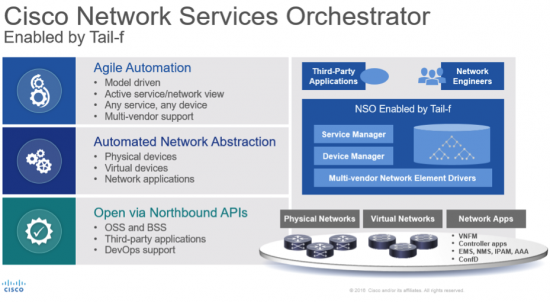
Level 3 knew they needed a simpler, more flexible long-term approach. So they opted for SDN network programmability, with an orchestration layer that abstracts away all of the underlying complexity. Using Cisco Network Services Orchestrator (NSO) enabled by Tail-F, Level 3 network engineers can design service offerings once, describing both high-level services and myriad underlying networking devices in the standardized Yang modeling language. The system maintains a single real-time database of every device and resource in the network. When someone requests a change, it analyzes the available resources and reprograms the network to execute it—without having to be told explicitly how, and without disrupting running services.
Level 3 (and its customers) can now start with a high-level command: “Create a new E-line circuit to this office.” Or “Spin up a new development environment in the public cloud, with a secure connection to my product team.” For example, Cisco NSO automatically reprograms the network to make it happen. Nobody has to spell out which devices and cloud services should be activated, or how they should be configured. Customers don’t have to wait weeks for Level 3 to manually deploy and configure new hardware. The network handles everything, automatically, in minutes.
An Agile Foundation for the Future
It all adds up to big benefits for Level 3 and its customers. New services and changes can be made much faster—which translates to faster time-to-revenue. Errors and service disruptions associated with complex manual configurations largely disappear. Level 3 is separating itself in the marketplace by delivering customized solutions that other CSPs can’t match. And Level 3 customers get exactly what they need, exactly when they need it.
“We no longer need to differentiate ourselves with the plumbing – with speeds and feeds,” says Scola. “Now, we can do it at a service layer, with software and the customer experience.”
View Level 3’s Software Defined Networking Success Story
There’s a lot more to the story. Read on to learn how Level 3 is using its programmable network to transform the customer experience here.
Find Out More
To find out what Cisco Network Services Orchestrator can do for your business, visit www.cisco.com/go/nso.
And for more details on how Level 3 is leveraging NSO, please view their case study here.
Hello from Anaheim! I’ve had the chance to connect with tons of colleges and universities at EDUCAUSE 2016, and there have been many great breakout sessions.
By far, the biggest trend this year is digital everything. Everywhere I look, digital challenges and solutions are front and center. In fact, according to a recent Campus Computing survey, the number one education technology trend people are excited about is digital.
On Wednesday, I got the chance to sit down with some higher education leaders and hear a bit more about their experiences with digital learning – specifically, with virtual learning environments. These experts explained that the chief reason their campuses are turning to digital solutions is to allow students to learn no matter their circumstances.
From L to R: Dov Friedman, CirQlive; Tracy Atkins, GSU; me; Kevin Reeve, USU; and Shane Milam, Mercer.
More often than not, these colleges and universities are seeing results from integrated solutions – students, faculty and staff are finding that easy-to-use and easy-to-understand environments help adoption rates to rise across the board.
Another hot topic here in Anaheim is cybersecurity. EDUCAUSE just released its 2017 list of top IT issues, and security is the number one issue for higher education leaders! People are really excited about digital learning and connected classrooms, but as we adopt these wonderful new technologies we must ensure that our networks and IT environments remain secure. If you missed it, there was a great blog post from EDUCAUSE this week about the importance of protecting data when using collaboration apps.
My colleague Peter Romness spoke yesterday about the importance of cybersecurity in the higher education space. His panelists from the University of Wisconsin spoke on the need for integrated security architecture and how Cisco is helping them achieve their security goals. If you weren’t able to make his session, check out his recent Cisco education blog post for more insight.
(Peter Romness, left and Bob Turner, CISO at the University of Wisconsin-Madison)
The great thing is that higher education institutions don’t have to sacrifice security to get digital ready. In fact, on Wednesday we announced our new Digital Education Platform, which allows users to collaborate using the cloud while still remaining secure. Tools like this are what make me excited for the future of higher education!
Want to see more updates from EDUCAUSE? Make sure to follow us on Twitter at @CiscoHigherEdu and @CiscoEdu.
I was twenty-two years old when I joined Cisco Capital, a recent college graduate, ready and willing to bring everything I could to the table in my first real world position.
The role was in North Carolina – adding a new location to the new experience. So I packed up and moved 500 miles south. I had the pleasure of networking and meeting many colleagues on various teams in Finance as a whole.
Most people would think “Cisco Capital Team” and think “boring!” It soon became obvious to me that this team was the farthest thing from boring. Halloween is Cisco Capital’s favorite holiday. They pull out all the stops. Never would I have imagined working professionals in corporate America would embrace the fun like this. Count me in!
I had been an RA (Resident Assistant) at Marywood University, where I would plan and host events to bring people together. I saw this as my way to make an impact on my new team.
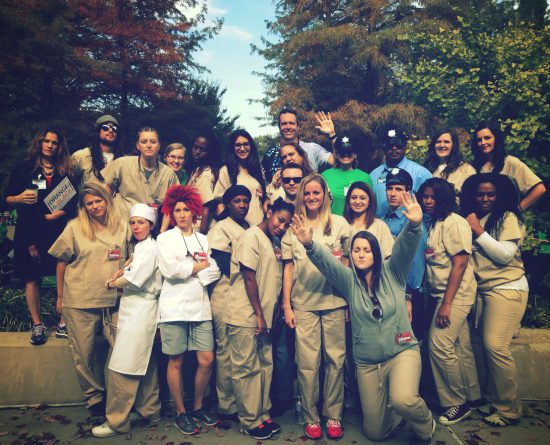
In 2014 the Netflix original series Orange is the New Black reached its peak of popularity. At the time I was coming into my own at Cisco, the second season was all anyone at work could talk about. My colleague, Margaret Baxter and I gathered our thoughts and pitched an idea to the Americas Operations Director, Deborah Baker. We were going to enter the Halloween costume contest and we were going to WIN!
The idea was a hit. Both our managers and their Director unleashed us to let the creative juices flow. Word spread like a wildfire. Soon teammates came to us for character signups. We even reached out to the more reserved colleagues to play a part. They agreed! We had over 25 teammates, managers, and a director dress as over 25 different characters from the show ranging from main characters like Piper and Alex to supporting roles like Sophia and Leanne.
The managers graciously supported our decision to not only have a little bit of Halloween fun (okay, a lot of fun) but also give back to our community and purchase a bulk order of tan scrubs and participate in the annual 5K Fun Run here in Raleigh. They encouraged us by offering to match a percentage of the entry fee for all Capital participants. Soon the day of the event came, and we skipped across campus, prison badges and all, in full costume. You could feel the excitement in the air. Teammates with big smiles on their face took selfies, Snaps, posted to Instagram… we basically took over social media before the event even started.
As our group congregated outside the 5K arch, random Cisco employees and volunteers ran up to us telling us how much they adore the show or how they wanted a picture with their favorite character. I have to say everyone’s favorite was Crazy Eyes! MJ (Margaret) stayed in character! Our team won the 5K costume contest.
Every day is a fun day in Finance, but this is one that stands out in my mind. Happy Halloween to all, and if you don’t celebrate in your location around the globe, make it an excuse to dress up and have fun with your team.
Want to join the Cisco Family? We’re hiring! Apply Now.
Following the sophisticated and highly distributed attack involving tens of millions of IP addresses this past week, the concept of DDoS protection is on the forefront of network administrators and operator’s minds alike. While the nature and source of the attack is under investigation, understanding what can be done to prevent and mitigate future attacks is of utmost importance. Fortuitously, several months ago, we scheduled a Cisco Knowledge Network for this very topic: DDoS Protection for the Network.
The distributed nature and complexity of these attacks is only increasing as the Internet of Things becomes a reality. Service and web providers with the Cisco ASR 9000 in their network have the opportunity to offer services for protecting against DDoS attacks, which is especially important given the scale and target of recent DDoS attacks shifting the focus to protection for core network infrastructure and services. With the Cisco ASR 9000 vDDoS protection powered by Arbor Networks, service providers can offer customers, including existing DDoS mitigation and protection firms greater scale and agility for handling much larger attacks concurrently.
There is not much network operators can do today to stem the deluge of internet connected devices and multi-vector attacks enslaved by hacks like botnets. Poorly secured Internet based devices like security cameras, digital video recorders (DVRs) and consumer routers are a fact of life for the era of IoT. Having a resilient network infrastructure capable of handling large scale DDoS attacks becomes a valuable service for end users and a potential new revenue generating service for customers.
Erica Parker shared her story with us this summer as a Cisco Intern before going back to class this fall. We hope your semester is awesome, Erica!
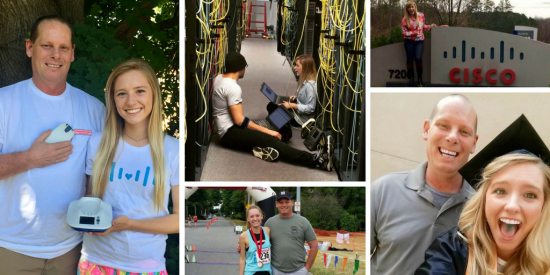
During the summer of 2015, my perfectly healthy father woke up one morning and suffered from a cryptogenic stroke – or a stroke without a cause. It was a scary time for us all, but thanks to technology my dad was paired with a small implantable cardiac device called a loop recorder.
This device uses wireless technology to transmit every single one of his heartbeats to my dad’s doctors – all while he is able to stay in the comfort of his own home, making the monitoring and diagnostic processes entirely remote for the patient. (Now tell me that isn’t cool!)
Yes, life changed for my dad and our family after this event – but it wasn’t until a couple nights after the device was implanted that this moment would really alter my future.
Just two nights after my father had the loop recorder implanted there was an awful thunderstorm that took the power out on our entire street. This caused his device to malfunction – none of his readings were being sent to the hospital! He was terrified.
Seeing how scared my dad was made me want to do whatever I could to make it better. He has always supported every decision I’ve ever made. However, I don’t think either of us would’ve expected that this life-threatening medical emergency would point me in the direction of my future career path.
I spent hours that night researching the wireless technology behind his device and even came up with a solution that fixed the issue. Immediately, I knew that I wanted to take what I knew in computer networking and use it to improve the lives of other people around the world requiring these medical devices, just like my dad, through development for improvement.
It was then that I started working towards becoming a developer in computer networking for biomedical technology.
Shortly after, I landed my co-op at Cisco and joined the Virtualization and Infrastructure team. My team let me take the reins and truly get a taste of what it is like to be a developer, and I absolutely fell in love with it! Everyone at Cisco really encouraged me to become heavily involved and they were all interested in helping me find more ways to grow and learn the skills I needed in broadening my horizons.
One of my team members even informed me about the Cisco Telehealth System, a system that allows for doctors and patients to connect remotely. This is a service that’s very similar to what my dad is using!
I got to see the Telehealth System in action during my internship at Cisco’s Raleigh, North Carolina campus during a tour of the brand new health facility. The receptionist explained that the devices allow patients to speak with and send their vitals remotely to doctors stationed all around the world. It was incredible to see first-hand how this technology and computer networking is aiding biomedical devices and patients.
Being able to experience this during my internship only motivated me further. I want to improve the efficiency, security, and quality of service in these networks that connect patients with their doctors in remote locations. This technology was profoundly helpful for my father – and I know it can allow other patients to lead more “normal lives” without the hassle of physical trips to the doctor’s office or giving their doctors access to a patient’s vitals in order to make quick medical diagnoses. Through research and development of better solutions I hope to one day improve the quality of life for these patients and their families – just like my father – by making this process as seamless as possible for all parties involved.
We hear it quite a bit – that Cisco is dedicated to empowering its employees to change the world. Maybe that sounds cliché to some, but speaking from experience – they’re not kidding. I’m living proof of someone who has been encouraged to change the world through my Cisco Internship.
As we approach the first anniversary of the Open Fog Consortium, I am proud of the strides we have made in building a diverse community dedicated to an open, collaborative approach to fog computing technology. Just this week, OpenFog and Barcelona Supercomputing Center (BSC) announced a new strategic agreement aimed at accelerating development of fog computing technology and proofs of concept.
The agreement will enable OpenFog and BSC to co-create new fog computing concepts and architectures, and to jointly promote them in industry activities. BSC will have access to OpenFog’s reference architecture and testbeds, and OpenFog will have access to BSC’s supercomputing facilities for testing new concepts and use cases.
Why is this important?
First, BSC is a prestigious provider of high-performance computing services to Europe’s top scientists and researchers. In addition to hosting a world-class supercomputing infrastructure, it is dedicated to transferring knowledge and technology to business and society—the perfect partner to help OpenFog prove new use-case scenarios.
Second, by collaborating the two organizations will be able to jointly contribute to an open, interoperable platform for the Internet of Things (IoT) and beyond. This will be particularly helpful as we explore emerging scenarios in artificial intelligence and 5G applications. For example, 5G can use fog capabilities to move radio control functions onto local and regional computing and control platforms and enable service providers to deploy applications inside radio access networks. Working with a partner like BSC will help accelerate development of these applications.
Finally, as chairman of the OpenFog Consortium, I am particularly pleased to see this expansion of the ongoing collaboration we have fostered across industries, academic organizations, and geographies over the last year.
OpenFog was founded last November by ARM, Cisco, Dell, Intel, Microsoft, and Princeton University, and has since grown into a robust organization with nearly 50 members from across the globe. Our aim is to accelerate the deployment of fog computing technologies, with a focus on developing open architectures that will support intelligence at the edge of IoT.
Even before this formal agreement, Cisco and several other OpenFog members have been working with BSC on various fog computing initiatives. For example, Cisco and the City of Barcelona worked with BSC and several other partners last year to conduct a proof of concept on fog computing focused development of a multi-vendor software platform for city services. With this new agreement, we look forward to even more in-depth collaboration.













 The idea was a hit. Both our managers and their Director unleashed us to let the creative juices flow. Word spread like a wildfire. Soon teammates came to us for character signups. We even reached out to the more reserved colleagues to play a part. They agreed! We had over 25 teammates, managers, and a director dress as over 25 different characters from the show ranging from main characters like Piper and Alex to supporting roles like Sophia and Leanne.
 and mitigate future attacks is of utmost importance. Fortuitously, several months ago, we scheduled a

 OpenFog was founded last November by ARM, Cisco, Dell, Intel, Microsoft, and Princeton University, and has since grown into a robust organization with nearly 50 members from across the globe. Our aim is to accelerate the deployment of fog computing technologies, with a focus on developing open architectures that will support intelligence at the edge of IoT.