Here’s a work riddle: When does having a Cisco Aironet Access Point (AP) result in fewer meetings?
Answer: Every time.
With Cisco Aironet Access Points employing Flexible Radio Assignment (FRA) to automatically adjust the AP’s dual radios to better account for increased network traffic. This means your meetings will be so worry-free (technology wise), you’ll have the time to get down to business without stressing about dropped connections and shoddy device performance. After checking out this new infographic, you’ll understand how Cisco’s unique feature, Flexible Radio Assignment can change the way your entire network operates.
Find out what happens with when Cisco Aironet 2800 and 3800 Access Points are put to the test against a competitor’s Flexible Radio Assignment-less AP. Spoiler alert: frustration, wasted time and a lost opportunity awaits for the office not using the Cisco Aironet Access Points.
Flexible Radio Assignment isn’t the only thing that separates Cisco Aironet Access Points from the competition; to find out the full story, click here.
Digital transformation is changing the landscape of business today and no company, regardless of industry, size, or location is immune from the pressure of these rapid changes.
When I speak with customers, they understand the need to transform, however one of the most frequent questions that I am asked is HOW. How do I transform my organization? What are the steps I need to take to transform into a digital company?
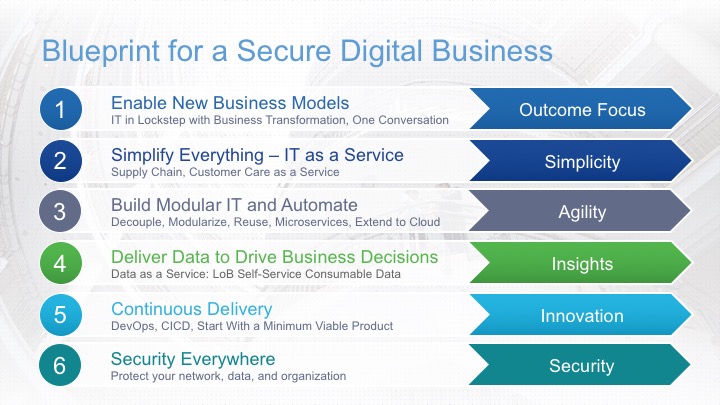
While digital transformation may be different for each organization, I can share Cisco IT’s Blueprint for Digital Transformation that can help customers transform their own business. Cisco IT has used the following blueprint to enable digital transformation in partnership with Business Leaders.
Enable New Business Models
Simplify Everything – IT as a Service
Modular IT and Automate
Deliver Data to Drive Business Decisions
Continuous Delivery
Security Everywhere
Watch the video for additional insight on Cisco’s IT Blueprint.
Have you started your digital transformation? What are your biggest obstacles to getting started?
Top digital brands today move fast. Their products can be accessed and adjusted on demand, through self-service portals. From configuring cable TV to tweaking a cloud hosting package, people expect to be able to do things online – and that their choices will take effect immediately.
Until recently, service providers haven’t been held to the same expectations. But thanks to programmable network technology, they can now offer this type of experience too, opening up a wealth of new business opportunities by enabling them to offer the kind of services their customers now expect.
Programmable networks use software to make the most of your existing physical equipment. Thanks to technologies such as virtualisation, segment routing and telemetry, they can transport data around the network in a more efficient way, extending your capacity. Many of these processes can be automated, bringing major operational savings.
Free to roam
What kind of new services do programmable networks make possible? Imagine a family who are planning the holiday of a lifetime that would take in several different countries. They don’t want to rack up huge bills on data, but can’t find a roaming pass that covers all the places they’ll be visiting.
At present, that’s a problem – but a provider using a programmable network could give their customers the opportunity to log in to a self-service portal and create a roaming pass configured to match their own individual itineraries. A product like this would be too complex to offer using a traditional network setup, but the agility of programmable network technology makes it feasible.
And there are so many other applications for the flexibility that programmable networks offer. Service providers could enable people to upgrade to cloud digital video recording in their home, or activate more bandwidth on demand, for example.
Bringing businesses up to speed
Self-service is also set to bring real benefits in the business world. It could allow companies to configure a new VPN service automatically using drag and drop functionality – and then adjust it to match their developing business priorities. Or to create and continuously refine the networks that will support the Internet of Things.
Last year, Deutsche Telekom used programmable network technology to launch a new cloud virtual private network (VPN) service. Business customers can use an online self-service portal to select, subscribe to and activate secure and scalable internet services.
The customers use a management dashboard to track the status and performance of their service. They can upgrade their packages – increasing the number of users or the bandwidth for example – with a click of a mouse. Provisioning is automatic and real time.This is just one example of how businesses are adapting to a competitive environment by quickly developing and implementing new services. Cisco’s programmable network technology makes this possible, because of its ability to re-provision capacity in real time.
It means that providers will be able to offer network services that are available instantaneously, bringing them up to speed with an application-driven, digital economy.
Bring products to market quickly
Programmable network technology doesn’t just enable you to do this: it makes it easy. It means you can bring your products to market fast – reducing the time from months to minutes – and respond quickly to a changing business environment.
In today’s economy, the rewards go to the most agile companies. Cisco gives you the tools to deliver the services that your customers need for lasting success.
KEY TAKEAWAYS
The top digital brands today move fast. Their products can be accessed and adjusted on demand, through self-service portals.
Thanks to programmable network technology, service providers can now offer this type of experience too, opening up a wealth of new business opportunities.
Programmable network technology could allow consumers or companies to configure the services they need themselves, using drag and drop
Offering on-demand network services will enable service providers to match customer expectations in an application-driven, digital economy.
Imagine an event where education and technology inspiration are at the core. Add in networking, uniquely curated content and, of course, fun! Well, Cisco Live Cancun has it all.
The power of digital transformation will be the key theme of our Higher Education Summit on Monday. Attendees will:
Discover the role of Chief Data Officers in the transformation of education
Learn to empower institutions and faculty members with Cisco’s unique partnerships
Hear from customers who have transformed their campuses with Cisco technology
And don’t forget about the World of Solutions! Our higher education team will be on-hand to demonstrate different secure solutions for students, faculty, and staff. Meet our experts and network with our ecosystem of partners.
Want to learn more? Check out the full event agenda here.
Size matters—especially as physical data center space becomes more coveted at premium prices. So why wouldn’t you pack more into less, for less, if you could?
That’s the approach that Green Cloud Technologies is taking with its investment in Cisco UCS S-Series storage-optimized servers. Green Cloud sells infrastructure and disaster recovery as a service, and is growing at a rapid pace. In fact, Inc. 5000 ranked Green Cloud number 73 on its list of fastest-growing companies, thanks to a 4,000 percent increase in revenue over a three-year period.
Green Cloud uses four data centers to offer infrastructure-as-a-service to small and medium-sized businesses. The company purchased Cisco UCS S3260 servers, which cost-effectively, pack a lot of storage and computing capacity into a small space.
“We didn’t want SAN or NAS for this application—we wanted an intelligent device with a lot of storage capacity,” explains Eric Hester, co-founder and CTO of Green Cloud. “We know UCS is reliable, we can use the same Cisco management tools we already use, and we improved density by 25 percent over a white-box solution.”
https://www.youtube.com/watch?v=9h1Hgdiqpl4
According to CEO Shay Houser, UCS S3260 servers, together with Veeam backup and recovery software, will also be at the heart of Green Technologies’ new backup-as-a-service offering. He’ll be in good company: University College Zealand in Denmark relies on UCS 3260 servers and Veeam to meet its high-capacity storage and high-performance, scalable computing needs.
“Veeam and Cisco UCS S3260 support us by simplifying backup and recovery and optimizing backup storage,” says Steffen Bendix Søjberg, IT operations manager at University College Zealand. “We now have 99.9 percent uptime and very happy users.”
That means students, faculty, and staff have 24/7 access to their work. Just four rack units store up to 360 TB. Even with a 30 percent annual growth rate, the college has enough storage capacity for years to come.
The modular nature of the UCS S-Series servers gives organizations like Green Technologies and University College Zealand the flexibility and agility for optimal efficiency. A consistent management architecture means that new capabilities can be added to the UCS platform, without the need for capital-intensive upgrades. This lowers the total cost of ownership in the long run—a result also echoed by cloud services provider Cirrity. “We’ve reduced the cost per gigabyte by 44 percent, and we’re passing the savings along to the customer,” says Cirrity’s Dan Timko, President and CTO.
In the meantime, Green Cloud is benefiting from the reputation capital that the Cisco brand carries. “Many of our partners are also Cisco partners, and it makes them more comfortable that we’re Cisco Powered,” says Hester. “We benefit from reduced risk and a faster sales cycle.”
Same battle, different day: Our branch offices demand speedy access to the same flexible capabilities as everyone back at corporate—mobility, BYOD, guest Wi-Fi, cloud services—but they don’t have corporate’s expertise or the space to run full security operations. Speed, flexibility, costs, and security—they’re equally important. But in the branch, we often feel trapped trading one for the other.
It reminds me of Sid Meier’s turn-based strategy game, Civilization. In it, you’re always striking a balance between expanding your civilization and securing your border. Your capital city may be fat with resources and strong walls, but your border towns are just a turn away from being sacked by barbarians.
We need a civilized solution
Backhauling your security through headquarters and then back out to the Internet is not a very elegant solution. For flexibility and affordability in the branch, you need to provide Direct Internet Access (DIA), but in a way that’s highly secure. Not with a rack of appliances, but with one device. A device that you already need in your branch edge, anyway.
A router.
In this episode of TechWiseTV, we’ll show you how you can strike that balance and win the battle at your branch with one of Cisco’s highest-selling routers of all time: the Integrated Services Router (ISR) 4000.
https://youtu.be/RttcSs3uXZ8
In the video, Jason Wright and I quickly review many of the basic on-premise and cloud-based security capabilities that have been added to this venerable box—things like Zone-based Firewall, Snort Intrusion Detection, Firepower Threat Defense, and Cloud Web Security.
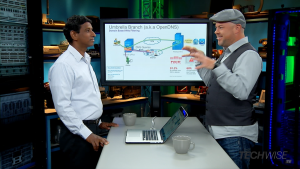
Then, Jason is joined by Kural Arangasamy, an engineer on our Branch Threat Defense team, to demonstrate two advanced capabilities that address this issue of backhauling traffic, and ensure that everything is really as secure as you think: Umbrella Branch (OpenDNS), and Stealthwatch Learning Network License.
Cisco Umbrella Branch with OpenDNS
With OpenDNS and Umbrella Branch connecting on the ISR, you can provide Direct Internet Access at the branch, and enforce your security policies at your local router.
Because you typically have no control over what DNS address a guest will use, the ISR automatically overrides it and sends its own query to OpenDNS via a secure tunnel. The policies you configure on the OpenDNS portal are accessible anywhere via a centralized management console, so security personnel from headquarters can manage the branch remotely, if necessary.
“An elegant weapon for a more civilized age” – Obi-Wan Kenobi
Stealthwatch Learning Network license.
Stealthwatch is like having your finger on the pulse of the network by allowing you to easily identify anomalies and mitigate potential threats:
Why is this server trying to call out to China?
Why is that printer hosting some kind of external services?
Why is traffic spiking in this portion of the network?
There are two components: An intelligent learning agent installed on the router that processes information locally, and a centralized management console that collects and reports on all this information.
In our TechwiseTV demo, the agent is running on the ISR itself. But, it’s actually a distributed learning agent that collects information from various sources like Netflow or NBAR. It performs deep packet inspection on DNS and other types of packets, and can query other routers on the network to help determine if an anomaly is indeed indicative of an attack.
It can also take action to mitigate the threat, like injecting an ACL or a QoS policy, and block the communication locally. So it’s not just a sensor, but an enforcer.
Jason Wright and Kural Arangasamy on TechWiseTV Episode 202
We demonstrate two different scenarios: An anomaly that turns out to be an FTP file transfer we didn’t expect, and an unusual spike in traffic. In both cases, what blew me away was how easy it was to understand what was truly going on, and how simple it was to take action. Some of the coolest features:
Radar Graphs – to visually differentiate between normal behavior and an anomaly you may want to block or investigate further.
Like and Dislike buttons – to easily tune the algorithm to show you more or less of the type of anomaly you’re looking at.
Whitelisting – to stop alerts for anomalies that you know are expected behavior.
PCAP – to perform in-depth analysis of the packet that triggered the anomaly.
Integrating Security into the Network
The SLN agent can also talk to other services, like Cisco Identity Services Engine (ISE) to get information about the user, the device, and the operating system—contextual information to help to better understand the anomaly.
What we’re doing with the ISR is delivering on the promise of integrating security technologies into the network—so you can not only leverage the combined intelligence of the network to understand threats and enforce security policies – but also reduce the footprint and resources required at each of your branch offices.
Integration. It seems like the civilized thing to do.
P.S. To learn more about Cisco Stealthwatch Learning Network License, and get your questions answered,register for the free live Webinarwe’ll be hosting on November 9th at 10 am PT/ 1pm ET.
Companies are being disrupted by smaller, more agile companies that are able to leverage software and better react to the needs of their customers. Some recent examples include Amazon, Uber, Netflix, and AirBnB.
To survive, your company must put software at the center of its business strategy. At the core of this software strategy are open source technologies. However, open source has a few downsides that your strategy should take into consideration. Open source projects like to take the happy path. In other words, an ideal world where everything works and you can function in a self-contained bubble. Unfortunately, as we know all too well, stuff happens in the real world for which we need to be prepared.
Additionally, this journey is difficult as culture and processes become an obstacle to the transformation. It’s important to look at the current skills and have an open dialogue about the digital journey. As with any transformation, you do not just arrive at the final state. It takes lots of planning, training, measurement of successes, and learning from failures. There are specific aspects that your business will need to consider as you prepare for this digital transformation journey.
Whether you have already started on this journey or are just beginning, there are several aspects that you need to consider for ensuring success.
The most critical aspect is setting the vision and goal of the organization to reach this end state. Over-communicate with your leadership, partners, and customers. Everyone must understand what winning means and to get on board.
It starts with preparing your greatest asset…your people. Break down the vision for the journey and invest in training and process improvements. Look at strengths and weaknesses assessed against the organizational goals to accomplish your vision.
The people and process aspects should not be underestimated. Identifying adequate training, organizing into small functional teams, and starting to go through the actions on a weekly basis are important to becoming a high-functioning team. Metrics on sprint velocity, user stories addressed, and numbers of issues resolved are early indicators of the growth and functioning of the teams. Leverage sprint retrospectives to address any people and process issues early in the journey.
The technology aspects will be easy to spot once the teams are functioning at their highest levels (should only take 4-6 weeks). Looking at the technology choices and getting familiar with them is the first step. As quickly as technology changes, you will need to adopt agile architectural design teams to evaluate the choices quickly. Request for Proposal (RFP) processes are adequate but need to be enhanced to include more hands on demos and evaluations in sprint. Lastly, plan for technology integration with existing tools and identify skill sets needed to be addressed through training or staff augmentation.
Continually improve and optimize performance and scale. Once the basics and some of these underlying issues of the technology are understood, the team can then focus on improvements from a process and technology aspect. Sprints should incorporate user stories to address performance and stability issues.
These 5 areas are just the initial critical aspects for preparing for the journey and they are related to your organization. In addition, you should consider what the role of a community such as open source or partners can play in your transformation.
Understanding the Role of Open Source
When considering this transformation, your organization needs to understand the role of open source technologies and the communities around open source. Open source is at the center of this digital transformation and has been an accelerant in the efforts of many large organizations. One reason for this is around the technology innovation and speed of adoption that a community of developers can deliver in open source. The second reason is around the power of community support and contribution quality. The quality of the code and the rigorous review of the code ensures reliability and production readiness. The last reason I’ll mention is the transparency and openness of the community. The roadmap is open, Pull Requests can be submitted, and acceptance and issues are visible. These reasons have led to the emergence of open source being central to your company’s business strategy. Learn more about how you can leverage open source in my blog post Open Source at Center of Digital Transformation.
Blueprint for Digital Transformation
At Cisco, we are working alongside you in this journey. We are co-developing a blueprint to assist you in the transformation. There has never been a better time to transform together.
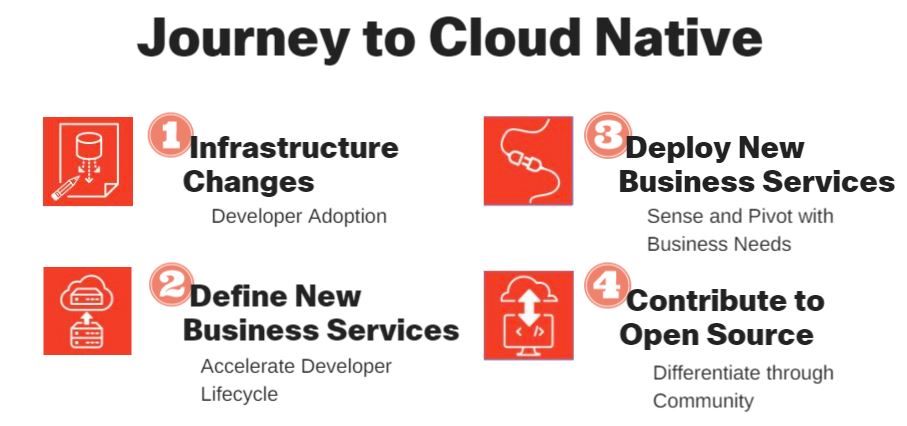
The journey to cloud native begins by first understanding the changes required to make the transition to infrastructure as code that enables your developers to move with greater agility and speed. Define the new business services and automate the business processes to accelerate the software development life cycle. Deploy these new business services and continuously integrate and deploy enhancements and new services. Partner closely with the business and gather user stories and issues regularly. Lastly, determine which open source projects are of interest to your business services and which ones you can utilize to differentiate your business through contributing to the project.
Stop by our booth (#11) at KubeCon to learn how Cisco can help accelerate the journey to cloud native, and make container deployments on Kubernetes production-grade. We also have speaking sessions and activities going on away from our booth, including:
Opening keynote (5 minutes)
Title: The Journey To The Center Of Digital Transformation
Date/Time: Tuesday, November 8, 9:45 – 9:50 am
Speaker: Ken Owens, Chief Technology Officer, Cloud Native Platforms
CloudNativeCon Ops Breakout Session (40 minutes)
Title: How to Monitor Application Performance in a Container-Based World
Date/Time: Tuesday, November 8, 3:40 – 4:20 pm
Speakers: Fabio Giannetti, Principal Cloud Engineer and Ken Owens, Chief Technology Officer, Cloud Native Platforms
Location: Aspen Meeting Room
Hackathon Session (20 minutes)
Cisco is a sponsor of the Hackathon, which takes place on Tuesday, November 8.
Talk Title: Production-Grade Networking for Containers
Date/Time: Tuesday, November 8, 10:40 – 11 am
Speaker: Kiran Kamity, Sr. Director, Container Products, Cloud Platforms and Services Group
Before Apple came out with the iPhone’s iOS, there was Cisco IOS—the original Internetworking Operating System. The two operating systems serve different purposes; however, the concept of applications is becoming more of a similarity. Developments in Cisco IOS XR, a carrier grade train of IOS, began with its evolution into a 64-bit Linux-based environment—with the aim of simplifying the integration of applications, configuration management tools, and industry-standard zero touch provisioning mechanisms. This is a drastic departure from the past, enabling operators running IOS XR with a platform for open development, application hosting, and third-party off-the-shelf applications.
To assist with developing for IOS XR, we have set up shop on Github @XRdocs for sharing open source documentation, demos, and usability guides. A major contributor to XRdocs, Akshat Sharma, recently co-hosted a Cisco Knowledge Network webinar on Cloud Scale Application Hosting, providing a good primer on what Cloud Scale Application Hosting may mean to you. The emergence of open source IOS XR for cloud scale networking highlights the potential for providers to create new efficiencies and define new service offerings. As one of my go to Cisco Technical Marketing Engineers for all things IOS XR Cloud Application Hosting related, Akshat highlights some of the benefits providers can enjoy with the new IOS XR and cloud scale application hosting. The recording and presentation are now available here.
Setting yourself apart from other schools can be difficult, even for a university that has even a small amount of name recognition. For a school that was founded in 2004, making sure you stand out in the crowded field of continuing education is a tough job. This is the tall order that India’s Mody University was facing recently.
As a private woman’s university based in Lakshmangarh, Rajasthan, India, school officials were concerned that obsolete Wi-Fi was detrimental to the learning experience of their students. Not only was this a hindrance to current schools, but it made attracting new students difficult too. For a school that has a curriculum that runs the gamut from engineering and technology to fashion design, Mody University wanted a new network that was quick, up-to-date and allowed the students and faculty to make sure they were ready for the modern world.
Enter Cisco.
“Our new Cisco infrastructure and network solution enhanced the satisfaction level of users,” said Amit Pareel, System Administrator for Mody University. “When comparing institutions, students have one eye on the quality of their teaching and the other on the quality of their technology.”
And being that it’s a Cisco network, the 3500 students, 1200 faculty and staff members, and 200 research scholars received a quality network upgrade.
The Mody University infrastructure was updated with over 200 Cisco Aironet 1530 and 1700 Series Access Points, Cisco Catalyst 2960X, 3850 and 6800 Series Switches, and Cisco 5500 Series Wireless Controllers.
The results have been amazing. Prior to the new network, Wi-Fi was limited to about 45 percent of classrooms and indoor areas. Now coverage is almost 100 percent through out the entire campus—both indoors and out. The new network has allowed professors to be more creative in the ways that they teach their classes. Students have confidence to explore new ways of learning now that they know that their equipment is not a liability.
To read more about this Case Study, please click here.












 ment—with the aim of simplifying the integration of applications, configuration management tools, and industry-standard zero touch provisioning mechanisms. This is a drastic departure from the past, enabling operators running IOS XR with a platform for open development, application hosting, and third-party off-the-shelf applications.