While I was in Tokyo, I was asked if I was interested in joining a #CiscoChat. Thought about it in Singapore and again in London. Each of those countries have something in common. They are becoming Fintech incubators with great ideas that will drive digitization into every business.
Having traveled multiple countries, I was thrilled to travel to NYC for the Tetration announcement, one of the financial capitals of the world.
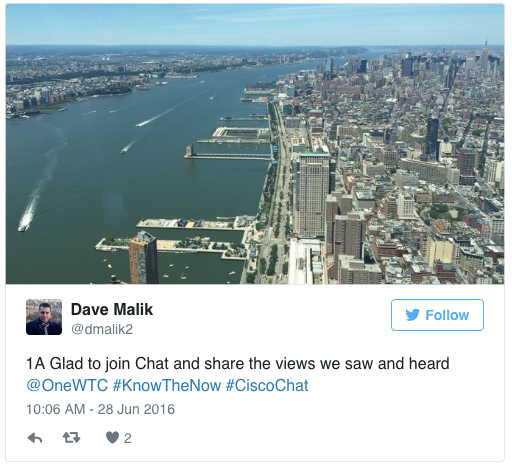
Everything happened at One World Trade Center. I was on top of the world seeing this unbelievable view:
Ever drive through a tract housing development where two to three models are repeated over and over again. All the houses have the same look, same layout, same square footage, etc. Over the last few years, it seems like a similar trend is happening in data center switching. Since most data center switches are based on the same Merchant silicon, there is very limited differentiation or innovation, much like the cookie-cutter housing tracts.
Sure, there’s a difference in the operating system from vendor to vendor—but for the most part, switches based on Merchant silicon are limited by what the ASIC is capable of. They offer the same functionality, number of ports, speeds, power profile, and capabilities. It’s like going to buy a car and only having a choice of colors. This approach is leading to stagnation and slow switching innovation.
With all the rapid shifts going on in the data center (cloud, higher density, faster speeds, containers, increased complexity, and more), Cisco recognized that current Merchant ASICs weren’t going to deliver the capabilities needed for the next generation of data centers.
To break away from the cookie-cutter, me-too approach that barely addresses today’s data center needs, Cisco developed the Cisco Cloud Scale ASIC to power our next-generation switches for the next-generation data center. Currently, the Cloud Scale ASICs are deployed across Cisco Nexus 9200 switches and the Nexus 9300-EX versions.
So, what’s different and innovative about Cisco’s Cloud Scale ASICs that puts it 2 years ahead of Merchant silicon ASICs? Let’s count the ways!
It starts off with the latest in manufacturing technology. Merchant silicon ASICs are manufactured using 28nm technology. Cisco Cloud Scale ASICs use the latest 16nm technology. So, what? 16nm fabrication allows us to put more transistors in the same die size as Merchant silicon, resulting in cost optimization, higher density, higher bandwidth, larger buffers, larger routing tables, and more room for new hardware-based features.
Lower price point: With the 16nm fabrication, we’re able to pack a lot more capacity and features into the same die size as Merchant ASICs and offer multi-speed 10/25G ports at the cost of 10G, and 40/100G ports at the price of 40G ports. More features, more flexibility, higher speeds, at the same price!
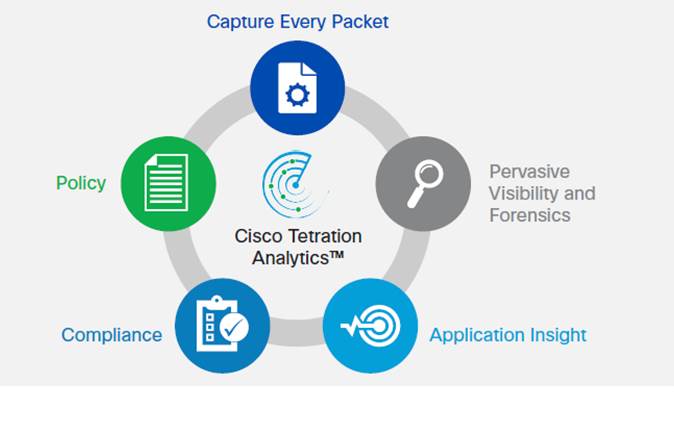
100% visibility: With Cloud Scale ASICs you can capture telemetry from every packet and every flow at line rate (yes, even 100G ports) with ZERO impact to the CPU (try that with NetFlow). Using the Cisco Tetration Analytics™ platform, the extensive telemetry provides pervasive visibility into your applications and infrastructure and delivers operational capabilities that just can’t be delivered with Merchant ASICs.
Greater bandwidth capacity: Cisco’s Cloud Scale switches offer more bandwidth per rack unit and are more cost-effective than that provided by Merchant silicon-based switches. The 16nm fabrication technology has enabled Cisco to build a single switch-on-a-chip (SoC) ASIC that can support 3.6 terabits per second (Tbps) of line-rate routing capacity. It has also enabled Cisco to build the first native 48 x 10/25Gbps and 6 x 40/100Gbps top-of-rack (ToR) switch in the industry with full Virtual Extensible LAN (VXLAN) support.
Smart buffering: Cloud Scale ASICs deliver larger internal buffers (40 MB versus 16 MB) plus several enhanced queuing and traffic management features not found in Merchant silicon switches. There’s a myth that the larger the buffer the better performance you get. That myth has been debunked in a Miercom test. Large buffers place all flows in a common buffer on a first-come, first-served basis, and then moved out in the same order. It does not distinguish between flow sizes; both large flows and small flows are treated the same. Therefore, the majority of the buffer gets consumed by large flows, starving the small flows. No matter how large the buffer is, the end result of deep buffers is added latency for both large and small flows, benefiting neither.
In contrast, the Cisco Cloud Scale smart buffer approach implements two key innovations to manage buffers and queue scheduling intelligently, by identifying and treating large and small flows differently.
Dynamic Packet Prioritization (DPP): DPP prioritizes small flows over large flows, helping to ensure that small flows are not affected by larger flows due to excessive queuing.
Approximate Fair Drop (AFD): AFD introduces flow-size awareness and fairness by an early-drop congestion-avoidance mechanism.
Both DPP and AFD ensure small flows are detected and prioritized and not dropped to avoid timeouts, while large flows are given early congestion notification through TCP to prevent overuse of buffer space. As a result, smart buffers allow large and small flows to share the switch buffers in a much more fair and efficient manner. This provides buffer space for small flows to burst, and large flows to fully utilize the link capacity with much lower latency times than a simple large buffer approach implemented in most Merchant silicon switches. For a more technical discussion on deep buffers versus smart buffers, check out Tom Edsall’s video.
Greater scalability: Beside higher bandwidth and larger buffers, Cisco Cloud Scale ASICs offer increased route and end-host scale. The Cisco Nexus 9000 switches (varies based on modular or fixed) can support up to 512,000 MAC address entries and up to 896,000 longest prefix match (LPM) entries: two to three times the number supported by popular Ethernet Merchant silicon–based switches. Cisco Nexus 9300 Cloud Scale switches are designed to support up to 750,000 IPv6 routes, compared with the 84,000 routes available with Merchant silicon.
So, no matter how you slice and dice the comparison between Cisco Cloud Scale ASICs and Merchant Silicon, you’re getting a two year head-start with a lot more value and investment protection with Cisco’s Cloud Scale based switches.
ISTE 2016 was an event to remember. Not just because it was my first international education conference, but it was also amazing to see the opportunity for thought leadership and professional development (100 sessions an hour), combined with the number of partners that are focused on the success of students through the use of technology.
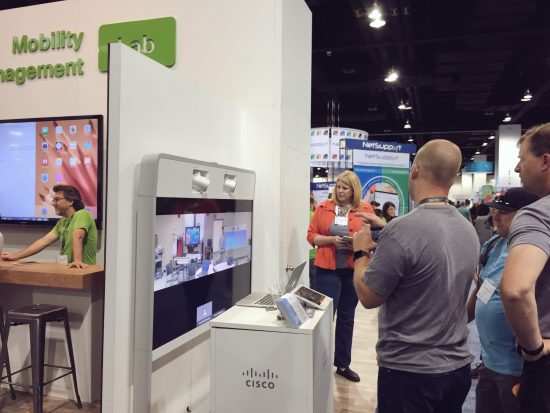
Cisco’s booth at ISTE 2016 showcased two main elements: Cisco Meraki and Cisco Digital Learning solutions.
Every hour, on the hour, our staffers presented many different topics including the importance of needing a reliable, secure, and easy to use cloud-based network, the different solutions required to make distance learning possible via TelePresence, and one-click Mobile Device Management to ensure students stay on task.
Aside from our presence at ISTE, we had many education-specific partners in attendance that fit in our digital learning and digital campus portfolios.
These partners included: McGraw Hill, Canvas, Blackboard, D2L, CirQlive, iSchool Initiative and Cyberpatriot. The latter is very interesting as it’s a K-12 competition that focuses on cybersecurity defense, instead of traditional “hacking.”
iSchool Initiative had one of the most interactive booths at ISTE. Their Escape the Bus activity attracted educators by the dozens and triggered many dance competitions between sessions.
Travis Allen and team “locked” attendees in their bus for 30 minutes with minimal instruction. The objective was to escape the iSchool bus based on various clues. There was only a 20% success rate amongst adults who participated, compared to a much higher student success rate – yet luckily enough, my group was one of the few to escape! See the pure joy below…
The digital investments schools are making for the future of their students are obvious. Mobile learning is changing the way students work, live, and prepare for their careers. Having the ability to learn anywhere, at any time, from any place requires a cultural transformation. ISTE is equipping teachers and administration with the correct tools to drive this change first-hand in their schools. The future for mobile learning has never looked brighter.
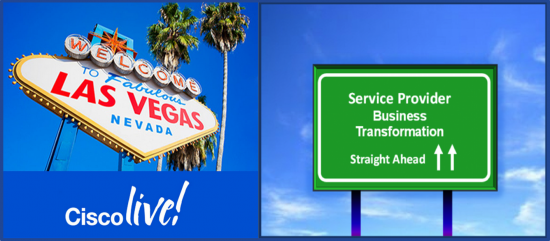
Cisco Live has never been the same since this event was first launched. One of the key recent accomplishments has been adding the service provider booth to the main campus thus establishing SP presence on the main show floor. This year we are enjoying the redesigned SP booth with new additional features. Namely, an addition of a mini-theater, flagship demo station, and a help desk station in the style of Apple’s Genius Bar as the new way we want to ignite new conversations. Overall, you will get an enhanced experience of learning about the SP’s products and solutions portfolio.
Here is what to expect when you come to the SP Booth: you may go to the mini-theater to listen to a brief strategy introduction for our solutions that you can later explore in depth by proceeding to a traditional demo station. Overall, traditional demos are where you will spend most of your time and we have 18 demos that are hosted in this area. I also recommend that you stop by our flagship demo that is featuring threat-centric security presentation and learn how it applies to service providers. Security is a very relevant subject for service providers and that it why we made it stand out from the rest of the demos. Our unique approach to security delivers consistent security policy across physical, virtual, and cloud environments by combining the power of open and programmable networks with deep integration of Cisco and third-party security services.
Our help desk area is very diverse in nature where you can get help on any topic and guide you further to address your interests; however, in addition to the traditional help desk topics, we added three specialized areas for discussion and we call it a “Guru Bar”. You will be able to learn about the Connected Analytics tool, and WAN automation tool, as well as services that are represented by Cisco and Ericsson partnership. As you may know Cisco Ericsson go to market partnership has been evolving since last year when the announcement was made. Next-generation strategic partnership will drive growth, accelerate innovation, and speed digital transformation demanded by customers across industries. So please stop by and learn about the IP transformation services and solutions as seen through the lens of this alliance.
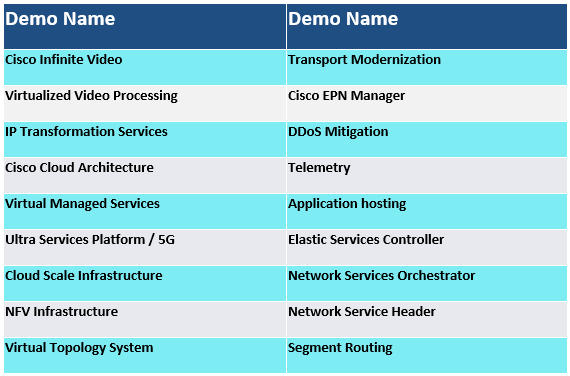
As I mentioned, most of your time will be in the traditional demos area. We have gotten a lot of feedback on the value of the service provider demos and hence we are continuing in that tradition and bringing you the following demo set:
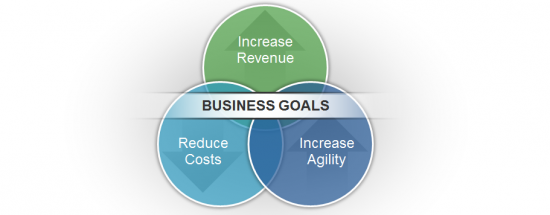
We understand your requirements and that is why all our demos are mapped onto business goals such as “Increase Revenue”, “Reduce Costs”, and “Increase Agility”. When you are in the booth, we will explain to you during the course of a demo how that product or solution maps on those three goals.
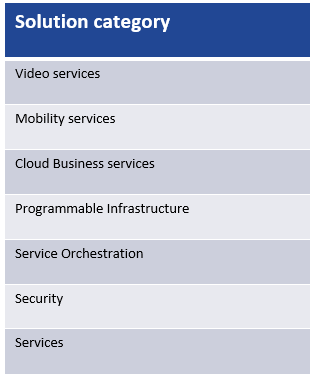
We also provide end to end coverage of the SP portfolio and hence devised seven categories of solutions and map our demos onto them.
Among those categories we have the following seven:
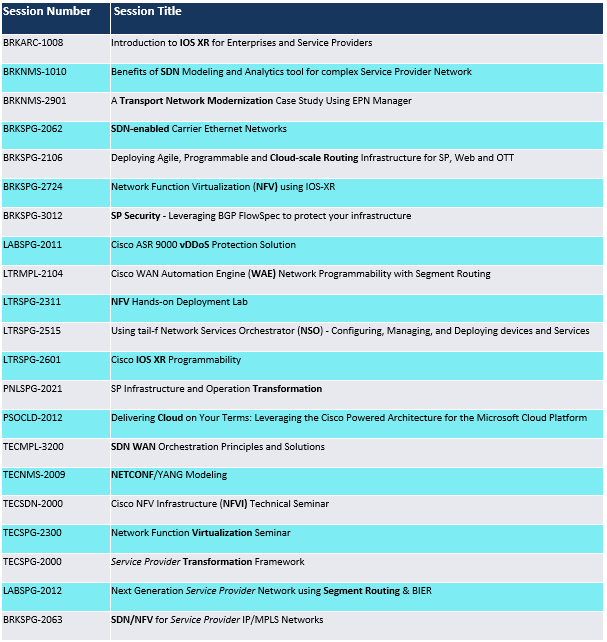
When you are at Cisco Live, please attend service provider-relevant training sessions. Here is the summary list that we pulled together; however, I invite you to see the complete list of offered classes. Click here for a complete list.
And of course, don’t forget to attend the Service Provider Innovation talk. Our demos are tightly linked to the subjects covered. Please visit the SP booth to understand the key steps you need to take to transform your network to meet your business goals. Learn how Cisco has the technology and tools for you to be successful today and in the future.
When talking with customers, it is rare when I encounter one who is “all in” with private or “all-in” with public cloud. Customers have come to realize that a single platform cannot deliver all the capabilities required by application, business and IT teams. Developers want self-service and fast access to cloud infrastructure. IT needs control and the adherence to both your company’s as well as regulatory guidelines and policies.
As more applications move to the cloud, companies are seeking a solution that delivers choice of cloud platforms ensuring the best price/performance for all workloads while meeting the needs of customers. The result is the rise of hybrid cloud.
This is not a new “as a service” delivery model or a new type of cloud. Hybrid cloud involves having the technology and operational processes to accommodate the placement of any workload into any environment. In essence, it is a way to transform your organization from the 196 manual trouble ticket process to an automated method of delivering choice of platform and workload placement.
Hybrid cloud does have a few drawbacks:
Cloud platforms are infrastructure-focused which forces development teams to code to the whims and capabilities of that platform’s infrastructure. Development teams need to become well versed on the nuisances of that platform’s infrastructure — something they are not keen to do.
Development teams require friction-less access to multiple clouds which results in high development, update and maintenance costs for infrastructure-centric solutions. The duplicity comes in the need to maintain multiple code streams for a single application to accommodate the infrastructure APIs associated with that platform.
IT is responsible for the care, feeding and performance of these environments as well as ensuring compliance to company policies. Today, this is a process that slows down the application life cycle and development process.
At its core, a hybrid solution is about automation which orchestrates the execution of tasks and enforcement of policies across a range of data center, private and public platforms. Does such a solution exist? YES!
Cisco CloudCenter delivers the friction-less access developers desire to over 19 different data center, private or public environments. Watch this video to learn more.
Abstracting applications from infrastructure relieves the frustration developers experience as well as the cost associated with infrastructure-centric solutions. CloudCenter utilizes application profiles which contain the DNA of the infrastructure setup and configuration, scaling capabilities, budgetary or time limits as well as usage rules. Say good-bye to the wrangling and filling out of forms required by IT. Developers are free to work on the platform of their choice without IT getting in the way. IT remains in compliance and control — but in a stealthy way. Everyone is happy!
Take the next step to go deeper with Cisco CloudCenter with this overview and see how hybrid cloud deployment can transform your business.
One of the major paradoxes in healthcare is that, despite broad recognition that relentless cost, quality and equity pressures are dominant drivers for significant change, there remains only slow progress towards real innovation in care delivery.
Many reflect that the risk-averse nature of healthcare delivery is a major factor in this limited progress. Yet healthcare is a hotbed of innovation in areas such as drug development, diagnostic devices, therapeutic technologies and surgical techniques. Even as we build massive electronic medical record systems, the progress on how these information technologies can be applied innovatively to really change the way care is delivered has largely been slow and siloed. It seems we are somewhat challenged to use the technology we have developed to change healthcare at the system level – that is, optimizing the way the parts of healthcare work together to deliver the order of magnitude improvements in quality, access and cost that are desired and required.
The complexity of healthcare information, the highly federated nature of its control, and issues of privacy and security are all contributing factors to this situation. Yet perhaps one of the primary inhibitors to achieving effective change is, in fact, ourselves. We all have a strong compulsion to make sense of what we see, to make it conform to our own version of reality, or to employ a now somewhat overused term – our own “paradigm.” This filter limits our ability to perceive and act on opportunities, making us selectively blind to potential collaborations and their solutions.
To assist in breaking this logjam we need to throw a spotlight on our biases. We can gainfully interact with communities outside healthcare that have successfully innovated at a system level to draw upon, learn from and adapt the drivers and enablers of change they have experienced. This is the primary aim of this year’s Digital Hospital Design Forum to be held as part of HIC 2016.
At the forum we are bringing together leaders who have guided their organizations through times of massive digital transformation to talk about their journeys. We have been truly fortunate to gather together Lee Hatton, the CEO of UBank, Robert Saint, the Deputy Vice Chancellor (Research) at Flinders University, and Jeffrey Atizado, the cofounder of SMB consultants, one of Australia’s leaders in retail cloud transformation.
Our aim is to create an engaging conversation with the audience on the underlying innovation processes that exist in other sectors and how they reflect into the healthcare space. As a complementary exploration we will then hear from three leading Australian hospitals to understand their digital transformations. Bruce Winzar will look at the delivery of a digital hospital in a rural environment, Zoltan Korai at a metropolitan hospital, and Michael Drahiem will talk to the digital transformation of a brownfield site. The audience discussion that follows will distill the common features that made all these stories successful.
We are seeking to advance our understanding of innovation, identify trigger opportunities for potential digital transformation, challenge some existing views, chip away at biases, and enthuse the participants to have the courage and insights to successfully deploy innovative digital initiatives in their own organizations.
What do we hope will be the outcome of this activity? At a minimum we hope it will cause all of us to question how we innovative. But what we really hope is that it will broaden the community that we innovate with, and create new opportunities for projects to be created that will be lower risk, more agile and better aligned to the needs of care providers and the patients they serve.
On June 23, the International Trade Commission (ITC) ruled that Arista’s products infringed three Cisco patents. The Presidential Review period (expiring on August 22) will be an important milestone in our effort to force an end to the unlawful use of our intellectual property.
In roughly a week, the ITC will release a public version of the 60-page opinion laying out the full background and rationale for its decision. The process to determine what is made public is straightforward. Both Cisco and Arista can request redactions of information they want kept private. Although redactions are meant to protect confidential business information, they can also be used to prevent the public from having full access to the Commission’s rationale.
Given the importance of transparency for the industry, Cisco is asking the Commission to make the entire ruling public. We waive all redaction requests, and call on Arista to do the same.
The ITC Final Determination has direct implications for customers, partners, investors, and suppliers. We want those making important business and investment decisions to be fully informed.
Cisco Cloud held our first Blab session yesterday. We were so inspired by the Red Hat documenatry, The Open Patient: Healing through sharing, that we wanted to continue the dialogue about open data and healthcare. Our goal was to touch on the tech industry’s role in open source and how it can change healthcare. Lofty optimism? Our panelists don’t think so. The journey calls for conversations…hence the Blab Open Patient: The Case for Change in Healthcare. Watch the replay below of the live discussion.
Meet our panelists:
Jarrod Weise (Moderator, Cisco): sits in the Americas Partner Marketing organization at Cisco. His focus is highlighting the exponential value of technology partnerships when they come together. He has been in technology for more than a decade has a passion for stories of digital transformation.
Jess Perkins (Red Hat): is a technology executive, with over 25 years in healthcare. His background covers a wide range of experience in leading-edge consulting, solution development, and sales, in the healthcare payer, provider, public sector, Pharma, and Life Sciences markets. He has consulted independently, as well as working with companies including Siemens, McKesson, Oracle, Optum, and several mid-sized and start-up organizations.
John Wilbanks (Sage Bionetworks): is the Chief Commons Officer at Sage Bionetworks, where he leads the governance team and led design on the Participant-Centric Consent toolkit, an open source visual consent methodology that has enrolled more than 100,000 participants in clinical studies via mobile phone since March 2015. Previously, Wilbanks worked as a legislative aide to Congressman Fortney “Pete” Stark, served as the first assistant director at Harvard’s Berkman Center for Internet & Society, founded and led to acquisition the bioinformatics company Incellico, Inc., and was executive director of the Science Commons project at Creative Commons. In February 2013, in response to a We the People petition that was spearheaded by Wilbanks and signed by 65,000 people, the U.S. government announced a plan to open up taxpayer-funded research data and make it available for free. Wilbanks holds a B.A. in philosophy from Tulane University and also studied modern letters at the Sorbonne.
Todd Bruni (Cisco): is an accomplished IT leader and strategist with over twenty years of experience in IT operations, architecture, consulting, management, and leadership. He has spent the last eighteen years of his career in the healthcare industry in both the healthcare organization and technology/services aspect of the business. Today Todd is a part of Cisco’s Global Business Transformation Team focused on Healthcare as a Business Architect. Prior to Cisco, Todd worked as a principal consultant focused on strategy, planning, architecture, and delivery oversight and was at a large healthcare system for approximately fourteen years where he held many roles mainly in IT management and leadership for over eight years.
Watch the Replay:
Use the comment section below and tell us the topics that you would like to discuss. We would be happy to schedule more Blabs on topics about what YOU want to learn and discuss. Cloud computing, private cloud, SaaS, open source, open tech – the list is endless! Suggest speakers as well, and we will invite them.
As stated in my previous blog on Segment Routing, 2016 marks an inflexion point in Segment Routing adoption.
I’m not making this claim in a vacuum. This is actually grounded on multiple Service Providers’ feedback expressed during a Tech Field Day event on Segment Routing held last week in San Jose.
Tech Field Day brought together experts from Walmart, Microsoft and Comcast to discuss and share their perspective on Segment Routing.
The speakers presented to a delegate panel of independent industry veterans and bloggers who are respected names in the industry. During the session anyone watching the live stream could interact with the panel by using a special twitter hash tag – #SegmentRouting. If you are on Twitter you can search this # and read all the comments made during the event. Videos from the Segment Routing Tech Field Day Session can be found here on YouTube.
Here is a brief recap of the morning sessions:
Mark Pagan, from Walmart, started the day with an insight into Walmart’s decision to roll out Segment Routing for their brand new Global WAN. Mark stressed the simplicity Segment Routing brings to operations by cutting down the number of protocols to be operated (LDP is no longer needed for instance).
Next, Paul Mattes, from Microsoft, shared details about the use of Segment Routing in a hyperscale environment. Being able to control how their applications are transported over their WAN network enables Microsoft to not only optimize network infrastructure utilization but also to deliver a better End-User experience. For those interested in understanding the roots of this project, check out this White Paper published in 2013 by Microsoft.
Finally, John Leddy, from Comcast, gave a status update on Comcast’s IPv6 implementation and talked about the power of bringing IPv6 and Segment Routing together! This was a mind-blowing presentation that triggered many questions from the panelists. Watch the video and learn about the multiple Use Cases Comcast has started to work on!
Afternoon sessions were dedicated to Cisco presentations and to a delegate roundtable:
Sumeet Arora, SVP Engineering in charge of Core Software Group, gave an overview of Cisco software innovations, that enable Service Providers to operate their network infrastructure with greater efficiency and agility.
Clarence Filsfils, Cisco Fellow, shared a status on Segment Routing by looking at what has been accomplished over the past 3 years. As a take-away, Segment Routing is the de-facto SDN network architecture.
This event clearly exemplifies the adoption of Segment Routing across diverse customer segments, be it Enterprise, Hyperscale Web Provider or Cable Operator.
If you’re interesting in getting regular updates on Segment Routing, become a member of our LinkedIn group and visit this public segment-routing website to get access to multiple resources.
We certainly want to hear from you. Please reply back and give us your thoughts on this Tech Field Day Event.
For more questions or comments, please tweet us @CiscoSP360.