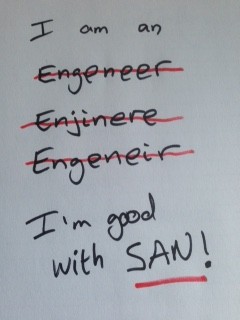
One of the aspects I really enjoy about my job is that I get to learn from some of the world’s top network and data center design engineers, and I get to hear about technology adoption challenges across the world. If there is a complex network or data center design being worked by our customers, if our customers are under time pressure, or if our customers are facing key business or technical challenges, Cisco Services’ consultants are often called in to help. Globally then, they experience first hand the challenges of deploying advanced technologies. In this blog, in the same spirit as my OpenStack Deployment Challenges blog, I’d like to share their experiences on some of the most common challenges and misconceptions faced by our customers when building Storage Area Networks (SAN). I’ll publish this in 2 parts – so look out for the concluding part next week.
Before continuing, I’d like to thank two of our SAN expert consultants, Barbara Ledda and Wolfgang Lang, for sharing their experiences and challenges.
If you had a million airline miles, where would you travel?
Kyle Lovett, a security penetration tester with the Advanced Services Security Team is asking himself that very question right now. That’s because his United Airlines mile bank is overflowing, thanks to a security bug he found through a bug bounty United Airlines was offering.
Kyle Lovett, security penetration tester at Cisco, has a million miles in his United app, thanks to a bug bounty the airline initiated.
Bug bounties are nothing new, they’ve been around for a while, usually offered by big tech companies. It’s an opportunity for white-hat “hackers” (those using their powers only for good) to find security vulnerabilities for rewards. United is the first airline to offer a bug bounty.
Kyle lives and breathes security. He says he’s been “breaking things” since he was a kid. It’s a part of his day-job, but also something he enjoys in his free time. Normally, he doesn’t participate in bug-bounties, but in the case of United, he was intrigued.
“Sometimes, a company will recognize the work with a good reward,” Kyle says. “What caught my eye [with the United bug bounty] is that they were giving away miles. But they were significant miles. So I sat down one Saturday morning and got to work.”
Kyle Lovett, security penetration tester at Cisco.
Kyle got to work for sure. In a few hours, he’d made several different submissions. One of those submissions was significant enough to get United’s almost immediate attention. He’s under agreement not to say what the bug was, but it was big enough to earn the largest prize in the bug bounty – he’s now in the million mile club.
“United reached out to me with questions and clarifications,” he explains. “We went back and forth over the course of a week, and they had it fixed in a few days. Then they said ‘Congratulations! Here are a million miles.’ They were genuinely concerned about the bug and very professional.”
He opened his United app, and saw the seven-figure number. A million miles means approximately 40 domestic round-trip flights, 20 round-trip flights to Europe, or eight first-class trips. Here’s the kicker. He still has additional submissions that might earn him MORE miles.
How will Kyle put them to use? He’s already bringing his mom and brother out from Virginia to visit him in California. His job gives him a lot travel opportunities as well, so he’s a little stumped right now.
“I’ve always wanted to go to East Asia or the Southern Pacific. Not for the scenery (although that’s nice). I’m more intrigued to see the culture,” he says. “But I would like to give at least one ticket away for someone who might really need it, maybe for medical treatment or they can’t afford to get home.”
How’d Cisco get so lucky to have such a great security tester on the team?
“The Internet of Everything is near and dear to my heart, especially the security around it,” Kyle says. “There is such a large wealth of people to reach out to in all different areas. And the culture and atmosphere here is genuine. I’ve not met one person who works here that doesn’t enjoy what they do!”
More specifically, the user was asking how MPI defines its interactions with languages other than C and Fortran (i.e., the two officially-supported language bindings).
This is a good question, and has implications on both the MPI standards documents and various MPI implementations. Let’s dive in.
Technology is all the rage in education circles. But correctly deploying mobile technology takes more than talk. Without a clear path, schools and districts can make common mistakes that hamstring their efforts.
In a recent article “Ten Barriers to Technology Adoption”, Travis Allen, president and CEO of iSchool Initiative, explains the common issues he sees impeding the adoption of technology throughout the world. However, with some preplanning, many of these challenges can be avoided.
In short, schools and districts should actively and continually listen to students, teachers, and parents during the early stages of planning. Not only does this open discussion create a more active forum for sharing ideas, it also creates a culture of collaboration that accelerates adoption.Continue reading “Best Practices for Effective Technology Deployment in Education”
I have good news and bad news. First, the bad news: across industries, digital disruption is threatening to overturn incumbents and reshape markets faster than perhaps any force in history. Now the good news: companies can take control of their own destiny by embracing digital transformation and the Internet of Everything (IoE).
Let’s take a closer look. By “digital disruption,” I’m referring to the effect of digital technologies and business models on a company’s current value proposition — and its resulting market position. Digital disruptors innovate rapidly, and then use their innovations as a powerful competitive advantage to gain market share and scale far faster than challengers still clinging to traditional business models that can’t keep up with the pace of change.
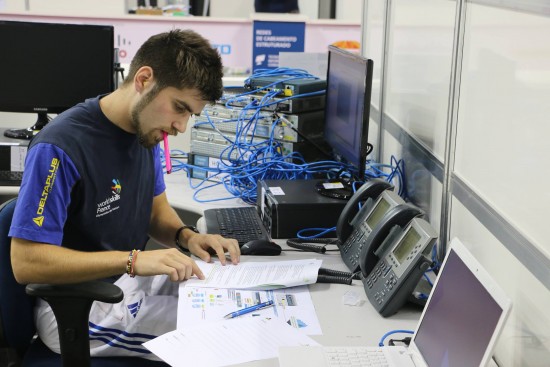
Another amazing World Skills week has come to an end. Congratulations to all participants across the various skills areas, you are all winners!
Some highlights from the week of our Skill 39 competitors, who after months of training finally had the chance to put their hard work to the test during the 4-day competition.
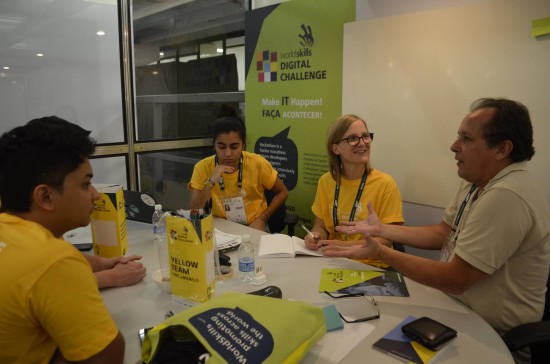
More than 1,100 competitors attended WorldSkills from more than 60 countries and regions in the Americas, Europe, Asia, South Pacific and Africa.Cisco mentors advised teams during the Digital Challenge at WorldSkills and helped students apply technology to the world’s social problems.
full: adjective – not lacking or omitting anything; complete
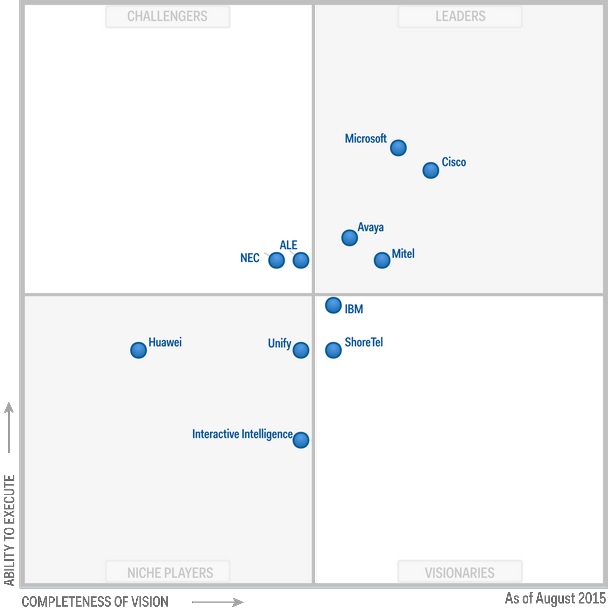
It’s a word that Gartner mentions when describing leaders.
“Leaders have a full UC offering and strong market presence, and demonstrate success in the field. They have a strong presence in related markets to expand their footprint in UC. These vendors and their channel partners have experience delivering UC to a broad range of enterprise types and into most geographic regions.”
We believe our position as a leader for unified communications in this year’s report reflects that fullness. This is especially evident in our position as furthest to the right for “Completeness of Vision.”
We are excited to share that Cisco will be participating in Networking Field Day 10 this year. Cisco brings together independent thought leaders and our engineers to share information and opinions in a two-hour interactive discussion format. If you cannot attend NFD10 all presentations will be live streamed from the Tech Field Day website.
These are the topics Cisco is covering this year at #NFD10:
Intelligent WAN (IWAN) Architecture: We are busting the myth that IWAN is part of a marchitecture and explaining DMVPNv3, Pfrv3, and AVC. We will also be expanding on how the IWAN architecture improves scale and performance while delivering better business outcomes for customers. Learn more about Cisco Intelligent WAN.
Branch Security: We will be showing how our security solutions simplify WAN provisioning. We will also explain how Cisco protects and hardens the network from outside attacks and security vulnerabilities. Topics covered during this presentation are Crypto, Certification CC, FIPS, NSA Suite B, and Security Designs. Learn more about Cisco Security.
Software Defined WAN (SD-WAN): Our presenter will be demonstrating how our APIC-EM Controller with IWAN App provides centralized configuration and orchestration for the WAN while doing a live demo. Learn more about SD-WAN.
In the world of service providers and networks, the demand for new and better services continues to grow. As more services and applications migrate to the Cloud, service providers will continue to play a crucial role in delivering quality experiences and performance at the speed businesses and consumers demand. What emerging technologies, trends, and unique opportunities are transforming the way next-generation services are developed?
The growth of video, wireless mobility, Internet of Everything (IoE), and cloud services presents both business opportunities and security challenges. To take advantage of these new opportunities, service providers are adopting open and programmable network architectures that increase business agility and lower costs.
Cyber risk, however, must be addressed. Adversaries are exploiting the growing attack surface presented by new services, expanded network connections, and device proliferation. Legacy security approaches have not kept pace with evolving network architectures or the changing threat landscape.
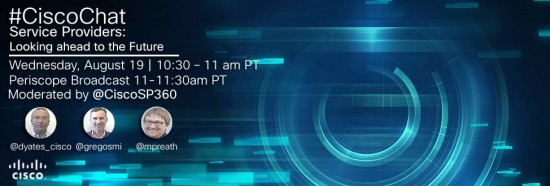
During our next #CiscoChat on Wednesday, Aug. 19 at 10:30-11:00 a.m. PST, followed by a Periscope session at 11-11:30am PST, @CiscoSP360 will moderate a discussion on how to prepare your service provider business to thrive. The discussion will explore all the latest service provider technology news and looking ahead in deploying orchestration and virtualization to be more agile, reduce costs and generate new revenue. Continue reading “#CiscoChat: Future of Service Provider Deployments in the Internet of Everything Era”













 Networking Field Day 10 this year. Cisco brings together independent thought leaders and our engineers to share information and opinions in a two-hour interactive discussion format. If you cannot attend NFD10 all presentations will be live streamed from the