Avatar

This post was written by guest blogger Unni Nair, manager for Cisco’s Supply Chain Sustainability and Diversity.unnair

As companies seek better ways to connect with and compete in markets all around the world, having a diversity mindset plays an increasingly important role. Cisco’s supply chain is particularly relevant to this focus because, as one of the largest and most complex supply chains in the world, regions, cultures, communities and customers can be connected through our business operations. When these connections are valued and nurtured, it underscores a company’s committed path to inclusion and diversity.

To better leverage diversity across operations, an inflection point came in 2014 as Cisco began an ambitious initiative to transform its global supply chain operation. Many programs and ideas, like diversity, helped ignite this transformation. Within a year, Cisco was named #6 on Gartner’s 2015 Supply Chain Top 25. According to Gartner, the future of many companies will depend on their willingness and ability to rethink their supply chains and evolve.

Supplier diversity can play a powerful role and serve as a strong competitive advantage for businesses – especially supply chains – as it opens new channels to access skills, provides resiliency, promotes inclusiveness, broadens partnership opportunities and offers an abundance of viewpoints needed to solve today’s complex challenges. We believe business is strengthened, as diversity boosts our social license to better understand and successfully operate around the world.

Diversity%20Image

Diversity programs can, and should, invigorate business simply because they obligate organizations to be bold when forming and maintaining partnerships. A strong procurement process helps to shun complacency and boost alternative methods, identify products or services that can enhance the business and breathe in new ideas. As Cisco continues to track progress, data, and trends in supplier diversity, it has become clear that digitization represents a significant opportunity that has the potential of future success.

Continue reading “Creating Value in Cisco’s Supply Chain through Diversity”

Authors

Austin Belisle

No Longer with Cisco

Avatar

Much has been written about Data Science and Analytics, but at the end of the day, there is a single reason why Data Analytics has staying power, and continues to attract investment across all industries – and that is its compelling ROI.

Yes, industries are awash with a lot of Data, but that is no reason to do anything about it. It is not even the insights this Data possesses that is propelling investment, but instead, quite plainly, it is its monetization potential that is attracting sustained attention.

Let us do a quick & dirty back of the envelope ROI calculation:

Assume that a distributor spends $100M annually moving goods from place A to place B. Being a fan of IoT, he collects a lot of data that covers each touch point in the journey. He hires (or outsources) some data analysts/modelers who build a recommendation engine for him that eventually saves him 0.5% of his cost (an uplift of 0.5%). This translates to $500K in savings annually. His investment in the modelers, recommendation engine and changed business process is $500K in the first year, and $150K on an annual basis thereafter.

Continue reading “The ROI (and Staying Power) of Data Analytics”

Authors

Sri Srikanth

Advanced Data Analytics & Strategy, Senior Data Scientist, Cisco Digial

Avatar

Cisco PSIRT openVuln APIIn October, we announced details about Cisco PSIRT’s new and improved security vulnerability disclosure format. Our Chief Security and Trust Officer, John Stewart, also revealed that Cisco will launch an application programming interface (API) that empowers customers to customize Cisco vulnerability information and publications. Today, we have officially launched the Cisco PSIRT openVuln API and it is available for immediate use.

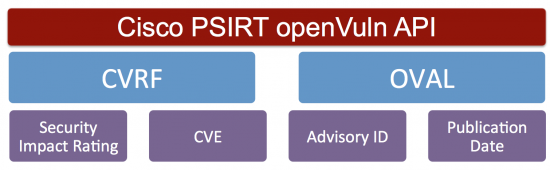
The Cisco PSIRT openVuln API is a RESTful API that allows customers to obtain Cisco security vulnerability information in different machine-consumable formats. It supports industrywide security standards such as the Common Vulnerability Reporting Framework (CVRF)Open Vulnerability and Assessment Language (OVAL), Common Vulnerability and Exposure (CVE) identifiers, and the Common Vulnerability Scoring System (CVSS).

openVulnSupportedStandards

This API allows technical staff and programmers to build tools that help them do their job more effectively. In this case, it enables them to easily keep up with security vulnerability information specific to their network. That frees up more time for them to manage their network and deploy new capabilities in their infrastructure.

Continue reading “Introducing the Cisco PSIRT openVuln API”

Authors

Omar Santos

Distinguished Engineer

Cisco Product Security Incident Response Team (PSIRT) Security Research and Operations

Avatar

Manufacturing is one of the key industries that has been in the forefront of digital transformation. Leading manufacturing organizations have evolved beyond driving efficiencies within their own processes to automating and including their broader ecosystems of customers, partners and vendors in order to enable rich customer experiences. In this new era of digital manufacturing, these value chain transformations and their capability to enable new customer experiences will drive revenues and help in achieving a sustainable growth.

Ecosystem enablement in digital manufacturing is driven by a seamless, secure integration which requires robust software platforms. Cisco Analytics and Automation Software Platforms is one platform that enables seamless integration Continue reading “The Changing Landscape of Digital Manufacturing”

Authors

James Jamison

Director, Technical Marketing

Software Platforms Group

Avatar

Integration of Cisco FireSIGHT Management Center and Identity Services Engine (ISE) Now Available

As explained in our 2015 Cisco Midyear Security Report, attackers are using innovative tactics like exploit kits, ransomware, and advanced malware to evade detection. Organizations are using as many as 40 to 60+ disparate security solutions that typically don’t – and can’t – work together. These point solutions have limited impact against well-funded cybercriminals and typically generate vast numbers of alerts, many of which may not be relevant. On average, large organizations have to sift through nearly 17,000 alerts each week to find the 19 percent that are considered reliable, and security professionals only have time to investigate 4 percent of warnings.

It’s no wonder that, based on various reports, the current industry average for time to detection is 200 days. That’s far too long. The longer the threat goes undetected, the greater potential for damage. By the time a breach is discovered the damage has been done.

The new Cisco Rapid Threat Containment solution with Cisco FireSIGHT Management Center and Cisco ISE lets you get to the heart of what matters – providing deep network detection and automatic containment of critical threats so you can mitigate your security risk quickly and efficiently without overburdening your security team.

Continue reading “New Cisco Rapid Threat Containment Solution Detects and Automatically Contains Threats”

Authors

Dan Stotts

Former Product Marketing Manager, Cisco

Security Product Marketing Organization

Avatar

Cisco strives to deliver a great customer experience, every time. It’s a top priority at our company. But even with that focus, we still trip up from time to time. With the increasing complexity of today’s IT environments and as our customers’ business networks grow, invariably things go wrong. When that happens, the most important thing we can do is address the issue with an urgency, transparency, and immediacy that gets our customers back on track and restores their confidence in Cisco.

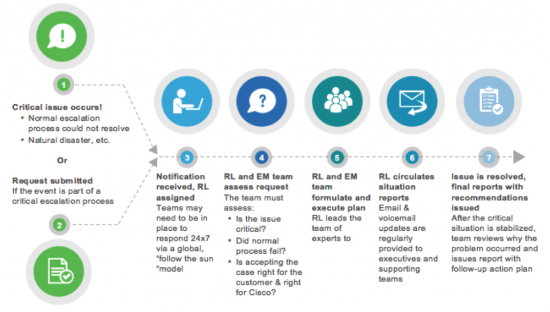
With over 20 years of experience handling our customers’ most challenging technical issues, we’ve developed expertise and best practices in how to quickly respond to and resolve an issue while identifying the root cause so we can drive lessons learned back into the business for continuous improvement. In parallel, we continuously evolve and innovate how we serve our customers, particularly how we handle our customers’ most critical issues.

We recently documented our processes and based on that, I’m excited to share with you a new white paper: “Developing a Customer Assurance Program from Start to Finish: Best Practices from Cisco’s Award-Winning Customer & Partner Assurance Organization”

Graphic for white paper
In this white paper, we share the five key best practices that form the foundation
of Cisco’s entire critical situation response process. Our intent is to share ideas and innovations that you can adopt in your business on a number of levels: to build out a full-blown critical situation response team, to better drive lessons learned in your business, or simply to improve the cross-functional leadership skills of your employees.

 
We also know that many of our customers and partners operate in similar environments. Cisco has a vision to build a common escalation management framework in the industry that can be employed when multiple companies are involved in the same critical escalation with a mutual customer or in a multi-vendor scenario. This would allow for standards that help all of us better manage customer expectations and deliver a more consistent experience. Together, we can ensure our customers’ success when it is most at risk.

Please give the paper a read, share it with your teams, and give me your feedback. I’m interested in the approaches you use at your business and the experiences you’ve had in resolving critical customer issues. Sharing ideas and learning from one another makes all of us better at serving our customers.

Authors

Curt Hill

Senior Vice President

Customer Assurance

Avatar

Last month, I had the privilege, as part of my job, to go to Greece to deploy emergency communications infrastructure. Cisco was asked by partner NGOs to support the influx of people passing through the Greek islands due to the Syrian refugee crisis.

Syria’s civil war is the worst humanitarian crisis of our time. Half the country’s pre-war population, more than 11 million people, have been killed or forced to flee their homes. Hundreds of thousands of refugees are attempting the dangerous trip across the Mediterranean Sea from Turkey to Greece, hoping to find a better future in Europe—and unfortunately not all of them make it across. Those who do, then face steep challenges from strained resources and minimal services due to the enormity of the situation.

This is why they need our help. The majority of the refugee community in Greece is Syrian and the rest are Iraqi and Afghans, trying to escape wars there. The current humanitarian aid effort is led by UN agencies working with the national governments and a multitude of NGO aid organisations. The overall response has been humbling to see, people providing shelter and power to sites, and the local support offered by Greek citizens in welcoming the refugees has been inspiring.

Copy of _SOS0827-PanoTen of us (from Cisco, a partner NGO and other corporate disaster response teams) have just returned from the region. We went there with one aim in mind; to install secure Wi-Fi zones and charging stations so that the refugees could contact their loved ones and families back home. For many, they had been out of touch with those that mattered for so long and this was the first opportunity they had to let them know they were safe and ok.


When we first arrived on Greek shores, most of the refugee sites had no communications infrastructure in place at all. The Disaster Response Team had been tasked to bring connectivity to various points along the migration routes, starting in the Greek islands. The importance of this was brought home, as we learned that one of the first questions refugees ask when they get rescued out of their boats is, “Do you have Wi-Fi?”

For people arriving from these boats with very few possessions, little money, and certainly no local currency, the chance to just let people know they were ok had a hugely positive effect. We often forget how much we rely on digital communications in our day-to-day lives. Once we’d set up the networks, people were immediately able to Continue reading “Reconnecting refugees with loved ones thanks to the Cisco Disaster Response Team”

Authors

John Baekelmans

Chief Technology Officer

Internet of Everything (IoE) Solutions group

Avatar

I love working at Cisco.

It’s a company that cares deeply about its customers and its employees, and most importantly, cares about giving back to the community. I’m proud to be part of an organization that has helped raise more than $40 million and deliver nearly 160 million meals over the past 15 years as part of its Global Hunger Relief efforts.

When I was considering giving a portion of my latest book’s profits to charity, I stumbled across a post about Cisco’s Be the Bridge campaign. This is Cisco’s latest employee giving initiative, which supports more than 400 nonprofits and non-governmental organizations (NGOs) worldwide through employee donations, volunteerism, and matching from the Cisco Foundation.

I was pleased to find out that Cisco would match my donation, dollar for dollar. This means that I can easily double the total amount I can donate to charity, all because I’m a Cisco employee. How cool is that? So, I decided to donate the profits of my latest book through Cisco’s Be the Bridge campaign (for all sales from December 14 to December 18, 2015). Continue reading “Giving to Cisco’s Be the Bridge Campaign through Book Sales”

Authors

Hassan Osman

PMO Manager

Cisco Advanced Services

Avatar

Holiday shopping isn’t like it used to be. Retail sales associates – a.k.a Santa’s helpers – are taking on more than just ushering shoppers into fitting rooms and helping them check out. Today, their role more resembles that of a concierge.

Here are three ways the role of the sales associate is changing:

#1: The sales associate is now your product and inventory expert.

It’s shocking to think that today only 30% of employee time is spent on customer service. To allow sales associates to spend more time with customers and provide a better shopper experience, stores are asking associates to evolve from clerk to expert. In this new role, associates are providing more value to customers by saving them time and helping them make better decisions.

Blog2_1 Continue reading “3 Ways Santa’s Store Helpers are Making Shopping Easier this Holiday Season”

Authors

Kathryn Howe

Former Director, Healthcare Digital Transformation, Cisco Americas

Customer Value Acceleration/Business Transformation