The pace of change around us is no longer constant. It is continually accelerating. We all want to get and consume information, services, and just about anything instantly. My new coffeemaker brews me a fresh cup in just a couple of minutes, but it usually takes me ten minutes just to collect up the tools I need to prepare to start a home improvement project, and more than that to travel and get what I need from the local hardware store. And let’s not forget how long commute times are for most of us — much longer than just 10 minutes.
So, just how fast can we get new networking services up and running and customize them for our businesses. Imagine if we could easily and securely order the network services we want online in minutes. Imagine too if you could select them from an online marketplace and personalize them just like ordering your favourite late evening food cravings with just an emoji or on-line tweet. Imagine no more, with this video.
Today schools have two primary goals: educating children and keeping them safe. For the largest coeducational, independent K-12 school on a single campus in the United States, that goal is doubly difficult because their campus spans 60 buildings over 77 acres. The large area coupled with the unique architecture—most campus buildings lack interior hallways and have doors that open to the outdoors—Punahou School in Hawai’i had interesting hurdles to overcome to update their facility.
In order to maintain better security, the school updated its 2006 Cisco Wireless network to a more modern solution. This new Cisco solution—which has seen the amount of access points grow to over 300 devices and also included a variety of Cisco Catalyst switches—allowed the Punahou School to take advantage of the Internet of Everything (IoE).
Whether it’s wireless door locks or high-definition security cameras monitoring the campus or even campus lighting and temperature control, the entire upgrade is being run through an updated Cisco network.
(This blog has been developed in association with Farid Jiandani, Product Manager with Cisco’s Insieme Networks Business Unit)
If you work for an enterprise that’s looking to hit its digital sweet spot, then you’re scrutinizing your sales, marketing and operations to see where you should make digital investments to innovate and improve productivity. Super-fast data processing at scale is being used to obtain real-time insights for digital business and Internet of Things (IoT) initiatives.
According to Gartner Group, one of the cool vendors in this area of providing super- fast big data analysis using in-memory streaming analytics is called DataTorrent, a startup founded by long-time ex-Yahoo! veterans with vast experience managing big data for leading edge applications and infrastructure at massive scale. Their goal is to empower today’s enterprises to experience the full potential and business impact of big data with a platform that processes and analyzes data in real-time.
DataTorrent RTS
DataTorrent RTS is an open-DataTorrent RTS provides a single, unified batch and stream processing platform that enables organizations to reduce time to market, development costs and operational expenditures for big data analytics applications. source, enterprise-grade unified platform for stream and batch processing on Hadoop.
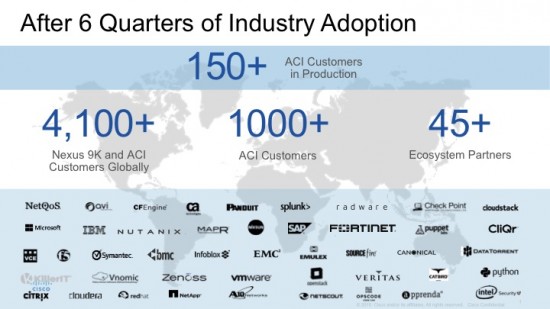
Cisco is unquestionably leading in enterprise SDN adoption with over 1,000 ACI customers, 150+ customers in production, 45+ ecosystem partners benefiting from the ACI policy driven automation approach.
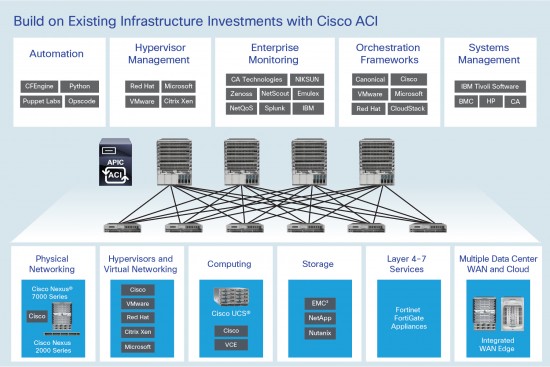
The robust and open APIs made it easy for the technology partners to rapidly integrate with ACI. The result is customers have the broadest set of security, monitoring, orchestration, and automation choices with the ability to adapt the ACI implementation to their own operational model.
And the best part is that we know that what we have built is working because our customers and partners are telling us (See List).
Why is ACI Winning
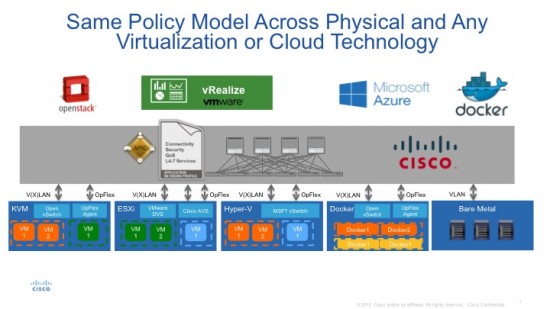
Cisco ACI delivers an agile, open, and secure solution for deploying applications across any physical, virtualization or cloud technology being used for data center infrastructure.
Cisco ACI provides consistent policy and operational flexibility for the leading cloud management platforms, for multi-hypervisor and bare metal server workloads. It is a true SDN solution with built-in secure multi-tenancy.
Several years ago, Cisco published predictions on the growth of Internet traffic – such as by 2017, there will be 5 devices and related connections for every Internet user worldwide. While the vision of the Internet of Things (IoT) is growing into reality, in just a couple of years, it’s expected to create more global network traffic than experienced in all prior “Internet years” combined. To leverage and prepare for the future of networked communications, businesses must transform the ways they manage their data collection and analysis. The old rules of capturing and storing information can no longer apply since the wealth of data is found not in a repository but in the place where data is actively collected – at the edge of your network.
Cisco estimates that 50 billion devices and objects will be connected online by 2020. With that in mind, can you imagine the ways your business can innovate its operations to best fulfill customer needs? Living on the edge doesn’t have to be intimidating – your journey to the edge begins with understanding the data that is vital to your business.
In your digital transition approach, begin with developing a strategic framework for your data processes:
Cisco’s open ACI eco-system is gaining rapid momentum in Data Centers with more than 45 leading partners developing joint solutions addressing L4-L7 network and security service use-cases along with application stack automation. Just a few weeks ago we announced a major milestone in our journey, Cisco’s 1000th ACI customer.
Some of our customers have deployed the ACI-Fortinet joint solution. In this blog, I want to talk about the integration of Fortinet FortiGate Firewall with Cisco APIC. The integration of Cisco APIC and the Fortinet FortiGate solution provides customers several benefits:
Consistency and transparency for workload security deployment across physical and virtual application environment.
Single-pane-of-glass management from Cisco APIC with full visibility on security policy enforcement
Predefined security policies are deployed on command and automated through complete application deployment lifecycle
Let me take you on a quick tour of some of the customer success stories.
Qbranch Case Study: Orchestrating FortiGate Security with Cisco ACI
European service provider Qbranch, part of Axians, and networking leader Cisco discuss the real-world challenges with manually provisioning firewalls and security policies, and how orchestration of Fortinet’s SDN Security framework with Cisco’s Application-Centric Infrastructure (ACI) can reduce costs and enable better service delivery in multi-tenant environments. Watch Video and Case study for details of the implementation.
Hosting Provider Zitcom Accelerates Time to Market with Cisco ACI and Fortinet
Zitcom, a premier partner-driven hosting company based out of Denmark is one of the early adopters of Cisco’s Application Centric Infrastructure (ACI). Watch Thomas Raabo, Network Operations Manager of Zitcom, share details about how Cisco ACI made Apps deployment easier, fostered collaboration between apps and network teams, and brought an overall agile application deployment environment.
There are several other customer stories featuring ACI-Fortinet solution, but I’d run out of time and space to list them all. For your easy reference visit http://www.fortinet.com/videos/index.html for more customer videos.
Let’s look in detail at the key capabilities of Fortinet-Cisco ACI solution and the benefits it brings to Data Center customers. Fortinet’s FortiGate firewall solution integrated into Cisco Application Policy Infrastructure Controller (APIC) delivers application-centric security automation in modern data centers. The solution provides automated and predefined policy-based security provisioning for next-generation firewall services. It enables location independent security services insertion anywhere in the network fabric through a single-pane-of-glass management. Cisco ACI – FortiGate solution architecture is shown below:
The joint FortiGate Integration with Cisco APIC has two major components:
FortiGate device package for Cisco APIC
FortiGate physical or virtual appliances
Now let us segue to the Fortinet Device package integration with Cisco APIC. The Device package integrates with Cisco APIC through open APIs and provides per-app, per-tenant L4-L7 policy configuration and dynamic service chaining and insertion. In addition, the integrated solution also allows exchange of intelligent telemetry information between Fortinet and APIC for application and tenant visibility.
The Fortinet Device Package for Cisco ACI comprises a device Model and a device Script. The Device Model defines the functions provided by FortiGate such as firewall inspection including IP reputation, web filtering, anti-virus, DNS filtering, SSH inspection, IPS, and DDoS etc., The Device Script provides the adapter functions required for FortiGate to communicate with APIC.
I am pleased to inform that we are also having a detailed Webinar, Oct 23, on the ACI-Fortinet joint solution topic, presented by subject matter experts from Cisco and Fortinet. Register Here.
In the dynamic and fast-changing technology sector, it takes a smart, motivated, diverse workforce to stay ahead of the competition. At Cisco, we are committed to a culture that values such diversity, which makes us better, stronger, and more agile.
The Executive Leadership Council is an organization that is helping improve the pipeline of diverse executive-level talent. Through its Foundation, the ELC provides scholarships and training programs designed to help African-American employees discover pathways to promotion, up to and including the senior-most executives and board members of America’s largest companies.
Tonight, at the ELC’s annual recognition gala at National Harbor, the organization will celebrate and recognize individuals and companies that are supporting the ELC in its activities, and the individuals it is advancing through its programming.
Cisco is proud to be the Lead Sponsor of “The Power of One” celebration. Our CEO, Chuck Robbins, will be on stage as part of the event, and Cisco will be well-represented by executives and leaders from within our company.
“At Cisco, we strive to connect everything, innovate everywhere, and benefit everyone—but we can’t do that without the power of our people,” says Chuck Robbins. “Each one of our employees brings unique talents, backgrounds, and experiences that contribute to our success as a company. It is only by creating a culture that values all diverse perspectives that Cisco will be able to capture opportunities in the future.”
Congratulations to the Executive Leadership Council on the occasion of their annual gala, and for their hard work in opening up a diverse talent pipeline for future executives.
By Christopher Kelley, Lead Architect, Solution Services, Data & Analytics Group
Next week is the penultimate tech-fest of the year, in cable and broadband circles — the Society of Cable Telecommunications Engineers’ annual Cable-Tec Expo, happening in New Orleans. One topic we expect to be big involves the Energy2020 initiative, which aims to substantially reduce power consumption in all aspects of traditional and new cable infrastructure — essentially, from the side of the house, to the cloud / data centers.
We’ll be there next week, talking sustainability and lots of other things, but we wanted to take a moment today to tell you about the work we’ve been doing on our cBR-8 converged broadband router. In fact, we just hosted a webinar on the topic this morning, with the SCTE! This blog can serve as a forum for the highlights, as that demo won’t be live yet. Continue reading “The State of Cisco and Energy2020”





 safe. For the largest coeducational, independent K-12 school on a single campus in the United States, that goal is doubly difficult because their campus spans 60 buildings over 77 acres. The large area coupled with the unique architecture—most campus buildings lack interior hallways and have doors that open to the outdoors—Punahou School in Hawai’i had interesting hurdles to overcome to update their facility.




 Cisco estimates that 50 billion devices and objects will be connected online by 2020. With that in mind, can you imagine the ways your business can innovate its operations to best fulfill customer needs? Living on the edge doesn’t have to be intimidating – your journey to the edge begins with understanding the data that is vital to your business.




 By Christopher Kelley, Lead Architect, Solution Services, Data & Analytics Group