Avatar

Note:  Cisco’s Mohammed Ahmed of the Cisco IBM Alliance team was the key contributor for this blog post

In the IT industry we understand that customer confidence and respect is a leading reason that customers choose IBM and Cisco solutions and  services. Cisco and IBM have earned this trust over the years by each having deep technical expertise; global resources; and world-class support that few companies can match. With an almost two-decade history of working together, our success in the market together is demonstrated by more than 25,000 shared customers.

Cisco and IBM strive to work together to deliver innovative solutions to meet our joint customer needs – Cisco Application Centric Infrastructure, the IBMBigInsightSolBriefData Center, the Internet of Everything (IoE), and Collaboration are just few examples.
Recently, Cisco and IBM added another strategic solution to the list “Cisco UCS Integrated Infrastructure for Big Data with IBM BigInsights for Apache Hadoop” to help customers maximize the value of their big data and leverage business insights from it.

The Cisco UCS Integrated Infrastructure for Big Data (CVD Link) with IBM BigInsights has been jointly tested and validated by both companies and provides a flexible, industry leading platform affording enterprises to fully leverage the latest open source technology together with the powerful SQL on Hadoop and Analytic capabilities.  The solution highlights are:

  • Powerful and high performance SQL on Hadoop designed for enterprises that require greater SQL standards compliance, performance, concurrency, and security
  • Highly scalable analytics for Data Scientists, Business Analysts to explore, discover, analyze and build advanced predictive models
  • Comprehensive enterprise-grade infrastructure using Cisco Fabric Interconnects and Rack Servers optimized for BigInsights

Continue reading “Cisco at IBM Insight 2015: Showcasing Industry-leading Technology for Big Data and Analytics”

Authors

Rex Backman

Senior Marketing Manager, Big Data Solutions

Data Center and Cloud

Avatar

At the end of last month, September 30th,  Cisco received the International Corporate Energy Management Award from the Association of Energy Engineers (AEE) for our global energy management program and our commitment to reducing greenhouse gas (GHG) emissions globally.

Ali Ahmed, who leads the Global Energy Management and Sustainability team within Workplace Resources at Cisco, was honored that Cisco received this award and very proud of the work that Cisco have done in setting aggressive targets and pursing high value projects to achieve the targets.

His Blog, summarized here, talks about:

• In 2009, Cisco met a goal we had set in 2006 to reduce business-air-travel emissions worldwide by 10 percent against a 2006 baseline
• In 2012, we met a commitment to reduce all Scope 1, 2, and business-air-travel Scope 3 GHG emissions worldwide by 25 percent against a 2007 baseline.
• In February 2013, we announced a set of five new goals related to our operational energy use and GHG emissions.

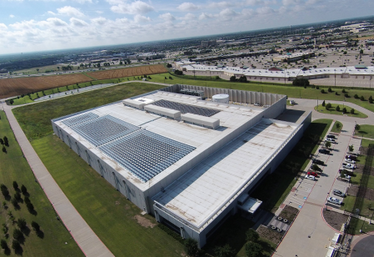
Cisco Allen TXTo achieve these goals, Cisco approved $57.5 million in funding for 2014 through 2017 for the creation of a program called EnergyOps.

Since we launched the EnergyOps program, we have completed or initiated 344 energy efficiency and renewable energy projects. This has reduced Cisco’s energy annual use by 105 GWh and GHG emissions cumulatively by over 1 million metric tonne of CO2e.

Examples of some of these projects include solar installations in the United States and India, numerous indoor and outdoor lighting improvements, and various types of upgrades to HVAC systems at many of our campuses, like our Shanghai location. Cisco estimates that the projects we have completed or initiated to date will save approximately US$15M annually. Continue reading “Summary: Cisco Awarded Top International Honor for Energy Management”

Authors

Peter Granger

Senior Sales Transformation Manager

Avatar

I can remember it vividly: The year was 1995, and I was working at a start up in Silicon Valley. What was the Internet like back then? It was certainly not ubiquitous, as it is today. At that point, the Internet was still fledgling—although it was exploding—and ecommerce was starting to take off. There was no YouTube, no Google, and no Facebook.

In 1995, the Yahoo.com domain was registered, Amazon.com and Craigslist.org launched, and eBay was founded. We were quickly realizing the Internet could provide us with opportunities and experiences that were unimaginable only a few years prior. There were some early-adopter companies, with websites up and running and open for business. And there were many enterprises taking things slower. Was this Internet thing just a fad? What can we do with it? Will people actually buy goods and services online, and use their credit cards over a computer? Is this safe? Secure? Is this for everyone, or just the Silicon Valley tech crowd?

Fast forward to today, when we cannot imagine a world without connectivity and information, online commerce, streaming music and video—all at our fingertips, available in milliseconds. Many of the companies that hesitated back in the 1990s are not around today. And since we know that history often repeats itself, we again find ourselves at another massive disruptive crossroads.

There are already 15 billion connected things. That number could rise to 75 billion—some say 200 billion—by 2019, and there will be three times the Internet traffic by that date. By 2020, it is predicted that there will be 5 terabytes of data generated per person. The predictions back in the 1990s seemed lofty at the time, but they’ve been overshot massively!

What does this mean for the world we live in? How do companies prepare for this digital revolution? The answer is Continue reading “Digital Adoption Lifecycle: Don’t Be a Laggard”

Authors

Chris White

Senior Vice President

IoT Global Sales

Avatar

It can be a tough world out there for a cloud provider. You’re facing stiff competition from the big cloud players like Amazon and Google to deliver more flexible cloud services. But you have an edge that they don’t. Customers can trust you to deliver guaranteed reliability, security, and data sovereignty for business-critical applications in a way that pure public cloud providers can’t match.

To capitalize on that trust, you need to:

  • Offer a suite of public, private, and hybrid cloud solutions “as a service,” and bring them to market fast
  • Deliver business-class performance (scalability, flexibility, reliability and security, and more) against customer SLAs
  • Support key hybrid cloud capabilities like workload portability; and security, policy, and infrastructure management across clouds
  • Deliver globally while retaining data sovereignty

There are technologies available to do all of that, but typically you’d need to spend a lot of time and money knitting together hardware and software from multiple vendors. Then you’d have to test them to make sure they work together, and you could encounter a lot of complexity deploying and provisioning new services.

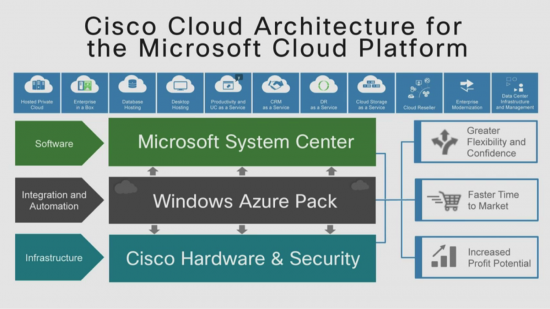
But there’s good news: Cisco and Microsoft have teamed up to create the next-generation architecture for cloud providers. It’s called the Cisco Cloud Architecture for the Microsoft Cloud Platform. And it’s going to make capturing the cloud opportunity a whole lot easier for you and your customers.

Untitled

Introducing Cisco Cloud Architecture for the Microsoft Cloud Platform

Cisco Cloud Architecture for the Microsoft Cloud Platform combines Cisco’s world-class hardware with Microsoft’s enterprise-ready software to help you build comprehensive hybrid cloud solutions—faster, more easily, and more profitably. It’s part of a multi-year agreement between two of the world’s hybrid cloud heavyweights, Cisco and Microsoft, to deliver joint engineering, product development, and go-to-market support.

Cisco Cloud Architecture for the Microsoft Cloud Platform is the result of a shared vision about how the cloud needs to work for businesses. We know that if you’re going to deliver viable cloud solutions to your customers private, public, and hybrid clouds need to work together seamlessly. And they need to be a lot easier to deploy and operate.

Cisco Cloud Architecture for the Microsoft Cloud Platform maps application policy to infrastructure policy for Microsoft and third-party ISV applications. And it implements our Unified Data Center and Application Centric Infrastructure (Cisco ACI) with Microsoft Windows Azure Pack (WAP) as part of a complete, pre-tested and validated, ready-to-deploy cloud platform. So you can deploy new applications and services at DevOps speed, with lifecycle support from the partners you trust.

Continue reading “Cisco and Microsoft Accelerate Cloud Providers’ Journey to the Hybrid Cloud”

Authors

John Malzahn

Senior Marketing Manager

Service Provider Cloud Solutions

Avatar

That was one of the key themes discussed during today’s “Internet of Everything – What’s in it for Europe event” in Brussels, with MEP Kaja Kallas asking the audience to consider a change in innovation culture to capture the predicted 4.3 trillion that the IoE could generate in value in Europe. Kallas coined the EU attitude to a fear of failure and failing fast compared to the US with “Silicon Valley innovates, DC litigates and Brussels investigates”.

4.3 trillion is a big number, but we think its on the conservative side based on our engagement with public and private sectors around the world. Digital disruption fuelled by the Internet of Everything is redefining industries, cities, countries at an unprecedented rate and promises productivity and economic gains with 1.4% increase in annual GDP and with 1 million new jobs created over ten years.

Michael Hager, Head of Cabinet for Commissioner Oettinger, echoed Kallas’ sentiment on the courageousness required to capture the IoE opportunities, leveraging the Alliance for IoT Innovation (AIOTI) and the Digital Single Market (DSM) to look beyond national borders to a European and international approach. Engaging cross-sectoral collaboration and getting privacy, security and connectivity right will be key enablers.

I was struck by how much in common an enterprise like Bosch, start up AirCloak and the City of Copenhagen had – all touched on the need for vision to breakdown siloed use cases, using concrete demonstrations to illustrate value, to tackle privacy and security issues head-on and the need for education initiatives to accelerate digitisation.

So yes we can celebrate failure in Europe but we can’t afford for the policy environment to be the reason we fail. Fostering the right policy environment means getting it right on issues as diverse as an adaptable data protection framework, a partnership-based security model and the development of an IoE-savvy workforce. The Digital Single Market will bring many elements that will help take us forward, but we need more Member States to complement these efforts by putting digitisation front and centre of their accelerated national digital agendas and municipalities to embrace the opportunities.

Please click here for more information on the opportunity that digitisation fuelled by the Internet of Everything enables.

Authors

Chris Gow

Senior Director, EU Public Policy

Government Affairs

Avatar

When it comes to the Internet of Everything, few industries have as much opportunity, or as much at stake, as manufacturing. Specifically, certain verticals such as Consumer Packaged Goods (CPG) and Food and Beverage manufacturing face unique challenges and opportunities. According to the Price Waterhouse 2015 Consumer Goods Report , the current market is seeing “changing consumer attitudes toward products and brands, as the great fragmentation of consumer markets takes another turn. In response, companies must dramatically shift the route they take to reach consumers in terms of both product distribution and communications.” In particular, bottlers have to adopt to these industry trends as well as changing distribution, fleet and territorial roles. Success in this new era requires smarter, more streamlined operations and the ability to respond to opportunities and problems in real time.

At Cisco, we are constantly seeking new ways to connect data, people, processes and things to help businesses thrive. Our goal is to continually drive solutions that simplify systems for our customers so they can focus on adding real value to their business. That’s why we’re excited to announce The Bottling and Distribution Smart System powered by Cisco, a user-friendly portal that we created while working with leading global bottling and distribution enterprises.

Our customers in the bottling and distribution industry have told us that their businesses suffer when they have to patch together different solutions for reporting, fleet management, maintenance records and more. Continue reading “Introducing “The Smart Bottling and Distribution System” from Cisco”

Authors

Dan Kern

Lead Marketing Manager

Manufacturing & Energy Industry Sector

Avatar

Andrew Miller, Sr. Sales Engineer from Bit Stew Systems, showed me an oil and gas use case a short while ago. He was using real-time analytics to demonstrate how an energy company could monitor and respond to a natural disaster that might effect an oil and gas pipeline infrastructure. I was impressed by the visualizations he showed me and how he could interact with a map on the screen that was showing real-time analytical data fed in from a number of sources.

https://www.youtube.com/watch?v=hjC7EBDeCo8&index=1&list=PLC9B77E2CF83FB00D

The demo shows some critical assets in the service territory in the north west of North America. That includes pipelines, block valves stations, initial injection stations, pumps, regulators and the like. We were able to see lots of details on the assets, and real-time status. Andrew simulated a natural disaster event (a fire), and that info would generally come from a live data feed and be overlaid on the map. We then looked at the affected assets and which ones were at risk. The really cool thing was the modeling of where the fire might spread to (based on weather). Response teams could be dispatched in real time to tackle the situation, and the situation monitored so that crews could be sent to where the fire was likely to spread to. Crew locations could be seen, again in real time.

Bit Stew Blog #1Bit Stew’s MIx Director™ (formerly Grid Director™) works with Cisco IOx and enables industrial companies to discover actionable insights that optimize operational performance. Andrew talks about how it leverages Cisco IOx and therefore hardened infrastructure that might include Cisco CGR or ISR solutions can be implemented enabling ‘fog computing’ or edge computing as it’s sometimes called.

IOx enables the analytics to be closer to the edge of the network. Closer to the sensors and devices that energy companies want to monitor. That relieves the pressure on the central IT sites and allows faster analysis at the source. Continue reading “Analytics for Oil and Gas – real-time data enabling real-time intelligence and response”

Authors

Peter Granger

Senior Sales Transformation Manager

Avatar

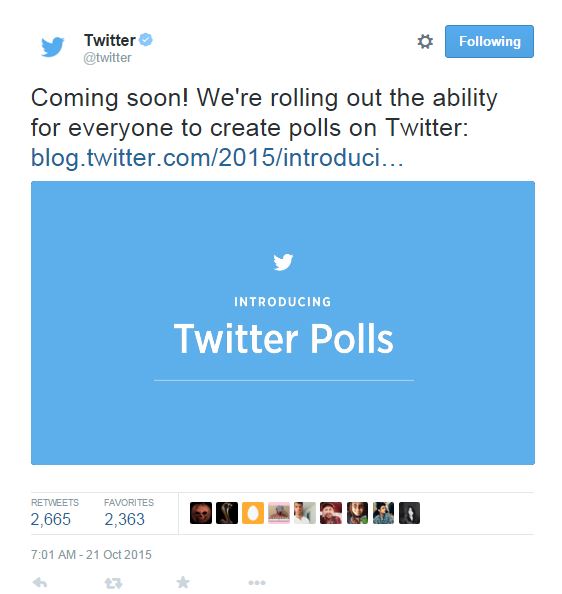
You may have heard the news coming in from Twitter this week…

TwitterPollsNews

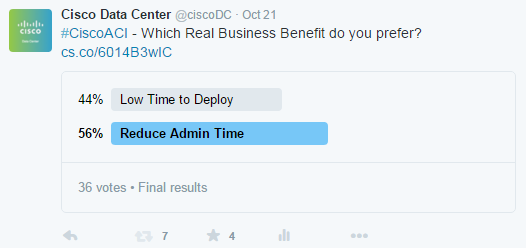
Cisco Data Center, @CiscoDC, received the opportunity to be one of the first Twitter handles to have the polling enabled on to our account. (Yes, we do feel special too). Here at Cisco, we are excited to test the feature so we conducted our first poll yesterday with great results.

Benefits of Polling

One of the biggest benefits to Twitter Polls is that it gives brands a new opportunity to engage with their Twitter network. The most obvious benefit is that brands now have the opportunity to ask anything and get feedback in real time. The real time aspect of Twitter’s new polling feature will enable quicker decision making that will help brands create more effective social media campaigns.

Time and Analytics

Each poll is live for 24 hours, which gives people only 24 hours to choose one answer of the two you can provide. No third or fourth answers are possible. During this time you will be able to see real time analytics of the number of respondents and the current results of the poll . Your respondents are able to answer the question anonymously.

During Polling Analytics Information

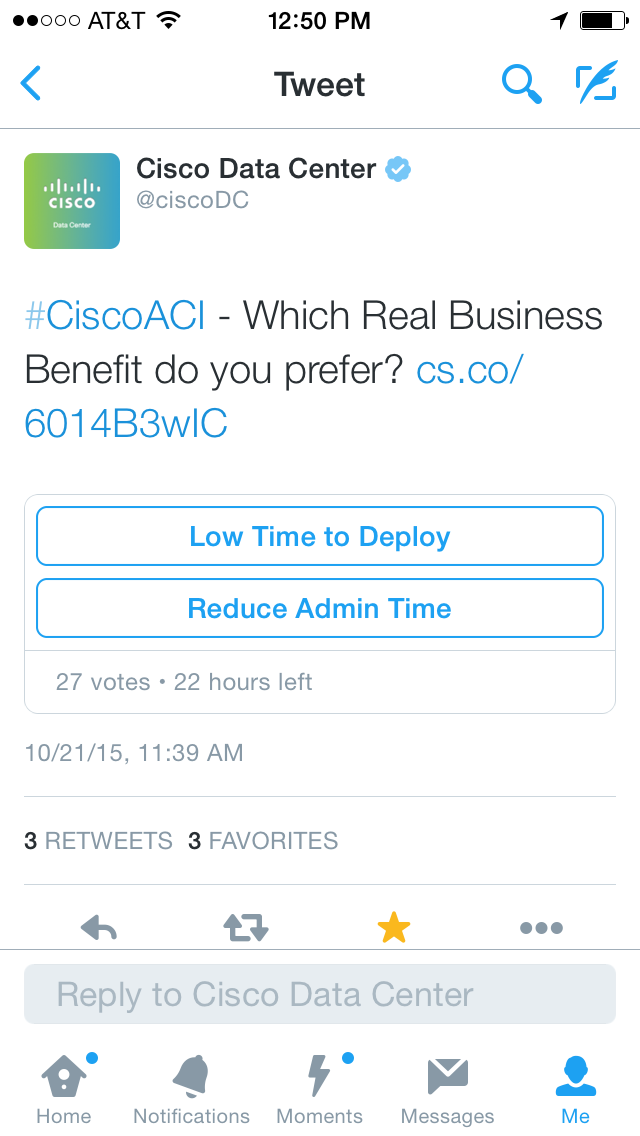
During the 24-hour response period, mobile users are able to see the question rendering in two big buttons like this:

pic2

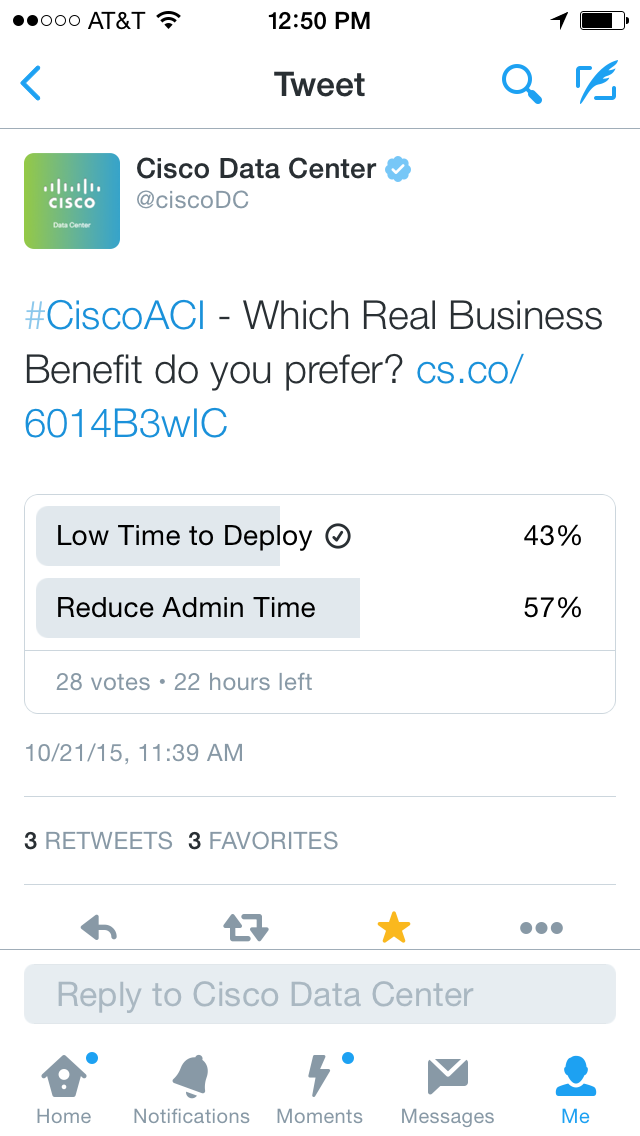
Participants are also able to see how many people have already voted and how many more hours the poll is open to respond.

After participants have answered, they are able to see via visual confirmation, their choice and also the real time results of the poll as show below:

pic 3

Post Polling Analytics Information

Once the poll has closed, everyone (whether they have participated in the poll or not), will be able to see the results of your poll. As seen here:

pic 4

Character Limits

For the initial tweet, you are limited to 95 characters and for each of the possible answers; you are limited to 21 characters. Clear messaging and a concise plan will be critical for using this feature.

Are you excited to use this feature on your account? What would be your first poll question be?

Tell me in the comments below.


Authors

Melanie Kraintz

No Longer with Cisco

Avatar

Yesterday was “Back to the Future Day.” Michael J. Fox had a glimpse into his futuristic world. What if you too had the same capability? Imagine this: you’re an astronaut on a time travel space mission. You come upon a futuristic world years from today, and this is what you see.

A vortex of insurmountable forces sucking you and the surrounding environment into the abyss. Yet you’re still attached to the present. You still have control. (It is a visual presentation of a Digital Vortex, working its way into becoming a black hole putting your business at risks.)
A vortex of insurmountable force is sucking you and the surrounding environment into the abyss, yet you’re still attached to the present. You still have control. (It is a visual presentation of a Digital Vortex, working its way into becoming a black hole, putting your business at risks.) Image Source: Lightfarm Studios

Armed with this vision, what would you do if today, October 22, 2015, is your “Back to the Future” day?

This is a continuation of a previous post by Hugo Vliegen, Digital Vortex, Part I: How Not to Be the 40% That Will Fail. (Re-read that post here). In this blog (part II), I will share four key tenets of a digital business network, a.k.a recommendations for the hypothetical NeedToChange company scenario (as referenced in part I).

Continue reading “Digital Vortex Part 2: Key Tenets of a Digital Business Network”

Authors

Anna Duong

Products & Solutions Marketing

Enterprise Network and Cloud