Avatar


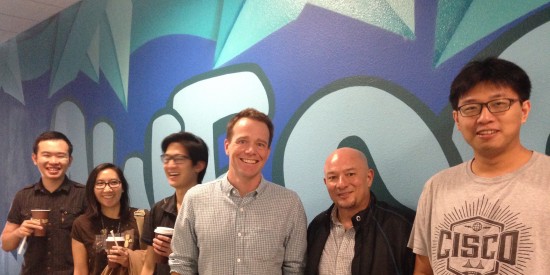
Employees and Graffiti wall

“Delivering Awesome” might mean different things to different people.

For the team delivering a workspace reboot, it meant finding a fun way to make the employee residents in the updated Building 18 in San Jose, CA feel at home in their new work environment.

For the engineers who work in the updated Building 18, it ‘s about discovering and making that awesome “next thing” for Cisco.

The two interpretations came together in a unique, artistic way – graffiti on the walls! There are two graffiti installations, and one displays the team mantra of “Delivering Awesome.”

https://www.youtube.com/watch?v=1tOZu2vdkpk

“It was supposed to be temporary,” says Jodi Washington, program manager at Cisco. “We wanted to be different than anyplace else in Cisco. We wanted to get people excited about ‘Delivering Awesome.’ The whole mantra is about bringing things to the table that change how people think, so the graffiti kind of worked.”

What started as an idea for hallway artwork for move-in day became a rallying call for the engineers in the building.

“We got such a great response,” Jodi continues. “We thought about making the next iteration of the artwork a contest among the engineers, but in a survey, 61% of them wanted to keep the graffiti!”

Jean-Francois Vincent, a Product Owner at Cisco, has been at Cisco for several years, sitting in Building 18 for many of them.

“It used to feel like we were in a zombie shooter game,” he says. “There was a long, dark hallway and a cube farm. But now, it’s open, fresh, and full of light.”

The graffiti wall was icing on the cake for Jean-Francois.

“I like it. It relates to me. I don’t get up in the morning to do anything but deliver awesome.”

Maybe you want to deliver some awesome of your own? Apply at Cisco.

Authors

Carmen Shirkey Collins

Social Media Manager

Talent Brand and Enablement Team, HR

Avatar

SC'15 LogoWho’s heading to SC’15 this weekend?  I am!

Austin looks to have an exciting lineup this year.  Here’s the things I’m involved with:

We’ve also got some fun schwag to give away in the Cisco booth.  You’ll have to stop by to see what it is.  🙂

Continue reading “It’s that time again! SC’15”

Authors

Jeff Squyres

The MPI Guy

UCS Platform Software

Avatar

Yes, I just used “cool” and “PowerPoint” in the same sentence.  In this case I think that’s justified because of a very simple trick you can do to show off long scrolling designs (like most web and mobile pages are today) in corporate PowerPoint (or Keynote, etc) presentations.

A challenge we digital design teams face is that PowerPoint and presentation software, while ubiquitous in giving talks or business presentations, is not really great for showing off most designs — especially modern, scrolling “poster-style” designs, in depth: Either the design is scrunched into a tiny, unreadable format, just so it’ll fit, or you do something wonky like use motion paths to have the design flow up the slide like an out-of-control hovercraft.

There’s a pleasant alternative, however: Use cropping and “push” transitions in PowerPoint to simulate scrolling as you’re actually flipping between slides. There’s a video demo below, but you can quickly get the idea just by looking at these still slides I pulled from an actual PowerPoint deck about the Unified Access Solution page:

Slide2 Slide3 Slide4 Slide5Slide6 Slide7

Now, here’s a video of what it looks like in practice and how to build scrolling slides in PowerPoint:

You can grab this example PowerPoint file to try it yourself (click the “Download” button on the preview page to get the PowerPoint file). Enjoy!

Authors

Martin Hardee

Director, Cisco.com

Cisco.com

Avatar

I had a good conversation with an ISV yesterday who makes a popular MPI-based simulation application.  One of the things I like to do in these kinds of conversations is ask the ISV engineers two questions:

  1. What new features do you want from the MPI implementations that you use?
  2. What new features or changes do you want from the MPI API itself?

You know — talk to the actual users of MPI and see what they want, both from an implementation perspective and from a standards perspective.  Shocking!

Continue reading “More crazy MPI ideas: Fault detection and recovery”

Authors

Jeff Squyres

The MPI Guy

UCS Platform Software

Avatar

Information technology and its use have transformed every aspect of society. In today’s digital economy, every company requires effective security to protect their information. Security breaches mean lost intellectual property, compromised customer information, and reduced customer confidence. These are critical considerations as organizations become more agile and try to grow their business models to leverage evolving trends of mobility, cloud and digitization.

The number of connected devices alone is expected to grow to 50 billion sensors, objects, and other connected “things” by the year 2020. With this, the number and type of attack vectors will increase, as will the amount of data, creating a daunting challenge for companies and those responsible for defending the infrastructure.

Cybersecurity has expanded from just focusing on building secure technology perimeters, to now also working with business management to reduce security risks – as well as detecting, responding to, investigating and handling security events when they occur. As a result, security is not a point-in-time component, but rather, it must be a part of every deployment, every development and every decision.

Continue reading “The Importance of Security Skills in Today’s Workplace”

Authors

Tejas R Vashi

Senior Director, Product Strategy & Marketing

Learning@Cisco, Cisco Services

Avatar

The 27th annual SuperComputing conference is next week from November 15-20 in Austin, TX. The conference spotlights the many applications of high-performance computing (HPC) and innovations from around the world that are affecting the space. SuperComputing 2015 will attract the premier scientists, engineers, researchers, educators, programmers, system administrators, and developers in the international supercomputing community, and they’ll all be in Austin next week to talk about the latest and greatest in HPC!

We’re extremely excited to have some of our own Cisco representatives on hand, both to learn from the experts that will be present and to share some of Cisco’s initiatives in the HPC space. If you’re going to be at SuperComputing 2015, check out these two Cisco-led sessions:

Dave Goodell, Technical Leader Software Engineering

Monday, November 16 1:30-5:00 PM Room 12

Jeffrey M. Squyres, Technical Leader, Engineering

Wednesday, November 18 12:15-1:15 PM Room 18CD

In addition, there will be daily presentations happening at the Cisco booth (#588) throughout the conference on topics like Application Centric Infrastructure (ACI), Next Generation Firewalls and HPC with Cisco UCS. There will also be a presentation on Science DMZ led by Cisco’s Jason King and Chris Hocker. Science DMZ is a subnetwork that is secure, but doesn’t have the performance limits that can occur with traditional security devices like firewalls. Science DMZ is designed to handle high volumes of data and is an important part of supercomputing.

However, it has been difficult to implement securely with traditional network protocols and hardware. One way to tackle this problem is using software defined networking (SDN). In fact, Cisco recently published a whitepaper on how an event-based SDN solution can utilize blocking and steering actions to improve both the security and efficiency of the traditional Science DMZ. You can check out the full whitepaper to learn more about this approach to Science DMZ.

If you’re going to SuperComputing 2015, be sure to stop by booth #588 to say hi and learn more about Science DMZ and hear from our HPC experts.

Hope to see everyone there!

Authors

Shannon Leininger

Director and Market Lead

Federal Civilian Operation

Avatar

Digital transformation is changing the world as technology continues to play a central role in today’s business strategy. By helping to reach more customers, offer differentiated services, and grow the business, the relevance of IT is stronger than ever. Customers want to deploy services fast, at scale, at the lowest cost possible.

DIGITAL_ERA_FB

Cisco’s SDN strategy and portfolio enable policy-driven infrastructure built around ACI and the programmable fabric and network. Cisco offers freedom of choice to IT teams looking to add automation capabilities to their network infrastructure by leveraging their programmability capabilities to accelerate application deployment and management, automate network operations and create a more responsive IT model.

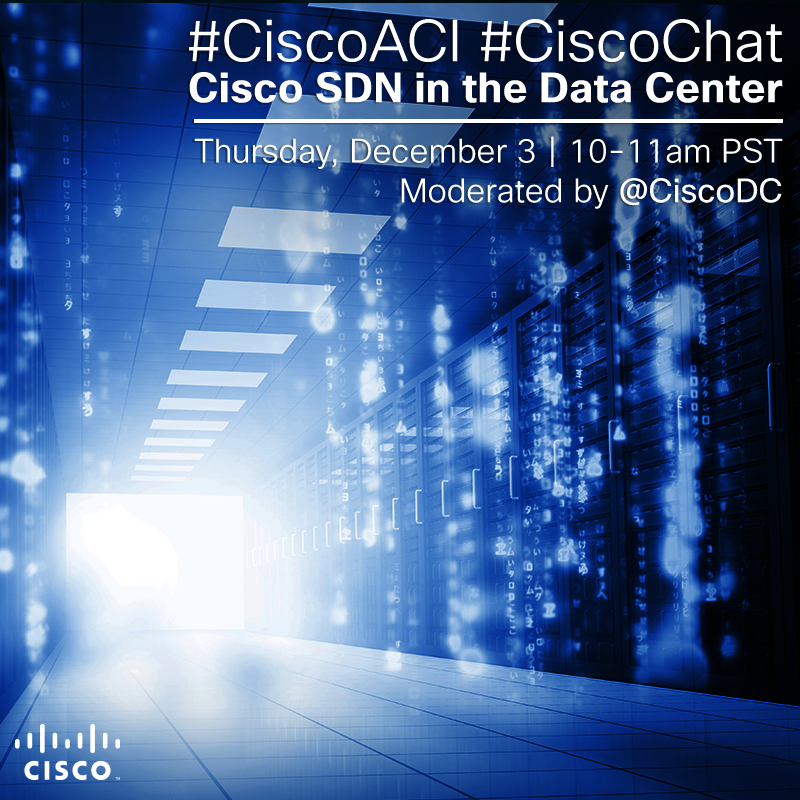
Cisco Application Centric Infrastucture delivers an agile, open, and secure solution for deploying applications across any physical, virtualization or cloud technology being used for data center infrastructure. Cisco ACI provides consistent policy and for multi-hypervisor, container and bare metal server workloads. It is a true SDN solution with built-in secure multi-tenancy. So much so, that our next #CiscoChat on Thursday, December 3rd at 10:00 a.m. PST will bring together a team of experts to discuss the extent of Cisco ACI challenges and the solutions leaders can use to address them.

In the article “The New Need for Speed in the Datacenter Network”, IDC confirms that “Today’s datacenter networks must better adapt to and accommodate business-critical application workloads. Datacenters will have to increasingly adapt to virtualized workloads and to the ongoing enterprise transition to private and hybrid clouds”.

In this #CiscoACI #CiscoChat led by Cisco Data Center, @CiscoDC, with co-hosts, Mike Cohen, (@mscohen), Principle Engineer at Cisco Systems and, Zeus Kerravala, (@zkerravala), Principle of ZK Research, will assess how Cisco ACI can help businesses stay competitive with an agile and programmable network and through a Fast, Open and Secure approach. You don’t want to miss this #CiscoChat on #CiscoACI Thursday, December 3rd at 10:00 a.m. PST as we reveal our latest innovations.

Authors

Melanie Kraintz

No Longer with Cisco

Avatar

Earlier this year, Cisco senior system engineer Josh Kittle attended Cisco Live in San Diego and had his first encounter with the Cisco Networking Academy Dream Team – a group of students who are given the chance to gain real-world experience setting up massive networks at high-profile events like Cisco Live and the NBA All-Star Game.

The Cisco Networking Academy Dream Team at Cisco Live US 2015 in San Diego, California

Josh is a former Cisco Networking Academy instructor,  one of almost 9,500 who have taught 5.5 million students IT skills worldwide since 1997. The Networking Academy curriculum is licensed free of charge to learning institutions and is Cisco’s largest and longest-running Corporate Social Responsibility (CSR) program. Our courses provide in-depth technology training in the latest networking, security, and cloud technologies, preparing students for in-demand jobs and globally recognized certification.

Josh described the Dream Team as a way for Networking Academy students to gain “real-world experience at the logistics and execution of network design, installation, and support – at a hyper-accelerated pace.”

Read Josh’s full blog post here and learn how you can hire Networking Academy talent for your company.

Authors

Austin Belisle

No Longer with Cisco

Avatar

This post has been authored by Karel Bartos and Martin Rehak

The volume of the network traffic has been steadily increasing in the last years. In the same time, the delivery of critical services from cloud data centers has increased not only the volume of traffic, but also the complexity of transactions.

High volumes of network traffic allow the attackers to effectively hide their presence in the background. Moreover, attackers can shift or deceive the internal models of detection systems by creating large bursts of non-malicious network activity. Such activity typically draws an attention of statistical detection methods and is further reported as anomalous incident, while the important, yet much smaller malicious activity would remain unrecognized. To counter this, we need to deploy more sophisticated detection models and algorithms to detect such small and hidden attacks. The increase in volume of the transaction logs also brings computational problems for such algorithms, as they may easily become increasingly difficult to compute on the full traffic log.

Sampling reduces the amount of input network data that is further analyzed by the detection system, allowing the system of arbitrary complexity to operate on network links regardless of their size. However, the use of sampled data for CTA would be problematic, as it negatively impacts the efficacy. CTA algorithms are based on statistical traffic analysis and adaptive pattern recognition, and the distortion of traffic features can significantly increase the error rate of these underlying methods by breaking their assumptions about the traffic characteristics. The loss of information introduced by sampling methods also negatively impacts any forensics investigation.

Continue reading “How (not) to Sample Network Traffic”

Authors

Martin Rehak

Principal Engineer

Cognitive Threat Analytics