How do you treat hardware like software? That question sounds like a contradiction, but we’ve been helping customers answer this question for the past six years with Cisco UCS. When you abstract all configuration and identity of hardware and transform it into software defined infrastructure (SDI), or better yet, policy driven infrastructure, you’re moving down the path of managing the “infrastructure as code.”
An essential aspect of this automated management is encapsulating the best practices of your server, storage and network experts as policies and templates. Cisco describes these as Service Profiles. The Service Profiles combined with the open Application Program Interface (API) in UCS provide a common “language’ for provisioning and configuring the infrastructure across the different types of devices. As we examined in a previous blog in this series, the combination of true SDI plus best practices defined in Service Profiles makes sure routine tasks are implemented consistently and correctly to reduce risk. Our customers are receiving tremendous benefits using Service-Profiles today with their existing UCS blade and rack systems, and we have extended this same management framework to our composable infrastructure.
Here’s where it gets fun:DevOps and Infrastructure as Code
The Internet of Things (IoT) is widely accepted as a key business opportunity for Mobile Service Providers (MSP) in the next 5 years. One recent report from Analysys Mason, predicts $8 billion in new IoT/M2M revenues from 2013 to 2019 in APAC alone. Other report predict even larger business potential, but where everyone agrees is that new IoT revenue is essential to compensate for other declining areas of revenue such-as voice and messaging.
Telecoms Revenue Growth by Service Type, Asia-Pacific, 2013-2019. Analysys Mason.
This is part of a blog series on the evolution of the Cisco Collaboration Cloud platform, which explores the technical and design principles behind its unique architecture.
I came to Cisco with the idea that, in many ways, enterprise communications technology had fallen behind consumer technology. And that we could apply to enterprise communications much of what the industry had learned in the mobile cloud revolution.
So it’s no surprise that I believed the next generation of business communications technology would be powered by the cloud, delivered on mobile devices and browsers, and used in larger settings (like conference rooms) through group systems.
The first thing we did as a team was define the “ultimate experience.” We assembled a small group of really smart people from around the world who had invented many of the collaboration technologies we all rely on today. We asked them to dream and dream big! From that dreaming, we created a vision of the future experience we could aim towards.
Assembling the Pieces The missing piece of the puzzle was a cloud platform to power this next-generation experience. Just one minor catch: The cloud platform we needed simply didn’t exist, though many companies had built pieces and parts. WebEx had web conferencing to which it later added video. A handful of startups had video calling and bridges in the cloud. Some companies had cloud-based telephony systems. And others had even built closed networks to deliver 1:1 and small group video conferencing in the cloud.
As recently announced, Cisco AnyConnect 4.2 extends visibility to the endpoint with the Network Visibility Module (NVM). Users are one of the most vulnerable parts of any security strategy, with 78% of organizations saying in a recent survey that a malicious or negligent employee had been the cause of a breach. However, until now, IT Administrators had been blind to user behavior on their devices. NVM allows you to monitor and analyze this rich data to help you defend against potential security threats like data exfiltration and shadow IT, as well as address network operations challenges like application capacity planning and troubleshooting.
AnyConnect NVM supports the Cisco Network Visibility Flow protocol or nvzFlow for short
(pronounced: en-vizzy-flow). The protocol is designed to provide greater network visibility of endpoints in a lightweight manner by extending standard IPFIX with a small set of high-value endpoint context data. Leading IPFIX vendors have begun implementing the new protocol to provide customers with an unprecedented level of visibility.
The promise of digital transformation brings many important business outcomes and corporate strategies. A staggering majority of companies acknowledge that digital disruption is inevitable according to a recent Manufacturing thought leadership survey. With this disruption and transformation, there are some benefits to workers. In fact, I’m particularly passionate about the impact and improvements to worker safety and employee quality of life. These are specifically relevant to mining, manufacturing, and energy and any other verticals with harsh and rugged industrial work sites.
This came to life for me last week when I had the honor of working with our customer Caterpillar, at the Phoenix International Raceway Track. Ryan Newman, a top driver in NASCAR for the Caterpillar racing team was in Phoenix to move towards the next round of the Chase Sprint to the Cup. We invited Ryan try a new experience quite different from his typical driving at 200 mph. Instead, we had him driving one of the largest bulldozers in the world (at 230,000 pounds), a Cat D11T situated 150 miles away. Cars are flying by in the background while we walk Ryan through directions on how to drive a remote bulldozer.
You would think that a professional driver would know how to do this, but remote operation is very different. The initial joke was that Ryan had to do some right turns (in NASCAR it is a circular track with mostly a left turn for the vehicle to follow). Ryan of course made this look easy and hit the ground running. After his, and a few others, practice runs Continue reading “Improve Worker Safety and Maximize Uptime with Caterpillar and Cisco”
With robotics and automation, manufacturers have advanced our industry over the last few decades, driving innovations and improvements in productivity and efficiency that were once only the imagination of science fiction writers and TV/movie producers. Today, however, the next wave of transformation is required—in order to take companies and the industry to even grander levels—with a digital revolution in manufacturing.
Pressures on manufacturers from global market upheavals, changing customer expectations, and digital disruption require companies to take every competitive advantage—at every step in the supply chain and beyond. To meet these demands and market transition, manufacturers must have deep organizational and technological progress, what we refer as digital business transformation.
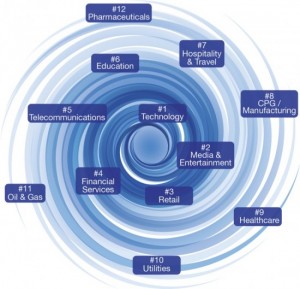
Last week while trapped in the confines of seat 22A, I re-read “Digital Vortex: How Digital Disruption Is Redefining Industries”. This paper is full of interesting insights on how digital technology is changing the competitive landscape for every industry. If you haven’t read it – grab a copy and keep it handy for for your next commute.
The paper reminded me that any industry can quickly shift in or out of the “digital center” of the vortex – a place where digital change can rapidly disrupt, or cause disruption for a company or an entire industry. It offers a key insight on digital transformation: To disrupt oneself in an industry, “organizations must change themselves – including operations, culture, revenue model, and more – in fundamental ways, and perpetually.” Many IT leaders feel the impact of this reality every day.
Trevor Moore, the CIO of Qatar University, is using IT as a platform to transform higher education as part of a country-wide initiative to transform Qatar into a knowledge-based economy. In a recent interview with Trevor, he explained, “Providing services to students and researchers anytime and anywhere is a key component of our ongoing growth.” Trevor’s story is a powerful reminder of how IT organizations around the globe are using technology to drive digital transformation. Organizations like Qatar University are not just seeing the impact of digital transformation in education… they are causing transformation, for their industry, and for their country. They’ve moved themselves to the center of the vortex.
Far beyond delivering “courseware” through a web browser, Qatar University must deliver application suites that give faculty and students the tools they need to learn, invent, and discover. Of course, Qatar also wants to deliver a customized and personal experience to every student. To deliver on this vision, students must be able to access material when and where it is most convenient for them.
Digital learning is a key part of the country’s vision of becoming a knowledge-based economy – and as Moore points out, IT is at the heart of it all. Qatar University chose Cisco’s Application Centric Infrastructure as the foundation for their new data center and digital strategy. Working closely with Cisco and F5 Networks, Qatar was able to build an automated data center that greatly simplified their operations and delivered on their vision of automatically and securely provisioning applications to students, faculty, and research staff.
Choosing a new or different way to deliver IT isn’t always the easy or popular choice – but when done right, the results deliver exceptional efficiencies. As early adopters of Cisco ACI, Moore and his IT team are leading the way, and reaping the benefits of an open, automated, application-centric approach to the data center. If you’d like to know more about how Qatar University used Cisco ACI and the ACI ecosystem to solve its challenges, the Qatar ACI case study will tell you more.
With the second International Trade Commission (ITC) trial regarding Arista’s use of Cisco’s proprietary networking technology patents almost complete, now is a good time to provide an update.
As you will recall, Cisco filed copyright and patent infringement cases against Arista last December in the District Court in Northern California. One case, focused on 12 technology patents, remains “stayed” while the ITC trials involving the same patents are ongoing. The other District Court case, regarding Arista’s literal copying of Cisco’s command line interface (CLI) and two related patents, is moving forward. None of the patents in these cases cover technology that has been adopted as a standard. And all the patents were invented by people who worked at Cisco and then went to Arista, or by Cisco employees whose managers went to Arista.
Arista makes no secret out of its willful, intentional and on going use of Cisco’s proprietary networking technology. That’s why this litigation is necessary. For instance, why does Arista use over 500+ of Cisco’s multi-word CLI commands, when competitors like Alcatel Lucent, Brocade, HP and Juniper have only a fraction of that overlap in their own products?
This case, before Judge Beth Labson Freeman, is slated for trial in August 2016. Recently Arista moved to delay the start of the trial to 2017. The Judge held a conference on that issue, and will rule after briefing the question.
Peter Memon, J.P. Morgan, presents during the general session.
The inaugural Data and Analytics Conference last month was, in my opinion, the best conference of the year. The brightest minds in the industry gathered for two days in Chicago to discuss the latest trends and new solutions for big data, the Internet of Things, cloud, analytics, digital transformation and data virtualization.
UC San Francisco (UCSF) and Cisco announced an initiative to jointly develop an interoperability platform for sharing health care information among multiple entities. The platform will be designed to enable health systems, providers and application vendors to share and integrate health data from multiple sources, making pertinent patient information accessible when and where it’s needed for care through a highly secure process.
https://www.youtube.com/watch?v=ipkG_KJVLj8
Cisco and IBM Watson announced a strategic partnership. Over many years of working together customers value the joint solutions the two companies provide. Dark data, inaccessible or unused data collected, is not being taken advantage of by companies today. This is the catalyst behind the partnership. This long-standing and deep partnership will explore the world of Watson and cognitive computing.










 e a remote bulldozer.