Flash has long been a favorite target among Exploit Kits (EK). In October 2014 the Angler EK was believed to be targeting a new Flash vulnerability. The bug that the Angler exploit kit was attempting to exploit had been “accidentally” patched by Adobe’s APSB14-22 update. According to F-Secure, the vulnerability that Angler was actually attempting to exploit was an entirely new bug, CVE-2014-8439. The bug was severe enough that Adobe fixed it out-of-band.
Fast forward to January 2015. With the emergence of this new Flash 0-day bug, we have more evidence that the Angler Exploit Kit developers are actively working on discovering fresh bugs in Flash for themselves. The group is incorporating these exploits into the Angler EK *before* the bugs are publicized. Considering these 0-day exploits are being used alongside one of Angler’s preferred methods of distribution, malvertising, thus intensifying the potential for large-scale compromise. Continue reading “Flash 0-day Exploited by Angler Exploit Kit”
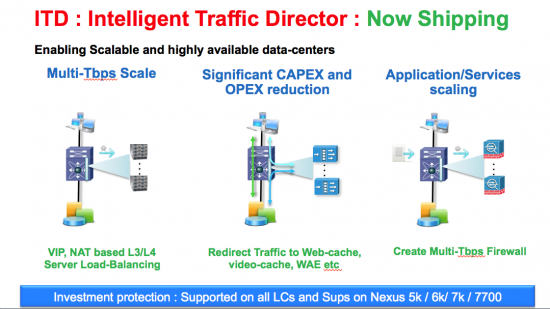
Cisco® Intelligent Traffic Director (ITD) is an intelligent and scalable, clustering and load-balancing engine that addresses the performance gap between multi-terabit switches and gigabit servers and appliances. The ITD architecture integrates Layer 2 and Layer 3 switching with Layer 4 to Layer 7 applications for scale and capacity expansion to serve high-bandwidth applications. ITD provides adaptive load balancing to distribute traffic to an application cluster.
It allows customers to deploy servers and appliances from any vendor with no network or topology changes. With a few simple configuration steps on a Cisco Nexus® 7000/7700 series switch, customers can create an appliance or server cluster and deploy multiple devices to scale service capacity with ease. The servers or appliances do not have to be directly connected to the Cisco Nexus switch. ITD started shipping in NX-OS 6.2(8) and has significant new features in 6.2(10).
Below are some of the reasons why customers used ITD:
Load-balance traffic to 256 servers of 10Gbps each.
Load-balance to cluster of Firewalls. ITD is much superior than PBR.
Scale up NG IPS and WAF by load-balancing to standalone devices.
Scale the WAAS / WAE solution.
Scale the VDS-TC (video-caching) solution.
Replace ECMP/Port-channel to avoid re-hashing. ITD is resilient.
This post was written by guest blogger Emma Reid, marketing manager for Cisco’s Social Innovation Group, Asia-Pacific region

Countries across the Asia Pacific region are facing a broad range of social challenges. Unemployment, widening gaps between rich and poor, urbanisation, insufficient access to quality healthcare and education, to name a few.
According to the International Data Corporation (IDC) study, The Evolution of the Networking Skills Gap in Asia/Pacific, there will be a shortage of more than 400,000 networking professionals across the region by 2016. This will represent a segment of the 2 million unfilled information and communications technology jobs globally within ten years.
Indonesia is one of the fastest-growing economies in our region and its technology skills gap is expected to increase beyond 99,000+ full-time networking professionals. Cisco recognizes this problem and provides training through its Cisco Networking Academy program to prepare students with the skills needed to support industries in our increasingly connected world. Over the past 15 years, we have trained 125,000+ students in Indonesia through 177 partnerships with higher educational institutions, vocational schools, public sector agencies, and nonprofits.
Recently, Cisco was honored in the Automation World 2014 First Team Honorees list. This award recognizes Cisco as a leader and trusted partner for manufacturing, distributing and industrial companies.
A Paved Path to IoE Value
We’ve heard a lot about the $14.9T value opportunity provided by the Internet of Everything (IoE) with $3.9T or 26% of the overall IoE value residing in manufacturing and industrial (Mining, Oil and Gas, …) industries. The challenge for the market is determining the best and most efficient path to capture that value.
The Automation World 2014 First Team Honoree award validates that the industry is embracing Cisco’s holistic approach of providing tightly integrated system architectures and solutions like Cisco Connected Factory – Automation and Cisco Connected Factory – Wireless as a best practice path to IoE value.
In fact, these solutions are being deployed by leading manufacturers like Proctor and Gamble, GM,Stanley Black and Decker,Sub Zero, and Shell. These forward thinking companies are tightly integrating their entire business value chain from R&D, operations, and supply chain through to customer retention and acquisition sales, and driving the business outcomes that give them a competitive advantage in the market.

Its Not About Products or Solutions … It’s About the OUTCOMES!
This award is not about the ‘speeds and feeds’ on how the Cisco Aironet 1550 Series Outdoor Access Points enables a self-healing, and self-optimizing wireless network that mitigates the impact of wireless interference or how the Cisco Industrial Ethernet IE2000, IE3000 and IE400 Series Switches extends the proven Cisco Catalyst technologies prevalent in enterprise networks to industrial networks for ease of use and best in class performance.
…Stanley Black and Decker to maximize their plant productivity and operational efficiency.
“With the help of the Cisco and AeroScout Industrial solution, we are on our way toward realizing our vision of a virtual warehouse and fully connected factory, with complete visibility and traceability.” –Gary Frederick, CIO Industrial Division, Stanley
…Sub Zero to meet their new product introduction goals and reduce manufacturing downtime.
“With this solution, we found a way to see and discuss very detailed video and images from afar in a highly secure manner. We are now using video collaboration on a daily basis to finalize designs, correct production line issues, work with suppliers, and train installers and servicers.” – Paul Sikir, VP of Engineering, Sub-Zero
My colleagues Bryan Tantzen, Sr. Director -IoE Manufacturing and Todd Edmunds, IoE Architect demonstrate the possibilities of Connected Factory
http://youtu.be/XokYZPKrLxc
Cisco Connected Factory is the foundational building block for these transformative business processes that leads to greater innovation and efficiencies throughout the business value chain. We thank our customers, partners and Automation World for partnering with us as we pave the way to IoE value nirvana!
If you are a fan of TechWise TV, like I am, then you are always curious as to what Jimmy Ray and Robb are going to delve into next. In the latest Techwise TV episode focused on Cisco Meraki cloud-managed IT, the TechWise guys have amassed a band of technical and cloud-managed experts to discuss what cloud-managed IT is really all about.
The TechWise TV guys will look at the Cisco Meraki solution to see if simplicity means reduced functionality, or if you need to sacrifice security to have a more agile solution. They will also discuss how data is handled, what it means from a business protection perspective, along with a lot of other top of mind questions.
Moving to cloud offers many benefits to organizations. However, these benefits come with a corresponding range of new challenges for IT to address. One of these challenges is what is known as “Shadow IT.” Shadow IT refers to activities of members within an organization to secure their own IT resources without going through a company’s IT department.
There are many compelling reasons why organizations consider Shadow IT an important issue:
Security: IT resources outside the management of a company’s IT department are also outside of their control and policy management. Many cloud providers offer only marginal security with their baseline service; to get better security requires an upsell and higher cost. This means that sensitive company data and digital assets may be exposed without a company’s knowledge. As a result, a company may be at risk in many ways, either through potential loss of customer data or failure to comply with industry standards and requirements.
Cost: When cloud services are purchased individually, they cost more. A large organization can consolidate cloud resources needs across all of its departments to achieve volume-pricing discounts.
Efficiency: A group that purchases its own cloud resources may underutilize them. When clouds resources are managed by IT, unutilized resources can be shared with other departments. Such a strategy increases the efficient usage of cloud resources. In addition, fewer resources are required across the company, resulting in lower cost as well.
Unified Management: When cloud resources can be centrally managed, their management can be consistent and unified across the company. This enables IT to ensure that cloud resources are properly protected as well as simplifies tracking allocation and usage of resources.
There is a high value in eliminating Shadow IT. However, it is clear that relying upon policies that prohibit Shadow IT activities is not enough to solve the problem. In the blog, “Overcome Your Shadow IT Struggles”, cloud provider Presidio discusses the reasons why Shadow IT exists. The blog also describes how you can provide compelling reasons for members of your organization to go through IT and use internal resources.
Another important facet of eliminating Shadow IT is selecting the right cloud services and provider. It does little good to consolidate cloud access if the services IT brokers to the organization don’t provide enterprise-class security, performance, and flexibility as a baseline.
Learn more about how Hybrid Cloud and Cisco Powered cloud and managed services can transform your business.
In 2014, Cisco joined the Coordinated Malware Eradication (CME) coalition, where multiple companies cooperate to stop the growing malware threat that all customers are experiencing. In one case, Cisco researched and published malware and activity that was using a remote access tool (RAT) called ZxShell (also known as Sensocode).
The Cisco team did the ZxShell technical analysis because Novetta, Inc., who is also part of the CME, began researching a new threat in September 2014, and reached out to other member companies to help. Novetta asked Cisco to analyze the ZxShell malware only, understand its technical nature and capability only, and publish our results – our technical results are published in the second blog post above. This was Novetta’s only request. Novetta referenced our technical results, but they did not ask, nor did we participate, cooperate, or contribute in the researching, identifying, or naming of who developed the malware or deployed the malware.
We are disappointed that the appearance of Cisco’s logo on the cover of the Novetta report may suggest that Cisco endorses all of the report conclusions, including conclusions that China was behind the activity described in the report. We only endorse our findings about the technical attributes of ZxShell; the rest of Novetta’s report is unrelated to Cisco and the conclusions are their own.
We focus on protecting our customers through technical analysis of the attacks, and creating protections against them.
Cyber-attacks are global and the attacks must be stopped. Our fundamental security objective is to protect all customers, be transparent, and be their trusted partner. We hope this clears up any misconceptions.
Previous blogs in this series, both by Splunk and Cisco, detail how Cisco Identity Services Engine (ISE) can be used to drive enhanced event visibility in Splunk.
Splunk is a machine data platform that allows you to search, report, alert, and visualize any data that it ingests. Cisco ISE brings an added dimension to analyzing all this data; it attaches key contextual data (for example, username, location, network policy status) to events and data analyzed by Splunk. The Splunk for ISE app, a free download from Splunk, comes with a number of built-in dashboards to correlate this machine data with user information and create customizable dashboards and reports.
One customer can be multiple shoppers, and retailers need real-time insight into every shopping journey. Be sure to take a look at Cisco VP Joseph Bradley’s new blog as he shares three retail Internet of Everything attributes that deliver hyper-relevance and build a dynamic infrastructure: http://cs.co/9003xAm3