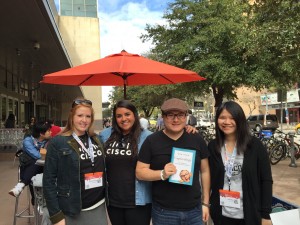
The Cisco social media marketing team was on the ground in Austin for the SXSW Interactive Conference and the second ever #CiscoChat. The team engaged with participants onsite and over social media, teeing up an announcement around our new collaboration service–Cisco Spark–by asking participants how they collaborate with coworkers on the go.
We also had several influencers join us onsite, including former Mashable co-editor and CAPTIOLOGY author Ben Parr. Always keeping a finger on the pulse of new platforms and trends, Ben answered questions with us live and streamed the event on Meerkat to nearly 100 attendees.
Cisco’s Security Solutions (CSS) consists of information security experts with a unique blend of law enforcement, enterprise security and technology security backgrounds. The team works directly with Cisco’s Talos Security Intelligence & Research Group to identify known and unknown threats, quantify and prioritize risk, and minimize future risk.
When consumers make purchases from a retailer, the transaction is processed through Point-of-Sale (PoS) systems. When a credit or debit card is used, a PoS system is used to read the information stored on the magnetic stripe on the back of the credit card. Once this information gets stolen from a merchant, it can be encoded into a magnetic stripe and used with a new card. Criminal markets exist for this valuable information because the attackers are able to easily monetize stolen credit card data. Incidents involving PoS malware have been on the rise, affecting many large organizations as well as small mom-and-pop establishments and garnering a lot of media attention. The presence of large amounts of financial and personal information ensures that these companies and their retail PoS systems will remain attractive targets.
Overview
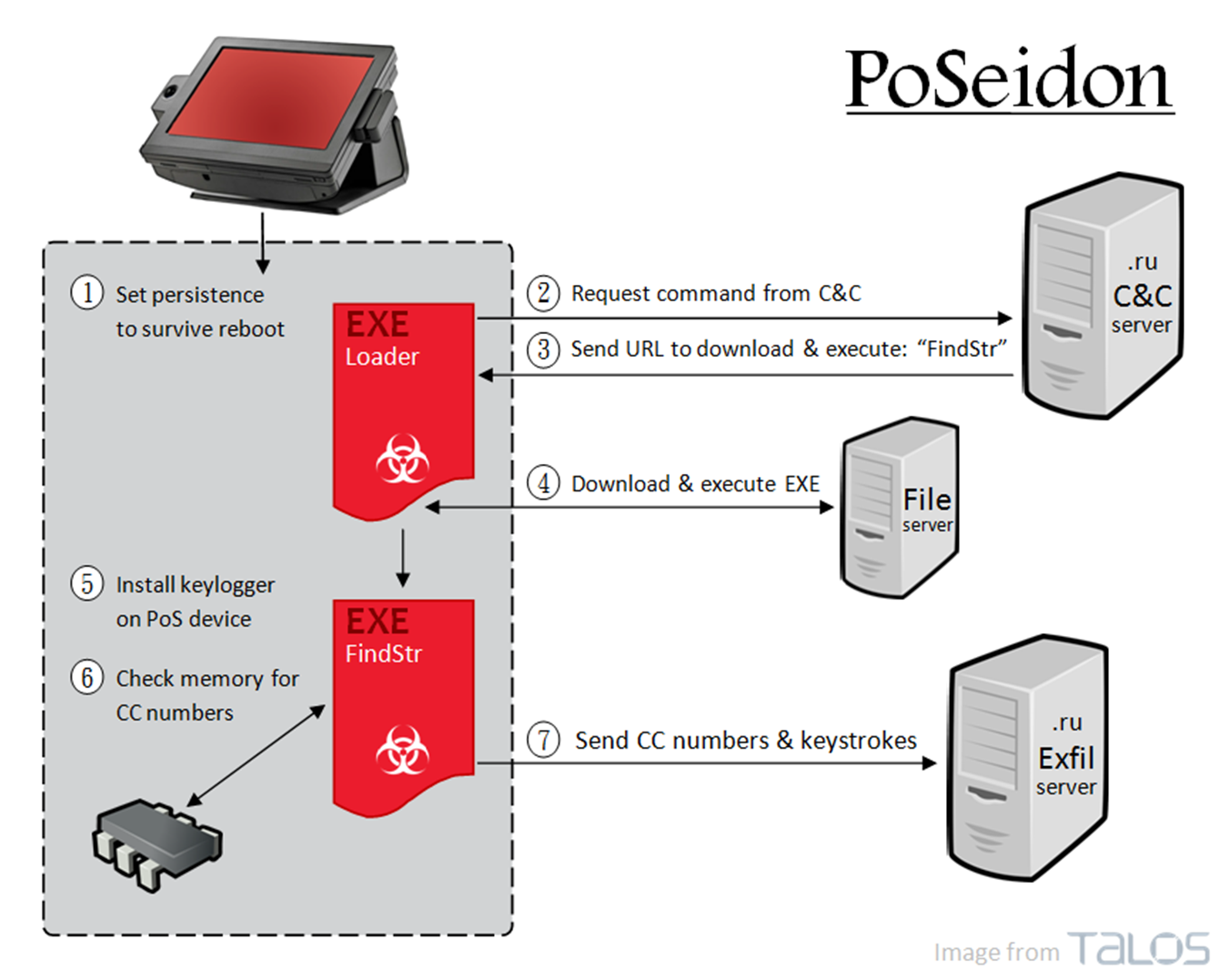
There is a new malware family targeting PoS systems, infecting machines to scrape memory for credit card information and exfiltrate that data to servers, also primarily .ru TLD, for harvesting and likely resale. This new malware family, that we’ve nicknamed PoSeidon, has a few components to it, as illustrated by the diagram below:
At a high level, it starts with a Loader binary that upon being executed will first try to maintain persistence on the target machine in order to survive a possible system reboot. The Loader then contacts a command and control server, retrieving a URL which contains another binary to download and execute. The downloaded binary, FindStr, installs a keylogger and scans the memory of the PoS device for number sequences that could be credit card numbers. Upon verifying that the numbers are in fact credit card numbers, keystrokes and credit card numbers are encoded and sent to an exfiltration server.
Our world is rapidly connecting people, process, data, and things in ways that were unimaginable just a few years ago. The Internet of Everything (IoE) is at the heart of this transformation.
The debate about whether businesses need hybrid clouds is over. Technology executives see value in public clouds because they offer speed, economics, and scale that are very hard to achieve in a private cloud environment. On the other hand, private clouds offer control, data sovereignty, and security. Businesses need both, which means they need hybrid clouds. The question is; how can they successfully build them?
What makes a true hybrid cloud?
Hybrid clouds are like the Internet. When users connect a device, whether it’s a handheld or a laptop, or another machine, they don’t think twice about how these things are going to talk to each other. Similar to that, hybrid clouds are an “Intercloud” of clouds. That means that regardless of whether it’s a combination of a private cloud, a public cloud, or an extended set of clouds, the environments all work seamlessly together. They have consistent security and networking, and applications and workloads can be moved freely from cloud to cloud. Continue reading “Building a Successful Hybrid Cloud That Delivers Flexibility, Choice and Control”
You might recognize Stu Miniman as the host of theCube. Others know him as a Senior Analyst at Wikibon. But the tables turned in the 24th episode of OSPod!
In this episode, get the inside skinny on:
Stu’s roots in tech, including sales, engineering, product management, and strategy
OpenStack reality versus hype per the latest Wikibon survey data
Startup culture versus enterprise culture, and the need to innovate around old processes
How Docker really is changing everything
Career transformation and staying relevant as companies head for the cloud
https://www.youtube.com/watch?v=76XCnX8mH9w
For a full transcript of the interview, click read more below.
Guest blog by Greg Nehib, SP Product and Solutions Marketing
How important are physical routers in the move toward virtualization?
My one word response would be “very”. But the longer version would start with “it depends”.
Here’s the longer version:
It depends on your perspective. I remember when the Cisco 12000 Series GSR was introduced in the late 90’s. It started an arms race that would last for over a decade. The popular comparison at the time was all about who had the biggest router, or “speeds and feeds” as we used to describe them. 2015 offers us a very different networking discussion. People that design and operate networks are more interested in programmability and virtualization (a.k.a. SDN (Software Defined Networks) and NFV(Network Functions Virtualization). From Frederic Trate’s blog on Application Engineered Routing, you can see why this level of control is such an interesting and important place to start the discussion.
I would argue that in terms of talking points, “speeds and feeds” have taken a back seat in network design. After all, a bunch of static ports and traffic-engineered tunnels don’t lead us to the flexibility and scale that we all seek – or can they? Here are some instances where physical routers are still Continue reading “How Important are Physical Routers in the move toward Virtualization?”
For those following trends in the software industry, Continuous Delivery (CD) has been all the rage. What is it? Simply put – continuous delivery is the ability of a SaaS application to push new software into production multiple times per day. Typically, only the cloud software components are updated at this rate. Client code – either browser code or mobile applications – are updated at a pace between once a week and once a month.
As a software development team, continuous delivery is very exciting. But as the IT person that is the ultimate customer of SaaS applications, do you care about continuous delivery? The answer is -absolutely.
Rowan Trollope recently blogged about the importance of moving fast and innovating quickly. That is the essence of fast IT, and continuous delivery is the key to unlocking fast IT. This is because continuous delivery delivers three essential ingredients that make fast IT possible.
First, continuous delivery means better quality. A SaaS application with continuous delivery will be able to measure and improve upon the performance, reliability and speed of the application in the hands of your own users. Every day you will see it get a little bit better. With continuous delivery, quality isn’t just about defect counts. With continuous delivery, Continue reading “Continuous Delivery – realizing fast IT”
South Island School in Hong Kong is made up of students from around the world, with 1,400 students from over 35 countries. One value that sets the school apart is its commitment to using technology in the classroom. For instance, every student has a laptop that they use to access e-books, watch educational videos, and complete homework assignments. Some exams are even taken digitally.
With wireless devices used daily by every student and faculty member, a stable network connection is almost as important as pencil and paper in classrooms. South Island School’s existing Cisco network had reached end of life, and the school needed to refresh the infrastructure with a network that could meet bandwidth needs for years to come.
“We looked at other vendors, but we were extremely impressed with how the existing Cisco equipment performed over the years,” says Victor Alamo, ICT manager at South Island Schools. “By upgrading to the latest Cisco access points and switches, we’d have an infrastructure that would keep up with our needs.” Continue reading “Converged Access Improves Wireless Performance at South Island School, Hong Kong”
Exciting times! Cisco Live Melbourne 2015 started on the 17th with four packed days of technology updates and new solution launches. This year we are expecting a phenomenal crowd of more than 5700 attendees. Cloud, virtualization and SDN(Software Defined Networks)/NFV(Network Function Virtualization) are a big agenda for all our customers and you will find the latest here at Cisco Live with up to 16 concurrent sessions to choose throughout the day. Try your hands on one of many Self-paced Labs or show off your prowess at DevNet.
And then, there is the World of Solutions @ Cisco Live. This year, the World of Solutions will have a wonderful village-like atmosphere complete with bus stands, trees and clouds amongst the Meet the Experts and CCIE corners. At Cisco, we believe that the future is about Connecting the Continue reading “Cisco Live Melbourne 2015”











 Guest blog by Greg Nehib, SP Product and Solutions Marketing

 of students from around the world, with 1,400 students from over 35 countries. One value that sets the school apart is its commitment to using technology in the classroom. For instance, every student has a laptop that they use to access e-books, watch educational videos, and complete homework assignments. Some exams are even taken digitally.