This blog was guest written by Renaldo Rheeder, director of professional and vocational development at the American University of Nigeria
Nigeria has the highest number of children out of school, according to A World at School. Of the 57 million youngsters worldwide who are not receiving a formal education, more than 10 million live in Nigeria. The majority of non-attendees are girls, mainly in the majority-Muslim north. Of those fortunate enough to enroll, less than two-thirds complete primary school and even fewer girls finish secondary school.
Despite these challenges, approximately 150 girls have successfully completed Cisco Networking Academy courses at the American University of Nigeria (AUN). According to their instructors, the girls’ performance in the courses was on par with the male students – ample proof supporting our already firm belief that networking is not a gender-specific field.
AUN was established in 2004 with the mission of becoming Africa’s premier development university. In teaching, research, and community service, AUN addresses our community and region’s most pressing challenges: poverty, economic barriers to growth, lack of education, gender discrimination, lack of opportunities for disabled youth, environmental degradation, violence, and problematic governance. We are an agent of peace and development through myriad programs.
Students in the Cisco CCNA Routing & Switching course work in the practical lab at American University of Nigeria (AUN). Photo courtesy AUN.
A lot of air time (pun intended) has been provided for the PHYsical layer amendments to the 802.11 standard. These would include 802.11n, 802.11ac, 802.11ad, and others. These amendments tend to get a lot of publicity because they have increased the speed/throughput of 802.11 over the years (from 1-2 Mbps in 1997 for the original 802.11 spec to “gigabit” in 2013 with the 11ac and 11ad amendments).
But what about those amendments that simply aren’t as “sexy” and provide only MAC layer enhancements? Aren’t these important too?
The answer is YES and in this short series of blogs, we’ll spend some time looking at the lesser known but undeservedly underappreciated amendments to 802.11, especially 802.11k, 802.11r, and 802.11v and the features/benefits they provide.
This first blog will explain the basics of 802.11k “WLAN Radio Measurements” and will specifically zoom in on the Neighbor Request/Report.
Wireless LAN Radio Measurements (802.11k)
Wireless Local Area Network (WLAN) Radio Measurements can enable any device, AP or client, with the capability to better understand the environment in which it is operating. A variety of requests can be generated for which the device receiving a request can respond with a report.
As one example, an AP could ask a client “how well are you hearing me?” using a Link Measurement request. The client would respond with a Link Measurement report (conversely, a client could ask an AP “how well are you hearing me?”).
Since the ability to measure and collect information is provided, a device submitting a request can make a better informed decision as to its “next steps” in adapting to/compensating for the dynamics of the WLAN environment.
Information obtained from a measurement and/or report can be made available to upper layers of the measuring and/or requesting device where it may be used for a range of applications. Such applications may be engaged in attempting to preserve the QoE (Quality of Experience) for the end user.
As one example, in order to preserve the QoE for applications such as VoIP and video streaming, WLAN Radio Measurements may be used by client device to collect information from the AP prior to that client device disassociating from one AP and reassociating to a new AP. This can dramatically speed up reconnecting from one AP to another AP in the same WLAN.
Guest Blog by, Paul Bosco, vice president, market development, Cisco Service Provider business
At NAB this week, Cisco is showcasing to media and entertainment companies its certification of independent software vendors (ISV) focused on media-centric applications.
A few weeks ago, I posted a blog about the increased volume of encoder solution bakeoffs, inside the global service provider community. Today, I am happy to share another success story: MLBAM – Major League Baseball’s technology company. MLBAM is using our AnyRes Live encoders for adaptive bit rate (ABR) streaming to help support more than 350 individual, live channels of H.264-compressed video, to multiple content delivery networks (CDNs)– and not just from the 30 MLB ballparks.
In the past, enterprise architecture was designed to be silos – Data, Voice, Clinical and many more. Demarcation, Control and Ownership was given special emphasis. IT departments ruled and decided what, when, how systems were procured, installed and operated.
As market transitions happened and new consumption models became available, the line of business started procuring cloud based services to keep up with their demands outside of the IT’s enterprise systems. While this accelerated innovation and efficiencies, with applications everywhere, challenges grew alongside.
As health care providers adopt more cloud and software-as-a-service (SaaS) services, their application environment has become extraordinarily complex. With billions of new cloud, mobile, and Internet of Things (IoT) connections coming over the next few years, things will get even more complicated. IT is facing high operational costs and inefficiencies as they struggle to simply and manages all of these diverse applications, systems, data, and things, many of which no longer even reside within the enterprise. They look for new ways to capitalize on existing resources and data, augment other services outside of the enterprise and deliver new customer experiences to stay ahead.
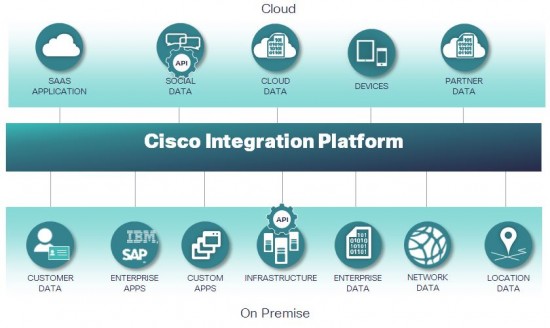
To keep up with the needs of our customers to enjoy seamless services from anywhere, the Cisco Integration Platform helps to connects all of your diverse on-premise, cloud, and SaaS applications across the enterprise, and makes it easy to securely exchange data and services between them. And it does it in an automated fashion, reusing application integrations and APIs to radically accelerate the delivery of patient experiences.
Cisco is connecting infrastructure with data, applications, and devices to enrich the collaboration and sharing of data between patients, physicians, and providers. Market leading infrastructure solutions can now be integrated into back office clinical applications, and utilized in new ways. Integration is playing a key role in creating a connected healthcare experience. This is leading to more personalized care, self-service, and extending the value a health system can provide outside the four walls of the physical facility. Please visit the Cisco HIMSS booth (#2002) to see the Cisco Integration Platform and many other solutions in action.
It’s my privilege to join Kristen Wilson-Jones, CTO, Sutter Health RD&D and David Chao, Director of Industry Solutions at Mulesoft in a panel discussion at the Mulesoft event at HIMSS 2015 (Time: on April 14th at 5.00pm, RSVP Link: http://himss15reception.splashthat.com). We will talk further about how Internet of Everything will shape up Healthcare delivery and experiences. On behalf of the entire team, I want to invite you to join the conversation.
Cisco Cloud Services is proud to announce the 0.2 release of microservices-infrastructure, a modern platform for rapidly deploying globally distributed services based on Mesos, Marathon, and Consul.
Few have been involved in OpenStack as long as Monty Taylor, who’s OpenStack path began at Rackspace and continues today at HP where he is a Distinguished Technologist. Watch or download this OSPod episode to hear Monty’s thoughts about:
His love for Duke and his background in theater
Nebula shutting their doors, and what it means for OpenStack
Why AWS isn’t a fit for everyone or everything
Project Shade and varying behaviors behind APIs
The chicken and the egg problem running OpenStack as a public cloud provider
Containers and Project Magnum
OpenStack and the “sophomore slump”
The importance of focusing on stability in OpenStack
https://www.youtube.com/watch?v=ihRDs9FxmCs
You can follow Monty on Twitter at @e_monty and on IRC at mordred. Have a show idea? Tweet Jeff and Niki at @openstackpod
See past episodes, subscribe, or view the upcoming schedule on the OSPod website.
For a full transcript of the interview, click read more below.
Catalyst 4500E Supervisor 8-E now supports Converged Access with the IOS XE 3.7 release. The Supervisor 8-E is the latest generation high performance supervisor for Catalyst4500E and provides cutting edge features such as Service Discovery Gateway and support for SDN Openflow in addition to Converged Access and industry leading scale and performance. Miercom recently tested the performance of Supervisor 8-E and the report can be downloaded here. Since its launch, the Supervisor 8-E has become the highest selling supervisor in modular access and has been deployed by a large portion of the Catalyst 4500 install base.
The integrated wireless functionality for Converged Access on Supervisor 8-E is implemented through the same Unified Access Data Plane (UADP) ASIC as in the Catalyst 3850, so Catalyst 4500E customers who deploy Converged Access get the same field tested solution that has been deployed by thousands of Catalyst 3850 customers. Additionally, the Converged Access solution on Supervisor 8-E provides high availability (Access Point Stateful Switchover) and investment protection for wireless, which are the hallmark of the Catalyst 4500 platform. Continue reading “Converged Access now available on Catalyst 4500E!”
I caught up with Franco Castaldini, VP, Marketing at Bit Stew Systems to talk about Bit Stew and Cisco and wanted to know about where Bit Stew are going with product offerings, industry solutions, and customer engagements. This is what he told me:
Franco Castaldini, VP, Marketing at Bit Stew Systems
“It’s an exciting time for Bit Stew Systems as we extend our heritage in utilities into new markets such as the oil and gas industry. This week, the Bit Stew team is showcasing our MIx Solutions at the Entelec Spring Conference & Expo in Houston, Texas.
Bit Stew’s transformative MIx Core™ platform manages real-time industrial data at scale, automating the ingestion process, and utilizing machine intelligence both centrally and at the edge. Our MIx Director™ application (formerly Grid Director), harnesses the power of MIx Core, by building operator workbenches to provide industry-specific data models, search, reports, dashboards and so much more. MIx Director continues to serve as a container to plug-in MIx Apps™, which offers pre-built analytics, data adapters and visualizations that solve specific use cases that improve asset and operational performance.
Bit Stew majoring in Fog Computing with Cisco’s IOx Platform
With Cisco’s IOx® technology, Cisco’s field-based hardware devices such as the Cisco Connected Grid Router (CGR) and Integrated Services Router (ISR) bring a whole new level of capabilities to market. These devices are capable of hosting a guest operating platform where companies like Bit Stew can run our own applications like never before. Bit Stew is a member of the Cisco ‘Solutions Partner’ program.
Collaboration goes Beyond ‘Big Data’ and Drives Value
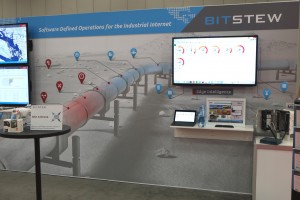
Bit Stew at Entelec
Bit Stew’s MIx Core takes full advantage of Cisco’s IOx technology, by embedding its core technology inside these Cisco fog devices, providing data analysis at the edge of the network and in cloud-based systems – all in real-time. Running MIx Core in the “fog” brings a significant new advantage for organizations that are dealing with massive amounts of data running on complex networks in the Industrial Internet of Things (IIoT). This end-to-end visibility enables industrial companies to gain actionable insights from the network in order to manage risks, improve asset performance and increase uptime.
A Proven Track Record of Success
Together, Bit Stew and Cisco have worked collaboratively to bring fog technology to life at major utilities such as BC Hydro, a Canadian electric utility in the province of British Columbia, which first deployed smart meters in 2011. The successful and proven track record we have had together with utilities is now resonating with the upstream and midstream oil and gas markets. The response the Bit Stew and Cisco teams saw at Entelec this week has been exciting and we will have more to announce in the weeks ahead.
Take time to learn more about Bit Stew at www.bitstew.com and read our new blog the Bit View for more insights and commentary on the IIoT.”
About Franco Castaldini Franco Castaldini is an experienced marketing, sales and product management executive who has led go-to-market strategies for innovative startups to large global companies. Franco leads Bit Stew’s product marketing and management, marketing communications, and global go-to-market strategy for the company’s growth in the Industrial Internet market.


 This blog was guest written by Renaldo Rheeder, director of professional and vocational development at the American University of Nigeria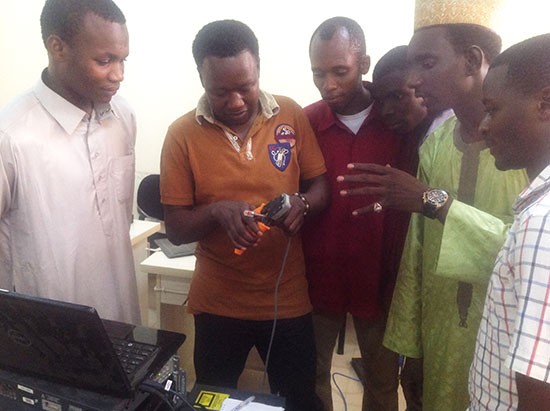


 Guest Blog by, Paul Bosco, vice president, market development, Cisco Service Provider business


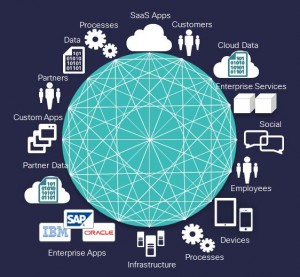 As health care providers adopt more cloud and software-as-a-service (SaaS) services, their application environment has become extraordinarily complex. With billions of new cloud, mobile, and Internet of Things (IoT) connections coming over the next few years, things will get even more complicated. IT is facing high operational costs and inefficiencies as they struggle to simply and manages all of these diverse applications, systems, data, and things, many of which no longer even reside within the enterprise. They look for new ways to capitalize on existing resources and data, augment other services outside of the enterprise and deliver new customer experiences to stay ahead.