

One of the great scientific challenges of our time is the construction of a practical quantum computer. Operating using the counterintuitive principles of quantum physics, such a device could rapidly explore an vast number of possible states. It could perform computational tasks that are far beyond our current capabilities, such as modeling molecules and designing new types of drugs—and breaking most of the cryptographic systems that are currently in use. Fortunately, no one has yet built a practical quantum computer, though many countries and companies are striving do just that. It has been claimed that the U.S. National Security Agency has a secret US$80M project with that aim, for example. Quantum computing is still an unproven technology, and it may not be practical for decades, but since it poses an existential threat to cryptography, we need to start preparing now for the possibility that one day the news will announce a breakthrough in quantum computing, and we will be living in a post-quantum world.

Authors

Why do you login to your various social media accounts? Is it to be entertained by videos and images? Catch up on the latest news in your industry? Engage with colleagues? My hunch says you do all of the above.
Nobody has time to sift through every piece of content on social media though. We quickly scroll through our feeds, bypassing updates that do not grab our attention. So how do we as social marketers create content that is not ignored? Here are some absolute musts for creating engaging B2B social content.
The content must be a balance between entertainment and education
Let’s look at marketing content as a spectrum. On the left we have lengthy and boring technical data sheets and white papers. On the right, we have funny videos, memes, and other amusing pieces. While we all need to push the left content to our audiences, we need to incorporate aspects from the content on the right to grab our audience’s attention. The middle of the spectrum is where we as B2B social marketers need to be.
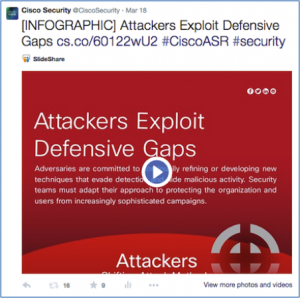
Gary Vaynerchuck writes in his book Jab, Jab, Jab, Right Hook, “If we want to talk to people while they consume their entertainment, we have to actually be their entertainment.” But not only is our B2B audience looking for entertainment, they are also seeking information and new insights so they can be ahead in their industry. Some examples of good content for this include infographics, informational short videos, and visual SlideShare decks of key highlights. We must strike a balance between informative and entertaining content, such as the examples below.

Authors


On April 13, 2015, Cisco kicked off day one of the annual HIMSS healthcare conference by hosting a media panel to discuss a range of healthcare technology topics impacting the U.S. as well as around the world including the Internet of Everything (IoE), telehealth, and the use of virtual pediatric networks (VPN).
Members of the media heard from leaders in the healthcare industry about how they are utilizing the latest technologies to provide enhanced healthcare to patients, the meaningful impact on patient-doctor interactions as well as the broader social impact on the community as a whole.
One such example discussed at HIMSS was the results of a program piloted by Cisco; the Federal University of Sergipe, Brazil; and other key partners in Sergipe to bring care via telehealth technology to underserved children who may not have convenient access to physicians given they’re located in such a remote north-east region of Brazil.
On April 13, Cisco released a report called Connecting Brazil’s Children to a Healthier Future, which includes results based on a survey conducted by Cisco. The results indicated that telehealth helps enhance the quality of care to patients, and also reduces travel time it takes to visit a medical specialist. So rather than traveling to a bigger city in Brazil to see a specialist, patients and their families can remain in Sergipe but meet with a specialist over video. Some of the key findings from the pilot illustrate how the technology is having a powerful impact on the patient care. For example, 93% of patients surveyed and who participated in virtual consultations found them effective and were satisfied with their experience.
The pilot, which is slated to go into full production later this month, utilizes Cisco collaboration technology, for example, to help with virtual patient-to-physician consultations. This connectivity allows for the patients located in Sergipe to receive consultations from medical experts residing outside the region – a method that allows patients to tap into a wider pool of medical expertise.
Additional supporting resources:
Connected Healthy Children – Brazil Video (English)
Connected Healthy Children – Brazil Video (Portuguese translation)
Connected Healthy Children – Brazil Video (Spanish translation)
Connected Healthy Children Program
Brazil Starts Pediatric Care Through Telemedicine in Sergipe
Virtual Pediatric Networks Connect Doctors with Doctors
As healthcare challenges are being addressed around the world, many healthcare challenges are actively being addressed inside the U.S. During the HIMSS event, media heard from CHOC (Children’s Hospital of Orange County) about the implementation of a virtual pediatric network.
This virtual pediatric network utilizes Cisco technology and creates a hub to connect leading pediatric oncologists from CHOC Children’s and five other leading hospital locations with one another to collaborate on how to treat children and teens with rare forms of cancer. The VPN consortium aspires to link to 200 cancer centers of excellence globally including 8,000 physicians through the Children’s Oncology Group (COG) http://www.childrensoncologygroup.org.
For more on how CHOC Children’s is utilizing the virtual pediatric network, watch the video here: https://www.youtube.com/watch?v=97LPNwSwXcg&feature=youtu.be
These are just couple of examples where we see the true impact of technology on the healthcare industry. Over the next few years, we are going to see increasing adoption of these types of technologies, which ultimately is going to result in improved quality of patient care. To say the least, we live in very exciting times and we are just at the tip of the iceberg!
Authors

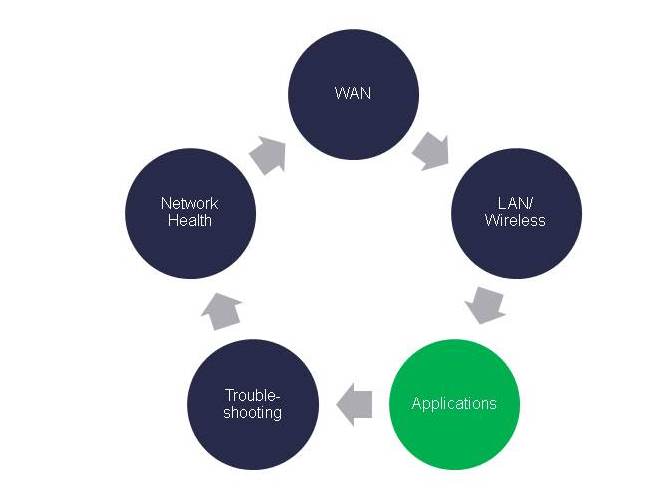
Last week, I discussed with you how to set up and managed converged wired and wireless access with Cisco Prime Infrastructure. Here, as the 3rd post of our 5-part blog series, I’ll focus on how to ensure application performance for your branch site users with Prime. Again, here’s my blog series plan on how to set up networking with Prime for a new branch site.
| WAN deployment – blog 1 Converged wired and wireless – blog 2 Application performance – blog 3 (This blog) Troubleshooting – blog 4 Network health – blog 5 |
 |
Your new branch network is up and running as planned. Everything for your WAN, wired and wireless access is working beautifully. But how is your business application performance? At the end of the day, it’s all about the applications and user experience.
Continue reading “Bringing Up a New Branch Site the Easy Way with Prime Infrastructure – Part 3”
Authors

On the way to tradeshow week (May 4th), I decided to do a brief blog series on UCS Mini tied to these shows. Last week was Microsoft Ignite.
This week SAPPHIRE NOW and ASUG Annual Conference in Orlando and the discussion of UCS Mini for SAP and SAP HANA.
Authors

Cyber-Security: it has always been important for video entertainment companies. But times have changed- now it’s mission critical. Top of mind again this last few days, the events of the last 6 months have proven this point. If cyber-protection is not bullet-proof, any video entertainment company is living on borrowed time… and that bill is going to come due with potentially disastrous consequences.
There is a second change going on: security at video entertainment companies used to focus on protecting content in the distribution chain – DRM, CAS and the like. But there are many more ways to lose content – many more places in the “connected” production chain where content can be stolen. For instance, as has happened in the last few months, if an attacker can gain access to Continue reading “NAB 2015 Attendees: Is Your Security Model Threat-Centric?”
Authors

Hello and welcome to Part One of my new blog series discussing cyber intelligence and security around the critical infrastructure sectors in the U.S. Cyber-attacks are becoming increasingly prevalent and threatening to utilities, refineries, military defense systems, water treatment plants and other sectors of our critical infrastructure. Part One of this series details the dangers of cyber-attacks by state and non-state actors and how cyber intelligence can help organizations combat future cyber-attacks. Part Two will detail the role of data in cyber security and ways cyber intelligence can be gathered to further prevent attacks.
The New State of Cyber-Attacks
As technology advances so will the amount of cyber-attacks. Many companies play a vital role in their nation’s critical infrastructure and these companies are adopting digital systems to replace older, analog controls. This digitization of technology is helping operators obtain remote visibility and control over operations, including processes in refineries, the generation and transmission of power in the electrical grid, and the temperatures in nuclear cooling towers. In doing so, industrial facilities have become more efficient and productive.
However, the same digital hyper-connectivity that facility managers use to collect data and control machines and processes, also can serve as entry points for cyber attackers to get into system networks and steal or alter classified information, disrupt processes and cause damage to equipment. Many early control system breaches were random or accidental infections, but we’ve now entered a stage where kinetic attacks are becoming more prevalent, with industrial control systems becoming the object of targeted attacks.
Threats to a company’s information systems and assets could come from anywhere. State and non-state actors from around the globe are almost certainly targeting and possibly even penetrating the networks of energy providers and other critical infrastructures in the U.S. Effectively cyber criminals have loose alignment (affiliation) with state actors and now these criminals are beginning to use different methodologies, creating a huge challenge. Traditionally, we see malicious actions like zero-day attacks, Denial of Service attacks, (DoS) i.e. vulnerability attacks, bandwidth or connection flooding, stopping or delaying workflows and SQL Injections that help hackers exploit or steal data from organizations.
Continue reading “Combating Cyber-Attacks Through Cyber Intelligence & Security: Part One”
Authors
 Guest Blog by – Peter Chave, Technical Engineering Leader, Cisco Video Software and Solutions
For as long as there’s been cause for broadcast video engineers to get together to talk shop, there’s been that big blob in the middle of the topological diagram — the frame-accurate crosspoint router, based on the coaxial workhorse that is the SDI (Serial Digital Interface.)
And at this week’s National Association of Broadcasters, in Las Vegas, broadcast video technologists will again assess the fate of SDI-based technologies, along the prism that is the inevitable and worldwide shift to their Internet Protocol (IP)-based successors.
The quest for an IP-based video switch — built from the off-the-shelf hardware that rides the cost curves happening in data centers Continue reading “See Cisco’s Proof Of Concept, IP-based Video Switch at NAB”
Authors

Did you know these corporate travel facts?
- On average, companies spent more than 10% of their total annual budget on expenses related to business travel in 2014, according to Aberdeen.
- Non-compliance with corporate travel policies is a top-three challenge for 57% of executives surveyed by Travelport.
- Nearly 85% of respondents to the Travelport survey say rising airfares and hotel rates have negatively affected their corporate travel programs.
One of my favorite things in life is to travel and to explore new places. It’s inspiring and gives me perspective on different regions and lifestyles. That said, business travel can be a far cry from leisure travel.
It’s great to meet customers and partners, and I enjoy dinners with colleagues on the road. But when I travel, my work week gets jumbled by the diversion from my routine. Time changes, the lack of veggies in my diet, and missing my oh-so-comfy bed. There are times when we all have to meet in person. But business travel sometimes exacts a high cost from project deadlines and time-sensitive work.
Honestly, and I know I am not alone, spending time in security checkpoints, then sitting on a plane for hours trying to get comfortable and be productive can be a nuisance.
Travel itself is expensive. Continue reading “Collaboration Technologies Can Help Reduce Travel Costs Without Reducing Relationships”
Authors