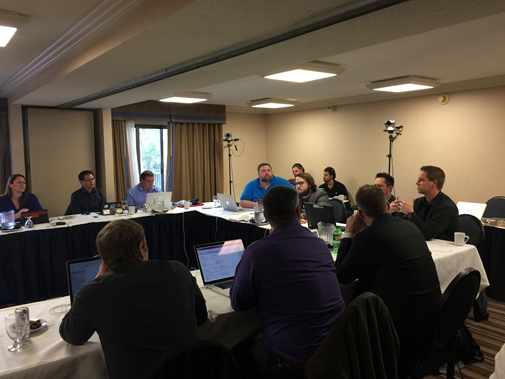
We can’t express how excited we were when Cisco was asked to sponsor and participate in an independent event, hosted by Tech Field Day, which invited experts from NetFlix, Google, eBay, and SignalFX to discuss the technical challenges some of these web scale providers face and the innovations they have helped drive in the industry to answer those challenges. Although, the major focus of the event was on telemetry, they discussed various aspects of scale, management and operational efficiency in their environments. If learning from the industry leaders interests you – continue reading!
Have you heard the expression, “People don’t remember what you say, they remember how you made them feel?” Last week, I had the opportunity to participate with more than 8,000 women (80 from Cisco) — in a one-day conference sponsored by Cisco Systems, Inc. and other companies. There were many amazing speakers who shared their stories of perseverance, optimism and goodness. I don’t recall everything these presenters had to say, but I certainly remember how they made me feel. Here are just a few of the great pearls of wisdom from the event.
Preparation – It’s what defines champions. @CarliLloyd
Carli Lloyd is a star on the U.S. Women’s National Soccer team, a two-time Olympic gold medalist and Most Value Player (MVP) of the 2015 Women’s World Cup champion. She was always the best player on each of her youth soccer teams, but when she reached the collegiate level, she knew she had to step-up her performance if she was to be a leader. It was her personal coach who told her she needed to not only improve her soccer skills and game technique, but also her character. Ouch! This was tough feedback to accept. Her coach was wise enough to give Carli this needed correction, but also hope and a goal: If she Continue reading “Preparation, Optimism, Goodness: 3 Pearls of Wisdom + 1 from the Conference for Women (2015) in Philadelphia”
This post was written by guest blogger Emma Reid, marketing manager for Cisco’s Social Innovation Group, Asia-Pacific region.
In 2001, the Employers’ Federation of Ceylon (EFC) launched the Network on Disability, a program designed to connect Sri Lanka’s disabled community to meaningful jobs. The EFC’s ICT Training Center, which launched in 2009 with the support of the International Labour Organization (ILO), has empowered more than 160 disabled people with the IT and language skills training they’ll need to thrive in a digital world. The EFC’s objective is to develop the employability skills of people with diverse disabilities in Sri Lanka by embracing the vision of “productive employment through social harmony.”
In 2014, the training center achieved status as a Cisco Networking Academy. “This is a milestone of the ICT Training Center, as it is the only center in Sri Lanka which trains people with diverse disabilities in Cisco courses,” said Manique Gunaratne, Head of the ICT Training Centre. This year, EFC started offering Cisco Certified Network Associate (CCNA) courses to students with disabilities. For the CCNA course, nine men and women with disabilities have been selected. Among them are three visually impaired participants, three hearing impaired participants, and three with physical disabilities. On October 23, the Commercial Bank donated millions worth of Cisco equipment to be used for the courses. Gunaratne, herself, lost her sight 15 years ago due to retinitispigmentosa, a disease for which no cure has been found.
“Cisco’s own research indicates that certified professionals often earn as much as 10% more than peers without Cisco credentials working in similar routing and networking jobs.”
Gunaratne was recruited as a role model to the Network on Disability in 2001 as the first employee with a disability. Trained both locally and internationally to teach, promote, and develop IT skills for individuals with disabilities, Gunaratne has been nationally and internationally recognized. In addition to winning a Gold Medal at the Assembly for Women with Disabilities in Seoul, South Korea in 2011, she also received several coveted national awards in 2007, including the Keerthi Sri Lankabhimani Desha Bandu Award, the Zonta Woman Achiever, and Most Inspirational Woman on Special Skills of the Year. Gunaratne’s commitment to the betterment of the visually impaired in Sri Lanka is exemplary.
The training center is fully equipped with more than 50 devices specially designed for individuals with disabilities as part of a collaboration with Curtin University of Technology in Australia and SLIIT (Sri Lanka Institute of Information Technology) Malabe. The programs are also recognized by the Tertiary and Vocational Education Commission (TVEC) and within the EFC membership, which consists of 620 companies.
“The prime objective of the program is to improve the computer knowledge and networking skills of our students,” said Gunaratne. “Moreover, it aims to improve the employability of the trainees and create a group of trainers for future training needs.”
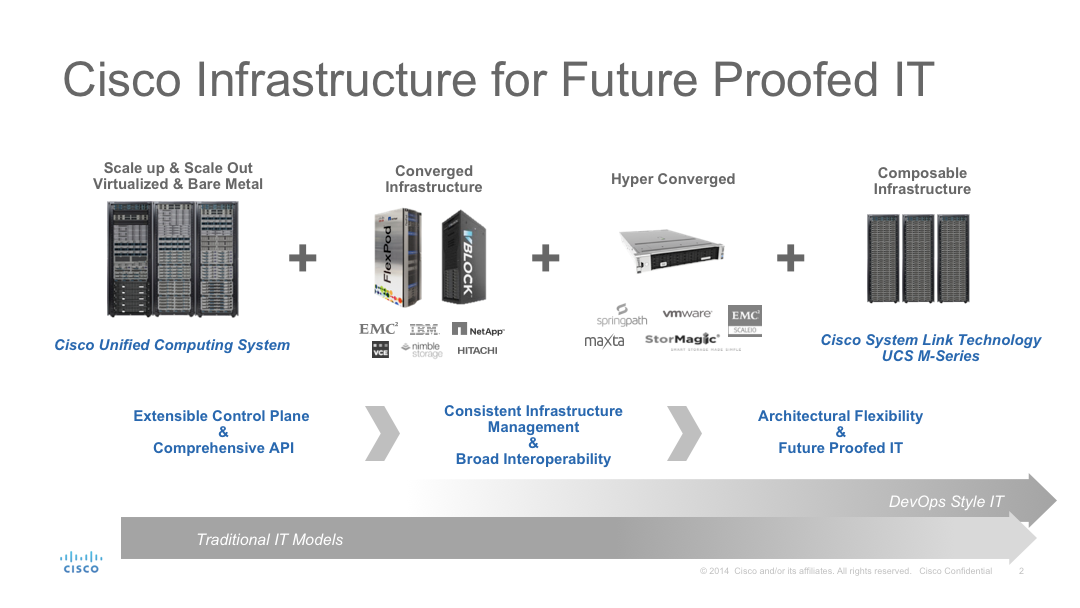
Its seems that lately, there is a lot of noise in the industry about composable infrastructure. Some of others in the industry seem to be busy churning out a bunch of noise around their vision of the future as though just talking about it repeatedly will somehow capture mindshare. Most of what is out there amounts to a whole lot of talk and hand-waving, but it has been pretty light on real products that customers can buy. Back in September of 2014 we launched the UCS M-Series and C3000 families of products. At that time, we not only added the new server products to the UCS portfolio, but also introduced SystemLink Technology. We set out to lay the foundation for our composable infrastructure vision, a vision that is being noticed by many in the industry. Check out what Moor Insights & Strategy is advising customers about Composable Infrastructure. Also, take a few minutes to hear more about the attributes of a composable infrastructure with the video below.
The revolutionary capabilities of SystemLink really lay the groundwork for one of the most important elements required for a truly composable infrastructure. The Cisco SystemLink ASIC, the first of it’s kind in the x86 Server space, has several key capabilities.
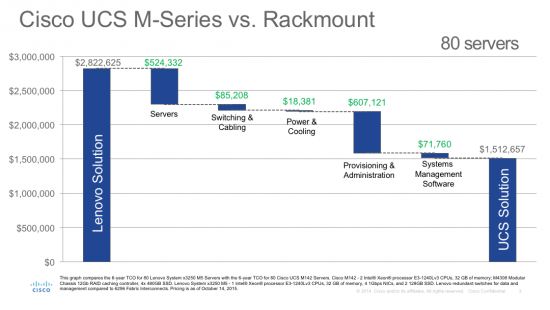
First, it enables server subsystem disaggregation. This is critical to be able to break down the traditional server, which is traditionally defined primarily by convention and sheet metal, into its basic elemental resources. By separating the physical components of the server, those resources can then be pooled and programmatically composed into a logical server and then, subsequently decomposed, returning the elements back to the pools allowing for reuse. This breaking down of the server means that not only can the most efficient and optimal use of resources be made, but also the lifecycle management of those resources is also decoupled. So, in the case of M-Series, the next CPU generation that would drive a complete replacement of the server with a traditional rack-mounted server would only require the replacement of the CPU and possibly DIMMs to achieve an upgrade. Subsystems like the local storage, RAID controller, network adapter, power supplies, fans, and cabling are preserved until upgrades of those respective elements would yield benefit to the business. As you can see illustrated below, this adds up to a significant savings of both capex and opex, while at the same time offering a more agile IT environment.
Another key capability afforded by Cisco SystemLink Technology is the extension of the control plane into the hardware. After all, simply sawing a woman in half on stage is not a real magic trick unless you put her safely back together at the end. So too is the case with server disaggregation. It’s why we chose the term Composable Infrastructure. The reconstitution of the elements (in a more efficient and flexible form) is where the real benefit comes in. To accomplish this, without undue complexity or multiple layers of software, you must have a control plane within the server that can arbitrate the connection of the subsystems as prescribed by the policies that are defined by the user / application.
If you would like a more in-depth understanding of how SystemLink works, check out a very informative blog that Steve McQuerry posted back in October of 2014.
Thus, SystemLink’s unique capabilities expose some truly revolutionary capabilities within the underlying infrastructure, but the more evolutionary (read: consistent) part of Cisco’s Composable Infrastructure architecture is the management framework which allows for the policy-based programmatic control of the disaggregated elements. The UCS Management environment along with a highly extensible set of APIs provides the customer the ability to control this composable infrastructure while at the same time abstracting the added complexity of the larger and more granular pools of resources.
The UCS Management architecture is capable of providing not only the capabilities to orchestrate the Composable Infrastructure, but do so with the common set of interfaces and user experience that customers employing a more traditional model, one that is transitioning between a traditional and a DevOps style, and ultimately the organization that requires ultimate agility. That means that UCS is uniquely positioned to offer both traditional server elements and composable elements in whatever combination that best meets the needs of the business without siloed tools and processes. Additionally, consistent UCS Management tools and interfaces means that IT staff need not re-learn new tools to manage an infrastructure even as it evolves from traditional to agile. This allows the IT staff to be treated as the ultimate resource in the infrastructure and be utilized as efficiently as the hardware.
So while the talk about Composable infrastructure continues in the market, at Cisco, we believe that with products like UCS M-Series and the UCS C3260, we are not just defining Composable Infrastructure, but we are walking the walk with shipping products that customers can buy today to begin the journey to the next generation of agility and efficiency.
‘Tis the season for bold and forward-thinking retailers to try new things! Excitement is building as many innovative retailers focus on areas to make the holiday shopping experience better for their customers.
Enhancing Retail Mobile Apps
Some retailers are using mobile apps to help customers spend less time gathering deals and waiting in line, and more on finding the gifts their friends and family want:
Target makes it easy for parents to play Santa by enhancing their kids’ wish list app. This app includes new holiday games and a kid-friendly search function to add products in a “letter to Santa.” Parents then log into adult mode and respond to the letter, buy the presents directly, and share the list with relatives.
Kohl’s mobile app lets shoppers gather all their deals in one place by scanning gift cards, Kohl’s Cash, and Yes2You loyalty rewards into a mobile wallet. Customers also enjoy accelerated checkout in stores using Apple Pay.
Walmart’s mobile app lets customers build holiday wish lists by scanning items while shopping in stores, which can then be accessed by friends and family members using the app’s search feature. The app also directs consumers who order presents online to pickup locations in the store.
Intelligent Traffic Director (ITD) is a hardware based multi-terabit layer 4 load-balancing, traffic steering and services insertion solution on the Nexus 5k/6k/7k/9k series of switches.
Domain
Written Exam (%)
Lab Exam (%)
1.0 Cisco Data Center L2/L3 Technologies
24%
27%
Show Details
2.0 Cisco Data Center Network Services
12%
13%
Hide Details
2.1 Design, Implement and Troubleshoot Service Insertion and Redirection
2.1.a Design, Implement and Troubleshoot Service Insertion and Redirection for example LB, vPATH, ITD, RISE
2.2 Design, Implement and Troubleshoot network services
2.2.a Design, Implement and Troubleshoot network services for example policy drivenL4-L7 services
This is part of a series on the evolution of the Cisco Collaboration Cloud platform, exploring the technical and design principles behind its unique architecture.
In the last post in this series, Jens Meggers talked about the huge importance of user experience, and how essential it is to simplify, connect, and delight. Software-as-a-Service (SaaS) is increasingly essential to delivering those three ingredients.
A true SaaS platform can provide continuous delivery, enabling rapid updates of software to make constant improvements on those ingredients. It also enables A/B testing and metrics-driven software development, which can ensure that the product is in fact delivering a great user experience.
The problem is that all of that works fine and well for companies that can get a complete collaboration solution from the cloud. But – the reality is – these types of greenfield environments are not all that common. Most companies have a huge amount of on-premises software. In fact, most of them have a huge amount of on-premises software that provides collaboration functionality. IP PBXs (like our own Unified Communications Manager), email servers, corporate directories – these all exist en-masse on-prem. And for many companies, these products work and work well, with quite a bit of life left in them. Consequently, even for a company that is excited about the user experience that SaaS can deliver, it’s not clear how to get there because they aren’t greenfield. Continue reading “The Myth of Greenfield Technology Environments”
The holidays are upon us and the shopping season is kicking into high gear. This year, an estimated 270 million consumers will shop online and, for the first time, more than half of them will use mobile devices to check off their holiday shopping lists.
With consumers searching for holiday discounts through display ads, social media and email, Cisco Talos Security Intelligence and Research Group predict that both malvertising and email spam will be significant vectors for cyber crime this season — especially for mobile shoppers. This is worrisome for the simple reason that most mobile devices do not posses the ability to block many of these threats, leading to increased vulnerabilities as attackers seek profit gain during the busiest time for online commerce.
Through their research, Talos found that Android users are particularly vulnerable. Of the all Apple and Android OS blocks observed on the Cisco’s Cloud Web Security (CWS) platform, the Talos team found that nearly 95% were Android-related. At the heart of the problem, many users are running significantly older versions of the Android OS, which lack the security updates for today’s most persistent threats. This holiday season, we advise that our mobile shoppers exercise additional caution.
Cisco UCS C460 M4 Rack Server continues its tradition of Industry leadership with the latest announcement of two benchmark results capturing the best 4-socket server SPECjbb®2015 MultiJVM benchmark performance for max-jOPS and critical-jOPS.
The SPECjbb2015 benchmark allows vendors to demonstrate Java-based business software performance so you can evaluate the way that your software will run in real-world environments. The SPECjbb2015 benchmark provides two measures of performance: the max-jOPS metric provides a measure of overall transactional throughput, and the critical-jOPS metric provides a measure of interactive responsiveness. In two different benchmark reports, Cisco demonstrated that the Cisco UCS C460 M4 Rack Server has the flexibility to be tuned for world-record-setting performance on either the throughput or responsiveness metric.
Some of the key highlights of Cisco’s new SPECjbb2015 benchmark results are:
When tuned for max-jOPS, the Cisco UCS C460 M4 delivered a score of 171,642, more than 18 percent higher than HP’s best score for the 4-socket HP ProLiant DL580 Gen9 server
When tuned for critical-jOPS, the Cisco UCS C460 M4 delivered ascore of 99,646, or almost 96 percent higher than HP’s best posted result.
Your real-world workloads may require maximum interactive responsiveness or maximum throughput, and these results demonstrate that you can tune your Cisco UCS® C460 M4 Rack Server to achieve world-record-setting performance by either measure.
SPECjbb2015 Results for the Cisco UCS C460 M4 Rack Server:
Server
SPECjbb2015 MultiJVM max-jOPS
SPECjbb2015 MultiJVM critical-jOPS
Disclosure Date & Disclosure Link
Cisco UCS C460 M4 with 4 Intel Xeon processors E7-8890 v3 CPUs at 2.5 GHz
171,642, Best 4-socket Multi JVM max-jOPS Performance
The benchmark configuration included the benchmark controller, back-end, and transaction injector components, each running in its own JVM. The JVM instances ran on a Cisco UCS C460 M4 Rack Server running a single instance of SUSE Linux Enterprise Server (SLES) 12 and 64-bit Oracle Java HotSpot Server Virtual Machine (VM) 1.8.0_60.Check out the Performance Brief for additional information on the benchmark configuration. The detailed official benchmark disclosure report is available at the SPECjbb2015 Website.
Although all vendors have access to same Intel processors, only Cisco UCS unleashes their power to deliver high performance to applications through the power of unification. The unique, fabric-centric architecture of Cisco UCS integrates the Intel Xeon processors into a system with a better balance of resources that brings processor power to life. . For additional information on Cisco UCS and Cisco UCS Integrated Infrastructure solutions please visit Cisco Unified Computing & Servers web page.
Disclosure
SPEC and SPECjbb are registered trademarks of Standard Performance Evaluation Corporation. The performance record described in this document was valid based on results posted at http:// www.spec.org as of November 12, 2015.








 In 2001, the Employers’ Federation of Ceylon (EFC) launched the