With Cisco’s heritage in networking the enterprise, we understand how to create a secure, scalable and high performing networking framework – one that enables connectivity and new user experiences. In a nutshell, this has been the foundation for our efforts in connecting cars. We’ve taken some of the key aspects of our enterprise core in defining how we view the car of the future. With a highly secure and reliable networking infrastructure as the foundation of a connected vehicle, you enable a full spectrum of partners to create new experiences for end users and you enable tangible benefits for the automotive industry and its customers.
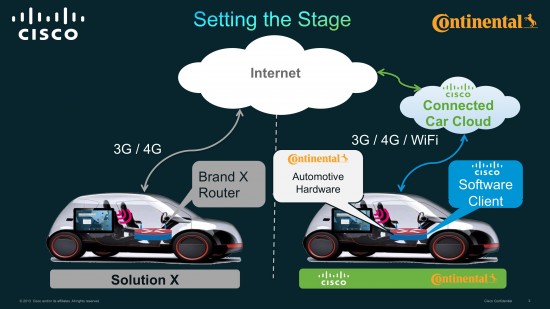
In Traverse City, Michigan this week, we’ve had a very exciting demo to show off. With tier 1 supplier Continental, we’re announcing the very first proof-of-concept of a connected vehicle using Cisco technology. With the Center for Automotive Research Management Briefing Seminars as the backdrop, we’re showcasing for attendees the impact of Cisco’s enterprise-grade, secure and seamless wireless network technology on the connected vehicle.
Uniquely Identifying Things Enables the Internet of Everything to Thrive
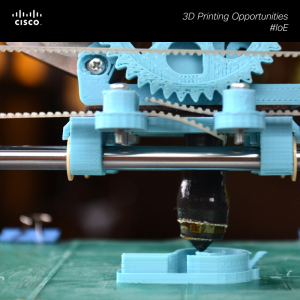
In February 2014, patents are set to expire on selective laser sintering, the key to industrial-grade 3D printing. This is expected to cause an explosion in 3D printing.
In a recent interview, GE CEO Jeff Immelt cited his company’s rapid adoption of this technology in manufacturing its new line of jet engines. “3D printing allows you to make that product right the first time,” he stresses, adding that it is “worth a lot of investment.” The UPS Store also sees the importance of this potentially game-changing technology. It is running a test program that will make it the first national retailer in the United States to offer 3D printing services targeted at helping entrepreneurs, architects, startups and other retail customers.
In the Internet of Everything realm, 3D printing promises exciting opportunities by enabling unique identifiers to be printed directly onto a product or product part. In the GizMag article RFID be gone: Why you might soon be 3D printing the Internet of Things, author James Holloway explores the emerging field of terahertz imaging (Tz). Scientists have developed a way to print a unique 3D tag called an InfraStruct, which is added within the object as it is being printed. These tags take on various forms or patterns, giving an object a unique fingerprint, or “watermark”. The InfraStrut can be read by a scanner using terahertz radiation. The terahertz band falls between microwave and infrared wavelengths of the electromagnetic spectrum. Current RFID technology requires a chip that can slow the printing process and increases the cost of the item; printed Tz IDs would greatly simplify and streamline the process. Terahertz could ultimately provide new ways to connect certain objects at a lower cost by recognizing items without the need for a chip.
Looking forward, a Tz scanner could be built into your smart phone. You could then scan the aisles at your local retailer for the precise plumbing part to mend your broken sink — or the right color cartridge for your home printer. Retailers, in turn, could associate special deals with your buying history. Scan that sofa through your shopping app and up pops a personal discount aligned with your level of brand loyalty!
The success and growth of the Internet of Everything depends on connecting staggering numbers of people, processes, data, and things. Discovering novel ways of connecting new things —including being able to make those connected objects uniquely identifiable — will continue to be crucial.
What are other ways do you see emerging that will uniquely connect things?
“We (Real Madrid), with our experience & ideas on how to grow in the sports and entertainment world, and you (Cisco) with your technology, innovation and revenue models… our collaboration, has always resulted in a win- win relationship…and, a proven reference in the world” – Enrique Uriel, CIO, Real Madrid
Eight years ago we embarked on a relationship with Real Madrid to collaborate in transforming the Santiago Bernabeu stadium into the “Ultimate Bernabeu,” which would deliver a fan experience unlike any other. Our first goal was to build a network that would make the stadium the safest, and most secure in the world.
That goal was closely followed by the next phase, which was to support the need for more “things” being connected to the network in the stadium – broadcasting companies, sponsors, ticketing, hundreds of partners and VIP’s such as the Royal family! The most recent goal, embarked upon three years ago, was to address the continually evolving need for fans and members to connect with the Club through technology. Together we innovated, designed, and transformed the fan experience through key Cisco solutions – StadiumVision, Connected Stadium Wi-Fi , and StadiumVision Mobile – to enable the most interactive “live” experience in the world. Continue reading “Failure is not an Option! Real Madrid & Cisco Continue to Innovate and Partner for a Winning Formula”
Waiting rooms. Lengthy paper work. Medical bills. When you are ill, these are the last things you want to worry about. Checking in to your appointment shouldn’t take longer than your visit with the doctor, and the old paper charts just aren’t cutting it anymore. The industry has taken huge steps in moving to electronic health records (EHR), but what’s next? With the Internet of Everything connecting people, processes, data and things, how can electronic health records and smart devices play a role in saving lives?
A couple of weeks ago, I kicked off a new blog series called “Ask the Futurist” where I answer questions about the future directly from you. Today’s question comes from Isaac Naor, SVP & Chief Technology Officer at Ping Mobile:
Question: “Will more smart devices in healthcare drive medical institutions to innovate by creating a single universal digital format for medical records?”
The explosive growth in mobility is transforming the ways in which we live, learn, play and, in particular, work. Every dimension of our business lives stands to change: whom we work with and when, where, how, and why we work — all will be impacted.
The ultimate goal of business mobility is to drive increased productivity, heightened customer experience, and harmonious work-life balance. Business mobility offers freedom for knowledge workers beleaguered by accelerating demands on their time and talents; with it, they can take control of their success at work while protecting their personal lives. And, increasingly, it is the knowledge workers themselves who are driving these sweeping changes in the workplace.
But how can service providers and enterprises embrace the disruption?
It’s a nightmare out there. School districts’ wireless networks now have to support teachers, students, and staff – all touting desktops, tablets, smartphones, and/or laptops. For some in IT, knowing who is accessing what using what on the network (a confusing statement itself) could very well be cosmic chaos; for others, it is simply a black hole of the unknown.
Many of us are turning to social media to not only give us news on our friends, but news of the day.
The birth of a royal baby to Kate and William took Twitter and Facebook by storm… and the British monarchy right into the Internet age. Companies can do the same by tapping into what people are already excited about.
In my latest blog, I talk about how to make your own content timely and interesting. Read the full post here
Social media is quickly becoming ubiquitous in our lives — not only giving us news on our friends, but news of the day. We found out all about the recent birth of the newest heir to the British throne on social.
The number of mobile devices in our companies are exploding – and one of the fastest and best ways to deliver all those existing Windows-based apps to these devices is using app virtualization. At the same time many of you are probably thinking about upgrading and expanding your Citrix XenApp deployment to Citrix XA 6.5 or XD 7 in any case.
But can your Citrix XenApp infrastructure support this upgrade and all these new users? When customers started asking us these questions we decided we needed to check it out. So we asked Principled Technologies to look at helping us test out how well our Cisco UCS architecture with Cisco UCS VM-FEX would cope with these stresses.
With Cisco UCS VM-FEX 29% more responsive Citrix XenApp sessions can be obtained
Under extreme network loads, Cisco UCS VM-FEX enabled Virtual Machine (VM), provided up to 53% more CPU resource optimization, than is possible with a traditional vSwitch




 This is expected to cause an explosion in 3D printing.