Avatar

BirenProfilePicture-e1349971468612-300x369By Biren Mehta, Senior Marketing Manager, SP Marketing in Routing and Switching, Cisco

Have you ever tried to order a pizza that 20 different people would enjoy?  Just imagine getting twenty companies to agree upon a vigorous test plan that included over 600 test cases! (No easy cop-out by just getting plain cheese here…).  Big kudos go out to the Metro Ethernet Forum (MEF) for the launch of the Carrier Ethernet 2.0 (CE 2.0) certification program and to the first wave of MEF CE 2.0 certified companies.

The MEF certification of Carrier Ethernet equipment and services is of significant value to network operators.  The certification establishes a standard for delivering carrier-grade Ethernet services, speeds deployment of new services, and creates interoperable trust in a multi-vendor multi-operator network environment. MEF CE 2.0 greatly expands Ethernet services and further advances the industry through standardization of interconnectivity. Improvements include extending the Ethernet services reach, multiple classes of services for optimized mobile backhaul delivery, and greater manageability for delivery of differentiated applications over managed networks globally. Continue reading “Taking Carrier Ethernet To Another Level: Cisco CE 2.0 Certification Pioneer”

Avatar

In my previous blog post I discussed the format of GSX (Cisco’s annual global sales meeting) and tactics deployed to listen to, engage with, and motivate the audience. In this blog post I am going to dive into new approaches we took to enable peer networking and team appreciation.

Enabling meaningful networking and recognition for attendees at any event is challenging, but in the hybrid format of GSX, this task is exponentially harder. This year, a number of new tactics were deployed to address these challenges.

Peer Networking
A new networking tool called ‘Make Connections’ was created exclusively for use at GSX. This tool was available on desktops and mobile devices. Using a variety of criteria such as market segment expertise, technology interests, job roles, and sales recognition status, attendees were able to control how they were found, as well as what they were looking for in a network connection. Once a match was made, attendees could add individuals to their personal network, chat with connections one-to-one, and make notes about the connection. After the event, attendees could download their network for reference and/or import it into a contact management tool such as Outlook. The response was very positive with a 6% increase in year over year “ease of networking” satisfaction score, and utilized by 57% of registered attendees during the event.

Team Recognition
Although we have a robust sales recognition program, every year we hear from the winners and the audience at large that they would like to find a way to recognize the contributions their teams made to their success. So this year we decided to tackle the request head on and deployed a digital engagement called ‘Team Appreciation’. Continue reading “Connect, Recognize, and Motivate: Cisco’s Global Sales Experience (GSX) 2012, Part Two”

Authors

Dannette Veale

No Longer with Cisco

Avatar

Choosing the right compute platform for your VDI environment requires both science and art. You have to balance CPU and memory characteristics against your expected workload profile and your desired density. At the end of the day, VDI has to meet some cost criteria in order to go from a fun science project to a funded program in your company. That means you can’t just throw the top bin CPU at the problem; you have to pick the right CPU. This is further complicated by the fact that there is not one CPU that is ideal for all VDI workloads. There is no magical bill of materials at the end of this series of blogs, but we will attempt to make your VDI decisions based more on science than art.

Strength in numbers? Or strength in speed? As Tony said in his introduction, we had several involved questions related to VDI that we honestly couldn’t answer… so we decided to start testing. This will be a series of blogs that attempts to answer practical questions like “when is processor A better than processor B?” And of course you then have to ask “when is processor B better than processer A?” In this first installment in the series, I will tackle the question of whether the number of cores or the core speed is more important when the goal is to achieve the best desktop density per host. Here is a handy guide to the other posts in this series:

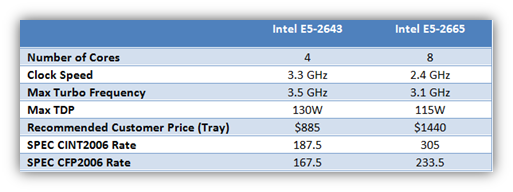
The usual suspects. Throughout this series, we will focus on two processors. We picked them because they are popular and cost effective, yet quite different from each other. They are not top bin processors. Take a look at the table below for a comparison.

Note: Prices in this table are recommended prices published by Intel at http://ark.intel.com and may vary from actual prices you pay for each processor. The SPEC performance numbers are an average of SPEC results published by many OEMs (at http://www.spec.org/) across many platforms. These are not Cisco-specific SPEC numbers.

Continue reading “VDI “The Missing Questions” #1: Core Count vs. Core Speed”

Authors

Doron Chosnek

Consulting Systems Engineer

Data Center Solutions Architecture Team

Avatar

Money is tight. Everyone wants to feel as if they are getting the most out of every dollar spent.  While brand perception and trust are vital, many insurers have refined their customer satisfaction focus to now pursue and measure customer loyalty.

Like many other industries, the insurance industry is experiencing diminished returns on traditional advertising designed to improve brand loyalty and fuel business growth. Ads are no longer a reliable means of driving new business especially with younger, tech-savvy consumers. As a younger generation begins to make insurance purchasing decisions, it is vital for insurance agencies to harness technology in order to connect with customers and build brand loyalty.

Now more than ever, insurance providers are struggling to increase customer retention and are in need of some help. A recent study conducted by Satmetrix gathered the average customer loyalty of various industries and found that insurance was one of the lowest, with a customer loyalty rate of 23 percent. It is likely there is a correlation between this percentage and the lack of technology insurers have to utilize that would strengthen relationships with existing customers. Consumers are clearly expecting more from their insurance companies and increasingly desire a more personalized and proactive touch.

So how can technology help? Continue reading “Customer Loyalty is the Ultimate Goal, Not Just Satisfaction”

Authors

Colleen Crafton

Americas Lead

Financial Services Industry Marketing

Avatar

I’ve written about NUMA effects and process affinity on this blog lots of times in the past.  It’s a complex topic that has a lot of real-world affects on your MPI and HPC applications.  If you’re not using processor and memory affinity, you’re likely experiencing performance degradation without even realizing it.

In short:

  1. If you’re not booting your Linux kernel in NUMA mode, you should be.
  2. If you’re not using processor affinity with your MPI/HPC applications, you should be.

Continue reading “Process and memory affinity: why do you care?”

Authors

Jeff Squyres

The MPI Guy

UCS Platform Software

Avatar

Kristin Peterson, CEO of Inveneo, a key Cisco CSR partner, is a guest blogger on Cisco’s Impact X section on the Huffington Post.

In her post, Kristin talks about how Internet connectivity can impact economic and social advancement in developing communities. She describes the remote Kenyan island of Mfangano, where Internet access has dramatically increased participation in HIV/AIDS-related testing and social service programs.

Cisco has supported Inveneo’s efforts to design and deliver information and communications technology (ICT) to the most remote and underserved areas of the world with more than $US3 million in cash and product grants since 2007. For example, Cisco supported expansion of Inveneo’s Certified ICT Partner Program in Africa, and worked with Inveneo to establish Community Knowledge Centers in sub-Saharan Africa as part of Cisco’s Clinton Global Initiative commitment.

Read Kristin’s full post on the HuffongtonPost ImpactX.

Authors

Alexis Raymond

Senior Manager

Chief Sustainability Office

Avatar

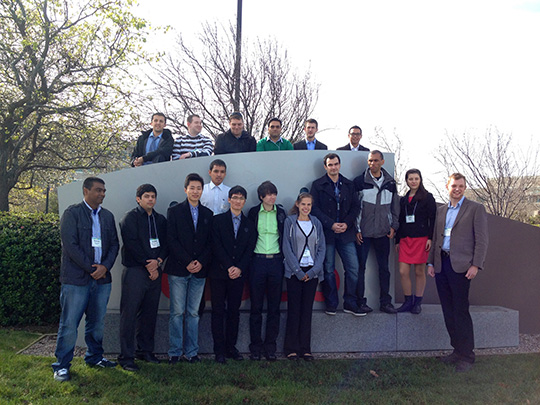
This week Cisco is proud to host 17 NetRider Champions from 13 countries around the globe at Cisco headquarters in San Jose, California. These tech wizards are students from the Cisco Networking Academy program who competed against more than 10,000 applicants in 85 countries. They range in age from 20 to 37.

The annual Networking Academy NetRiders competition is an interactive networking skills contest. It utilizes Cisco’s Web 2.0 technologies to challenge students to achieve high standards of competence, enhance classroom learning, and motivate them to further pursue technology education and training.

NetRiders_2013_web_1 Cisco Networking Academy NetRiders winners are visiting the Cisco San Jose, California campus from 13 countries.

Cisco believes in educating people with new skills for life, as well as in providing aid to those in need. Networking Academy is Cisco’s largest and longest-running corporate social responsibility (CSR) program; it was established in 1997 to teach IT based skills to people around the world, helping them get good jobs and encouraging long-term, sustainable economic growth in communities by providing highly skilled network professionals to support local industries. The 10,000 Cisco Academies around the world teach more than 1 million students in over 165 countries each year!

Brian Forward, the NetRider Champion from Canada, was particularly attracted to the interactive element of the competition. “Participating means that I have had the chance to compete with the countries’ and continents’ finest, while showcasing my talents and skills, and enhancing them while representing my home Newfoundland,” he said. “On a forward-looking note, it has created confidence within me that propels my learning.”

The contest is such a good way to motivate students that Tracy Granlund from the Networking Academy Student Advocacy Team says, “We hope to see the competition grow to 50,000 student participants.” The winners are in California to meet with Cisco staff and tour our offices, labs and data center; the Stanford University campus; Intel Museum; coastal Redwoods and beaches at Santa Cruz; and attractions in nearby San Francisco.

We’ll keep you posted about what the NetRiders are up to throughout the week.

Authors

Jennifer Barr

Social Media Manager, Online Brand

Cisco Talent Acquisition

Avatar

The data center is at the heart of promoting IT transformation. Mobility initiatives have created a need for increased connections; power initiatives have created a need for greater efficiency; and the increased need for real-time workload processing are driving that change. I see these as “signature” trends in 2013 and also highlighted these in my earlier post this year. Conventional IT security approaches often add complexity and usually impede efficiency gains. What’s needed is an approach that does not introduce latency or require the data center to be reconfigured to accommodate security. Neither should it introduce a myriad of new of tools, new reports, and new processes.

Very few vendors can claim to provide an end-to-end architecture where security is a key programmable element of the underlying data center fabric. This capability not only accelerates the adoption of virtualization and cloud technologies but also mitigates the complexity associated with disparate and siloed security technologies. The benefits are increased business agility backed by assured security posture, strong alignment of business function to security and reduced operational costs. In this paradigm, data center and IT executives will no longer be forced into making tradeoffs between business function and security to ensure newer and more capable services.

Continue reading “Streamline Your Data Center with Three Key Optimized Security Measures”

Authors

Evelyn de Souza

Cloud Data Governance Leader

Chief Technology and Architecture Office

Avatar

bill-Gerhardt11By Bill Gerhardt, Director, IBSG Service Provider

Online video is growing at a rapid — if not explosive — pace, with innovation and disruption spreading across all areas of the value chain. Some of the greatest innovation is currently occurring around multiscreen delivery and related services.

To better understand the climate for video consumption, in March, 2012 the Cisco Internet Business Solutions Group (IBSG) surveyed 1,152 U.S. broadband consumers between the ages of 13 and 75+ to gain a better understanding of how they watch video: their habits, preferences, and the devices they use.

The study found that consumers spend more time watching Internet video today than watching DVDs/Blu-ray Discs, video on demand (VoD), or live premium cable channels — and they want to watch streaming video across a variety of screens. In the future, multiscreen delivery will take on greater importance as laptops, tablets, and smartphones advance and become even better video devices.

Service providers must address these Continue reading “Multiscreen Video Delivery: Tangled Solutions, Smoothed by the Cloud”

Authors

Chris Osika

Senior Director, Global Lead

Service Provider Practice Internet Business Solutions Group