Avatar

Businesses and Governments are using multiple clouds in different ways. They are moving core functions in to a controlled private or managed cloud. But they are still using public clouds for new services, content and demand spikes. Some large enterprises are becoming specialized cloud providers for smaller businesses, while traditional providers are using different clouds for different tiers of service. These trends are leading to a world of many clouds with numerous service choices from a variety of cloud vendors. For example IT organizations can:

  • Offload complexity and access specialized services (e.g. Virtualized Desktop Infrastructure, Collaboration)
  • Share vertical expertise and Intellectual property across data centers (e.g. Regulatory compliance, Data clearinghouse)
  • Leverage a Provider’s Capacity for unplanned Demand (e.g. Disaster recovery, Seasonal IT surge)
  • Access network-optimized-clouds to deliver content reliably (e.g. Content distribution, Mobile streaming) Continue reading “Delivering High Value Cloud Services in a World of Many Clouds”
Avatar

Cisco announced the best 2-socket SAP Sales and Distribution (SD) on Linux Benchmark result with the Cisco Unified Computing System™ (Cisco UCS®) delivering impressive scalability and performance to growing deployments of SAP Business Suite applications.

Cisco’s results on the SAP Sales and Distribution (SD) Benchmark support for up to 6,530 concurrent users and a 35,680 SAP Application Performance Standard (SAPS) score derived from the processing of 713,670 order line items per hour and 2,141,000 dialog steps per hour.

The benchmark results successfully demonstrate how a Cisco UCS® B200 M3 Blade Server delivers high scalability and low latency to SAP Business Suite solutions by supporting up to 6,530 concurrent users in a Red Hat Enterprise Linux and Sybase ASE environment. High-performance blade servers and network fabrics enables application throughput optimization as Cisco UCS handles many SAP application tasks, with results showing that the system can process 713,670 order line items per hour or 2,141,000 dialog steps per hour.

 The tested configuration consisted of a Cisco Unified Computing System™ chassis equipped with one Cisco UCS B200 M3 Blade Server running Red Hat Enterprise Linux 6.3. The server was configured with two 2.90-GHz, 8-core Intel® Xeon® processor E5-2690 CPUs and 256 GB of 1600-MHz memory. The blade server ran both the SAP Business Suite application software and the 64-bit Sybase ASE Server 15.7. The SAP Enhancement Package 5 for SAP Enterprise Resource Planning 6.0 was used in this scenario. One LSI 400GB SLC WarpDrive provided solid-state disk capacity for database log files that require low-latency write access.

The “Cisco UCS B200 M3 Blade Server: Scalable Performance and Capacity for SAP Business Suite Applications” Performance Brief provides additional benchmark configuration details.Official Benchmark Certification is available at the  SAP® Standard Application Benchmarks certification web site.

 Cisco UCS deployed with Red Hat® Enterprise Linux® provides additional flexibility, efficiency and savings. Combined with enterprise-class open source operating system Cisco UCS servers are the perfect foundation for any standards-based infrastructure solution. The LSI 400GB SLC WarpDrive enables storage performance to be decoupled from storage capacity. Using solid-state disk technology and intelligent caching software, the LSI 400GB SLC WarpDrive integrates a powerful new memory tier that is uniquely designed to accelerate in-server application performance for database workloads.

 By deploying SAP Business Suite on Cisco UCS configured with Red Hat® Enterprise Linux®, LSI solid-state storage and running Sybase ASE Server, IT departments can support more users and accelerate response. IT departments can choose from a full range of Cisco UCS blade and rack server models to scale deployments further with larger servers, or add servers, to create scale-out deployments with a small footprint. These innovations and a dramatic reduction in the number of physical components demonstrate Cisco’s commitment to delivering systems that provide value to SAP deployments.

Please check the SAP Press Release covering this benchmark for additional details: “SAP Sybase Adaptive Server Enterprise Scores Top Two-Processor and Four-Processor Linux Performance Results on Two-Tier SAP SD Standard Application

 Girish Kulkarni

Sr. Product Marketing Manager

Unified Computing System 

gikulkar@cisco.com

Authors

Girish Kulkarni

Senior Marketing Manager

Data Center & Virtualization Marketing

Avatar

Cisco’s 2013 Global Mobile Visual Networking Index (VNI) once again shows that mobile networking traffic continues to rise.  Big picture:   by 2017, global mobile data traffic will reach unprecedented levels of 11.1 exabytes per month.  That’s the highest projection we’ve ever made in the Global Mobile VNI.  It’s the same story in the United States.  By 2017, mobile data traffic will reach new highs of 1.96 exabytes per month.  To put this in context, that’s the equivalent of 491 million DVDs each month or 5,410 million text messages each second.

As we dig deeper inside the numbers, we’re also seeing a couple of key trends that are a result of changes in how consumers are using their mobile devices.

First, the 2013 Global Mobile VNI has called out a significant shift globally away from consumers using laptops to access mobile networks. This shift is particularly important because data traffic from mobile-enabled laptops generates much more data traffic than smartphones or tablets.  While this shift is most pronounced in Western Europe, we’re seeing the same trends globally, including here in the United States.

Second, our 2013 study dramatically illustrates a more rapidly evolving shift toward accessing the Internet through Wi-Fi/Fixed networks, commonly known as “Wi-Fi offloading.”   By 2017, the study projects 46% of global mobile data traffic will be offloaded to Wi-Fi.  Compare that to last year, when we projected that by 2016, 22% of traffic would be offloaded.  The U.S. is well ahead of the global curve on this issue – by 2017, we project 66% of mobile data traffic will be offloaded to Wi-Fi.

Together, these two seemingly disconnected shifts in consumer behavior produce an interesting effect on mobile data growth rates. Globally, growth will be about 30% less than what we projected last year and about 25% less in North America. That’s the combined effect of consumers using fewer mobile-enabled laptops that generate 368X data relative to a basic cell phone, while increasingly taking advantage of Wi-Fi networks at home, in the office or on the go.  That’s an amazing shift in consumer behavior.

We learn something new with every new edition of the Global Mobile VNI, and this year, we learned how shifts in consumer behavior can have an impact on forecasted growth projections.  But the basic narrative, which the Global Mobile VNI has been telling us for these many years, remains unchanged.  Mobile data traffic keeps growing and growing and growing – and policymakers will have to take this into account as they consider ways to meet the ever-increasing demands on networks.

Authors

Avatar

Today, Cisco released its latest Visual Networking Index (VNI) Mobile Forecast, 2012-2017. This annual study provides lots of interesting data, new growth projections, and our perspectives on key trends that are shaping the future of mobile networks and user behavior. While many ardent forecast aficionados may be eager to delve into the 34-page white paper, we recognize that others simply want us to “net it out.”

So if you’re time-challenged (or just prefer shortcuts), here are just a few figures and findings to help you expeditiously grasp some key takeaways from this year’s report. Continue reading “Cisco VNI Mobile Data Forecast Update (2012 – 2017): Major Milestones and Shifts Revealed in 2013 Study”

Authors

Thomas Barnett, Jr.

Director, SP Thought Leadership

Worldwide Service Provider Marketing Group

Avatar


At one time, a knock on the door was from a friend or neighbor looking to borrow some sugar or the hedge trimmer. Today, more often than not, that knock represents someone stopping by for a visit and asking to “borrow” your home network to connect to the Internet.

U.S. consumers carry an average of 2.6 mobile devices, according to recent research by the Cisco Internet Business Solutions Group (IBSG).  Not only do they expect their devices to connect to the Internet—they also expect friends and neighbors to have home Wi-Fi, just as they have electricity and running water. 

Many service providers are now trying to understand how they can create community Wi-Fi networks among their broadband customers and reap new business benefits.  However, they have very little research on customer behaviors that will enable them to design a winning program and build the business case for further investment.  To learn more, Cisco IBSG conducted a survey of 1,060 Canadian mobile users to understand their needs and behaviors, their current and future mobile usage, and the average profile of community Wi-Fi users. Continue reading “May I Borrow a Cup of WiFi?”

Authors

Carter Cromwell

Global Analyst Relations Manager

Corporate Communications

Avatar

This may seem intuitive to some of you, but just in case, here are TWO easy steps to watch a webinar on our new community (under Fun & Learning)

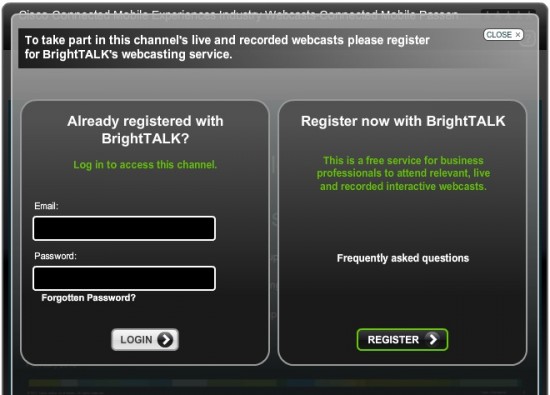
1. The video player with your webinar will have a play button. Hit the play button, and this screen will pop up.

  • If you already have a BrightTalk account, then login and you can watch the webinar now!
  • If you’re new, simply hit Register and follow just one more easy step.

5

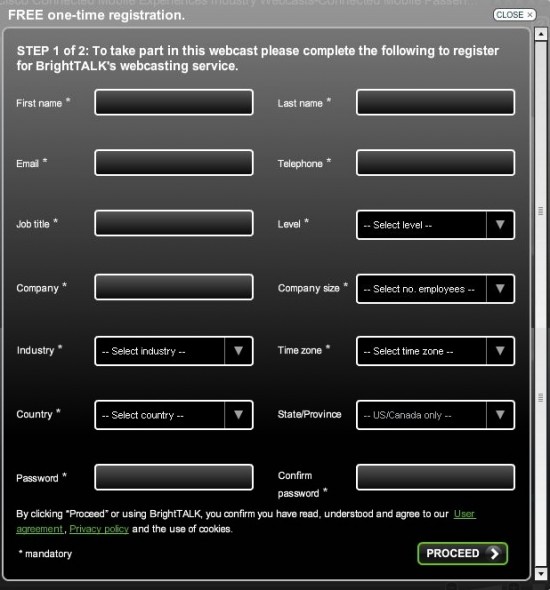
2. Register with BrightTalk by filling in the fields and hit Proceed

8

Congratulations! Now you can watch all the webinars on our BrightTalk channel without any more hassle!

Avatar

You may have heard of the Cisco® Global Cloud Index. From our predictions, the cloud’s future is both promising and daunting. With the forecast calculating cloud traffic to increase sixfold by 2016, you have to wonder if the Cloud is ready to take on the load.

Cisco thinks so. We are pleased to introduce the latest edition of Unleashing IT, the technology-focused business resource for data center best practices. Unleashing IT showcases the latest technology trends, while experts demonstrate how the path to the cloud is being cleared, and how virtualization is transforming the data center while strengthening businesses.

With a unified architecture and unparalleled infrastructure, companies are bridging the gap between IT and business. Liberty University’s enrollment soars thanks to a consolidated IT infrastructure.  Republic Services, a nationwide waste company, provides local-level satisfaction on a budget. From managing Big Data to the possibilities in healthcare through collaboration and centralization, IT plays a prominent role in the workplace.

Subscribe to Unleashing IT today to get full access to articles, offers, resources, and events. Already a subscriber? Simply log in to check out our Winter edition.

Authors

Adrian den Hartog

Senior Marketing Manager

Field Marketing US Commercial

Avatar

Cloud computing is part of the journey to deliver IT as a Service which enables IT to change from a cost center to a business strategic partner. Forrester Research recently published a report that concluded, “Cloud computing is ready for the enterprise… but many enterprises aren’t ready for the cloud.”1   Yet Cloud deployments are happening – and I mean all types of Clouds – Private, Public and Hybrid. In other words, we have entered the World of Many Clouds.

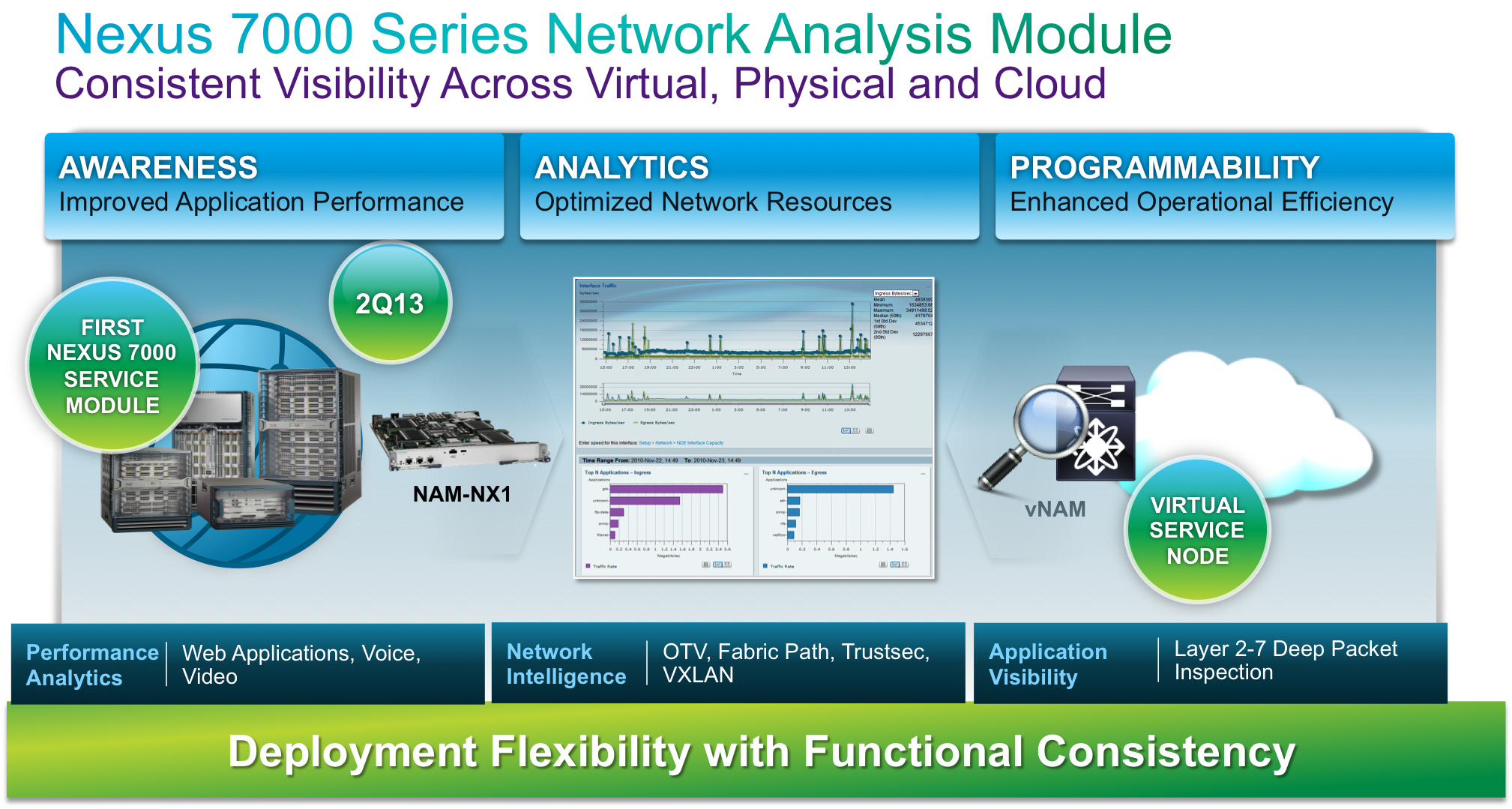
Network touches everything and is a key building block for agile and scalable virtualized and Cloud-based data centers. Yesterday, I have introduced our new Nexus 6000 series and new 40 GE extensions to Nexus 5500 and 2000 Series. Today, I would like to introduce the very first services module for the Nexus 7000 Series.

  NAM

  Continue reading “Introducing First Services Module on Nexus 7000 Series”

Authors

Berna Devrim

Former Senior Manager of Marketing

No Longer at Cisco