

12 years back when I delivered my first child, I went into postpartum depression and lost my work-life balance. I know exactly how it feels to lose balance and how to regain it. I have developed a purpose to make women more aware about symptoms of losing work-life balance and providing solutions that worked for me.Always put yourself first and then only you can take care of your family and work. I am thankful to Cisco for providing me flexibility to work from home. Continue reading “Juggling Work-Life Balance in Demanding Times”
Authors

Wow. According to a recent Forbes article, there could be 9.5 billion people on the planet by the year 2075. Think how much energy will be generated by that kind of world population. This puts the emphasis on energy-efficient technologies in a whole new light. Technologies, like switches that reduce power consumption, can save businesses money. But so far, it’s not enough to outweigh the other critical factors small businesses seek: resiliency, easy configuration, and zero packet loss. That’s why the Cisco Small Business 500 Series switches are a home run.
A recent study by Miercom, a network consultancy, specializing in networking and communications-related product testing and analysis, favorably compared the Cisco SF500, SG500, and SG500X series of switches with similar products offered by HP, D-Link, and Netgear. The overall findings with regard to the Cisco 500 series switches:
- Easiest to configure and implement; highest capacity and scalability of configuration parameters including VLANs, MACs, ACLs, and IP routes
- Best resiliency when subjected to a DoS attack
- More efficient in terms of overall energy consumption, and the energy saving capabilities, plus more economical when measured using normalized pricing based on price per gigabit and price per PoE watt
- Forwarded line rate full mesh traffic at all frame sizes with zero packet loss
- Most extensive support for IPv6 transitions
Nice to know that if you’re a small business looking to save money and power, you can have all that and more—without having to sacrifice other critical factors you need to keep your business running. You can read more about the results of the Miercom study here. Or, to learn more about how Cisco helps small businesses, visit www.cisco.com/go/smb.
Authors


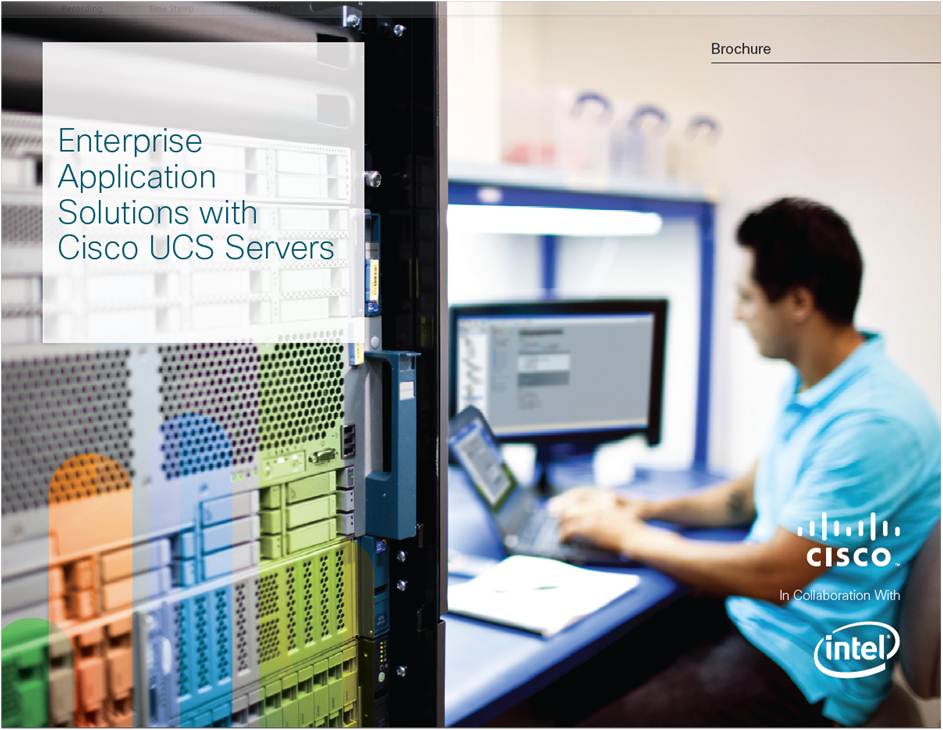 Organizations use Cisco UCS servers to gain the power, flexibility, and management simplicity needed to meet their Microsoft SQL Server workload demands while increasing their IT agility.
Starting with standalone servers for performance and bandwidth, or connecting servers through Cisco UCS for automated configuration, simplified management, and massive I/O flexibility which provide SAN and network-attached storage (NAS) access, the pairing of Microsoft SQL Server with Cisco UCS provides business intelligence and OLTP applications exceptional connectivity to your data.
Let’s not about record-setting performance with lower cost, too! In its inaugural TPC-H™ result, Cisco asserted industry leadership in partnership with Microsoft, establishing Cisco UCS as the fastest 4-socket Intel Xeon processor– powered platform for running Microsoft SQL Server at the 1,000 GB scale factor.
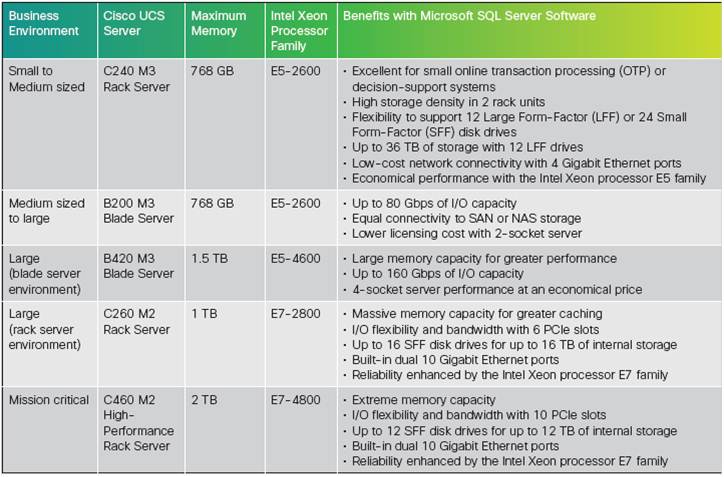
Table 1 below outlines the flexibility of SQL Server on UCS, describing various sized configurations to support your data management needs. Here you can see how our B series or C series UCS servers support small to medium organizations up to the largest of enterprises.
Table 1 – UCS SQL Server Sample Configurations
Want to learn more about Microsoft applications on Cisco UCS? Then please feel free to download in this new Application Solutions Brochure and see how UCS provides an optimal platform for Microsoft SQL Server, SharePoint and other leading applications.
www.cisco.com/go/microsoft
Authors


In this installment of the “We’re Listening” blog, Kathy Harrington, VP of Global Service Delivery, delves into actions taken by Cisco’s Order Management team to improve your order management experience.

By Guest Contributor Kathy Harrington
We constantly strive to achieve the best possible customer experience in every part of our business. As customers and partners, you’ve told us you want Cisco’s order management process to be less complicated, more efficient, and take less time. Your feedback is taken seriously and has resulted in several improvements to ensure placing a product or service order with Cisco is fast and simple. Continue reading “The We’re Listening Blog Series: Making It Easier to Do Business with Cisco by Simplifying Order Management”
Authors

After the great success of our last K-12 webinar, it’s clear there’s a lot of interest in how mobile devices and wireless technology can play a key role in K-12 schools.
In my last post, I mentioned that I spent some time with the Utica Community School system in Utica,MI observing how they have implemented a Cisco Wireless Network solution for their schools. We now have a video case study which is listed here.
In this video, the Utica Community Schools Superintendent, Dr. Christine Johns discusses how the school system views the importance of creating a collaborative classroom which is enabled through Cisco wireless technology.
John Graham, the Executive Director of Information Technology discusses requirement that the technology must be reliable and easy to deploy and maintain. He highlights the ease of deployment with the Cisco solution including the Cisco Aironet 2600 while also providing some insight into the importance of some of Cisco’s Technology solutions such as CleanAir and Clientlink that are essential to operating a high density wireless network that is reliable on a day to day basis.
Lastly, Craig Mathias from the Farpoint Group, who recently published a white paper on the needs of the Mid-Market wireless networks was invited to observe the network in action. Continue reading “A Closer Look: Utica Community Schools Enables Anytime, Anywhere Learning”
Authors

Customers have often said to me, “Joann, we have virtualization all over the place. That’s cloud isn’t it?” My response is, “Well not really, that is not a cloud, but you can get to cloud!” Then there is a brief uncomfortable silence, which I resolve with an action provoking explanation that I will now share with you.
Here’s why that isn’t truly a cloud. What these customers often have is server provisioning that automates the process of standing up new virtual servers while the storage, network, and application layers continue to be provisioned manually. The result is higher management costs that strain IT budgets, which are decreasing or flat to begin with. With this approach, businesses aren’t seeing the agility and flexibility they expected from cloud. So, they become frustrated when they see their costs rising and continue struggling to align with new business innovation.
If your IT department adopted widespread virtualization and thought it was cloud, my guess is you are probably nodding your head in agreement. Don’t worry, you’re not alone.
So then, what are the key elements an organization needs to achieve the speed, flexibility and agility promised by cloud?
1) Self-service portal and service catalog
The self-service portal is the starting point that customers use to order cloud services. Think of a self-service portal as a menu at a restaurant. The end user is presented with a standardized menu of services that have been defined to IT’s policies and standards and customers simply order what they need. Self-service portals greatly streamline resource deployment which reduces the manual effort by IT to provision resources.
2) Service delivery automation
After the user selects services from the portal service menu, then what? Well, under the hood should be automated service delivery—which is a defining characteristic of a real cloud environment. Behind each of the standardized menu items in the self-service portal is a blueprint or instructions that prescribe how the service order is delivered across the data center resources. This has been proven to appreciably simplify IT operations, reduce costs and drive business flexibility.
Continue reading “Virtualization Everywhere, but not a Cloud in Sight!”
Authors

Today’s guest post is from Rolf vandeVaart, a Senior CUDA Engineer with NVIDIA.
GPUs are becoming quite popular as accelerators in High Performance Computing clusters. For example, check out Titan; a recent entry into the Top 500 list from Oak Ridge Laboratories. Titan has 18,688 nodes (299,008 CPU cores) coupled with 18,688 NVIDIA Tesla K20 GPUs.
To help ease the programming burden working with GPU memory in MPI applications, support has been added to several MPI libraries such that the MPI library can directly send and receive the GPU buffers without the user having to stage them in host memory first. This has sometimes been referred to as “CUDA-aware MPI.”
Authors

 Topics such as Software Defined Networking and programmable networks are of great interest to many network operators these days. With that in mind we’re pleased to kick off a new series of Webcasts to help our customer learn more about Cisco’s Open Network Environment strategy.
Please join us on February 14, 2013 (9:00 am PST, 5:00 pm GMT) for an educational webcast featuring David Ward, Cisco CTO, Engineering and SP Chief Architect, and Chair of the Technical Advisory Group at the Open Network Foundation (ONF). It’s a chance to learn more about OpenFlow and its components, the protocol evolution and use cases, as well as its integration into existing networks. Continue reading “Cisco ONE Webcast Series: An Introduction to OpenFlow”
Authors

Here are tips to help you adopt and support mobility for your small and midsized business.
Did you know, 42 percent of employees who own smartphones use them for work? In addition, 8 percent of Internet web based transactions and activities are conducted from a mobile device.
The new BYOD trend has changed both employee and customer expectations. The future is in your hands now! Are you reading this on your smartphone?
When you consider this new way we all live—the mobile world, as a small or medium sized business why would you want to ignore this BYOD trend? As Linda Beaton, marketing manager for Cisco points out in her recent blog, this BYOD trend encourages business growth and has security challenges. The upside is that companies that choose to embrace mobility reap a lot of benefits, including attracting more customers and serving them better. According to the Cisco ISBG Horizons Research, mobility improves employee productivity and ultimately can provide you with a competitive advantage.
In addition, when employees get to choose how, where, and with which tools they work, there is a 16 percent increase in job satisfaction. Cost savings are a benefit, too! Companies save approximately 15 percent when employees pay for all or part of their own devices and mobile data plans. And what company wouldn’t want to save money?You many ask: so how can I prepare my business for this new growing trend? It’s easy. By taking into account the following tips, you can get your business ready to adopt mobility and start reaping the benefits today.
Network infrastructure: According to the Cisco Connected World Technology Report, 40 percent surveyed expect to be able to access their company network from their personal mobile device. The inability to access the network impedes productivity—up to six hours per week. To support employees with mobile devices, you need a robust network, fast access and a lot of bandwidth, all wireless! You may also need to invest in network improvements to support advanced technologies to improve communication and collaboration among employees, partners and customers all seamlessly—and Cisco’s unified communications is the key.
Security: You may think that your anti-virus is the only protection you need. But guess what? In a recent Dark Reading article it points out, even when 40 antivirus products were tested with the most common viruses today they detected less than 5 percent of those threats. A breach in your company business data can result not only in financial loss, but also lost customer and business downtime. In fact, the new Cisco ISA500 is a comprehensive all-in one solution that performs like a router, firewall, and unified threat management device.
Protecting the privacy of your data from outside threats requires a three-pronged approach:
- First, put infrastructure precautions in place to protect your network from malicious activity, such as: firewalls, anti-virus and anti-spam software, and intrusion prevention systems (IPS).
- Second, you need a VPN to ensure secure access and transmission of your data from mobile employees.
- Third, you need an acceptable use policy that includes guidelines for mobile device usage. The AUP should outline your expectations for these devices, such as who has rights to the data on them, users’ responsibilities, and security procedures.
Support: So, when employees use their mobile devices for work, how do you provide them with support? For example, if your employees use their smartphones or tablets for work and encounter a technical issue, who do they call? Time spent dealing with technical issues is time that your employees aren’t spending on company business.
To address this, consider purchasing a service contract. A service support plan gives you access to expert technical support engineers who can quickly resolve issues, keeping employees productive. Perhaps the biggest hurdle for small and medium-sized businesses is where to start when it comes to mobility and BYOD. A Cisco Partner can help plan, implement, and support a secure, scalable mobile experience for you and your employees. So what are you waiting for? Find a partner today!
This is a great topic, right? Want more? Check out these posts:
Authors