Every year, ARC Advisory Group hosts forums and conferences in major cities around the world. Topics range from automotive, CPG, aerospace, biotech, chemicals, mining, oil and gas and other sectors. The forums allow corporate executives to network with peers and gather industry intelligence.
https://www.youtube.com/watch?v=S8lyWjxzMco
Cisco is pleased to be highlighting its converged, industrial networking architecture at the seventeenth annual ARC World Industry Forum:“Achieving Breakthrough Performance with New Processes and Technologies”.
I was really impressed with Cisco Live London..for those of you who took the time to shake our hand and say hello…THANK YOU! You make us feel like geek rock stars! Good thing the doors are really big at these conferences so my inflated ego could still make it through. I mentioned our Fundamentals of Converged Wireless and Wireless Access yesterday…but there are a few more detailed videos surrounding this Unified Access Launch that were definitely worth mentioning.
First off – Jimmy Ray gets with Muhammad Imam so that he can demonstrate the new controls for QoS on wired or wireless now.
https://youtu.be/XEDovYuE78o
We circle back with another friend, Sachin Gupta, to hear what kind of feedback we are getting back from both geeks and others who have actually already deployed the Catalyst 3850. The pricing is extremely attractive on this…no extra cost even though this is a HUGE revolution from the previous 3700 series.
https://youtu.be/ULMsZfzphEI
Perhaps a bit overshadowed, but really should not be overlooked, are the changes we see within the 5760. As the first IOS based Wireless LAN Controller – this new release has identical commands for configuration and management as you do with the 3850. Great example of the ONE Network we speak of now on such a regular basis.
Join Cisco executives and technology experts at one of the premier optical networking conferences from March 17-21 in Anaheim, California. We welcome you all to be part of the dialog around Next Generation Transport technology!
Optical networks are the foundation of communications today – and trends such as programmable networks, dynamic networking, interconnected data centers, and Software Defined Networks (SDNs) are all facilitated by advances in photonic technology. Experts agree that the only way network operators will support the traffic forecast in Cisco’s Visual Networking Index is cost effective and widely deployed services at 100 Gbps and beyond. And all of these services over a flexible, touchless, and programmable optical layer.
If you’re interested in learning more in how the latest in silicon photonics and advanced ROADM technology will enable the Internet of Everything you should make your way to Anaheim, California, March 17-21 for the Optical Fiber Communication Conference and Exposition and the National Fiber Optic Engineers Conference (OFC-NFOEC). We are excited to engage in the discussions around these hot topics including the Cisco CRS Elastic Core solution and nLight technology, announced last October.
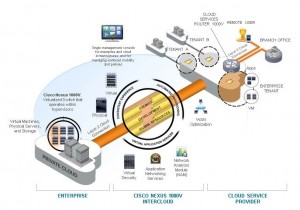
Today we wrap up our three part introduction of Cisco’s new hybrid cloud infrastructure, Nexus 1000V InterCloud. In Part 1, we provided an overview of the architecture and the components that make up Nexus 1000V InterCloud. In Part 2, we looked a bit more closely into the single pane management of the cloud network and resources across the on-premises private cloud and the cloud service provider. In Part 3, we’ll answer some of the most frequently asked questions we’ve been getting from customers, analysts and the press in the early stages of this announcement.
Q: What is Nexus 1000V InterCloud? What part of the hybrid cloud infrastructure does it comprise? Is it software, hardware, some combination of both? Is it a switch, a server or an application?
A: Nexus 1000V InterCloud is a set of software components that run as virtual machines on a variety of servers. It forms the infrastructure that extendss your existing on-premises virtual network and virtual services to cloud providers in a seamless and secure manner. It provides all the infrastructure and protocols to support VM migration from the data center to the cloud provider. Effectively, Nexus 1000V InterCloud (with VNMC InterCloud management software) creates a secure, on-demand layer-2 virtual private cloud (VPC).
We’ve posted two new videos of the mobility solutions that we showcased in the Cisco booth at NRF 2013.
Cisco Connected Mobile Experiences – Deliver personalized, highly targeted mobile services to consumers to optimize the customer experience and enhance store profits
Cisco BYOD Smart Solution – Support trouble-free network access for all users, on any Wi-Fi-enabled device
Click on the video images below to watch these two mobility solutions demonstrations.
More videos of our NRF 2013 demonstrations, Big Ideas Sessions, and press event are available at www.cisco.com/go/nrf.
Can 1 +1 really = 3 (or more)? Consider the opportunity presented by the thoughtful convergence of BYOD and virtual desktop technologies.
BYOD is one of the most important trends in education technology today. However, many BYOD initiatives are limited to providing personal devices with basic network connectivity via the campus Wi-Fi network. Traditional virtual desktops (VDI) are not new in education. Historically, VDI has allowed the delivery of non-persistent desktops, primarily to thin clients.
Through the Cisco Unified Workspace for Education, schools, colleges and universities can now provide next generation education workspaces that are virtual, social, mobile and collaborative. The Cisco Unified Workspace for Education integrates the Cisco BYOD and Virtualization Experience Infrastructure (VXI) Smart Solutions to provide students, faculty, and staff with the flexibility of using any device to access any information, any application, and any expertise—from anywhere.
Almost anywhere you go nowadays, you have internet access at your fingertips. With the trend of smart phones, tablets, and other personal devices taking flight, we’re just a touch away from being connected – and with that comes high expectations.
Not only are we experiencing an influx of mobile users, but these devices are being incorporated into the workspace. In order to support this influx, we need a simple, unified network that ensures the greatest experiences for employees as well as consumers.
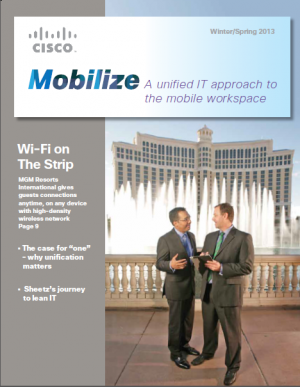
Cisco® has a brand new resource suited specifically to help you understand and meet these expectations. It is called Cisco Mobilize, and features best practices, expert advice, and customer stories regarding the latest in creating a unified mobile workspace. Continue reading “Going Mobile with Mobilize Magazine”
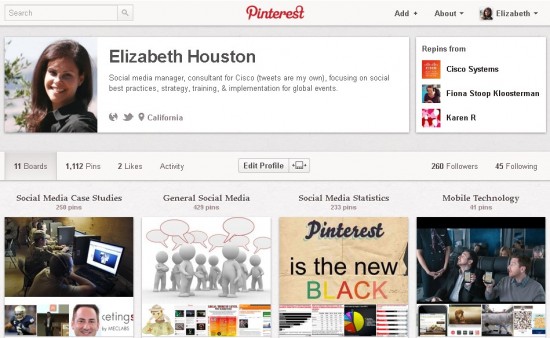
Oh the joys of pinning new ideas, trends, videos, and so much more on Pinterest! I’ll admit it…I have a little obsession, racking up thousands of pins between professional and personalPinterest accounts.
Use Pinterest best practices to create more meaningful conversations and increase followers.
Just like Twitter, LinkedIn, Facebook, and other social media channels, Pinterest has its own culture and communication style. After countless hours of reading, pinning, and repinning throughout the past year, I’ve recorded some Pinterest best practices and etiquette tips to share with you.
Here are some best practices to keep in mind:
Streamline content (Some Pinterest accounts have a board for every topic, but only have a few pins. Make it interesting for followers by providing broader range board topics that they can follow rather than segmenting topics too specifically. And try not to create empty boards until you have items to post to them.)
Leverage social channels (When appropriate, share your pins with Twitter and/or Facebook communities as well. It’s a great way to expand your reach and the conversation.)
Use keywords (One of the main features of Pinterest is the ability to search keywords by pins, pinners, or boards. Make sure to take advantage of this feature by using keywords in the descriptions as we do for other social media channels.)
Understand policies (Pinterest stirred up quite a bit of controversy regarding siting sources, etc. Take the time to understand Pinterest’s policies as well as your company’s guidelines (if using it on behalf of the brand) to protect yourself.)
Joining group boards (It’s flattering to receive invitations to join group boards. However, before clicking the tempting “accept” button, evaluate how many pins you would like to receive from those boards. Getting inundated with pins, from a certain topic each day, may have an adverse effect on your participation!)
Share information (Vary the type and format of content you pin to boards. While we all like infographics, they can get a little old on Pinterest if that’s the only thing that’s pinned. Mix it up with videos, case studies, reports, SlideShare presentations (if for business), articles, blog posts, and other types of content. I like to use the 70% new content/30% repins rule of thumb.)
And here are some etiquette tips to keep followers interested and to attract new ones:
Site sources (Always include the source, especially for items that have copyrights, etc. If the source is on Pinterest, use the @ format to link to the person/organization.)
Include a description (Insert a description, with keywords, to help followers understand the item more clearly, leading to more repins.)
Acknowledge comments (I find that 2-way exchanges are still a newer trend on Pinterest versus other social media channels. Since participants are still getting into this feature, it’s important to respond to posted comments. It will go a long way with followers and we can learn from each other!)
Pace pins (Space out the number and frequency of pins so that followers do not feel bombarded all at one time. By pacing the pin posts over time, it will also give you the opportunity to share new content without having to do a lot of research work ahead of time. And lastly, try not to duplicate pins. It gets confusing for followers.)
Maximize boards (Pinterest is dynamic and social. Leverage it for sharing a variety of information and use Instagram or Flickr for photo postings instead.)
Reciprocate information-sharing (Monitor followers and how the content you share is repinned. If you find there are certain followers that consistently repin your content, try repinning their content in reciprocation.)
Follow others (The same principles from other social media channels apply to Pinterest. We do not need to follow everyone that follows us. Check on the type of content the new follower pins and evaluate if the content matches your needs and what your other followers are interested in too.)
Lastly, if you are prepping items for Pinterest, here are a few details to consider:
Images: Use images in blog posts or other communications to make it easier on Pinterest users to post.
Pin Features: Include pinning capabilities as part of your “share” social media icons on websites, emails, and more.
Captions: Incorporate a short, but descriptive caption for each photo used to brand information more clearly.
Did the details above “pinpoint” the best practices you were thinking of as well? (Sorry, just had to play on that word!) Do you have other tips you are using as well? I’m interested in reading your insights and learning about the different ways you are using Pinterest too!
By Shaun Kirby, Director, Innovations Architecture Internet Business Solutions Group
If anyone still doubts the overwhelming complexity of today’s data deluge, Eric Schmidt, the chairman of Google, offers some poignant perspective. In a recent book, “The Human Face of Big Data”, he observes that from the dawn of civilization until 2003 humankind generated five exabytes of data. Now, we produce more than five exabytes of data every two days.
Those torrents of information may be intimidating, but they also promise great opportunities. Indeed, Big Data has been touted as an answer to many problems. Looking for customer buying patterns? Retailers have petabytes of purchasing history. Need to test a new drug? There are terabytes of patient data to be analyzed. Launching a new product? A mountain of social media data awaits you. Continue reading “The Extrasensory Enterprise: Turning Data Complexity into Advantage”