

There are a number of ways to deal with IPv4 exhaust and IPv6 transition, including Carrier Grade NAT and stateful Dual Stack Lite. Cisco has added another method called Mapping of Address and Port (MAP) based on two IETF drafts currently in the process of standardization in draft-ietf-softwire-map (MAP-E) and draft-ietf-softwire-map-t (MAP-T). The real advantage with MAP is that it’s stateless and doesn’t require additional hardware as traffic grows. In fact, the MAP implementation on the Cisco ASR 1000 or ASR 9000 is just a software feature that can be enabled as needed. Continue reading “A MAP to Easier, More Scalable IPv6 Deployments”

Authors

The data center landscape has changed dramatically in several dimensions. Server virtualization is almost a defacto in our customers’ data centers with a big increase in VM density. They are also moving towards world of many clouds. And then there is the massive data growth. Some studies show that data is doubling in every 2 years while there is an increase in the adoption of solid-state drives (SSD). Several of our customers are also either consolidating their data centers or forming mega data centers. All of these mega trends certainly come with increasing challenges for the Storage Administrator as the storage network is becoming more critical as it is the strategic asset in the Data Centers.
Take a look at this short video with Richard Darnielle (Director of Product Management for MDS Product lines) and me. Richard shares his insights on the mega trends that will shape the next-generation storage networks.
https://www.youtube.com/watch?v=0qu9FKbArZs
Guess what? Once again Cisco is here to help you on your journey to addressing these mega trends by raising the bar for storage networks. How you ask?
Continue reading “Mega Trends are Reshaping Storage Area Networks. But Are You Ready?”
Authors


Given your interest in healthcare innovation and transformation, we’re pleased to offer you access to TEDMED Live 2013 right from your desktop.
From April 16-19, TEDMED 2013 will feature ten 90-minute sessions from industry thought leaders focused on health, information, and technology. You can get complimentary access to either:
- Watch during the event
- Watch TEDMED sessions on-demand through Sunday, April 21st (midnight your time zone)
To register, create an account on the TEDMED site. On the second page, select “CISCO” from the dropdown menu on question 5 “How did you hear about TEDMED Live?” Within 24 hours, you will receive your affiliate code and further instructions.
Be sure to register for the Cisco Connected Health Community so that you can receive more offers like this one, news about upcoming events and our quarterly newsletter highlighting case studies and best practices.
Authors

Anecdotally, it would take about a week for a single machine to ping sweep the Internet. That would be approximately 4 billion IP addresses, essentially the whole Internet. In theory, this includes every single military address, every single ISP, every home user, and every mobile device. Such a port sweep does not include all options, UDP, and Nmap Scripts, as that would take too long. But what if I want to run the same scan to my home IPv6 range? It will have a /64 allocated to it, or about 18 quintillion addresses. Let’s compare a sweep of the entire Internet with my home IPv6 range:
- The Internet: 2^32 = 4,294,967,296 [1]
- The home range from my ISP: 2^64 = 18,446,744,073,709,551,616 [2]
A stark difference! So, how will I scan this? Is that just one network? I am Moses Hernandez, and this is one of my tips and tricks in this series. This post is about the venerable Nmap. Continue reading “Tips and Tricks: Nmap is still relevant”
Authors

 Wi-Fi is a convenience many expect to encounter whether they are at work, at home, or even out and about, say, shopping. Connecting to the internet from anywhere, at any time, is the norm these days, and for good reason. Smart devices are becoming more and more popular, and people are bringing these devices with them everywhere. So, how can the business world benefit from this? First, give the people what they want. Offer a robust wireless network so your customers are able to connect seamlessly. When you provide this, you are able, in turn, to engage with them. Continue reading “Wireless: More Than Just Internet Connection”
Authors

 At Microsoft Management Summit 2013 in Las Vegas this week, Cisco is showing a host of new technology innovations and integrated solutions for the virtualized data center. By bringing Cisco virtual networking and UCS solutions together with Microsoft cloud solutions, we are expanding the market for our technology, while providing more technology options and flexibility for our customers.
Critical to our Microsoft infrastructure strategy is the Nexus 1000V virtual switch for the Hyper-V hypervisor in Windows Server 2012 and integrated with System Center Virtual Machine Manager (SCVMM). Cisco’s Microsoft-oriented data center architectures, rooted by UCS and Nexus 1000V are proven to save customers’ OpEx and CapEx.
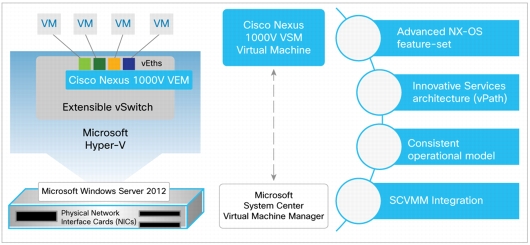
Our new version of Nexus 1000V for Hyper-V has been in wide use for the last several weeks since we opened up the public beta to all volunteers. The availability of Nexus 1000V and these go to market initiatives with Microsoft are the culmination of 3 years of joint effort between the companies, including developing the ecosystem for completely integrated solutions. These fully integrated solutions include VSPEX, FlexPod (with EMC and NetApp) that enable channel partners to deliver value to end customers.
The feedback we’ve been getting from the beta users of the new Nexus 1000V has been really positive. If you missed the insights from Microsoft MVP, Damian Flynn, when he presented at one of our online webinars, you can hear him talk about his experiences here.
What we consistently hear from customers is the Cisco Nexus 1000V for Microsoft Hyper-V:
- Offers consistent operational experience across physical, virtual, and mixed hypervisor environments
- Reduces operational complexity through dynamic policy provisioning and mobility aware network policies
- Improves security through integrated virtual services and advanced Cisco NX-OS features
Continue reading “Vive la Nexus 1000V on Microsoft Hyper-V!”
Authors

 If you had US$15,000 to take a trip anywhere in the world, where would you go? I’ve always wanted to visit Perth, Bangalore, and Brasilia myself, but sadly, I’m not elligable to win the Unified Access Challenge. However, if you’re reading this – you probably are! Basically, you watch an accelerated TechWiseTV episode with JimmyRay Purser, Robb Boyd (with a short Ike video too), and then answer a few questions about Unified Access.
The challenge is open for three more weeks and there are a few versions you need to choose from. If you’re a Cisco Partner you need to take the Partner version. If you don’t know whether you’re a partner or not, you’re probably not, so don’t fret. Because for non-partners we have the challenge in both English and Spanish: Continue reading “Win a Trip on Cisco and the Borderless Networks Week in Review”
Authors

The Global Certification Team is proud to announce the FIPS 140-2 crypto certification of the Cisco Adaptive Security Appliance (ASA) family. This certification covered the following models: Cisco ASA 5505, ASA 5510, ASA 5520, ASA 5540, ASA 5550, ASA 5580-20, ASA 5580-40, ASA 5585-X SSP-10, 5585-X SSP-20, 5585-X SSP-40 and 5585-X SSP-60 Security Appliances. The ASA’s were evaluated at level 2 and earned FIPS certificate #1932 on software version 8.4.4.1.
The Cisco ASA 5500 Series helps organizations to balance security with productivity. It combines the industry’s most deployed stateful inspection firewall with comprehensive next-generation network security services. More information on the Cisco ASA family can be found on Cisco.com!
Get up to the minute updates on Cisco product certifications from the official Cisco Global Certification Team twitter, @CiscoCertTeam!
FIPS-140 is a US and Canadian government standard that specifies security requirements for cryptographic modules. A cryptographic module is defined as “the set of hardware, software, and/or firmware that implements approved security functions (including cryptographic algorithms and key generation) and is contained within the cryptographic boundary.” The cryptographic module is what is being validated.
Authors
 Cisco is the official technology sponsor for the prestigious Skoll World Forum on Social Entrepreneurship (SWF) happening April 9 to 12 at the University of Oxford in England.
The goal of the Forum is to help advance entrepreneurial approaches to solving some of the world’s most pressing problems. SWF is an annual event with 1000 of the world’s most influential social impact thought leaders, social entrepreneurs, and the people and organizations who fund them from 65 countries. It is co-produced by the Skoll Foundation and the Skoll Centre for Social Entrepreneurship at the Saïd Business School in Oxford.
Continue reading “Cisco Supports Connected Collaboration at Skoll World Forum”
Authors