Avatar

Note: This guest blog is from our partner EMC. In it Chad Dunn, Director of VSPEX Business Operations, comments on VSPEX as an infrastructure solution for Microsoft oriented I.T. environments.  Rex. 

Cisco and EMC Buddy-Up on VSPEX for Microsoft Private Cloud

At EMC we’re always keen on working with fellow industry-leaders to deliver solutions that accelerate our customers’ journey to cloud computing – and Cisco, the leader in fabric, is one of our most collaborative friends.  In particular, we’ve focused a ton of joint effort on EMC VSPEX.

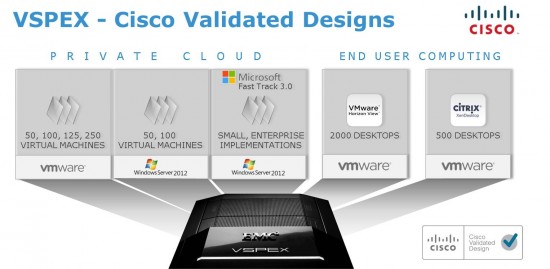
Since VSPEX was launched last April, hundreds of customers from across the globe have adopted VSPEX powered by EMC and Cisco technology – from the US to the UK to Australia.  That success is tied directly to our collaboration, from completing Cisco Validated Designs for VSPEX to jointly certifying VSPEX as part of Microsoft’s private cloud Fast Track 3.0 for “small” implementations.

If you aren’t already familiar: What is VSPEX?

VSPEX is a set of complete virtualization solutions – integrating virtualization, servers, networking, storage and backup – that are proven and validated by EMC and delivered to customers by channel partners.  That validation is extremely important too – why?  Because validation = confidence.  It ensures interoperability and fast deployment, and removes the complexity and risk.
EMCBlog


Well… What’s New?

With the increasing interest in Microsoft-based private clouds, we wanted to deliver a solution to customers that was not only validated by EMC and Cisco, but also certified by Microsoft.  Just like what we did with the “small” Microsoft private cloud Fast Track implementation – but bigger.  So that’s exactly what we’ve done: EMC and Cisco have just certified a new VSPEX configuration as a Microsoft private cloud Fast Track solution for enterprise implementations.

The enterprise implementation along with the small implementation greatly accelerates the transformation to Microsoft private cloud environments for our customers, but also just as important is how VSPEX can help customers simplify the ongoing management of their cloud.  Key to successful cloud management is delivering robust end to end orchestration and automation. EMC and Cisco’s integration with Microsoft System Center enables our customers to leverage the management tools and interfaces that they know and already utilize.  Additionally, EMC Storage Integrator (ESI) provides Microsoft application administrators more self-service and management empowerment and shortens the time to do storage provisioning by 4x for Microsoft applications.

Speaking of Microsoft applications, we’ve also just introduced 2 new VSPEX solutions to support them.   VSPEX for virtualized Microsoft Exchange makes deployment of 1,000 to 10,000 Exchange mailboxes fast and easy, while VSPEX for virtualized Microsoft SQL Server dramatically simplifies implementation of an environment supporting online transaction processing.

We’re very excited about these solutions as well as all of the other things that come as a result of our collaboration with Cisco around VSPEX – and there’s plenty more to come – so keep an eye out on www.cisco.com/go/vspex and follow @EMCVSPEX on twitter for the latest.

Authors

Rex Backman

Senior Marketing Manager, Big Data Solutions

Data Center and Cloud

Avatar

Note: This guest blog is from our partner NetApp.  VDI Reference Architect Rob Briggs introduces ExpressPod for the Microsoft private cloud as well as comments on FlexPod successes. Rex. 

FlexPod, ExpressPod, and Windows Server 2012 RDS – “It’s in the Box!”

I’ve seen a lot of great discussion and buzz this week at the Microsoft Management Summit on deployment of private cloud, Windows Server 2012 and System Center 2012 SP1.  Around the Cisco   and NetApp booths, it’s been exciting to see the interest attendees have shown around our new Private Cloud Fast Track 3.0 validated FlexPod solution – FlexPod with Microsoft Private Cloud.

But what exactly does this mean for customers? Take a look at ING Direct, which has deployed FlexPod with Microsoft Private Cloud and achieved massive cost and time to market savings.  With their “Bank in the Box” solution, ING Direct made “copies” of the entire bank environment for their developers in 10 minutes, compared to a previous 12 week turnaround.  This dramatically accelerated time to market of new products and services.

For many small to medium sized businesses or remote offices, FlexPod, System Center and a private cloud infrastructure may be more than what is required. Instead, we’ve seen that many of these customers want to start with a simple to deploy virtualization solution.  ExpressPod, with all of benefits of Windows Server 2012 Hyper-V , it is a pre-packaged and tested solution for growing small and medium sized organizations with exactly this scenario in mind.  Think of it as having many of the benefits of FlexPod, but priced, sized and packaged for small to medium sized deployments.

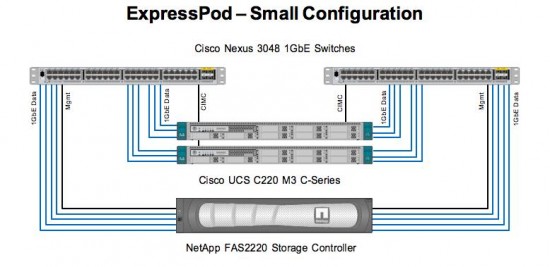
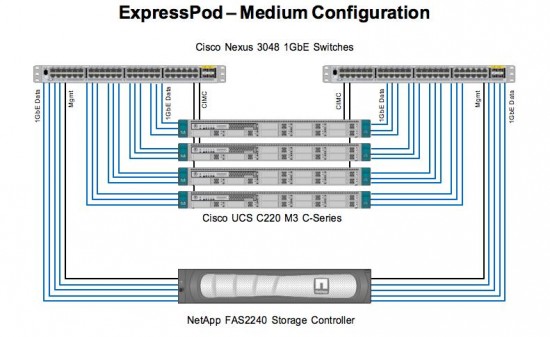
The hardware that comprises this solution is nothing to scoff at: ExpressPod integrates Cisco UCS® C-Series servers, NetApp FAS2220-series storage, and Cisco Nexus® 3048 switches with infrastructure management, into an affordable, easy-to-deploy shared virtualization infrastructure solution. ExpressPod supports an open ecosystem of management and hypervisor solutions and comes in two configurations, small and medium.

NetApp1


NetApp2

The small and medium ExpressPod configurations are low-cost, standardized infrastructure solutions, well-suited for virtualization of business critical applications. The configurations have been built and tested to deliver a cost-effective, high-value, and best practice architecture.

We recently completed testing and documentation of small and medium ExpressPod configurations with Microsoft Windows Server 2012® and Hyper-V. Take a look at our ExpressPod with Microsoft Windows Server 2012 Hyper-V Implementation Guide to see in-depth, detailed deployment instructions for each of these configurations.

Each configuration provides a standardized base platform capable of running a number of business-critical applications while providing scalability options to enable the infrastructure to grow with business demands.  One such application workload that ExpressPod is well-equipped to run is Microsoft’s Windows Server 2012 Remote Desktop Services (RDS).

RDS is a collection of independent role services in Microsoft Windows Server 2012 that support various desktop virtualization and session based remoting scenarios. Windows Server 2012 Remote Desktop Services on NetApp Storage gives detailed implementation guidance and best practices for a RDS solution.

A solution perfectly suited for the value of ExpressPod

As a desktop virtualization solution, RDS offers lower cost deployments.  In addition to the cost-effectiveness of using ExpressPod, Microsoft Windows Server 2012 RDS reduces both the capital and operational expenditures of VDI.  Simply said, “It’s in the box”.  Software box that is.  There are no additional software dependencies to roll out an effective VDI solution. Also, I’m happy to say that RDS deployments have been drastically simplified with Windows Server 2012, which reduces management costs.

If you are at MMS this week please be sure to stop by the Cisco or NetApp booths.  We’d be happy to further discuss the benefits that either FlexPod or ExpressPod can bring your organization.  You can also find out more about these solutions from certified Cisco and NetApp resellers.

Authors

Rex Backman

Senior Marketing Manager, Big Data Solutions

Data Center and Cloud

Avatar

It has been a couple of weeks since its launch and we are seeing lots of interest in the Cisco ISR-AX!  I have been hearing from customers, partners and folks  worldwide about how they are using the new ISR-AX platforms now and get a router, VPN, firewall, intrusion prevention, cloud/web security, AVC (NBAR2, QoS, NetFlow, Media Monitoring, PfR) and WAN optimization (WAAS) all in one box for less than the cost of just an alternative WAN Optimization appliance.  For WAN optimization with WAAS that is less than $1 per WAN optimized connection with ISR-AX!

Anyway, I’ve gotten lots of questions since the launch, so I grouped them and wanted to share the top 4: Continue reading “Momentum is growing for the Cisco ISR-AX!”

Authors

Adam Keller

Marketing Manager

Enterprise Networking and Mobility

Avatar

If you’re an end-user or manager of software that has publicly known security vulnerabilities, wouldn’t you want to know about it? If you’re a software developer, wouldn’t you want to know if there are third-party software vulnerabilities that may impact your applications or products?  Do you have a patch management compliance requirement for managing software vulnerabilities? I presume the answer is a resounding “Yes” to each question that applies to you. Anything we, as cyber security professionals, can do to help automate the vulnerability management process, while integrating security intelligence into that process from both an end-user and developer perspective, is a good thing. In this post, I will discuss Cisco’s Application Programming Interface (API) that exposes security intelligence as a direct data feed into applications or portals. The API is known as the IntelliShield Security Information Service (ISIS) and has proven effective to answering these leading questions.

“Continuous improvement in vulnerability management practices is imperative to keeping pace with the changing security environment as a result of evolving threats as well as new products and technologies” Russell Smoak, Cisco Systems, Cisco 2013 Annual Security Report

The above quote underscores the importance of striving to raise the bar in protecting against vulnerabilities, which may be exploited in your environment, or in the case of a developer, the products you provide to your customers. Cisco uses ISIS several ways, both internally and externally. Internally, Cisco takes advantage of custom-built tooling that uses vulnerability data from Cisco IntelliShield to notify the product development teams when a security issue originating in third-party software may impact a Cisco product. This tool has greatly increased the ability to manage security issues that originate in non-Cisco code. Externally, ISIS is used to provide the content to several sections accessible through the Cisco SIO portal. A couple of examples include:

  1. IOS Software Checker: this tool is used to query Cisco IOS Software Releases against published Cisco Security Advisories.
  2. Security Alerts: this tool provides an “At-A-Glance” type of view of security events such as vulnerability exposures.

Technically, ISIS provides a set of services that support application-to-application interaction using SOAP over the HTTPS protocol, allowing clients to develop ISIS-dependent applications that are not dependent on the technologies used to implement ISIS. The only dependency is for the client to have the ability to produce a SOAP message, send it to ISIS over HTTPS, and ultimately decompose the SOAP response. These services also allow clients to filter the security intelligence based on various inputs, enabling clients to align IntelliShield security intelligence with the unique business needs of their environment. Continue reading “A Programmatic Approach to Using Cisco’s Security Intelligence Feed”

Authors

Avatar

I’m standing here today in Geneva, at the annual Airport Passenger Terminal Expo, where Cisco and SITA are presenting our joint solution for WiFi-based location-based services in airports. This solution enables deep insights and understanding of how passengers use and move throughout  their arrival or departure journey.

The event kicked off this morning with a series of keynotes, and already on the exhibition floor I’ve been talking to a lot of airport leaders who are interested in the joint Cisco/SITA solution and how this really is starting to enable a better travelling experience and more efficient airport. Continue reading “Special Guest Post: Observations from Geneva Airport Passenger Terminal Expo”

Authors

Brendan O'Brien

Director Global Product Marketing

Connected Mobile Experiences

Avatar

In March, I make an annual journey from Dallas to Orlando – not to visit that famous mouse or take a Spring break.  No, I am there with thousands of IT, telecom, and networking professionals who have descended upon Orlando to attend Enterprise Connect, the leading conference and expo on enterprise communications and collaboration.

This year, both Jimmy Ray and Robb (along with the amazing TechWiseTV crew) joined me to capture all of the excitement, announcements, and cool demos.

 If you missed the conference, don’t fret.  We have all of the highlights here!

First, I caught up with Rob Lloyd immediately after his keynote to get the scoop on the Internet of Everything and how it will impact businesses. 

https://www.youtube.com/watch?v=5Xnrus_5omo

Continue reading “Enterprise Connect Recap: Smart Desk Phones, WebEx, TelePresence, and More!”

Authors

Laura Powers

Former Lead, Global Social Media Marketing

No Longer with Cisco

Avatar

skoll_worldforumMany technologies allow us to collaborate “virtually” today: email, instant messaging, texting, video conferencing, and desktop sharing to name a few. But regardless of what technologies we use, our interactions still rely on a basic element: other people.



Recently Cisco undertook a study of human behavior and the barriers to effective collaboration. The study showed that even in the digital age, collaboration is grounded in human relationships.

Harbrinder Kang, Cisco Sr. Director of Corporate Affairs, wrote about this topic for the Skoll World Forum on Social Entrepreneurship.

Continue to Harbrinder’s complete post on Forbes.com >>

Authors

Alexis Raymond

Senior Manager

Chief Sustainability Office

Avatar

Dave Evans  Joseph Bradley  This blog was co-authored by Dave Evans and Joseph Bradley, Cisco Internet Business Solutions Group (IBSG).

To receive the most value from the Internet of Everything (IoE), business leaders should begin transforming their organizations based on key learnings from use cases that show how IoE works in the real world. Cisco IBSG’s Economics practice recently developed 50 private-sector use cases to determine the Value at Stake in the new IoE Economy. It determined that $14.4 trillion of value (net profit) will be created or will migrate among companies and industries based on their ability to harness IoE.

https://www.youtube.com/watch?v=M578lU2TGeI

This blog will provide both near-term and more futuristic examples of IoE in healthcare and marketing/advertising to help you better understand the possibilities of IoE in different time frames. We provide both a futuristic view (Dave) and a near-term perspective (Joseph). Continue reading “#IoE: Present and Future”

Authors

Avatar

Almost everyone has heard of the “cloud,” as a result of advertising by computer companies and frequent mentions in the news media. “Cloud” refers to technology resources used by an organization that are not at their own location, but available over the global data communications network (otherwise called the Internet).  Moreover, the cloud is not just a question of getting access to some big data center in the sky; ultimately, it means gaining authorized access to any data or computing resource that is part of the Internet, and even combining data and software components from physically distant computers.

Public officials may have heard about how the cloud is being used in the public sector. For example, the United States Conference of Mayors had a session on this at its 2011 meeting where various mayors spoke about how their cities were using such services as shared email “in the cloud.” At the National Association of Counties, there have been sessions describing a cloud that is restricted to trusted government agencies at the state and local levels — what some call the “private cloud” because its services are not available to every organization, thus helping preserve the privacy and integrity of government data.

But the reasons state and local government officials might want to use the cloud are not often explained.  This post will describe the various ways that the cloud can provide strategic value to state and local governments.

Cost Savings

Most people have first heard of the cloud as a means of saving money, which is especially attractive at a time of tighter budgets. So instead of buying hardware and software, a government agency rents what it needs, when it needs it. This approach means you can shift from using bonds and debt service to an approach that matches your IT budget with the real demand each year.

And, often, the software services available in the cloud, such as email, can cost less per employee than licensing equivalent software in-house.

Resilience, Flexibility & Faster Technology Adoption

Potential cost reduction is not all there is to the story. There are other positive benefits as well.

Continue reading “Cloud for Local Government Global Blog Series: The Strategic Value of the Cloud for State & Local Governments”