On April 10th I had the privilege to deliver, via TelePresence, the keynote address for the Swiss eLearning Conference 2013 (SeLC) in Zurich. Aimed at the Swiss professional learning community, the event was themed “Educate Your Customer” with a focus on e-learning, online training and augmented reality. I enjoy engaging with forward-thinking educators who share my passion for creating new paths to learning.
In my keynote, I described Learning@Cisco’s innovative approach to creating the next generation of IT talent. The fact is that the industry is experiencing an IT networking skills gap at the very same time the world is approaching the Internet of Everything and the prospect of 50 billion connected devices by the year 2020.
To help bridge this divide, Cisco has pioneered the use of virtual classrooms, social networking, games, and other resources to democratize learning via our social learning network. We bring together groups and individuals across the globe to learn from each other about IT networking in ways that augment traditional classrooms. Our goal is to remove barriers to learning and assist our partners and customers with developing the right networking talent to run their businesses.
To learn more, please watch the full presentation here, view the slide deck I shared during the conference, or visit the Cisco Learning Network.
In our last blog, we talked about the next generation Internet. It will be about the Internet of Everything ─ people-to-people, machine-to-machine, machine-to-people, trillions of things coming online in coming years. Software Defined Networking (SDN) is only part of the overall solution. Real-time intelligence, automation and orchestration, instantaneous responsiveness, and unprecedented business and operational agility require a much broader approach. At Cisco we’re already creating the network of the future with our integrated framework, the Cisco Open Network Environment (Cisco ONE).
So now let’s come down to Earth and explore what all of this really means to an average service provider. What new capabilities and use cases does Cisco ONE enable right now? How does what we’re doing lay another building block for the Internet of Everything?
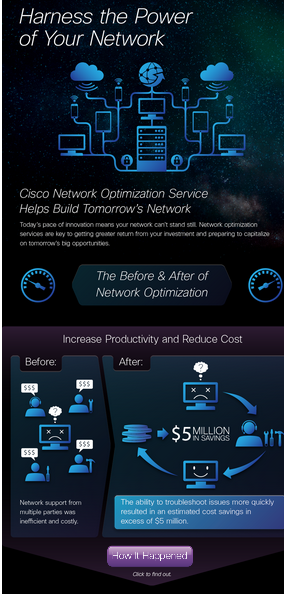
Infographic: The Before and After of Using Optimization Services on a Network [Click to see full]One of my passions in life is sailing, both cruising and racing. There is nothing quite like the wind in your hair and the sun on your face to paint a perfect day. The difference between a great day on the water and miserable one comes down to preparation. Basic maintenance of the vessel, proactively checking the weather, wind, and tides, and understanding how to optimally operate the vessel for the best performance will enhance the experience. It’s not something that one can fully master, and you will always be learning and striving towards perfection. This is very true of my other passion, which is helping customers get optimal performance out of their networks. Once again, success is all about preparation.
Over my career, I have been through more customers than I can count and have seen widely ranging degrees of success amongst these customers. Why is it that some customers are extremely successful with no outages or performance issues whilst others seem to never be able to keep pace with outages and performance issues are a near daily occurrence? Some deploy a new technology without a glitch while others dread the thought of adding new technologies to their network in fear of the potential impact to their business.
You need a holistic approach that takes into consideration all of the systems involved in a solution. You can design and deploy the best voice/video solution but if the underlying network is not designed and configured to support this business service, it will not likely meet the performance requirements of the business. For example, imagine your business has the requirement to deliver a periodic streaming video broadcast from senior management to the employees of the company. Your company consists of campuses globally along with remote and mobile workers. So, you need to be able to stream across your wired, wireless and VPN network to users both local and remote. This is where the role of architecture comes into play.
The importance of architecture is that it pulls together a complete holistic view of the business services and the requirements to effectively support them. How much bandwidth is required, what is the tolerable round trip delay, tolerance for packet loss are all considerations that will go into building that strong foundation that is required for success. In today’s world of BYOD, the expectation is that these services will be available and perform flawlessly over wired, wireless and VPN.
I set a goal to increase the speed performance of my sailboat and purchased brand new sails to reach this goal. After installing the sails, it was clear that I had gained no additional speed. After doing a bottoms-up assessment of the vessel, I realized that the hull was covered with barnacles. Without a clean hull, adding sails will not deliver the desired result. Trying to deploy a business service, such as a voice or video solution, over a network that is not designed for it will also fail to deliver the desired. Most problems with deploying advanced technologies lie within the foundational network rather than the advanced technologies themselves. Your network, like the hull of my boat, is the foundation of your business services. If this is not solid, the chances are the higher level services that rely on this “foundation” will likely not delivery the desired results. A holistic approach will take into consideration the business services that must run over the network and use this to build out an effective foundation. Read this success story on how Ecobank deployed collaboration solutions based on a solid infrastructure. You can also see how optimization has benefited other companies in this infographic.
Stay tuned for my next posts where I’ll cover proven strategies for optimizing your network.
Once again, we’re preparing for the exciting Cisco British Innovation Gateway (BIG) awards. Here’s some guidance about the on-going competition – to stimulate some thoughts around this year’s opportunity to recognise Britain’s entrepreneurs.
It’s amazing when I think back to when the BIG awards where first discussed, as apart of our legacy around Cisco’s involvement in the London 2012 Olympics. We are now into our second year, and trying to be as balanced as I can be, it has been a very beneficial journey for all concerned. Continue reading “The BIG Awards 2013: a Celebration of UK Innovation”
Many of you take part in our annual satisfaction surveys. You share opinions, discuss challenges, and make valuable recommendations. More than 65,000 customers and partners responded to our survey during the first half of FY13. For this installment of the “We’re Listening” blog series, I asked Joe Pinto, Senior Vice President, Technical Services, to review these responses and what we’re doing to improve your Cisco experience.
On April 26, Kamphuis, STOPhaus activist and possibly the person behind the large-scale SpamHaus DDoS attacks, was arrested in Spain. He had allegedly been operating out of his van, which he had transformed into a mobile computing office. Continue reading “STOPhausDDoS: Suspect in Custody”
It’s no secret that new technologies are changing the way students learn. The modern classroom is no longer confined to a physical space and students have access to greater educational opportunities than ever before.
Much like video has created new models for learning; mobile video collaboration is extending the boundaries of education even more. Imagine a school where students can instant message a professor from their tablet with an urgent question about tomorrow’s test and get an immediate response, or where a student athlete headed to a competition can join a lecture from their own personal mobile device. By overcoming space and time challenges, students and faculty can connect to the people and resources they need from wherever they are. No longer is education confined to the walls of the classroom. Continue reading “Elevating the Learning Experience through Mobile Collaboration”
I am drafting this blog on my laptop, sitting in the Embassy Suites lounge in Raleigh, North Carolina, enjoying the complimentary breakfast buffet. I share this not to disclose my breakfast habits, nor my whereabouts but to illustrate that we are relying more and more on mobile devices to keep us connected, both professionally and personally. In fact analysts predict that by the end of 2013, 80 percent of companies will allow BYOD (bring your own device) for employees.
As today’s workers embrace mobility, they have expectations that their experience outside of the office should mirror their experience inside the office. With mobility trends like telework and BYOD on the rise, it’s important that government organizations stay ahead of technology trends to better deliver their employees with the right tools that allow them to collaborate from anywhere at any time. Continue reading “Attention Agencies – It’s Time to Enable Your Mobile Workforce”
It’s May 1st again, which means it’s time for our annual Open Source Conference, a time to celebrate the multitude of free and open source software developers world wide. Even more so than last May 1st, I’m very impressed to see the large turnout and the great feedback after the keynote and four tracks on Big Data, Cloud, Internet of Everything (IoE), and Software Defined Networking (SDN). Our keynote was from Dan Frye, a wonderful friend and partner at IBM. Wonderful to see Doug Cutting from Cloudera, Adrian Cockroft from Netflix, Troy Torman from Rackspace, Chris Wright from Red Hat, Juan Negron from Canonical, Mark Hinkle from Citrix and Vijoy Pandey from IBM and the great discussions that ensued. My thanks to Bhushan Kanekar who helped me put together the SDN track and also to our other tracks leaders, Mark Voelker for Big Data, Kyle Mestery and Brian Mullen for Cloud, and Fabio Maino and Laurent Philonenko for IoE and Collaboration — it’s great to see these guys come of age in open source, enjoying the moment and helping the open community grow. To all those of you who came, contributed and enjoyed this event, we salute you! Open at Cisco is proving it has indeed become a vibrant and fast growing community. Happy May Day!









 By Guest Contributor Joe Pinto