

BYOH: Bring Your Own Harness with Cisco IQ, for partners
With bringing your own harness (BYOH) trusted context has become part of the security perimeter. Here's how Cisco IQ fits in.


With bringing your own harness (BYOH) trusted context has become part of the security perimeter. Here's how Cisco IQ fits in.


Discover how Cisco's Encrypted Visibility Engine (EVE) and Endace PCAP uncovered Flawed AMMYY RAT traffic at Splunk .conf without breaking TLS encryption.

Learn how the .conf26 Agentic SOC paired Endace full PCAP with Cisco Secure Firewall and Talos rules to retrospectively replay wire data against zero-days.

Cisco DevNet applies API engineering practices, such as versioning, linting, changelogs, documentation, to MCP servers with a new format: MCP Description.


A high-IQ network of independent AI agents isn't automatically smart. Learn how the emerging A2A standard lets agents coordinate—working alongside MCP—to turn isolated decision-makers into a truly cooperative SD-WAN.


DevNet’s Share Your Experience (SYE) initiative uses your insights to drive product improvements. Through Design Thinking at Cisco Live, we turn feedback into action. Join us in building a better developer experience, one interaction at a time.


OpenClaw enables powerful AI agent workflows—but introduces new security risks. Learn why securing tools, MCP servers, and agent-generated code is critical, and how DefenseClaw helps protect your environment.
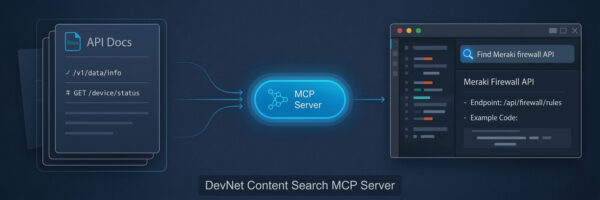

From Search on the Web to Search in the IDE Last year we launched AI-driven semantic search for Meraki API docs on developer.cisco.com—but developers live in their IDEs, not the browser. Without the right context, AI assistants in the IDE fall back to

In my previous exploration of making SD-WAN smarter with MCP, we examined how edge compute optimizes network performance by processing data closer to where it is generated. But when you have a modern enterprise network—especially one with hundreds or