For years, outdoor wireless was often treated as an afterthought or a nice-to-have feature; usually an extension of an indoor Wi-Fi network. It was designed for casual guest access or basic connectivity in outdoor areas like parking lots, sports venues, and construction sites. But outdoor Wi-Fi has become critical today because it must extend reliable, secure, and high-performance wireless connectivity beyond indoor environments to support essential applications like autonomous vehicles, high-definition security streaming, and sprawling industrial IoT operations. Best-effort outdoor Wi-Fi isn’t good enough anymore.
When connectivity drops in a shipping port or a manufacturing yard, operations don’t just slow down—they stop. When an ambulance speeds into the hospital bay, a dropped connection could mean the difference between life and death. Systems and operations in these environments increasingly depend on a signal that’s scalable, secure, and not limited by four walls.
To support critical outdoor wireless requirements, Cisco is proud to announce the Cisco Wireless 9177 Series Access Point, engineered to bring enterprise-grade Wi-Fi 7 and mission-critical reliability to the most challenging outdoor environments.
Beyond walls with Wi-Fi 7
The 9177 series access point isn’t just a ruggedized version of an indoor access point; it’s a high-performance powerhouse designed for the unique physics of the outdoors (Figure 1).
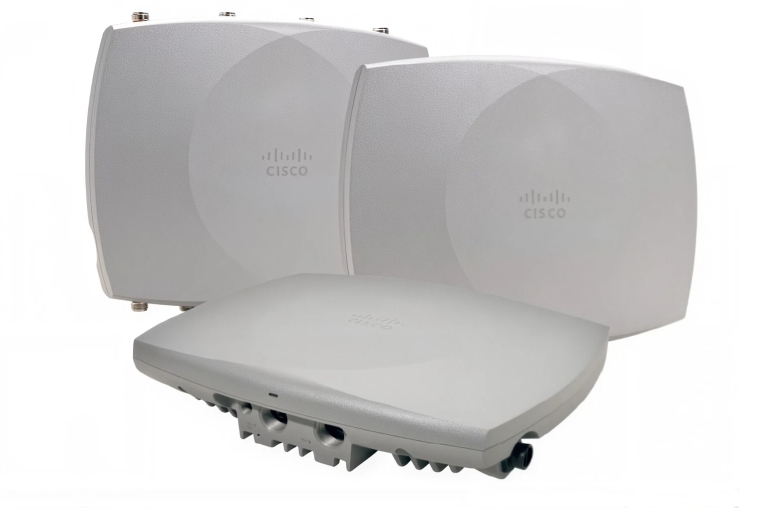
- Unlocking fast, reliable signal: With built-in support for automated frequency coordination (AFC), the access point can access the 6 GHz band outdoors, which provides up to six times more range, wider channels, and significantly higher throughput compared to low-power modes. Cisco Ultra-Reliable Wireless Backhaul (URWB) delivers deterministic, low-latency wireless connectivity with sub-10 ms handoffs and multigigabit throughput, essential for mission-critical applications where downtime is not an option. These features enable users of the 9177 series to access more bandwidth with less interference and support high-density deployments that were previously impossible.
- Tri-band versatility: With 4×4:4 on 2.4 GHz, 5 GHz, and 6 Ghz bands, customers get 12 spatial streams to support tens and hundreds of client connections. By leveraging Wi-Fi 7 features like multi-link operation (MLO), the 9177 series ensures that even if one band is congested, your data finds the fastest, most stable path to its destination.
- Flexible antenna design and accessories: Whether you need broad coverage for a campus quad or a long-range corridor of connectivity for a rail line, the 9177 series offers three model options: integrated omnidirectional, integrated directional, and external antenna support. Each is designed to get your signal where and how you need it.
- Choice of uplink options: With support for both copper and fiber uplinks, the 9177 series gives customers more deployment flexibility—whether connecting over existing copper infrastructure or using fiber for longer outdoor runs beyond the standard 100-meter Ethernet limit. From wiring a dense campus to providing connectivity to a remote corridor, you have the flexibility to design for the infrastructure you have.
Fast, without requiring fiber: Ultra-Reliable Wireless Backhaul
While Wi-Fi 7 provides an exceptional front-end experience for users and devices, the true differentiator of the 9177 series is its integrated URWB capability.
Traditionally, if you couldn’t run fiber to an outdoor location, backhaul options were limited and often prone to latency. URWB changes that. It provides fiber-like reliability with near-zero latency and “make-before-break” handoffs where a device establishes a connection with a new access point before disconnecting from the current one. This ensures continuous connectivity without downtime or dropped connections. The 9177 series acts as both a high-speed Wi-Fi 7 access point and a rock-solid backhaul bridge.
For moving assets—like automated guided vehicles (AGVs) in a warehouse or cranes in a port—URWB on the 9177 series ensures that the connection never drops, even as the asset moves at high speeds.
Real-world impact: From ports to smart campuses
Where do 9177 series access points truly shine?
- Industrial and ports: Eliminate the need for costly trenching and fiber runs. Use URWB to backhaul massive amounts of sensor and video data while providing Wi-Fi 7 to workers on the ground.
- Stadiums: Provide seamless, high-capacity coverage for outdoor events, stadium perimeters, and public safety initiatives without compromising security.
- Transportation and transit: Ensure that mission-critical telemetry for rail systems remains continual regardless of weather or physical obstacles.
- Campuses: Connect enterprise buildings to make coverage and access for employees easy and ubiquitous.
Cisco customers are already demonstrating that outdoor wireless has become critical infrastructure. We helped Live Nation deliver high-density Wi-Fi across BottleRock Napa Valley, supported the U.S. Open with Wi-Fi 7 connectivity across Oakmont, and enabled Nutrien to connect rugged, remote environments where safety and operations depend on reliable access.
When failure isn’t an option, neither is ordinary Wi-Fi
The Cisco 9177 series brings enterprise-grade Wi-Fi 7 performance beyond walls to connect people, devices, and operations without compromise. It’s rugged enough for the harshest environments and smart enough to deliver seamless connectivity across high-density venues, industrial sites, and everything in between.
And because outdoor connectivity often extends the enterprise network into more open and exposed environments, the 9177 series helps organizations expand coverage without compromising security, with secure access and policy enforcement built into the Cisco wireless architecture.
Outdoor networks can also be complex to deploy and operate, which is why the 9177 series gives customers flexibility in how they manage them. As part of the Cisco unified wireless hardware portfolio, it can be managed in the cloud or on premises, depending on the needs of the organization. With Cisco AgenticOps, IT teams can also use AI-powered insights and actions to troubleshoot faster, reduce manual effort, and keep critical outdoor environments running reliably.
Close the gap between your indoor network strategy and the outdoor demands your business can’t ignore. That’s the magic of MLO, integrated Global Positioning System/Global Navigation Satellite System (GPS/GNSS), AFC, URWB, and 10-Gbps uplinks—proof that “beyond walls” doesn’t mean beyond reliable.
Ready to take your outdoor wireless network to a new level of performance, reliability, and security?
Read the 9177 series data sheet.